




 Sign in


 Profile
 Signout

FREE PDF Download
-
1Chapter 1 Some Basic Concepts of Chemistry


-
2Chapter 2 Structure of Atom
-
3Chapter 3 Classification of Elements and Periodicity in Properties
-
4Chapter 4 Chemical Bonding and Molecular Structure
-
5Chapter 5 States of Matter
-
6Chapter 6 Thermodynamics
-
7Chapter 7 Equilibrium
-
8Chapter 8 Redox Reactions
-
9Chapter 9 Hydrogen
-
10Chapter 10 The s – Block Elements
-
11Chapter 11 The p – Block Elements
-
12Chapter 12 Organic Chemistry – Some Basic Principles and Techniques
-
13Chapter 13 Hydrocarbons
-
14Chapter 14 Environmental Chemistry


At SelfStudys, you get to access the Class 11 Chemistry NCERT solutions completely free of cost. It is a chapter-wise collection of concept-based answers to every question that is given in the NCERT Chemistry textbook. Our experts have designed them to provide you with clear definitions, balanced chemical equations, numerical problem-solving steps, exam-oriented explanations, and so on in one organized format.
This subject is known to establish the scientific foundation for advanced study in Class 12, as well as competitive exams like JEE and NEET. The Maths subject evaluates your accuracy in the procedures, and the main focus of Physics is on numerical application. But the subject of Chemistry is where you require clarity of the concepts, understanding of the reactions, application of formulas, as well as logical reasoning across Physical, Organic, and Inorganic branches. That’s why the Class 11 Chemistry NCERT solutions 2026-27 are a must-have resource during your academic journey.
What Makes Chemistry Different From Maths and Physics in Class 11?
Chemistry is considered to be quite different because it requires you to understand how substances change and react with each other. In Maths, you have to solve most of the questions by applying formulas and rules step by step. In Physics, you mainly use formulas to calculate values like speed, force, energy, etc. In Chemistry, you have to understand what is happening inside atoms as well as molecules. Here, you don’t just calculate, but you also explain why a specific reaction happens, how atoms combine, and what changes take place during a chemical process.
There is one more big difference in this subject. It is that Chemistry mixes theory and numericals together. In one question, you might calculate moles, write a balanced equation, and then explain the concept behind it. In Organic Chemistry, you can change the properties of a compound completely if you make even a small change in its structure. All this makes Chemistry more about understanding the connections rather than just solving the problems. For this reason, you need clear explanations as well as step-by-step NCERT solutions for Class 11 Chemistry PDF. They will not only give you the correct answer but also explain the logic and concepts in an easy and simple way.
How Class 11 Chemistry NCERT Solutions 2026-27 Make Learning Easier?
Chemistry in Class 11 teaches you entirely new concepts like atomic structure, mole concept, thermodynamics, equilibrium, organic chemistry basics, and so on. It might be the first time you deal with topics that connect calculations, theory, as well as chemical reactions in one subject. If you don’t have proper guidance, then this subject can confuse or overwhelm you. This is where the Class 11 Chemistry NCERT book solutions play a very important role. With their help, you will be able to understand not only what the correct answer is, but also why it is correct. When you get structured explanations as well as clear logic, it can make your learning more organized, focused, and stress-free. Here are some more points that reflect how this happens.
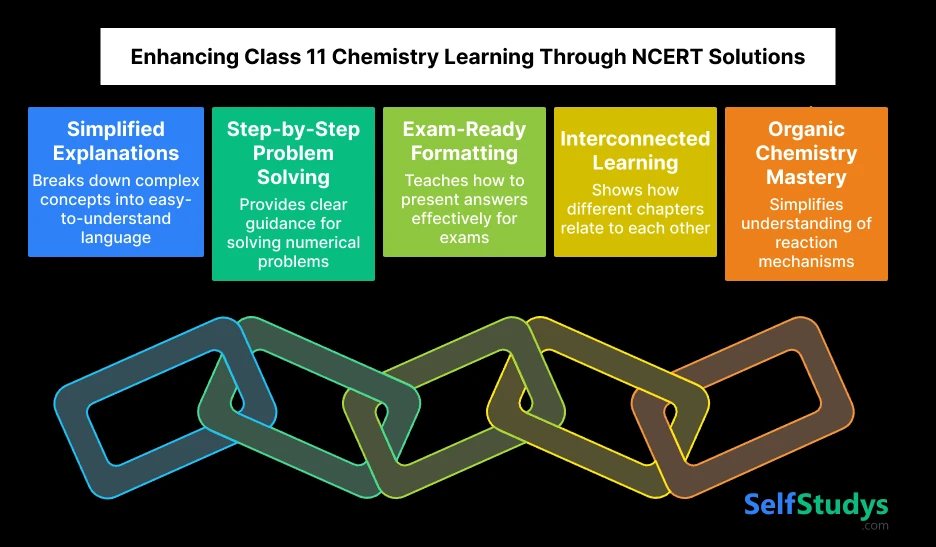
📝 In a variety of topics, there will be scientific terms as well as detailed processes included. The NCERT Chemistry Class 11 solutions PDF download explains these concepts to you in an easy language. This way, you can understand definitions, reactions, principles, etc., without any confusion. You will learn the meaning behind each concept instead of just memorizing the difficult lines from the NCERT textbook.
📝 There are numerical problems with multiple steps in some of the chapters, like the mole concept, thermodynamics, equilibrium, and so on. With the help of the NCERT solutions for Class 11 Chemistry, you can see each step clearly. From writing the formula to substituting values and solving correctly, you will be able to learn the process as well as avoid any mistakes in calculation.
📝 Most of the answers in this subject need balanced equations, correct units, structured explanations, etc. By using the NCERT Class 11 Chemistry solutions chapterwise, you can learn how to present your answers in a format that is exam-friendly. Furthermore, these solutions will also improve your writing skills as well as help you score better marks in the board exams.
📝 Chemistry is a connected subject. For example, the mole concept is used in chemical reactions, and periodic trends affect chemical bonding. Our well-prepared and latest Chemistry NCERT solutions for Class 11 show you these connections. Instead of studying each chapter separately, you will be able to build a strong foundation with them.
📝 The structures and reaction mechanisms in Organic Chemistry make it seem a bit difficult. But with the step-wise explanations in the Class 11 Chemistry NCERT solutions, you can understand how the reactions happen and why certain products are formed quite easily.
Chapter-Wise NCERT Solutions for Class 11 Chemistry PDF
The team of highly educated professionals at SelfStudys has created the Class 11 Chemistry NCERT solutions 2026-27 for each chapter in separate files. This way, we try to make your study sessions more focused as well as organized. In the table below, you will get further information about the important subtopics in the chapters and how these solutions help you master them.
|
Chapter |
Subtopics/Concepts |
How the NCERT Solutions for Class 11 Chemistry PDF Helps |
|
Some Basic Concepts of Chemistry |
Importance and scope of Chemistry, Laws of chemical combination, Dalton’s atomic theory, Atoms and molecules, Atomic and molecular masses, Mole concept, Molar mass, Percentage composition, Empirical and molecular formula, Chemical reactions, Stoichiometry, Calculations based on stoichiometry |
In the Class 11 Chemistry NCERT book solutions, you get step-by-step numerical explanations for the mole calculations, stoichiometry, and concentration problems. They help you in understanding the conversions of units and avoiding mistakes in calculations. |
|
Structure of an Atom |
Discovery of Electron, Proton and Neutron, Atomic number, Isotopes and isobars, Thomson’s model and its limitations, Rutherford’s model and its limitations, Bohr’s model and its limitations, de Broglie’s relationship, Heisenberg uncertainty principle, Concept of orbitals, Quantum numbers, Shapes of s, p and d orbitals, Rules for filling electrons in orbitals, Aufbau principle, Pauli’s exclusion principle, Hund’s rule, Electronic configuration of atoms, Stability of half-filled and completely filled orbitals |
The NCERT Chemistry Class 11 solutions PDF download simplifies the theories that are complex. It also explains the rules of electronic configuration clearly so that you can have better clarity of the concepts. |
|
Classification of Elements and Periodicity in Properties |
Significance and development of the periodic table, Modern periodic law and the present form of the periodic table, Periodic trends in properties of elements, Atomic radii, Ionic radii, Inert gas radii, Ionization enthalpy, Electron gain enthalpy, Electronegativity, Valency, Nomenclature of elements with atomic number greater than 100 |
With the help of this chapter’s NCERT solutions for Class 11 Chemistry, you can understand the periodic trends along with logical explanations. |
|
Chemical Bonding and Molecular Structure |
Valence electrons, Ionic bond, Covalent bond, Bond parameters, Lewis structure, Polar character of covalent bond, Covalent character of ionic bond, Valence bond theory, Resonance, Geometry of covalent molecules, VSEPR theory, Concept of hybridization, S, p, and d orbitals and shapes of some simple molecules, Molecular orbital theory, Hydrogen bond |
The NCERT Class 11 Chemistry solutions chapterwise explain the bonding concepts, VSEPR, hybridization, as well as molecular orbital theory with diagrams. They further support numerical as well as theory-based questions for the exam. |
|
States of Matter |
Three states of matter, Intermolecular interactions, Types of bonding, Melting and boiling points, Role of gas laws in elucidating the concept of the molecule, Boyle’s law, Charles law, Gay Lussac’s law, Avogadro’s law, Ideal behaviour, Empirical derivation of gas equation, Ideal gas equation, Deviation from ideal behaviour, Liquefaction of gases, Critical temperature, Kinetic energy and molecular speeds |
In its latest Chemistry NCERT solutions for Class 11, you will find the step-wise explanations for gas laws, liquid properties, numerical calculations, and so on. These solutions also clarify the derivations from idea behavior and key concepts of the chapter. |
|
Therymodynamics |
Concepts of System and types of systems, surroundings, work, heat, energy, Extensive and intensive properties, State functions, First law of thermodynamics, Internal energy, Enthalpy, Heat capacity, Specific heat, Measurement of ∆U and ∆H, Hess’s law of constant heat summation, Enthalpy of bond dissociation, Combustion, formation, atomization, Sublimation, phase transition, ionization, Solution and dilution, Second law of Thermodynamics (brief introduction), Introduction of entropy, State function, Gibbs energy change for spontaneous and non-spontaneous processes, Criteria for equilibrium, Third law of thermodynamics (brief introduction) |
The Class 11 Chemistry NCERT solutions solve each of the problems related to thermodynamics step-by-step. They also explain enthalpy, internal energy, and Gibbs energy in a proper manner. |
|
Equilibrium |
Equilibrium in physical and chemical processes, Dynamic nature of equilibrium, Law of mass action, Equilibrium constant, Factors affecting equilibrium, Le Chatelier’s principle, Ionic equilibrium, Ionization of acids and bases, Strong and weak electrolytes, Degree of ionization, Ionization of polybasic acids, Acid strength, Concept of pH, Hydrolysis of salts (elementary idea), Buffer solution, Henderson Equation, Solubility product, Common ion effect (with illustrative examples) |
The derivations of equilibrium concepts, pH, buffer solutions, solubility product, etc., are provided in our Class 11 Chemistry NCERT solutions 2026-27. By learning them, you can apply concepts in numerical as well as theoretical questions. |
|
Redox Reactions |
Concept of oxidation and reduction, Redox reactions, Oxidation number, Balancing redox reactions in terms of loss and gain of electrons and change in oxidation number, Applications of redox reactions |
The SelfStudys’ NCERT solutions for Class 11 Chemistry PDF for this chapter demonstrate the methods for assigning oxidation numbers properly, balancing redox reactions, as well as applying them in practical situations. |
|
Hydrogen |
Position of hydrogen in periodic table, Occurrence, Isotopes, Preparation, Properties of hydrogen, Uses of hydrogen, Hydrides – ionic, covalent and interstitial, Physical and chemical properties of water, Heavy water, Hydrogen peroxide – preparation, reactions, structure and use, Hydrogen as a fuel |
You will get clear explanations for hydrogen properties, reactions, compounds, and so on in our Class 11 Chemistry NCERT book solutions. Additionally, they simplify the theoretical and numerical parts of this chapter so that you can perform better in the exams. |
|
The s-Block Elements |
Group 1 and Group 2 Elements General introduction, Electronic configuration, Occurrence, Anomalous properties of the first element of each group, Diagonal relationship, Trends in the variation of properties (ionization enthalpy, atomic and ionic radii), Trends in chemical reactivity with oxygen, water, hydrogen and halogens, Uses, Preparation and Properties of Sodium Carbonate, Sodium Chloride, Sodium Hydroxide, Sodium Hydrogen carbonate, Biological importance of Sodium and Potassium, Calcium Oxide, Calcium Carbonate and their industrial uses, Biological importance of Magnesium and Calcium |
In the NCERT Chemistry Class 11 solutions PDF download, you will find that the trends, properties, reactions, etc., are explained in a step-wise format. This way, our experts make the comparative and application-based questions easy to understand. |
|
The p-Block Elements |
General Introduction to p-Block Elements, Group 13 Elements: Boron – physical and chemical properties, Important compounds: Borax, Boric acid, Boron Hydrides, Aluminium – Reactions with acids and alkalis, Group 14 Elements: Carbon-catenation, Allotropic forms, Physical and chemical properties, Uses of some important compounds, Oxides, Important compounds of Silicon and a few uses, Silicon Tetrachloride, Silicones, Silicates and Zeolites, their uses |
In its NCERT solutions for Class 11 Chemistry, there will be structured explanations for properties, compounds, and reactions. They help in understanding the trends as well as practical applications for the exams. |
|
Organic Chemistry – Some Basic Principles and Techniques |
General introduction, Methods of purification, Qualitative analysis, Quantitative analysis, Classification and IUPAC nomenclature of organic compounds, Electronic displacements in a covalent bond: inductive effect, electromeric effect, resonance, hyperconjugation, Homolytic and heterolytic fission of a covalent bond: free radicals, carbocations, carbanions, electrophiles, nucleophiles, Types of organic reactions |
The NCERT Class 11 Chemistry solutions chapterwise help you in learning the nomenclature, reaction mechanisms, electronic effects, and purification methods step-by-step. This way, you will be able to build a strong foundation for Organic Chemistry in Class 12. |
|
Hydrocarbons |
Classification of Hydrocarbons, Aliphatic Hydrocarbons: Alkanes – Nomenclature, isomerism, conformation (ethane only), physical properties, chemical reactions including free radical mechanism of halogenation, combustion, pyrolysis, Alkenes – Nomenclature, Structure of double bond (ethene), geometrical isomerism, physical properties, methods of preparation, ozonolysis, oxidation, mechanism of electrophilic addition, Alkynes – Nomenclature, structure of triple bond (ethyne), physical properties, methods of preparation, chemical reactions: acidic character, addition of hydrogen, halogens, hydrogen halides and water, Aromatic Hydrocarbons: Introduction, IUPAC nomenclature, benzene: resonance, aromaticity, chemical properties: directive influence of functional group in monosubstituted benzene, Carcinogenicity and toxicity |
Our latest Chemistry NCERT solutions for Class 11 provide you with the reaction mechanisms in detail, explanations for preparation, physical and chemical properties, theory-based questions, and so on. With their help, you can reduce confusion in the organic reactions as well as aromatic compounds. |
|
Environmental Chemistry |
Environmental pollution – air, water, and soil pollution, Chemical reactions inthe atmosphere, Smog, Major atmospheric pollutants, Acid rain, Ozone and its reactions, Effects of depletion of the ozone layer, Greenhouse effect and global warming, Pollution due to industrial wastes, Green chemistry as an alternative tool for reducing pollution, Strategies for control of environmental pollution |
All the concepts of environmental chemistry that are quite complex are simplified in our Class 11 Chemistry NCERT solutions. They also explain the causes and effects of pollution, and provide answers for practical or theoretical questions. |
How To Download The Class 11 Chemistry NCERT Book Solutions From SelfStudys?
If you are willing to get the Class 11 Chemistry NCERT solutions 2026-27 and utilize them for better learning, here are the steps you need to take on our platform.
- You have to use your preferred browser on any device to reach SelfStudys. In its search space, you can type www.selfstudys.com.

- On the homepage, you need to click on the ‘Navigation’ bar and select the ‘NCERT’ button.
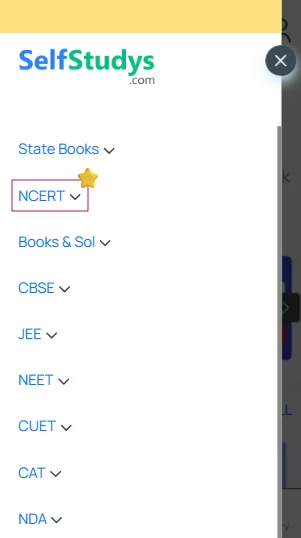
- Through this selection, you can check out all the resources related to NCERT that we provide and tap on the ‘NCERT Solutions’ option.
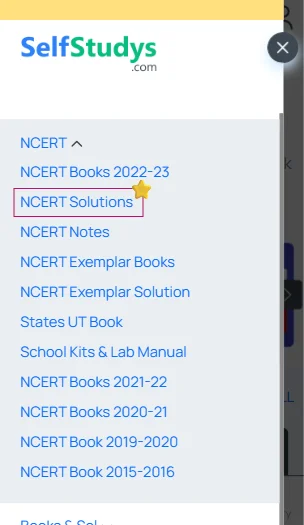
- Within a short interval, you will reach the page where you are required to select your class.
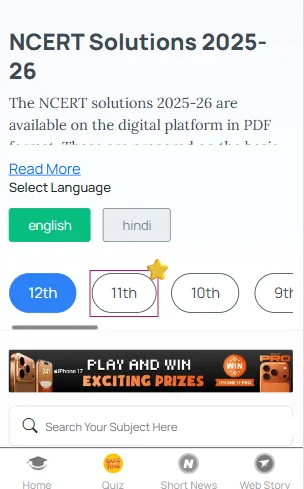
- After this, you will get the subject-wise options and can click on the ‘Chemistry’ icon.
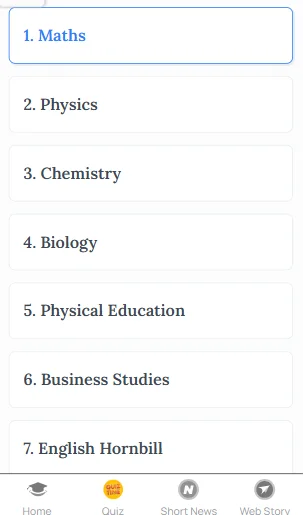
- Now, you can go through the list of chapters for the NCERT solutions for Class 11 Chemistry PDF.
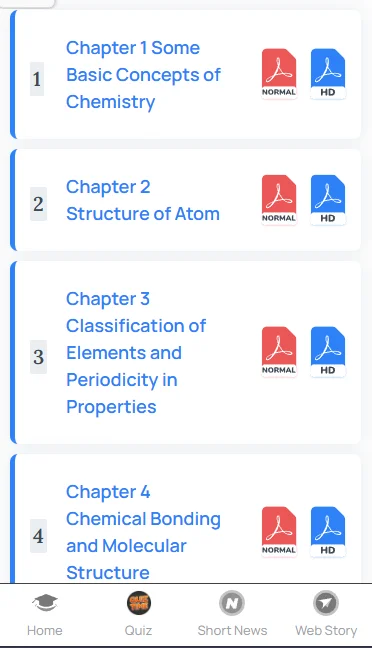
- You may either start with the Class 11 Chemistry NCERT book solutions from chapter 1, or choose the one as per your study plan.
- Finally, you can use them online or get the NCERT Chemistry Class 11 solutions PDF download for free on your device.
Note: Downloads of the NCERT solutions for Class 11 Chemistry are not possible without a Google Log In or Sign Up on SelfStudys.
How To Maximize Your Score By Using NCERT Chemistry Class 11 Solutions PDF Download?
Just reading the textbooks will not help you score high. For this, you need to understand the concepts clearly as well as practice the questions in the right way. We have noticed that many students lose marks because they skip steps in numericals, misunderstand reactions, or fail to connect the topics that are related. You can avoid all these mistakes with the help of the NCERT Class 11 Chemistry solutions chapterwise. They give you clear and step-by-step explanations for every question. In this section, we have described some points with which you can enhance your score while using these solutions.
💯 Before you attempt any of the questions, you should study one chapter at a time with the NCERT notes, as well as read the explanations that are provided in the latest Chemistry NCERT solutions for Class 11. When you understand the logic behind every answer, it will help you build strong clarity of the concepts. This is quite essential for solving both theory-based and numeric questions in an accurate manner.
💯 A few chapters, like mole concept, thermodynamics, equilibrium, etc, have important questions that require proper steps and formulas. If you follow the detailed Class 11 Chemistry NCERT solutions and then practice similar questions by yourself, then you can improve your accuracy as well as speed.
💯 You should revise all the summaries, formulas, important reactions, and so on in the Class 11 Chemistry NCERT solutions 2026-27 before the exams. Through this organized approach, you can save time as well as make sure that you cover all the high-scoring topics effectively.
💯 Whenever you get confused about a concept, reaction mechanism, or calculation, you can clarify it by referring to the NCERT solutions for Class 11 Chemistry PDF. With this immediate resolution of the doubt, you will be able to prevent carrying any misunderstandings to other chapters.
💯 The correct way to write chemical equations, show calculation steps, present explanations, etc., is mentioned clearly in the Class 11 Chemistry NCERT book solutions. By learning this format to structure the answers, you can surely score better in the examination.
💯 The concepts of Chemistry are interconnected, and many questions in the exam combine ideas from different chapters. When you study the NCERT Chemistry Class 11 solutions PDF download carefully, you will see how topics are linked, which will further improve your overall understanding.
💯 The practice of the step-by-step methods with the NCERT solutions for Class 11 Chemistry on a regular basis will make you faster at solving questions during the exams. In this way, you can manage your time in a better way and attempt all the questions with confidence.
💯 Once you have solved the questions on your own, you can compare your responses with our NCERT Class 11 Chemistry solutions chapterwise. Through this self-evaluation, you will be able to recognize your mistakes as well as improve your accuracy over time.
Conclusion
The latest Chemistry NCERT solutions for Class 11 on SelfStudys are a structured learning support system if you want to understand this subject deeply and score high in exams. With their access, you can make sure to not just memorize the reactions or formulas but truly understand the logic behind them. These solutions further help in improving your conceptual clarity, answer-writing skills, and time management. These are the three key factors that will impact your performance in the exam directly.
Absolutely! Weak students should definitely use the Class 11 Chemistry NCERT solutions because they break down complex topics into explanations that are easy to understand. With their practice on a daily basis, you can manage even the most difficult chapters.
Yes, the SelfStudys’ latest Chemistry NCERT solutions for Class 11 include diagrams wherever they are required. These are in chapters like Chemical Bonding, Structure of Atom, etc. With them, you can visualize the concepts in a better way.
In the NCERT solutions for Class 11 Chemistry, you will find that they demonstrate how to write balanced equations, show calculation steps, structure explanations properly, and so on. By using them, you will be able to improve your presentation skills and ultimately score better in written exams.
Yes, the Class 11 Chemistry NCERT book solutions are extremely useful for the revision sessions. They include key points, formulas, as well as important reactions in a structured format. With this resource, you can revise entire chapters quickly before the exams.
The team of subject-matter experts at SelfStudys updates the Class 11 Chemistry NCERT solutions 2026-27 according to the latest syllabus that is prescribed by the CBSE. This way, we make sure that you are using the updated version for preparing in an accurate manner.


 Home
Home
 Quiz
Quiz
 Short News
 Web Story
 Get latest Exam Updates







