


 Sign in


 Profile
 Signout

- 1. Electrostatics
- 2. Current Electricity
- 3. Magnetic Effects of Current & Magnetism & Matter
- 4. Electromagnetic Induction & Alternating Current
- 5. Electromagnetic Waves
- 6. Optics
- 7. Physics and Measurement
- 8. Kinematics
- 9. Laws of Motion
- 10. Work Energy & Power
- 11. Centre of Mass, Momentum and Collision
- 12. Rotational Motion
- 13. Gravitation
- 14. Properties of Solids and Liquids
- 15. Heat And Thermodynamics
- 16. Kinetic Theory of Gas
- 17. Oscillation and Waves
- 18. Dual Nature of Matter and Radiation
- 19. Atoms and Nuclei
- 20. Electronic Devices
It is very rare to see exact question repetition, but 60–70% of concepts are repeated year after year. On average, 10–15 questions appear in a very similar format to previous years; therefore, practising such questions is crucial for effective preparation.
SelfStudys provides the most repeated questions for NEET Biology (Botany & Zoology), Physics, and Chemistry, which you can use to prepare for this year's exam. While the NEET most repeated questions are important to practise, don't neglect NEET mock tests, PYQs, MCQ tests, and more. Now, let's begin by knowing the questions & concepts:
Subject-Wise Most Repeated Questions in NEET
In the NEET exam, about 60–70% of concepts are repeated year after year. SelfStudys’ experts have analysed the NEET old question papers, syllabus, exam pattern, and question trends to create this comprehensive resource: subject-wise most repeated questions in NEET. With this insight, you can check whether your preparation is in the right direction or not, and if there are any preparation tweaks you need to make in your strategy for the National Eligibility-cum-Entrance Test (NEET-UG).
|
NEET Most Repeated Questions Overview: Subject-Wise |
||
|
Subject |
Top Unit |
Weightage (%) |
|
Botany |
Genetics & Molecular Biology |
~24% |
|
Zoology |
Human Physiology |
~20% |
|
Chemistry |
Organic Chemistry (Class 12) |
~27% |
|
Physics |
Mechanics & Electrodynamics |
~25% each |
| Sr. No | NEET Subject-Wise Most Repeated Questions |
| 1 | |
|
2 |
|
|
3 |
|
|
4 |
Most Repeated Questions in NEET Physics
In NEET Physics, you can score a maximum of 180 marks with all 45 answers correct. A strong grasp of numerical problems and the ability to recall formulas are crucial aspects of scoring higher in this section. Mechanics, Electrostatics & Current Electricity, Modern Physics, Optics, and Thermodynamics & KTG are the top Physics units by weightage that you must pay attention to.
Below are the most repeated concepts of NEET Physics:
|
Main Topic |
Concepts |
Details |
|
Modern Physics |
Photoelectric Effect |
Einstein’s photoelectric equations and graphs between stopping potential and frequency. |
|
Atomic Models |
Bohr’s model for hydrogen-like atoms. |
|
|
Nuclear Physics |
Binding energy per nucleon and radioactive decay (half-life and mean-life relations) |
|
|
Semiconductors |
Logic Gates and Zener diode as a voltage regulator. |
|
|
Electrodynamics & Circuit Analysis |
Current Electricity |
Circuit solving using Kirchhoff’s Laws, combination of resistors, and the Wheatstone Bridge. |
|
Magnetic Effects |
Magnetic field due to a long straight wire or at the center of a circular loop. |
|
|
Capacitors |
Calculating equivalent capacitance and energy stored when a dielectric slab is inserted. |
|
|
Mechanics |
Projectile Motion |
Formulas for maximum height (H), time of flight (T), and range (R) are perennial favorites. |
|
Rotational Motion |
Moment of Inertia for common shapes (ring, disc, rod) using parallel and perpendicular axis theorems. |
|
|
Gravitation |
Variation of 'g' with altitude and depth, and Escape Velocity. |
|
|
Optics |
Ray Optics |
Lens Maker’s Formula, a combination of thin lenses, and total internal reflection (critical angle). |
|
Wave Optics |
Young’s Double Slit Experiment (YDSE) to find fringe width. |
Here are the top five Physics units by weightage and the number of expected questions:
|
Unit |
Approx. Weightage |
Expected Questions |
|
Mechanics |
~35–38% |
15–18 Qs |
|
Electrostatics & Current Electricity |
~17–19% |
8–9 Qs |
|
Modern Physics |
~10–12% |
5–6 Qs |
|
Optics |
~10% |
4–5 Qs |
|
Thermodynamics & KTG |
~7–9% |
3–4 Qs |
Most Repeated Questions in NEET Chemistry
Chemistry is known as the rank-decider in NEET. As per the old paper analysis, this section heavily relies on named reactions and periodic properties. Below you can find the most repeated questions for NEET Chemistry along with high-weightage chapters:
|
Category |
High-Weightage Chapters |
Most Repeated Concepts |
|
Organic |
GOC, Hydrocarbons, Aldehydes & Ketones |
Named Reactions: Aldol, Cannizzaro, Reimer-Tiemann. Stability of carbocations and acidic strength. |
|
Inorganic |
Chemical Bonding, p-Block, Coordination Compounds |
Hybridization & VSEPR (shapes of SF4, XeF2), periodic trends (electron affinity), and IUPAC naming of complexes. |
|
Physical |
Equilibrium, Thermodynamics, Solutions |
Numerical patterns in the Nernst Equation, Raoult’s Law, and calculations. |
Top 5 NEET Chemistry Units by weightage and expected questions:
|
Unit Name |
Approx. Weightage |
Expected Questions |
|
Organic Chemistry (Class 12) |
25–28% |
10–12 Qs |
|
Inorganic Chemistry (Class 11 & 12) |
22–25% |
8–10 Qs |
|
Physical Chemistry (Class 12) |
15–18% |
6–8 Qs |
|
Equilibrium (Class 11) |
6–7% |
3–4 Qs |
|
General Organic Chemistry (GOC) |
7–9% |
4 Qs |
Most Repeated Questions in NEET Biology (Botany & Zoology)
Biology in NEET has the highest weightage — 50% of the total marks (360/720). It is also divided into Botany and Zoology, and your performance in the Biology section will be a key rank-decider. It is also the section where you find the highest rate of direct repetition because most of them are directly from the NCERT. Here are the most repeated Biology concepts in NEET:
|
Unit / Topic |
Most Repeating Concepts |
|
Genetics & Evolution |
Mendelian laws (monohybrid/dihybrid crosses), Genetic disorders (Down’s, Sickle-cell), Hardy-Weinberg principle. |
|
Human Physiology |
Structure of the heart (ECG), Digestion enzymes, Nephron function, and Endocrine hormones. |
|
Ecology |
Energy pyramids, Biodiversity hotspots, and Population interactions (predation, mutualism). |
|
Cell Biology |
Cell cycle phases (Mitosis/Meiosis), Biomolecules, and Organelle functions. |
|
Biotechnology |
PCR techniques, Restriction enzymes, and applications like Bt cotton or Insulin production. |
From the table below, know the top 5 NEET Biology Units by weightage and the number of expected questions:
|
Unit Name |
Approx. Weightage |
Expected Questions |
|
Genetics & Evolution |
18–25% |
15–18 Qs |
|
Human Physiology |
18–20% |
13–15 Qs |
|
Ecology & Environment |
12–16% |
10–12 Qs |
|
Biotechnology |
8–13% |
8–10 Qs |
|
Cell: Structure & Function |
10% |
6–8 Qs |
How to Download NEET Most Repeated Questions With Solutions
You can browse our official website to access the NEET most repeated questions with solutions for each subject. For ease, here are the steps:
- Open Selfstudys.com and go to the menu section.

- Within the menu, find ‘NEET’ and click on it. Among several links, you will see a link for ‘NEET Most Repeated Questions’; click on it to proceed further.

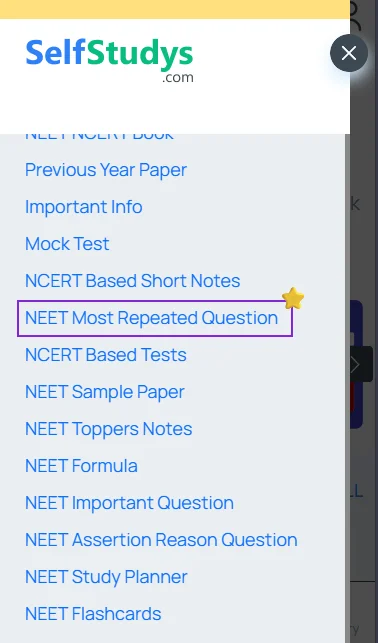
- Since our team has categorised them in a subject-wise manner, you need to select a subject of your choice — Physics, Chemistry, Botany, or Zoology.

- Next, a chapter-wise list will appear; click on any chapter to access the NEET most repeated questions PDF free download link for that particular subject and chapter for free.
What’s the Structure of the NEET Question Paper
For 2027, the NEET (UG) question paper structure has returned to its previous format, which means that all questions are now mandatory with no optional sections. The exam will be in pen-and-paper (offline) mode in a single shift. Knowing the NEET exam paper structure is as important as knowing the most repeated questions in NEET PDF; therefore, here is the Paper Structure & Subject Distribution for your convenience:
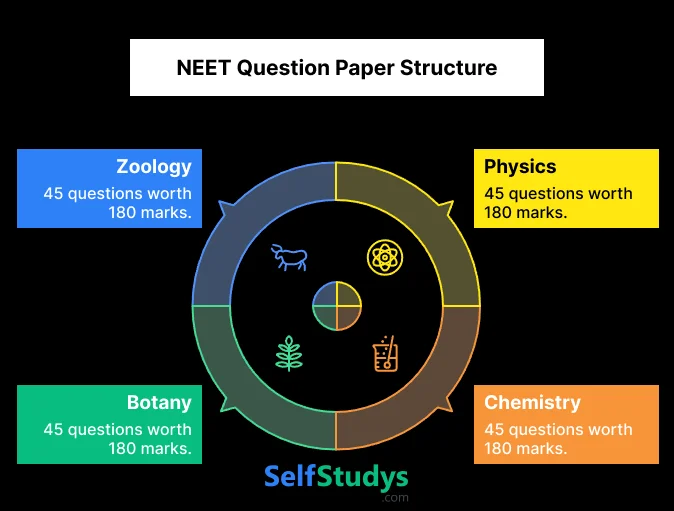
|
Subject |
Number of Questions |
Total Marks |
|
Physics |
45 |
180 |
|
Chemistry |
45 |
180 |
|
Botany (Biology Part 1) |
45 |
180 |
|
Zoology (Biology Part 2) |
45 |
180 |
|
Total |
180 |
720 |
Note that due to the negative marking system, maintaining higher accuracy is essential. Here is the NEET marking scheme for 2027:
|
Particular |
Marks Awarded |
|
Correct Answer |
+4 Marks |
|
Incorrect Answer (Negative Marking) |
-1 Mark |
|
Unanswered/Skipped Question |
0 Marks |
|
More than one option marked |
-1 Mark (Considered incorrect) |
Conclusion
A strong command of the NEET most repeated questions gives you a clear roadmap for your exam preparation. Although the NTA rarely repeats exact, word-by-word questions in this exam, learning and practising the most repeated concepts across Physics, Chemistry, and Biology increases your chances of scoring higher. We provide them in PDF with answer keys so that you can practise the questions along with PYQs and mock tests to boost your speed, accuracy, and confidence for the test. To tackle every section of the NEET important question paper, practise these most repeated questions today — they are available for free on Selfstudys.com.


 Home
Home
 Quiz
Quiz
 Short News
 Web Story
 Get latest Exam Updates