-
Question 1
1 / -0
Which of the following expressions represents the quotient when x3 + 1 is divided by x + 1?
Solution
x
3 + 1 divided by x + 1:
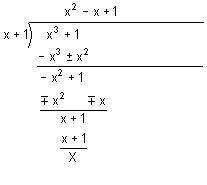
Hence, quotient = x
2 – x + 1.
-
Question 2
1 / -0
Which of following expressions is the expanded form of (5x – 3y)3?
Solution
(5x – 3y)
3 = (5x)
3 – 3(5x)
2 
3y + 3(5x) (3y)
2 – (3y)
3= 125x
3 – 225x
2y + 135xy
2 – 27y
3Hence, 125x
3 – 27y
3 – 225 x
2y + 135xy
2 is the answer.
-
Question 3
1 / -0
On dividing x4 + 2x2 – 3x + 7 by a polynomial g(x), we get quotient and remainder as x2 + 5 and –3x + 22, respectively. The polynomial g(x) is given as _______.
Solution
p(x) = q(x)

g(x) + r(x)
x
4 + 2x
2 – 3x + 7 = (x
2 + 5) g(x) + (–3x + 22)
(x
2 + 5) g(x) = x
4 + 2x
2 – 3x + 3x + 7 – 22
(x
2 + 5) g(x) = x
4 + 2x
2 – 15
g(x) =

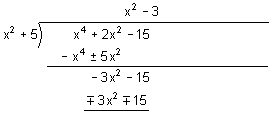
g(x) = x
2 – 3
-
Question 4
1 / -0
Find the remainder when x2 + 6x + 5 is divided by x + 1.
Solution
Divide x
2 + 6x + 5 by x + 1
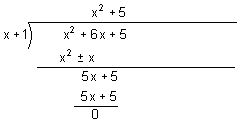
Hence, R = 0
-
Question 5
1 / -0
One of the zeroes of the polynomial x2 + 2x – 35 is 5. Which of the following options is the other zero?
Solution
On factorising x
2 + 2x – 35, we get
x
2 + 7x – 5x – 35
= x (x + 7) – 5 (x + 7)
= (x – 5) (x + 7)

x = 5, x = – 7
Hence, – 7 is the other zero.
-
Question 6
1 / -0
Which of the following expressions is the standard form of the polynomial x2 – x3 + 1 + 2x?
Solution
The standard form of the polynomial x2 – x3 + 1 + 2x is –x3 + x2 + 2x + 1.
-
Question 7
1 / -0
Factorise: x
2 – 2

x + 5
Solution
On factorising x
2 – 2

x + 5, we get
x
2 –
x –
x + 5
= x(x –
) –
(x –
)
= (x –
)(x –
)
-
Question 8
1 / -0
Find the remainder when x2 + 4x + 7 is divided by x + 4.
Solution
On dividing x
2 + 4x + 7 by x + 4, we get
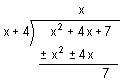
Hence, remainder is 7
-
Question 9
1 / -0
Find the remainder when x3 + 2x2 + x + 1 is divided by x + 1.
Solution
On dividing x3 + 2x2 + x + 1 by x + 1, we get
Remainder = 1
This can be calculated by putting x = -1 in the expression x3 + 2x2 + x + 1; or we have -1 + 2 - 1 + 1 = 1 as the final remainder.
-
Question 10
1 / -0
Which of the following expressions represents the remainder when x2 + 3x + 2 is divided by x + 2?
Solution
When x
2 + 3x + 2 is divided by x + 2, we get
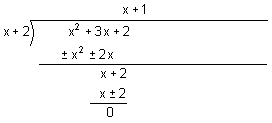
Hence, the remainder = 0
-
Question 11
1 / -0
Which of the following expressions is the standard form of the polynomial x3 – x2?
Solution
Standard form of x3 – x2
= x3 – x2 + 0x + 0
-
Question 12
1 / -0
One of the zeroes of the polynomial x2 – 5x + 4 is 1. Which of the following options is the other zero?
Solution
The polynomial x
2 – 5x + 4 can be factorised as
x – 4x – x + 4
= (x – 4) (x – 1)

x = 4 or x = 1
Hence, 4 is the other zero of the polynomial x
2 – 5x + 4.
-
Question 13
1 / -0
Which of the following expressions represents the quotient when 3x2 + 5x + 8 is divided by x + 4?
Solution
When 3x
2 + 5x + 8 is divided by x + 4, we get
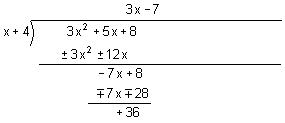
Hence, the quotient is 3x – 7.
-
Question 14
1 / -0
Which of following expressions is the expanded form of (2u – v – w)2?
Solution
The expanded form of (2u – v – w)2
= 4u2 + v2 + w2 – 4uv – 4uw + 2vw
-
Question 15
1 / -0
Which of the following expressions represents the remainder when 4x2 + 6x + 2 is divided by 2x?
Solution
When 4x
2 + 6x + 2 is divided by 2x, we get
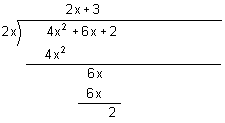
Hence, the remainder is 2
-
Question 16
1 / -0
Which of the following expressions is the standard form of the polynomial x + x2?
Solution
The standard form of x + x2 is :
x2 + x = 0.
-
Question 17
1 / -0
Which of the following expressions results from the factorisation of x3 + 3x2 + 3x + 2?
Solution
p(x) = x3 + 3x2 + 3x + 2
Let x = –2
p (–2) = –8 + 12 – 6 + 2
= 0
Hence, x + 2 is a factor.
Now, dividing x3 + 3x2 + 3x + 2 by x + 2, we get (x2 + x + 1) as the remaining factor.
Factors = (x + 2)(x2 + x + 1)
-
Question 18
1 / -0
Which of the following expressions represents the quotient when x3 + x2 + 2x – 3 is divided by x – 1?
Solution
Dividing x
3 + x
2 + 2x – 3 by x – 1, we get
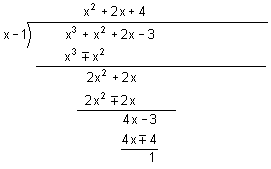
Hence, Q = x
2 + 2x + 4
-
Question 19
1 / -0
Find the remainder when x3 + 2x2 + x + 3 is divided by x + 2.
Solution
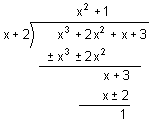

Remainder = 1
-
Question 20
1 / -0
Which of the following expressions represents the remainder when x3 + 1 is divided by x + 1?
Solution
When p(x) = x3 + 1 is divided by x + 1, then
remainder = p(–1)
Hence, p(–1) = (–1)3 + (1)
= – 1 + 1
= 0
-
Question 21
1 / -0
Which of the following expressions represents the remainder when x3 + 2x - 3 is divided by x + 1?
Solution
When p(x) = x3 + 2x - 3 is divided by x + 1,
the remainder = p(-1)
So, p(-1) = (-1)3 + 2(-1) - 3
= - 1 - 2 - 3 = - 6
-
Question 22
1 / -0
On dividing x4 + x3 + 2x2 + 3 by a polynomial g(x), we get the quotient x2 + x + 7 and the remainder is 5x + 38. The polynomial g(x) is ______.
Solution
nbsp; x
4 + x
3 + 2x
2 + 3 = (x
2 + x + 7) g(x) + 5x + 38Hence, g(x) =

=
g(x) = x
2 – 5
-
Question 23
1 / -0
Which of the following expressions is the standard form of the polynomial (x + 2) (x – 1)?
Solution
The polynomial (x + 2) (x – 1)
= x2 + 2x – x – 2
Standard form = x2 + x – 2
-
Question 24
1 / -0
Which of the following expressions is the expanded form of (3x + 4y + 5z)2?
Solution
Expanded form of (3x + 4y + 5z)2
= 9x2 + 16y2 + 25z2 + 24xy + 40yz + 30xz
= 9x2 + 16y2 + 25z2 + 24xy + 30xz + 40yz
-
Question 25
1 / -0
One of the zeroes of the polynomial 2x2 + x – 1 is – 1. Which of the following options is the other zero?
Solution
The polynomial 2x
2 + x – 1 can be factorised as
2x
2 + x – 1 = 2x
2 + 2x – x – 1
= 2x (x + 1) – 1 (x + 1)
= (2x – 1) (x + 1)
x =
and x = – 1
Therefore, x =
is the other zero of the polynomial.
-
Question 26
1 / -0
Which of the following expressions is the standard form of the polynomial x4?
Solution
The standard form of x4
= x4 + 0x3 + 0x2 + 0x + 0
-
Question 27
1 / -0
Find the remainder when 2x4 – 3x3 – 3x2 + 6x – 2 is divided by 2x2 – 3x + 1.
Solution
On dividing 2x
4 – 3x
3 – 3x
2 + 6x – 2 by 2x
2 – 3x + 1, we get
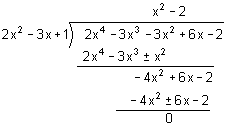
Hence, the remainder is 0
-
Question 28
1 / -0
Which of the following expressions is the factorisation of y3 – 23y2 + 142y – 120?
Solution
Factorise y
3 – 23y
2 + 142y – 120.
If y = 1, then
y
3 – 23y
2 + 142y – 120 = (1)
3 – 23(1)
2 + 142(1) – 120
= 1 – 23 + 142 – 120
= 0
Hence, (y – 1) is a factor.
On dividing y
3 – 23y
2 + 142y – 120 by y – 1, we get
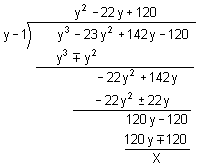
Now, y
2 – 22y + 120
= y
2 – 12y – 10y + 120
= y(y – 12) – 10(y – 12)
= (y – 10) (y – 12)
Therefore, (y – 1), (y – 10) and (y – 12) are the factors of y
3 – 23y
2 + 142y – 120.
-
Question 29
1 / -0
Which of the following expressions represents the remainder when x4 + x3 + 2x2 + 3x is divided by x2 + x?
Solution
On dividing x
4 + x
3 + 2x
2 + 3x by x
2 + x, we get
Remainder = x
-
Question 30
1 / -0
Which of the following expressions is the expanded form of
 ?
?
-
Question 31
1 / -0
One of the zeroes of the polynomial x2 + 2x – 3 is – 3. Which of the following options is the other zero?
Solution
The polynomial x
2 + 2x – 3 = x
2 + 3x – x – 3
= x(x + 3) (– 1) (x + 3)
= (x – 1) (x + 3)

x = 1 or x = – 3
Hence, 1 is the other zero of x
2 + 2x – 3.
-
Question 32
1 / -0
Which of the following expressions represents the quotient when x2 + x + 1 is divided by x – 1?
Solution
When x
2 + x + 1 is divided by x – 1, we get
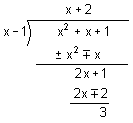
Hence, the quotient is x + 2
-
Question 33
1 / -0
Factorise: x2 – (y + z) x + yz
Solution
x2 – (y + z) x + zy
= x2 – xy – zx + zy
= x(x – y) – z (x – y)
= (x – y) (x – z)
-
Question 34
1 / -0
Which of the following expressions represents the quotient when x4 + x3 + 2x + 1 is divided by x2 + 1?
Solution
When x
4 + x
3 + 2x + 1 is divided by x
2 + 1, we get
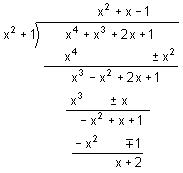
Hence, the quotient is x
2 + x – 1
-
Question 35
1 / -0
Find the quotient when x3 – 3x + 1 is divided by x + 2.
Solution
x
3 – 3x + 1 = (x + 2) g(x) – 1

g(x) =

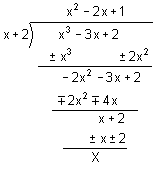

Q = x
2 – 2x + 1
-
Question 36
1 / -0
Find the remainder when x5 + x3 + 3x2 + 1 is divided by x3 + 1.
Solution
On dividing x
5 + x
3 + 3x
2 + 1 by x
3 + 1, we get
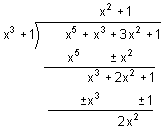
Hence, the remainder is 2x
2
-
Question 37
1 / -0
One of the zeroes of the polynomial x2 – 10x + 21 is 3. Which of the following options is the other zero?
Solution
Factorising x
2 – 10x + 21, we get
x
2 – 7x – 3x + 21
= x(x – 7) – 3(x – 7)
= (x – 7) (x – 3)

x = 7 or x = 3
Hence, the other zero is 7
-
Question 38
1 / -0
Find the quotient when x2 + 2x – 3 is divided by x – 1.
Solution
Dividing x
2 + 2x – 3 by x – 1, we get
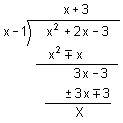
Hence, the quotient is x + 3
-
Question 39
1 / -0
Which of the following expressions is the expanded form of (2x – 1)2?
Solution

– 2 . 2x . 1 + (1)
2= 4x
2 – 4x + 1
-
Question 40
1 / -0
Factorise x2 - 5x + 4.
Solution
Factors of x2 - 5x + 4
= x2 - 4x - x + 4
= x(x - 4) - 1(x - 4)
= (x - 4)(x - 1)






 ×
×


 Sign in


 Profile
 Signout



 Get latest Exam Updates