


 Sign in


 Profile
 Signout


They are provided in PDF format that you can practice offline, revise in an efficient manner, as well as assess your readiness for the examination. Solving past questions also improves your time management, enhances your accuracy, builds confidence, and so on before you appear for the exam.
Whether you want to prepare for Accounting, Business Laws, Quantitative Aptitude, or Business Economics, the previous year question paper CA Foundation will act as your self-assessment tool. With this, you can recognize your strong as well as weak areas and guide you toward smarter revision. We advise you include these papers in your daily study routine so that you can increase your chances of scoring well in the upcoming examination.
Highlights Of The CA Foundation Examination
For your benefit, we have described some important details for this examination in the table below.
|
ASPECT |
DETAILS |
|||
|
Name of the Examination |
CA Foundation exam |
|||
|
Stage of the Examination |
1st stage |
|||
|
Exam Conducting Authority |
ICAI: The Institute of Chartered Accountants of India |
|||
|
Examination Type |
Descriptive cum Objective type |
|||
|
Mode of the Examination |
Offline: OMR-based exams |
|||
|
Number of Papers in the Exam |
Total: 4 papers |
|||
|
Total Marks in the Exam |
400 marks |
|||
|
Language of the Question Paper |
English and Hindi (OMR answer sheets for papers 3 and 4 will be in english medium only). |
|||
|
DATES & TIMINGS OF THE EXAMINATION (January 2026) |
||||
|
Subject |
Date |
Day |
Time |
Duration |
|
Accounting |
02/09/2026 |
Sunday |
2 pm to 5 pm |
3 hours |
|
Business Laws |
05/09/2026 |
Tuesday |
2 pm to 5 pm |
3 hours |
|
Quantitative Aptitude
|
07/09/2026 |
Thursday |
2 pm to 4 pm |
2 hours |
|
Business Economics |
09/09/2026 |
Saturday |
2 pm to 4 pm |
2 hours |
Previous Year Question Paper CA Foundation For Many Years
Here, you get the previous year CA Foundation question paper for multiple years, and by solving the PDFs, you can gain a better understanding of the pattern, question trends, topic-wise weightage, etc. This practice will also help you find the frequently asked topics, increase your speed in solving problems, as well as develop accuracy under exam conditions. You can access the links to these past papers easily below.
Previous Year CA Foundation Question Paper Provided With Solutions
The subject-matter experts at SelfStudys have spent immense hours curating the correct solutions to the questions of the CA Foundation past year question papers. This is done so that you can understand your level of preparation as well as highlight the areas where you need to focus more. You can find these solutions, along with explanations after every question. We advise you to first solve the questions yourself and then cross-check your responses with the given solutions. By doing so, you can further plan proper study sessions for the weaker areas and master them accordingly.
Why Solve CA Foundation Past Year Question Papers?
If you want to prepare for the exam in a focused as well as exam-oriented manner, then solving the CA Foundation PYQs is quite important. This is because there is no doubt that the textbooks and CA Foundation notes will help you in building your conceptual knowledge, but this PYP practice is what will truly prepare you for exam success. We have given some more points below on why you should solve them.
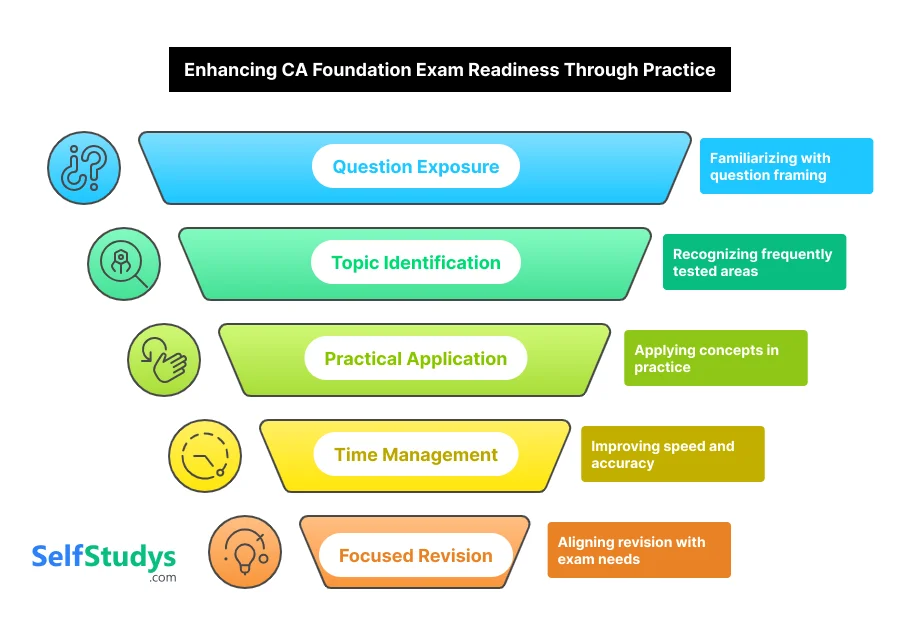
- With the help of the CA Foundation previous year question paper with solutions, you will have direct exposure to the framing of questions by the ICAI. So, when you solve them, you can learn how the concepts are twisted, combined, tested, etc., in indirect ways. This will further help you to avoid any surprises in the real examination.
- A number of topics in this exam are asked again and again over the years. By practicing with the CA Foundation previous year question paper PDF free download, you will be able to find these important areas and focus more on them during your revision sessions. In this way, you can make sure to have a maximum score with smart preparation.
- If you think that just by reading the theory, you can clear this exam, then you are completely wrong. These CA Foundation previous year question papers force you to apply the concepts that you learned in a practical manner. It will then lead to stronger conceptual understanding.
- By solving the previous year question paper CA Foundation in the given time limit, you will be able to allocate time to every question carefully. Through this practice, you can reduce any panic as well as make sure that you complete the paper comfortably in the actual exam.
- The previous year CA Foundation question paper guide you towards exam-focused revision rather than revising everything blindly. This way, you will be able to save time and ensure that your revision is aligned with the expectations of the ICAI.
How To Solve The CA Foundation Previous Question Paper On SelfStudys?
In order to enhance your practice sessions by solving the CA Foundation past year question papers on our platform, you need to take the following steps.
- Simply reach SelfStudys by typing the URL www.selfstudys.com in the browser that you prefer to use.

- Once the website is launched, you can click on the ‘Navigation’ tab from the left corner of the homepage.
- This will open our main menu, wherein you have to select the ‘CA’ section.

- There will be various study materials under this section, and you can tap on the ‘CA Foundation PYQs’ option.
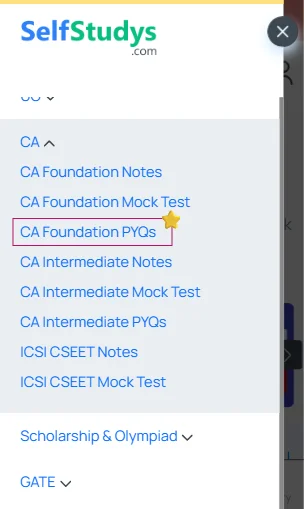
- Now, a new page will be loaded where we provide the year-wise CA Foundation PYQs.

- You have the option to choose any year for the CA Foundation previous year question paper with solutions and click on it.
- After clicking on the year, you can check out the CA Foundation previous year question paper PDF free download for each subject.
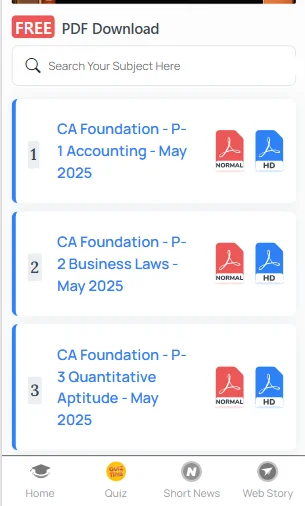
- Finally, you need to select the subject for which you want to solve the CA Foundation previous year question papers and start the practice.
Note: SelfStudys requires your Google Log In or Sign Up for downloading the previous year question paper CA Foundation.
Syllabus For The CA Foundation Examination
In the table mentioned below, we have mentioned the entire syllabus that is prescribed by the Institute of Chartered Accountants of India for the CA Foundation exam.
|
SUBJECT |
SYLLABUS |
|
Accounting |
MODULE 1 Chapter 1: Theoretical Framework
Chapter 2: Accounting Process
Chapter 3: Bank Reconciliation Statement Chapter 4: Inventories Chapter 5: Depreciation and Amortisation Chapter 6: Bills of Exchange and Promissory Notes Chapter 7: Preparation of Final Accounts of Sole Proprietors
MODULE 2 Chapter 8: Financial Statements of Not-for-Profit Organisations Chapter 9: Accounts from Incomplete Records Chapter 10: Partnership and LLP Accounts
Chapter 11: Company Accounts
Accounting Terminology Glossary |
|
Business Laws |
Chapter 1: Indian Regulatory Framework Chapter 2: The Indian Contract Act, 1872
Chapter 3: The Sale of Goods Act, 1930
Chapter 4: The Indian Partnership Act, 1932
Chapter 5: The Limited Liability Partnership Act, 2008 Chapter 6: The Companies Act, 2013 Chapter 7: The Negotiable Instruments Act, 1881 |
|
Quantitative Aptitude |
PART-A: BUSINESS MATHEMATICS Chapter 1: Ratio and Proportion, Indices, Logarithms Chapter 2: Equations Chapter 3: Linear Inequalities Chapter 4: Mathematics of Finance Chapter 5: Basic Concepts of Permutations and Combinations Chapter 6: Sequence and Series – Arithmetic and Geometric Progressions Chapter 7: Sets, Relations and Functions, Basics of Limits and Continuity functions Chapter 8: Basic Applications of Differential and Integral Calculus in Business and Economics
PART-B: LOGICAL REASONING Chapter 9: Number Series, Coding and Decoding, and Odd Man Out Chapter 10: Direction Sense Test Chapter 11: Seating Arrangements Chapter 12: Blood Relations PART-C: STATISTICS Chapter 13
Chapter 14: Measures of Central Tendency and Dispersion
Chapter 15: Probability Chapter 16: Theoretical Distributions Chapter 17: Correlation and Regression Chapter 18: Index Numbers |
|
Business Economics |
Chapter 1: Nature & Scope of Business Economics
Chapter 2: Theory of Demand and Supply
Chapter 3: Theory of Production and Cost
Chapter 4: Price Determination in Different Markets
Chapter 5: Business Cycles Chapter 6: Determination of National Income
Chapter 7: Public Finance
Chapter 8: Money Market
Chapter 9: International Trade
Chapter 10: Indian Economy Glossary |
Commonly Repeated Questions In The CA Foundation Exams
Over the past few years, our experts have noticed that the ICAI has a consistent trend of testing certain concepts, principles, as well as problem types in the previous year CA Foundation question paper. In this section, we have given some examples of the questions that have been commonly asked, along with their answers.
ACCOUNTING
- Ques. 1: What is the Accounting Equation? Explain its components.
Answer: The Accounting Equation is: Assets = Liabilities + Equity
It is the foundation of accounting, showing that everything a business owns (Assets) is financed by what it owes to others (Liabilities) and its owners (Equity). Its components are Assets (what a company owns), Liabilities (debts/obligations), and Equity (owner's stake). This equation ensures balance in financial records, forming the basis for the balance sheet and double-entry bookkeeping.
- Ques. 2: Distinguish between Capital Expenditure and Revenue Expenditure.
Answer: Capital expenditure is incurred to acquire or improve fixed assets and provides long-term benefits, whereas revenue expenditure is incurred for day-to-day business operations and benefits the current accounting period.
BUSINESS LAWS
- Ques. 1: What is Consideration? Mention its essential features.
Answer: Consideration in contract law is the "price" or value exchanged between parties- an act, promise, or forbearance—making an agreement legally binding, based on the principle of quid pro quo ("something for something"). Essential features include moving at the promisor's desire, being real and lawful, potential to move from any person, and existing in the past, present, or future, ensuring mutual benefit.
QUANTITATIVE APTITUDE
- Ques. 1: What is a Proposition in Logical Reasoning?
Answer: A proposition is a statement that is either true or false, but not both at the same time. It's the fundamental building block of arguments, represented by symbols to analyze their relationships using connectives to determine argument validity.
BUSINESS ECONOMICS
- Ques. 1: Explain the Law of Demand.
Answer: The Law of Demand states that, as the price of a good or service increases, the quantity consumers demand decreases, and as the price decreases, the quantity demanded increases, showing an inverse relationship between price and quantity demanded. This fundamental principle explains typical consumer behavior, graphically represented by a downward-sloping demand curve, driven by factors like diminishing utility, the income effect, and the substitution effect.
- Ques. 2: What is Price Elasticity of Demand?
Answer: Price Elasticity of Demand (PED) measures how much the quantity demanded of a product changes when its price changes, calculated as the % Change in Quantity Demanded / % Change in Price, indicating if demand is elastic (highly responsive) or inelastic (not very responsive).
Centers For The CA Foundation Examination
This examination is held at different places all over the country as well as overseas. We have mentioned all these exam centers below for your reference.
|
STATE |
EXAM CITIES |
|
Andaman and Nicobar Islands |
Port Blair |
|
Andhra Pradesh |
Anantapur, Eluru, Guntur, Kadapa, Kakinada, Kurnool, Nellore, Ongole, Rajamahendravaram, Srikakulam, Tirupati, Vijayawada, Visakhapatnam, Vizianagaram |
|
Assam |
Dibrugarh, Guwahati, Jorhat, Silchar, Tezpur, Tinsukia |
|
Bihar |
Begusarai, Bhagalpur, Darbhanga, Gaya, Madhubani, Motihari, Muzaffarpur, Patna, Purnea, Samastipur, Sitamarhi, Siwan |
|
Chhattisgarh |
Bilaspur, Durg, Korba, Raigarh, Raipur, Rajnandgaon |
|
Chandigarh |
Chandigarh |
|
Delhi/New Delhi |
Delhi/New Delhi |
|
Goa |
Mapusa, Margao |
|
Gujarat |
Ahmedabad, Anand, Bharuch, Bhavnagar, Bhuj, Gandhidham, Gandhinagar, Himatnagar, Jamnagar, Junagadh, Mehsana, Morbi, Nadiad, Navsari, Palanpur, Patan, Porbandar, Rajkot, Surat, Surendranagar, Vadodara, Valsad, Vapi |
|
Haryana |
Ambala, Bahadurgarh, Bhiwani, Faridabad, Fatehabad, Gurugram, Hisar, Jind, Kaithal, Karnal, Kurukshetra, Narnaul, Palwal, Panipat, Rewari, Rohtak, Sirsa, Sonepat, Yamuna Nagar |
|
Himachal Pradesh |
Shimla |
|
Jammu and Kashmir |
Jammu, Srinagar |
|
Jharkhand |
Bokaro Steel City, Deogarh, Dhanbad, Hazaribagh, Jamshedpur, Ramgarh, Ranchi |
|
Karnataka |
Bagalkot, Belgaum, Bellary, Bengaluru, Chikkaballapur, Chitradurga, Davangere, Gadag, Hasan, Haveri, Hubli, Kalaburgi, Kolar, Koppal, Mandya, Mangalore, Mysore, Raichur, Shimoga, Sirsi, Tumakuru, Udupi, Vijayapura |
|
Kerala |
Adoor, Alappuzha, Ernakulam, Idukki, Kalpetta, Kannur, Kasaragod, Kollam, Kottayam, Kozhikode, Malappuram, Palakkad, Thiruvananthapuram, Thrissur |
|
Madhya Pradesh |
Bhopal, Burhanpur, Chhatarpur, Chhindwara, Gwalior, Indore, Jabalpur, Katni, Khandwa, Mandsaur, Neemuch, Ratlam, Rewa, Sagar, Satna, Ujjain |
|
Maharashtra |
Ahmednagar, Akola, Amravati, Aurangabad, Badlapur, Beed, Bhiwandi, Khamgaon, Chandrapur, Dhule, Gondia, Ichalkaranji, Jalgaon, Jalna, Kolhapur, Latur, Mumbai, Nagpur, Nanded, Nandurbar, Nashik, Navi Mumbai, Palghar, Panvel, Parbhani, Pimpri-Chinchwad, Pune, Ratnagiri, Sangli, Satara, Sindhudurg, Solapur, Thane, Vasai, Wardha, Yavatmal |
|
Manipur |
Imphal |
|
Meghalaya |
Shillong |
|
Mizoram |
Aizawl |
|
Nagaland |
Dimapur |
|
Odisha |
Balangir, Balasore, Berhampur, Bhubaneswar, Cuttack, Jharsuguda, Puri, Rayagada, Rourkela, Sambalpur |
|
Puducherry |
Puducherry |
|
Punjab |
Amritsar, Bathinda, Jalandhar, Ludhiana, Mandi Gobindgarh, Pathankot, Patiala, Sangrur |
|
Rajasthan |
Ajmer, Alwar, Balotra, Banswara, Beawar, Bharatpur, Bhilwara, Bikaner, Bundi, Chittorgarh, Churu, Hanumangarh, Jaipur, Jhunjhunu, Jodhpur, Kishangarh, Kota, Nagaur, Pali-Marwar, Rajsamand, Sikar, Sirohi, Sri Ganganagar, Udaipur |
|
Sikkim |
Gangtok |
|
Tamil Nadu |
Chennai, Coimbatore, Cuddalore, Dharmapuri, Dindigul, Erode, Hosur, Kancheepuram, Karaikudi, Karur, Kumbakonam, Madurai, Nagapattinam, Nagercoil, Namakkal, Pudukkottai, Salem, Sivakasi, Thanjavur, Theni, Tiruchirapalli, Tirunelveli, Tirupur, Tiruvallur, Tiruvannamalai, Tuticorin, Vellore, Villupuram |
|
Telangana |
Adilabad, Hyderabad, Karimnagar, Khamman, Mahbubnagar, Nalgonda, Nizamabad, Warangal |
|
Tripura |
Agartala |
|
Uttar Pradesh |
Agra, Aligarh, Allahabad, Ayodhya, Bareilly, Bulandshahr, Firozabad, Ghaziabad, Gorakhpur, Hapur, Jhansi, Kanpur, Lucknow, Mathura, Meerut, Modinagar, Moradabad, Muzaffarnagar, Noida, Saharanpur, Varanasi |
|
Uttarakhand |
Dehradun, Haldwani, Haridwar, Kashipur |
|
West Bengal |
Asansol, Durgapur, Hooghly, Kharagpur, Kolkata, Raniganj, Siliguri |
|
OVERSEAS EXAM CENTERS |
|
|
Abu Dhabi, Bahrain, Thimphu (Bhutan), Doha, Dubai, Kathmandu (Nepal), Kuwait, Muscat, Riyadh (Kingdom of Saudi Arabia) |
|
Importance Of Revision After Solving The CA Foundation Previous Year Question Paper With Solutions
It is a known fact that practice of the CA Foundation past year question papers, as well as CA Foundation mock test is an important part of your exam preparation. But you also need to know that real improvement happens when you do revision after solving them. This is the step that transforms your practice into actual exam success. Here are some more points that explain the importance of revision in detail.
- With the help of the revision, you can highlight the difference between the topics that you think you understand and the ones that you actually do. By reviewing the CA Foundation PYQs, you will be able to pinpoint the conceptual gaps as well as revise the relevant chapters accordingly.
- You can repeat a lot of errors like calculation mistakes, incorrect law sections, misinterpretation of questions, and so on if you don’t review the CA Foundation previous year question paper with solutions. Revising helps you to notice these patterns and avoid them in future attempts.
- Revision of the CA Foundation previous year question paper PDF free download enables you to analyze whether your answers were well-organized, written in a logical manner, aligned with ICAI’s expectations, etc. In this way, you will be able to improve your answer presentation skills efficiently.
- When you revisit the CA Foundation previous year question papers, you can enhance your long-term retention for sure. As you rework incorrect questions, it will reinforce your learning through active recall as well as help you remember the concepts easily during the real exam.
- With the previous year question paper CA Foundation revision, you will be able to track your progress over time. By comparing your past mistakes with improved attempts, you can measure your growth and stay motivated in the final stages of preparation.
Conclusion
The previous year CA Foundation question paper is considered to be the most reliable as well as effective resource if you want to build a strong strategy for exam preparation. With this, you get a clear understanding of the exam pattern, question formats, difficulty levels, important topics, and so on. The PYQs help you prepare with direction and confidence instead of studying blindly. Moreover, with regular practice, you will be able to apply theoretical concepts in an exam-oriented manner.
Ideally, we advise you to solve around 5 to 10 years of CA Foundation PYQs. With the attempts at multiple papers, you will be able to recognize the recurring topics as well as strengthen your understanding of the concepts.
After solving the CA Foundation previous year question paper with solutions, you need to review your mistakes, revisit weak areas, as well as understand the correct solutions. Through this analysis, you will be able to make your practice more effective than just solving it once.


 Home
Home
 Quiz
Quiz
 Short News
 Web Story
 Get latest Exam Updates