Self Studies

Linear Programming Test - 31

Result Self Studies

Linear Programming Test - 31
  • Score

    -

    out of -
  • Rank

    -

    out of -
TIME Taken - -
Self Studies

SHARING IS CARING

If our Website helped you a little, then kindly spread our voice using Social Networks. Spread our word to your readers, friends, teachers, students & all those close ones who deserve to know what you know now.

Self Studies Self Studies
Weekly Quiz Competition
  • Question 1
    1 / -0

    Consider the following Linear Programming Problem (LPP).

    Maximise \(Z=x_{1}+2 x_{2}\)

    Subject to:

    \(x_{1} \leq 2\)

    \(x_{2} \leq 2\)

    \(x_{1}+x_{2} \leq 2\)

    \(x_{1}, x_{2} \geq 0\) (i.e., +ve decision variables)

    Solution

    Given

    Objective function

    Maximize, \(Z=x_{1}+2 x_{2}\)

    Constraints

    \(x_{1} \leq 2 \)

    \(x_{2} \leq 2 \)

    \(x_{1}+x_{2} \leq 2 \)

    Non neagative constarints

    \(\mathrm{x}_{1}, \mathrm{x}_{2} \geq 0\)

    The above equations can be written as,

    \(\frac{x_{1}}{2} \leq 1 \)

    \(\frac{x_{2}}{2} \leq 1 \)

    \(\frac{x_{1}}{2}+\frac{x_{2}}{2} \leq 1\)

    Plot the above equations on \(x_{1}-x_{2}\) graph and find out the solution space.

    Now, find out the value of the objective function at every extreme point of solution space.

    \(Z=x_{1}+2 x_{2}\)

    \(Z_{0}=0+2 \times 0=0 \)

    \(Z_{A}=0+2 \times 2=4 \)

    \(Z_{B}=2+2 \times 0=2\)

    Since the value of the objective function is maximum at \(A\). There \(A(0,2)\) is the optimal solution.

  • Question 2
    1 / -0

    Minimize \(\mathrm{Z}=7 \mathrm{x}+\mathrm{y}\) subject to \(5 x+y \geq 5, x+y \geq 3, x \geq 0, y \geq 0\).

    Solution

    Given:

    \(Z=7 x+y\) subject to \(5 x+y \geq 5, x+y \geq 3, x \geq 0, y \geq 0\)

    First we draw the lines \(A B\) and \(C D\) whose equations are \(5 x+y=5\) and \(x+y=3\) respectively.

    \(\begin{array}{|l|l|l|l|l|l|} \hline \text{Line} & \text{Inequation} & \text{Points on x} & \text{Points on y} & \text{Sign} & \text{Feasible region} \\ \hline AB & 5 x+y=5 & A(1,0) & B(0,5) & \geq & \text{Non - origin side A B} \\ \hline CD & x+y=3 & C(3,0) & D(0,3) & \geq & \text{Non - origin side of line CD} \\ \hline \end{array}\)

    1 unit \(=1 \mathrm{~cm}\) both axis

    common feasible region BPC

    \(\begin{array}{|l|l|} \hline \text{Points} & \text{Minimize} z=7 x+y \\ \hline B(0,5) & Z(B)=7(0)+5=5 \\ \hline P\left(\frac{1}{2}, \frac{5}{2}\right) & Z(P)=7 \times \frac{1}{2}+\frac{5}{2}=6 \\ \hline C(3,0) \quad & Z(C)=7 ×(3)+0=21 \\ \hline \end{array}\)

    \(Z\) is minimum at \(x=0, y=5\) and \(\min (Z)=5\)

  • Question 3
    1 / -0

    Find graphically, the maximum value of \(\mathrm{z}=2 \mathrm{x}+5 \mathrm{y}\), subject to constraints given below:

    \(2 \mathrm{x}+4 \mathrm{y} \leq 8 \)

    \(3 \mathrm{x}+\mathrm{y} \leq 6 \)

    \(\mathrm{x}+\mathrm{y} \leq 4 \)

    \(\mathrm{x} \geq 0, \mathrm{y} \geq 0\)

    Solution

    Given:

    \(\mathrm{z}=2 \mathrm{x}+5 \mathrm{y}\)

    \(2 \mathrm{x}+4 \mathrm{y} \leq 8 \)

    \(\Rightarrow \mathrm{x}+2 \mathrm{y} \leq 4\)

    \(3 x+y \leq 6, x+y \leq 4, x \geq 0, y \geq 0\)

    Draw the lines \(\mathrm{x}+2 \mathrm{y}=4\) (passes through (4,0\(),(0,2))\)

    \(3 \mathrm{x}+\mathrm{y}=6\) (passes through \((2,0),(0,6)\) and

    \(\mathrm{x}+\mathrm{y}=4\) (passes through \((4,0),(0,4)\)

    Shade the region satisfied by the given inequations;

    The shaded region in the figure gives the feasible region determined by the given inequations.

    Solving \(3 \mathrm{x}+\mathrm{y}=6\) and \(\mathrm{x}+2 \mathrm{y}=4\) simultaneously, we get

    \(\mathrm{x}=\frac{8}{5}\) and \(\mathrm{y}=\frac{6}{5}\)

    We observe that the feasible region \(\mathrm{OABC}\) is a convex polygon and bounded and has corner points.

    \(\mathrm{O}(0,0), \mathrm{A}(2,0), \mathrm{B}\left(\frac{8}{5}, \frac{6}{5}\right), \mathrm{C}(0,2)\)

    The optimal solution occurs at one of the corner points.

    At \(\mathrm{O}(0,0), \mathrm{z}=2×0+5×0=0\)

    At \(\mathrm{A}(2,0),~~ \mathrm{z}=2×2+5×0=4\)

    At B \(\left(\frac{8}{5}, ~~\frac{6}{5}\right), z=2 × \frac{8}{5}+5 × \frac{6}{5}=\frac{46}{5}\)

    At \(\mathrm{C}(0,2),~~ \mathrm{z}=2×0+5×2=10\)

    Therefore, z maximum value at \(\mathrm{C}\) and maximum value \(=10\)

  • Question 4
    1 / -0

    Linear programming \(( LP )\) problem can be formulated in terms of \(X\) and \(Y\) and Profit \((P)\). Maximize \(P=\) \(7 X+5 Y\) (Objective function) subject to \(4 X+3 Y \leq 240\) (hours of carpentry constraint) \(2 X+Y \leq 100\) (hours of painting constraint) \(X \geq 0, Y \geq 0\) (Non-negativity constraint).

    Solution

    The mathematical formulation of the LPP is:

    Maximize: \(P=7 X+5 Y \) \(\dots\) (i)

    Subject to:

    \( 240 \geq 4 X+3 Y\) \(\dots\) (ii)

    \(100 \geq 2 X+Y\) \(\dots\) (iii)

    \( X \geq 0, Y \geq 0\) \(\dots\) (iv)

    From equation (ii) and (iii)

    \(140 \geq 2 X+2Y\)

    \(70 \geq X+Y\) \(\dots\) (v)

    Multiply equation (v) with 3 then substract it from equation (ii), we get,

    \(30 \geq X\)

    Put value of \(X\) in equation (ii)

    \(240 \geq 120+3Y\)

    \(40 \geq Y\)

    To find the optimal solution to this LP using the graphical method we first identify the region of feasiblesolutions and the corner points of the of the feasible region. The graph for this is plotted below:

    In this, the corner points are \((0,0),(50,0)\), \((30,40)\) and \((0,80)\). Testing these corner points on \(P=7 X+5 Y\) gives:

    Corner Point profit
    A \((0,0)\) \( 0\)
    B \((50,0)\) \(350\)
    C \((30,40)\) \(410\)
    D \((0,80)\) \(400\)
    Because the point \((30,40)\) produces the highest profit we conclude thatpoint C \((30, 40)\) will yield the maximum profit of \(410\).
     
  • Question 5
    1 / -0

    The maximum value of\(z = ~3 x+2 y\), subject to the constraints:\(x+2y \leq 10 \);\(~3 x+y \leq 15 \) and\(x ,\) \(y \geq 0\) is:

    Solution

    It is given that \(z= ~3 x+2 y\) and it is subject to constraints:

    \(~x+2y \leq 10 \)

    \(~3 x+y \leq 15 \)

    \(x ,\) \(y \geq 0\)

    Converting inequalities into equation format:

    \(x+2y = 10 \)...(1)

    \(~3 x+y = 15 \) ...(2)

      \(x=0\) \(y=0\)
    \(x + 2y = 10\) 5 10
    \(3x+y = 15\) 15 5


    The corner points of this common region (shaded region) are: \(O(0,0), C (5,0), E(4,3)\) and \(B(0,5).\)

    \(x+2y= 10\) and \(3x+ y = 15\) intersects at E. From (1) and (2) coordinates of \(E\) is \((4,3)\).

    Points at Graph Coordinates \(z= ~3x + 2y\)
    \(O\) \((0,0)\) \(0\)
    \(C\) \((5,0)\) \(15\)
    \(E\) \((4,3)\) \(18\)
    \(B\) \((0,5)\) \(10\)

    From the table \(z = 3x +2y\) is maximum at \(E~ (4,3)\). So, the maximum value of \(z\) is \(18\).
  • Question 6
    1 / -0

    In order that linear programming techniques provide valid results:

    Solution

    Linear Programming: Linear programming is an important optimization (maximization or minimization) technique used in decision making in business and every - day life for obtaining the maximum or minimum values as required of linear expression, subjected to satisfy a certain number of given linear restrictions.

    Linear programming problem (LPP): The linear programming problem is general calls for optimizing (maximizing/minimizing) a linear function of variables called the objective function subject to a set of linear equations and/or linear inequations called the constraints or restrictions.

    The function which is to be optimized (maximized or minimized) is called the objective function.

    The system of linear inequations (or equations) under which the objective function is to be optimized are called the constraints.

    A primary requirement of an LPP is that both the objective function and all the constraints must be expressed in terms of linear equations and inequalities.

  • Question 7
    1 / -0

    If \(\mathrm{x}=(7+4 \sqrt{3})^{2 \mathrm{n}}=[\mathrm{x}]+\mathrm{f}\), then \(\mathrm{x}(1-\mathrm{f})\) is equal to:

    Solution

    \(\mathrm{x}=(7+4 \sqrt{3})^{2 \mathrm{n}} \)

    \(\mathrm{x}=3+\mathrm{f}\)

    \(\mathrm{f}\) is fractional part of \(\mathrm{x}\):

    \( 0<\mathrm{f}<1\)

    Let \(\mathrm{f}^{\prime}=(7-4 \sqrt{3})^{2 \mathrm{n}}\)

    \(0<7-4 \sqrt{3}<1 \)

    \(0<(7-4 \sqrt{3})^{\mathrm{n}}<1 \)

    \(0<\mathrm{f}^{\prime}<1\)

    \(\mathrm{I}+\mathrm{f}+\mathrm{f}^{\prime}=2\left[{ }^{2 \mathrm{n}} \mathrm{C}_{0}(7)^{2 \mathrm{n}}+{ }^{2 \mathrm{n}} \mathrm{C}_{2}(7)^{2 \mathrm{n}-2}+\ldots\right] \)

    \(=\text { even }\)

    \(0+\mathrm{f}+\mathrm{f}^{\prime}<2\) is integer

    \({ }^{\prime} \mathrm{I}^{\prime}\) is integer and \(\mathrm{f}+\mathrm{f}^{\prime}\) is also integer.

    \(\Rightarrow \mathrm{f}+\mathrm{f}^{\prime}=1\)

    \(\mathrm{f}^{\prime}=1-\mathrm{f} \)

    \(\mathrm{x}(1-\mathrm{f})=\mathrm{xf}^{\prime}=(7+4 \sqrt{3})^{2 \mathrm{n}}(7-4 \sqrt{3})^{2 \mathrm{n}} \)

    \(=1\)

  • Question 8
    1 / -0

    Solve the linear programming problem by graphical method.

    Minimize \(Z=20 x_{1}+40 x_{2}\) subject to the constraints \(36 x_{1}+6 x_{2} \geq 108 ; 3 x_{1}+12 x_{2} \geq 36\) \(20 x_{1}+10 x_{2} \geq 100\) and \(x_{1}, x_{2} \geq 0\).

    Solution
    Given:
    \(36 x_{1}+6 x_{2} \geq 108\)
    Let \(36 x_{1}+6 x_{2}=108\)
    \(6 x_{1}+x_{2}=18\)
    \(\begin{array}{|l|l|l|l|} \hline {x}_{1} & 0 & 3 & 2 \\ \hline {x}_{2} & 18 & 0 & 6 \\ \hline \end{array}\)
    Also given that \(3 x_{1}+12 x_{2} \geq 36\)
    Let \(3 x_{1}+12 x_{2}=36\)
    \({x}_{1}+4 {x}_{2}=12\)
    \(\begin{array}{|l|l|l|l|} \hline {x}_{1} & 0 & 12 & 4 \\ \hline {x}_{2} & 3 & 0 & 2 \\ \hline \end{array}\)
    Also given that \(20 x_{1}+10 x_{2} \geq 100\)
    Let \(20 x_{1}+10 x_{2}=100\)
    \(2 x_{1}+x_{2}=10\)
    \(\begin{array}{|l|l|l|l|} \hline {x}_{1} & 0 & 5 & 4 \\ \hline {x}_{2} & 10 & 0 & 2 \\ \hline \end{array}\)
    The feasible region satisfying all the conditions is \(\mathrm{ABCD}\).
    The co-ordinates of the comer points are \(A(12,0), B(4,2), C(2,6)\) and \(D(0,18)\).
    \(\begin{array}{|c|c|} \hline \text{Corner points} & \mathrm{Z}=20 x_{1}+40 x_{2} \\ \hline \mathrm{A}(12,0) & 240 \\ \hline \mathrm{B}(4,2) & 80+80=160 \\ \hline \mathrm{C}(2,6) & 40+240=280 \\ \hline \mathrm{D}(0,18) & 720 \\ \hline\end{array}\)
    The minimum value of \(Z\) occurs at \(B(4,2)\)
    \(\therefore\) The optimal solutlon Is \(x_{1}=4, x_{2}=2\) and \(Z_{\min }=160\)
     
  • Question 9
    1 / -0

    Solve the following using graphical method:

    Minimize: \(\mathrm{Z}=3 \mathrm{x}+5\) y subject to \(2 \mathrm{x}+3 \mathrm{y} \geq 12,-\mathrm{x}+\mathrm{y} \leq 3, \mathrm{x} \leq 4, \mathrm{y} \geq 3, \mathrm{x} \geq 0, \mathrm{y} \geq 0\).

    Solution

    Given:

    Min \(Z=3 x+5 y \)

    \(2 x+3 y \geq 12 .......(i)\)

    \(-x+y \leq 3 .......(ii)\)

    \(x \leq 4, y \geq 3, x \geq 0, y \geq 0\)

    Taking equation (i)

    \(2 x+3 y=12\)

    Putting \(x=0, y=4\) Let the point is \((0,4)\).

    Now putting \(y=0, x=6\) Let the point is \((6,0)\).

    Now taking equation (ii)

    \(-x+y=3\)

    Putting \(x=0, y=3(0,3)\)

    Putting \(y=0, x=-3(-3,0)\)

    The graph is as follows:

    ABCDA be the feasible region bounded by these lines Now we find the coordinates of A, B, C and D for A, Solving the equations \(2 x+3 y=12\) and \(-x y=3\). We get:

    \(x=\frac{+3}{5} \text { and } y=\frac{18}{5}\)

    For coordinate of \(A\left(\frac{+3}{5}, \frac{18}{5}\right)\)

    Now

    \(Z=3 \times\left(+\frac{3}{5}\right)+5 \times \frac{18}{5} \)

    \(=\frac{+9}{5}+\frac{90}{5}=\frac{90}{5}\)

    For coordinate of B:

    Solving the equations:

    \(2 x+3 y=12\) and \(y=3\)

    We get \(x=\frac{3}{2}, y=3\)

    \(\therefore\) Coordinate of \(B\left(\frac{3}{2}, 3\right)\)

    Now \(Z=3 \times \frac{3}{2}+5 \times 3\)

    \(=\frac{9}{2}+15=\frac{39}{2}\)

    For coordinate of \(C\):

    Solving the equations:

    \(x=4\) and \(y=3\)

    \(\therefore\) Coordinate of \(C(4,3)\)

    Now \(Z=3 \times 4+5 \times 3\)

    \(=12+1=27\)

    For coordinate of \(D\):

    Solving the equations:

    \(-x+y=3\) and \(x=4\)

    We get \(x=4, y=7\)

    Now \(Z=3 \times 4+5 \times 7\)

    \(=12+35=47\)

    \(\operatorname{Min} \mathrm{Z}=\frac{39}{2}\), for \(x=\frac{3}{2}, y=3\)

  • Question 10
    1 / -0

    Solve the linear programming problem by graphical method:

    Minimize \(Z=3 x+5 y\) Subject to the constraints \(x+3 y \geq 3, x+y \geq 2\) and \(x \geq 0, y \geq 0\).

    Solution

    \(Z=3 x+5 y\)

    \(x+3 y \geq 3, x+y \geq 2\) and \(x \geq 0, y \geq 0\)

    Converting the given in equations into equations

    \(x+3 y=3\)

    \(x+y=2\)

    Reglon represented by \(x+3 y \geq 3\) :

    The line \(x+3 y=3\) meets the coordinate axis at \(\mathrm{A}(3,0)\) and \(\mathrm{B}(0,1)\)

    \(x+3 y=3\)

    \(\begin{array}{|l|l|l|} \hline \mathrm{x} & 3 & 0 \\ \hline \mathrm{y} & 0 & 1 \\ \hline \end{array}\)

    \(\mathrm{A}(3,0) ; \mathrm{B}(0,1)\)

    Join the points \(\mathrm{A}\) to 5 to obtain a line.

    Clearly \((0,0)\) does not satisfy the in equation \(x+3 y \geq 3\).

    So the region opposite to the origin, represents the solution set of the in equation.

    Reglon represented by \(x+y \geq 2\) :

    The line \(x+y=2\) meets the coordinate axis at points \(C(2,0)\) and \(D(0,2)\). \(x+y=2\)

    \(\begin{array}{|l|l|l|} \hline x & 2 & 0 \\ \hline y & 0 & 2 \\ \hline \end{array}\)

    \(C(2,0) ; \mathrm{D}(0,2)\)

    Join the points \(C\) to \(D\) to obtain the line.

    Clearly \((0,0)\) does not satisfy the in equation \(x+y \geq 2\)

    So the region opposite to origin, represents the solution set of the in equation.

    Reglon represented by \(x \geq 0, y \geq 0\) :

    Since every point in the first quadrant satisfies these in equations.

    So the first quadrant is the region represented by the equations \(x \geq 0, y \geq 0\).

    The point of intersection of lines \(x+3 y=3\) and \(x+y=2\) is \(E(\frac{3 }{ 2}, \frac{1 }{ 2})\)
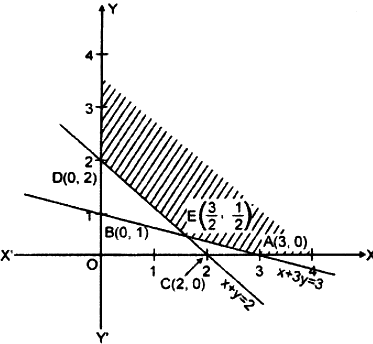
    The shaded region A ED is an open and common region of given in equations. This is the proper solution of the given linear programming problem.

    The coordinates of the shaded region are \(A(3,0)\), E \((\frac{3 }{ 2},\frac{1 }{ 2})\) and \(D(0,2)\).

    The values of the objective function of these points are given in following table:

    \(\begin{array}{|c|c|c|c|} \hline \text{Point} & \text{x-coordinate} & \text{y-coordinate} & \text{Objective function}~ Z=3 x+5 y \\ \hline A & 3 & 0 & Z_{A}=3 \times 3+5(0)=9 \\ \hline E & \frac{3}{2} & \frac{1}{2} & Z_{E}=3\left(\frac{3}{2}\right)+5\left(\frac{1}{2}\right)=7 \\ \hline D & 0 & 2 & Z_{D}=3(0)+5(2)=10 \\ \hline \end{array}\)

    Clearly \(Z\) is minimum at \(x=\frac{3 }{ 2}\) and \(y=\frac{1 }{ 2}\)

    Therefore \(x=\frac{3 }{ 2}\) and \(y=\frac{1 }{ 2}\) is the required solution of the L.P. problem and the minimum value of \(Z\) is 7.


Self Studies
User
Question Analysis
  • Correct -

  • Wrong -

  • Skipped -

My Perfomance
  • Score

    -

    out of -
  • Rank

    -

    out of -
Re-Attempt Weekly Quiz Competition
Self Studies Get latest Exam Updates
& Study Material Alerts!
No, Thanks
Self Studies
Click on Allow to receive notifications
Allow Notification
Self Studies
Self Studies Self Studies
To enable notifications follow this 2 steps:
  • First Click on Secure Icon Self Studies
  • Second click on the toggle icon
Allow Notification
Get latest Exam Updates & FREE Study Material Alerts!
Self Studies ×
Open Now