


 Sign in


 Profile
 Signout

-
1. Mathematics
- 1. Sets
- 2. Relations and Functions
- 3. Trigonometric Functions
- 4. Principle of Mathematical Induction
- 5. Complex Numbers and Quadratic Equations
- 6. Linear Inequalities
- 7. Permutations and Combinations
- 8. Binomial Theorem
- 9. Sequences and Series
- 10. Straight Lines
- 11. Conic Sections
- 12. Introduction to Three Dimensional Geometry
- 13. Limits and Derivatives
- 14. Mathematical Reasoning
- 15. Statistics
- 16. Probability
-
2. Accountancy
- 1. Introduction to Accounting
- 2. Theory Base of Accounting
- 3. Recording of Transactions-1
- 4. Recording of Transactions-2
- 5. Bank Reconciliation Statement
- 6. Trial Balance and Rectification of Errors
- 7. Depreciation, Provisions and Reserves
- 8. Bills of Exchange
- 9. Financial Statements-1
- 10. Financial Statements-2
- 11. Accounts from Incomplete Records
- 12. Applications of Computers in Accounting
- 13. Computerised Accounting System
- 14. Structuring Database for Accounting
- 15. Accounting System Using Database Management System
- 16. Accounting for Not-for-Profit Organisation
-
3. Physics
- 1. Physical World
- 2. Units and Measurements
- 3. Motion in a Straight Line
- 4. Motion in a Plane
- 5. Laws of Motion
- 6. Work, Energy and Power
- 7. System of Particles and Rotational Motion
- 8. Gravitation
- 9. Mechanical Properties of Solids
- 10. Mechanical Properties of Fluids
- 11. Thermal Properties of Matter
- 12. Thermodynamics
- 13. Kinetic Theory
- 14. Oscillations
- 15. Waves
-
4. Chemistry
- 1. Some Basic Concepts of Chemistry
- 2. Structure of Atom
- 3. Classification of Elements and Periodicity in Properties
- 4. Chemical Bonding and Molecular Structure
- 5. States of Matter
- 6. Thermodynamics
- 7. Equilibrium
- 8. Redox Reactions
- 9. Hydrogen
- 10. The s-Block Elements
- 11. The p-Block Elements
- 12. Organic Chemistry - Some Basic Principles and Techniques
- 13. Hydrocarbons
- 14. Environmental Chemistry
-
5. Biology
- 1. The Living World
- 2. Biological Classification
- 3. Plant Kingdom
- 4. Animal Kingdom
- 5. Morphology of Flowering Plants
- 6. Anatomy of Flowering Plants
- 7. Structural Organisation in Animals
- 8. Cell - The Unit of Life
- 9. Biomolecules
- 10. Cell Cycle and Cell Division
- 11. Transport in Plants
- 12. Mineral Nutrition
- 13. Photosynthesis in Higher Plants
- 14. Respiration in Plants
- 15. Plant Growth and Development
- 16. Digestion and Absorption
- 17. Breathing and Exchange of Gases
- 18. Body Fluids and Circulation
- 19. Excretory Products and their Elimination
- 20. Locomotion and Movement
- 21. Neural Control and Coordination
- 22. Chemical Coordination and Integration
- 6. India Physical Environment
-
7. Fundamental of Physical Geography
- 1. Geography as a Discipline
- 2. The Origin & Evolution of the Earth
- 3. Interior of the Earth
- 4. Distribution of Oceans & Continents
- 5. Minerals & Rocks
- 6. Geomorphic Processes
- 7. Landforms & their Evolution
- 8. Composition & Structure of Atmosphere
- 9. Solar Radiation, Heat Balance & Temperature
- 10. Atmospheric Circulation & Weather Systems
- 11. Water in the Atmosphere
- 12. World Climate & Climate Change
- 13. Water (Oceans)
- 14. Movements of Ocean Water
- 15. Life on the Earth
- 16. Biodiversity & Conversation
-
8. Themes in World History
- 1. From the Beginning of Time
- 2. Writing and City Life
- 3. An Empire Across Three Continents
- 4. The Central Islamic Lands
- 5. Nomadic Empires
- 6. The Three Orders
- 7. Changing Cultural Traditions
- 8. Confrontation of Cultures
- 9. The Industrial Revolution
- 10. Displacing Indigenous Peoples
- 11. Paths to Modernization
- 9. Indian Constitution At Work
- 10. Political Theory
- 11. Statistics for Economics
- 12. Introductory Microeconomics
-
13. Business Studies
- 1. Nature & Purpose of Business
- 2. Forms of Business Organisation
- 3. Private, Public & Global Enterprises
- 4. Business Services
- 5. Emerging Modes of Business
- 6. Social Responsibilities of Business & Business Ethics
- 7. Formation of a Company
- 8. Sources of Business Finance
- 9. Small Business
- 10. Internal Trade
- 11. International Business-1
- 12. International Business-2
- 14. Introducing Sociology
- 15. Understanding Society
- 16. Hornbill (Prose)
- 17. Hornbill (Poems)
- 18. Snapshots
By understanding the concepts deeply and testing your understanding through practice of the CBSE Class 11 MCQs, you will be able to score well in the exams. At SelfStudys, you will get a comprehensive and free collection of multiple-choice questions for each subject as well as its chapters.
Our CBSE Class 11 MCQs PDF is created especially for the students who want to reinforce their knowledge and prepare in an effective manner for school exams, class tests, as well as entrance exams like JEE, NEET, CUET, etc. These MCQs are based on the latest syllabus and NCERT textbooks to make sure that you stay aligned with what’s taught in your school. So, if you are looking for a practice material that is accurate, updated, and easy to access, start solving them today on our platform.
How SelfStudys Helps You Prepare With The CBSE Class 11 MCQs PDF
In order to master the topics of a subject, regular practice with the quality CBSE Class 11 MCQs question bank PDF is very important. In this section, we have highlighted the features of this resource that can translate into real learning benefits.
-
We organize the CBSE Class 11 MCQ questions chapter-by-chapter. With this, you are able to focus on one topic at a time. Through this targeted approach, you can reinforce your understanding and make revision sessions more efficient.
-
Unlike many platforms that hide MCQs behind paywalls, we offer CBSE Class 11 MCQ questions with answers completely free and open to all. This way, you can jump into practice directly without any subscription and increase your learning time.
-
The CBSE Class 11 MCQ questions PDF free download has varied difficulty levels of questions. In this, you will find questions from basic understanding to complex application-based ones.
-
Our team of highly educated experts updates the CBSE Class 11 MCQs in order to reflect any new patterns, typologies, important exam questions, and so on. In this way, we make sure that you are always preparing with relevant as well as high-probability content.
-
The CBSE Class 11 MCQs PDF is not only based on NCERT but also includes extra questions from reference books like HC Verma, RD Sharma, TS Grewal, etc. This adds variety and depth to our material and helps you prepare beyond the textbook level.
Subject-Wise CBSE Class 11 MCQs Question Bank PDF
Here, you can access the CBSE Class 11 MCQs question bank PDF for almost every subject that is a part of your syllabus. This division is done so that you don’t get confused during practice sessions and focus on what matters the most. We have also mentioned the links to these subject-wise MCQs below for easy access. You can click on any one of them to solve the questions of your preferred subject.
Answers Available In the PDF File For CBSE Class 11 MCQ Questions
On our platform, you get the CBSE Class 11 MCQ questions with answers. These accurate answers also include detailed solutions with which you can verify your responses as well as understand the reasoning behind them. Furthermore, by doing so, you will be able to enhance your clarity of the concepts and analytical thinking. Just try to solve the questions by yourself first, and then refer to these solutions for better learning.
How To Access The CBSE Class 11 MCQ Questions With Answers On SelfStudys?
Here are the steps that should be followed for accessing the CBSE Class 11 MCQ questions PDF free download on our platform.
- You can visit www.selfstudys.com on any of the web browsers and reach our homepage.

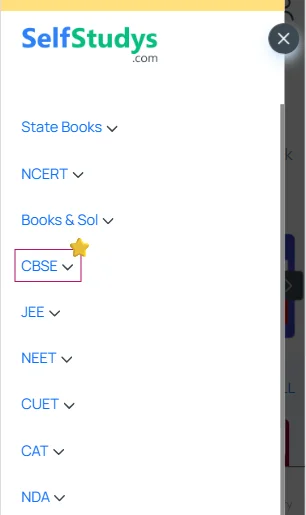
- There, you will see different elements, and you have to click on the ‘Navigation’ tab.
- Now, from the list of categories, you need to select the ‘CBSE’ section.
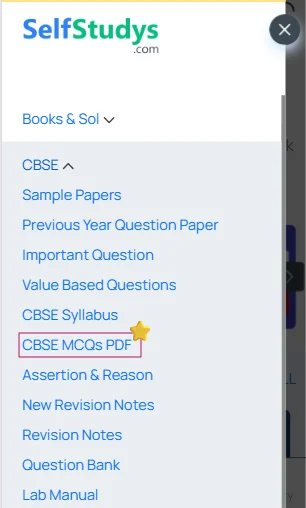
- With this selection, you can access all the study materials related to CBSE and tap on the ‘CBSE MCQs PDF.’
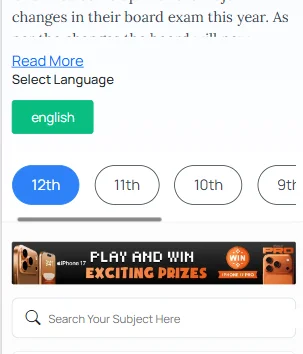
- Now, your screen will show a new page where you are supposed to select the class to get the CBSE Class 11 MCQs.
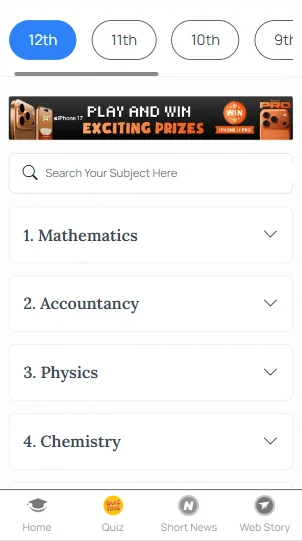
- Then, you can check out all the subjects for which we have CBSE Class 11 MCQs PDF and choose any.
- By clicking on the subject, you can go through its chapter-wise list for the CBSE Class 11 MCQs question bank PDF.
- Finally, you can select that chapter and solve its CBSE Class 11 MCQ questions.
Note: For downloading any chapter’s CBSE Class 11 MCQ questions with answers, make sure that you are logged in or signed up on the website.
Best Time To Start Practicing CBSE Class 11 MCQ Questions PDF Free Download
Many students wait until exams to start their practice with the CBSE Class 11 MCQ questions PDF free download. This approach might lead to stress, less understanding, poor time management, and so on. You should solve these questions in a progressive way throughout the year. Below are some points on the best timings to practice MCQs.

- As soon as you finish a chapter, you should solve the CBSE Class 11 MCQs related to it. This way, you will reinforce your understanding while the concepts are still fresh. Also, you will be able to retain the information for the long term.
- You should set a fixed schedule, like once or twice a week, to revise past topics using the CBSE Class 11 MCQs PDF. It will help you do a proper revision, find any knowledge gaps, as well as prepare yourself systematically.
- Before your school tests or unit exams, you must practice the CBSE Class 11 MCQs question bank PDF and revise all the core topics quickly. You need to make sure that you focus on important questions, frequently asked formats, and case-based or assertion-reason types.
- Around the mid-term break, you should attempt the CBSE Class 11 MCQ questions from mixed chapters in order to evaluate your retention across the topics. This is also the ideal time to switch to moderate as well as advanced-level questions. It will help you strengthen your critical thinking.
- Once you have completed the textbook questions, you should move on to the CBSE Class 11 MCQ questions with answers. This way, you can bridge the gap between your descriptive understanding as well as objective application. You will be able to move from knowing to applying.
Examples Of CBSE Class 11 MCQs
In this section, we have described a few questions from the CBSE Class 11 MCQ questions PDF free download for the most important subjects.
Mathematics
Ques.1: What is the value of the determinant of a two-by-two matrix with the first row as two and three, and the second row as four and five?
- A) Ten
- B) Negative two
- C) Negative ten
- D) Two
- Answer: B) Negative two
- Explanation: To find the determinant of a two-by-two matrix, you multiply the top-left number by the bottom-right number, and subtract the product of the top-right and bottom-left numbers. In this case, two times five is ten, and three times four is twelve. Ten minus twelve is negative two.
Ques.2: What is the domain of the function one divided by the square root of four minus x?
- A) x less than four
- B) x greater than four
- C) x equal to four
- D) x greater than or equal to four
- Answer: A) x less than four
- Explanation: A square root must have a non-negative number inside it, and since the square root is in the denominator, the expression inside must also be greater than zero. That means four minus x must be greater than zero, which is possible only when x is less than four.
Physics
Ques.1: Which of the following has a direction but is not considered a vector?
- A) Displacement
- B) Force
- C) Electric current
- D) Velocity
- Answer: C) Electric current
- Explanation: Electric current flows in a specific direction, but it does not follow the rules of vector addition. For a quantity to be considered a vector, it must follow certain mathematical rules. Since electric current does not behave like vectors in this sense, it is classified as a scalar.
Ques.2: A body is dropped from a height. What is its velocity after three seconds, if the acceleration due to gravity is nine point eight meters per second squared?
- A) Nine point eight meters per second
- B) Nineteen point six meters per second
- C) Twenty-nine point four meters per second
- D) Thirty-nine point two meters per second
- Answer: C) Twenty-nine point four meters per second
- Explanation: When an object is freely falling, its velocity increases steadily due to gravity. The increase in velocity is calculated by multiplying the acceleration due to gravity by the time it falls. After three seconds, the velocity becomes twenty-nine point four meters per second.
Chemistry
Ques.1: Which quantum number determines the shape of an orbital?
- A) Principal quantum number
- B) Azimuthal quantum number
- C) Magnetic quantum number
- D) Spin quantum number
- Answer: B) Azimuthal quantum number
- Explanation: The azimuthal quantum number defines the shape of an atomic orbital. Different values of this number represent different shapes, such as spherical for s-orbitals and dumbbell-shaped for p-orbitals. It helps describe where an electron is likely to be found around the nucleus.
Ques.2: At standard temperature and pressure, how many moles are present in twenty-two point four liters of carbon dioxide gas?
- A) One mole
- B) Two moles
- C) Half mole
- D) One and a half moles
- Answer: A) One mole
- Explanation: According to Avogadro’s law, at standard temperature and pressure (STP), one mole of any ideal gas occupies twenty-two point four liters. So, if you have twenty-two point four liters of carbon dioxide, that equals exactly one mole.
Biology
Ques.1: Which of the following is not a function of the smooth endoplasmic reticulum?
- A) Lipid synthesis
- B) Detoxification of drugs
- C) Protein synthesis
- D) Storage of calcium ions
- Answer: C) Protein synthesis
- Explanation: Smooth endoplasmic reticulum (SER) helps in making lipids, detoxifying chemicals, and storing calcium in cells. Protein synthesis happens in the rough endoplasmic reticulum (RER), which has ribosomes attached. Since SER does not have ribosomes, it does not perform protein synthesis.
Ques.2: Which phase of the cell cycle is known as the resting phase?
- A) Prophase
- B) Metaphase
- C) Interphase
- D) Telophase
- Answer: C) Interphase
- Explanation: Although it’s called the “resting phase,” interphase is when the cell grows and prepares for division. It carries out its normal functions and duplicates its DNA. It’s the longest phase of the cell cycle and is essential for successful cell division.
Accountancy
Ques.1: Which accounting principle requires that expenses be recorded in the same period as the revenues they help to earn?
- A) Cost principle
- B) Matching principle
- C) Consistency principle
- D) Conservatism principle
- Answer: B) Matching principle
Explanation: The matching principle ensures that income and the related expenses are recorded in the same accounting period. This helps businesses know the actual profit or loss for that specific period and gives a clear financial picture.
Ques.2: Which of the following is a real account?
- A) Salaries account
- B) Capital account
- C) Machinery account
- D) Rent account
- Answer: C) Machinery account
- Explanation: A real account is linked to assets or properties owned by the business. Machinery is a physical, tangible asset, so it is considered a real account. On the other hand, salaries and rent are expense accounts, and capital is a personal account.
Conclusion
Practice of the CBSE Class 11 MCQ questions PDF free download on a regular basis can make a big difference in how well you understand concepts, retain information, as well as perform under pressure. At SelfStudys, we try to simplify your preparation by offering high-quality, subject-wise, and exam-oriented MCQs free of cost. So, whether you are revising after class, preparing for a school test, or getting ready for competitive exams, our platform gives you the right tools at the right time. It includes detailed solutions, updated patterns, and easy access on any device.


 Home
Home
 Quiz
Quiz
 Short News
 Web Story
 Get latest Exam Updates