

 Sign in


 Profile
 Signout

-
1. Mathematics
- 1. Rational Numbers
- 2. Linear Equations in One Variable
- 3. Understanding Quadrilaterals
- 4. Practical Geometry
- 5. Data Handling
- 6. Squares and Square Roots
- 7. Cubes and Cube Roots
- 8. Comparing Quantities
- 9. Algebraic Expressions
- 10. Visualising Solid Shapes
- 11. Mensuration
- 12. Exponents and Powers
- 13. Direct and Indirect Proportions
- 14. Factorisation
- 15. Introduction to Graphs
- 16. Playing with Numbers
-
2. Science
- 1. 1. Crop Production and Management
- 2. 2. Microorganisms Friend and Foe
- 3. 3. Synthetic Fibres and Plastics
- 4. 4. Materials Metals and Non-Metals
- 5. 5. Coal and Petroleum
- 6. 6. Combustion and Flame
- 7. 7. Conservation of Plants and Animals
- 8. 8. Cell Structure and Functions
- 9. 9. Reproduction in Animals
- 10. 10. Reaching the Age of Adolescence
- 11. 11. Force and Pressure
- 12. 12. Friction
- 13. 13. Sound
- 14. 14. Chemical Effects of Electric Current
- 15. 15. Some Natural Phenomena
- 16. 16. Light
- 17. 17. Stars and the Solar System
- 18. 18. Pollution of Air and Water
- 3. Civics
- 4. Geography
-
5. History
- 1. How, When and Where
- 2. From Trade to Territory
- 3. Ruling the Countryside
- 4. Tribals, Dikus and the Vision of a Golden Age
- 5. When People Rebel 1857 and After
- 6. Colonialism and the City
- 7. Weavers, Iron Smelters and Factory Owners
- 8. Civilising the Native, Educating the Nation
- 9. Women, Caste and Reform
- 10. The Changing World of Visual Arts
- 11. The Making of the National Movement 1870s-1947
- 12. India After Independence
- 6. Honeydew Prose
- 7. Honeydew Poems
- 8. It So Happened
- 9. English Grammar
-
10. Hindi
- 1. ध्वनि
- 2. लाख की चूड़ियाँ
- 3. बस की यात्रा
- 4. दीवानों की हस्ती
- 5. चिट्ठियों की अनूठी दुनिया
- 6. भगवान के डाकिए
- 7. क्या निराश हुआ जाए
- 8. यह सबसे कठिन समय नहीं
- 9. कबीर की साखियाँ
- 10. कामचोर
- 11. जब सिनेमा ने बोलना सीखा
- 12. सुदामा चरित
- 13. जहाँ पहिया हैं
- 14. अकबरी लोटा
- 15. सूरदास के पद
- 16. पानी की कहानी
- 17. बाज और साँप
- 18. टोपी
- 19. भारत की खोज
Through objective questions, a student's conceptual clarity is assessed. Although the annual exam is not a board exam, schools follow the NCERT curriculum and CBSE guidelines; therefore, objective-type questions are part of the internal or annual assessments. With regular practice of CBSE Class 8 MCQs at SelfStudys, you can prepare for about 20–30% of the total marks.
Knowing the importance of this question type, and to help you be prepared for future board patterns, our team has prepared the CBSE Class 8 MCQs PDF for all subjects, organised in a chapter-wise format. To understand your preparedness for the exam, begin solving these questions today.
Subject-Wise CBSE Class 8 MCQ Questions
CBSE Class 8 students have five core subjects: Mathematics, Science, Social Science, English, and Hindi. Although these five subjects are the primary subjects on which schools focus, some schools also include additional subjects in their curriculum to offer holistic learning. Therefore, we at SelfStudys have prepared the CBSE Class 8 MCQs question bank PDF for all subjects.
Each PDF for the CBSE Class 8 MCQ questions has an answer key, which students can use to cross-check their answers for accuracy. Experts recommend solving these objective questions after covering the chapter, so that the feeling of being overwhelmed can be reduced.
CBSE Class 8 MCQs From Mathematics (For Quick Practice)
For a glimpse, here we provide the CBSE Class 8 MCQ questions with answers that you can use to test your current preparation:
Q1: Which of the following quadrilaterals has all sides equal but not necessarily all angles equal to 90°?
(a) Square
(b) Rectangle
(c) Rhombus
(d) Parallelogram
Hint: A square is a special type of rhombus where all angles are 90°, but a general rhombus only requires equal side lengths.
CBSE Class 8 MCQs PDF From Science (For Quick Practice)
Let's practise some Class 8 MCQs CBSE chapter-wise for Science to understand how well you know this subject so far:
Q1: Which of the following is a non-metal that remains liquid at room temperature?
(a) Mercury
(b) Bromine
(c) Phosphorus
(d) Chlorine
Hint: While Mercury is also liquid at room temperature, it is a metal, not a non-metal.
Q2: In the human eye, the image of an object is formed on the:
(a) Iris
(b) Pupil
(c) Retina
(d) Cornea
Hint: The retina acts like a screen where light-sensitive cells (rods and cones) convert light into electrical signals.
How to Get CBSE Class 8 MCQ Questions PDF Free Download Link
SelfStudys experts have prepared the CBSE Class 8 MCQ questions PDF free download for all subjects in a chapter-wise manner. By following these steps, you can get the direct download link for each chapter free of cost:
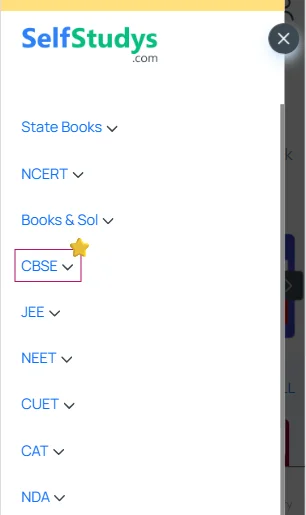
- Go to Selfstudys.com and browse the navigation menu.

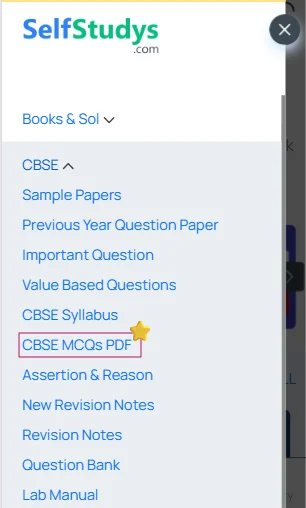
- Within the menu, explore the ‘CBSE’ link and then click on ‘CBSE MCQs PDF’.
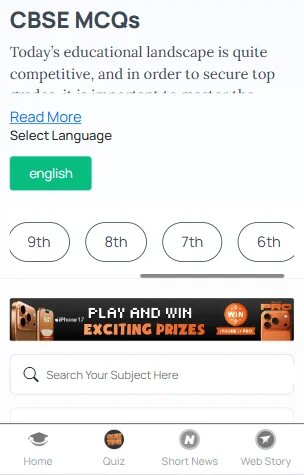
- A new page opens where you are required to select your class; click on the button that says ‘8th’.
- Next, scroll down the page and click on any subject you want—whether it is Mathematics or Hindi—and then click on the chapter for which you want CBSE Class 8 MCQs.
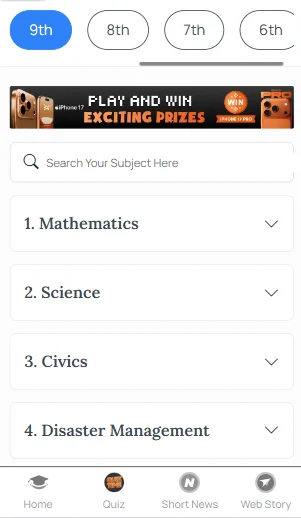
- Clicking on the link will open the CBSE Class 8 MCQs PDF, which you can use to practise questions or download for offline study for free.
Why Practice CBSE Class 8 MCQs Question Bank PDF?
Practising the CBSE Class 8 MCQs question bank PDF is one of the best ways for students to prepare for about 20–30% of the total marks. Practising these types of questions helps you perform regular revision and self-assessment properly. Here are some key reasons why practising them is beneficial:
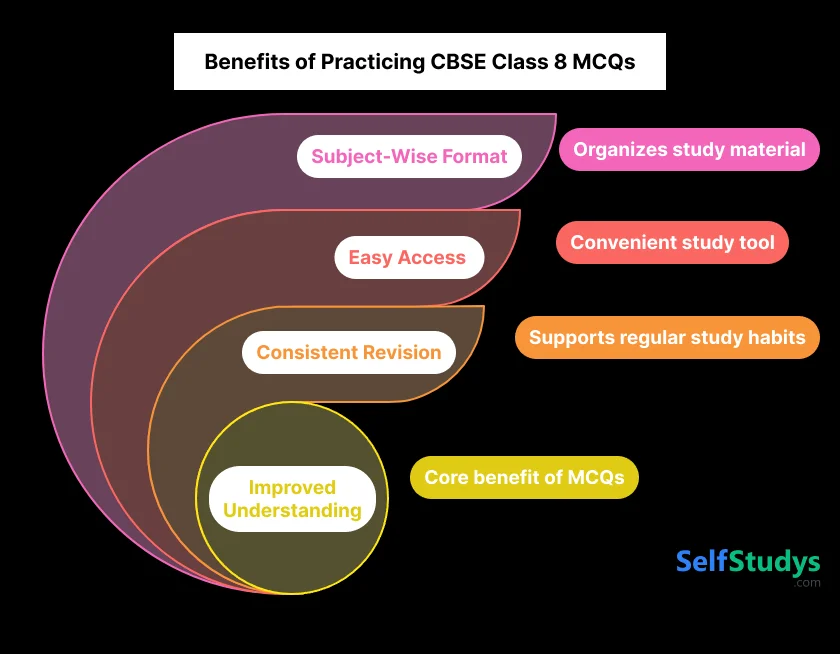
- Since the CBSE Class 8 MCQ questions can be downloaded and accessed on mobile phones, tablets, or computers—and can be used to study even without an internet connection—it is helpful for maintaining higher consistency in self-assessment or revision.
- Our CBSE Class 8 MCQ questions with answers are structured and organised in a subject-wise and chapter-wise format, which makes it easier to revise particular topics from Mathematics, Science, Social Science, English, Hindi, and more.
- Class 8 MCQs CBSE chapter-wise evaluate your understanding of topics, rather than just memorisation. When students like you attempt a variety of questions, identifying weak areas becomes easier, which you can then use to improve your concepts.
Class 8 MCQs CBSE Chapter-Wise vs Worksheets
In this section, we will be discussing the core differences between CBSE Class 8 MCQ questions PDF free download and CBSE worksheets.
|
CBSE Class 8 MCQ Questions |
CBSE Worksheets |
|
The question type you get in the CBSE Class 8 MCQs is objective. |
Worksheets contain mixed types of questions, where you solve both objective and subjective problems. |
|
Answering CBSE Class 8 MCQs PDF is faster, and you can finish a chapter within a short period. |
CBSE Class 8 worksheets are time-consuming — meaning you have to spend more time on them than on the MCQs question bank PDF. |
|
The core focus of the CBSE Class 8 MCQs question bank PDF is to test your conceptual clarity, where minimal writing is required. |
Surface-level conceptual understanding may not be suitable to handle all the questions; therefore, you must have a detailed understanding to deal with worksheet problems. Of course, the questions are lengthier, so more time is required. |
|
Practising with CBSE Class 8 MCQ questions is best for objective sections. The same can also be helpful in scholarship and Olympiad exams. |
CBSE Class 8 Worksheet practice is best for overall exam preparation. It can better support your revision process and practice sessions. |
Conclusion
With regular practice of CBSE Class 8 MCQ questions with answers for all subjects, you can improve your conceptual understanding, exam performance, and accuracy during the revision process. You can combine this study material with CBSE revision notes to boost your command of subjects like Mathematics, Science, and Social Science. Regular practice sessions with the MCQs can prepare you for internal assessments, annual exams, and scholarships or Olympiads.


 Home
Home
 Quiz
Quiz
 Short News
 Web Story
 Get latest Exam Updates