


 Sign in


 Profile
 Signout

-
No Data Found
Among the various preparation tools that are available for this exam, the JEE Main sample paper at SelfStudys is the one that is known to improve your exam performance significantly. By solving it, you will get a real-time experience of the real examination, as well as help you understand the structure, difficulty level, and time pressure of the JEE Main.
Additionally, with the practice of the JEE sample paper, you will be able to check how well you have prepared for the syllabus of the subjects. You should know that our experts collect and design this resource as per the latest exam pattern and question trends. This way, you can get familiar with the multiple-choice questions, numerical-based questions, and the overall marking scheme.
Joint Entrance Examination (Main) 2027 Highlights
In the table, you can find out the highlights related to the JEE (Main) 2027 in detail. You must know this information in advance for a better exam experience.
|
ASPECT |
DETAILS |
|
Examination Name |
JEE: Joint Entrance Examination |
|
Authority that Conducts the Exam |
NTA: National Testing Agency |
|
Examination Level |
National level |
|
Frequency of the Examination |
Twice a year |
|
Number of Papers |
Three
|
|
Mode of Examination |
|
|
Types of Questions |
Two types
|
|
Duration of the Examination |
|
|
Official Website |
JEE Sample Paper Series Available For Several Years
On our platform, we have categorized the JEE Main sample paper PDF on the basis of the specific year of the exam. This means that you can practice these sample papers for various past years and learn about any changes in the examinations. Moreover, for every year, you will get around 5 to 20 sample papers to solve completely free of cost. This wide variety of questions will help you to understand the concepts that are evaluated repeatedly and focus on them properly while preparing for the exam. You can click on the links below to access any year-wise papers directly.
Pattern Of The JEE Main
Here, you can go through the exam pattern for the Joint Entrance Examination- Main, 2027.
|
PAPER |
SUBJECT |
NUMBER OF QUESTIONS |
MARKS |
|
Paper 1: B.E./B. Tech |
Mathematics |
Section A: 20, Section B: 5 |
100 |
|
Physics |
Section A: 20, Section B: 5 |
100 |
|
|
Chemistry |
Section A: 20, Section B: 5 |
100 |
|
|
Total |
75 |
300 |
|
|
Paper 2 (A): B. Arch. |
Part I: Mathematics |
Section A: 20, Section B: 5 |
100 |
|
Part II: Aptitude Test |
50 |
200 |
|
|
Part III: Drawing Test |
02 |
100 |
|
|
Total |
77 |
400 |
|
|
Paper 2 (B): B. Planning |
Part I: Mathematics |
Section A: 20, Section B: 5 |
100 |
|
Part II: Aptitude Test |
50 |
200 |
|
|
Part III: Planning |
25 |
100 |
|
|
Total |
100 |
400 |
|
|
Note: Marking Scheme for question types is as follows:
|
|||
Solutions Provided In The JEE Main Sample Paper PDF
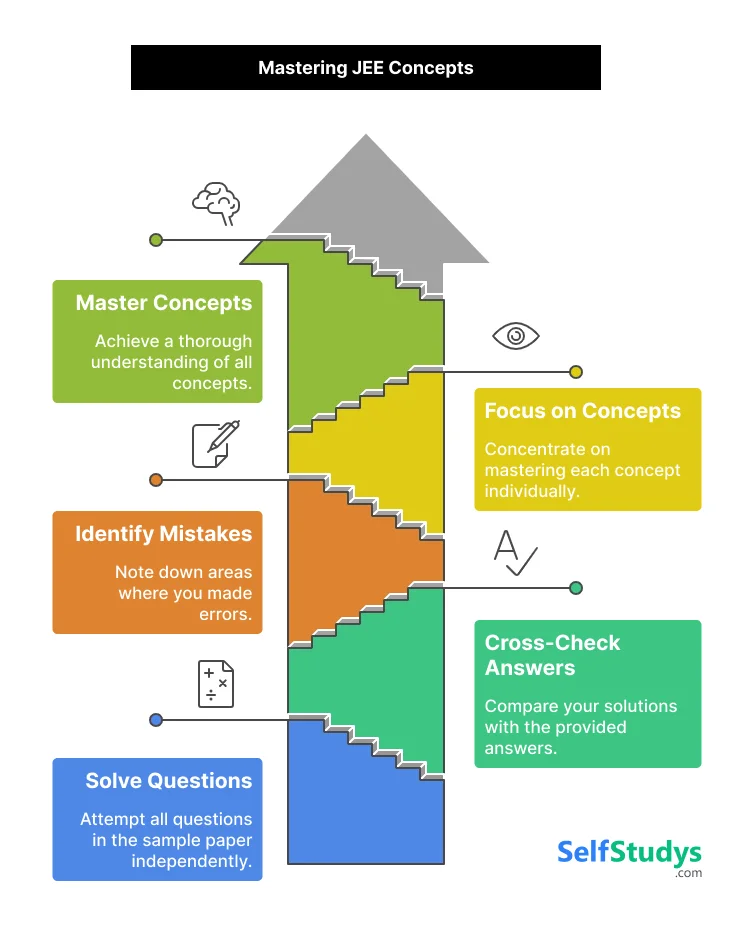
The SelfStudys’ team of subject-matter experts provides the JEE Main sample paper PDF with solutions as well as detailed explanations. This is done so that you can understand the correct answer and the logic behind it. The best technique you can follow is first solve all the questions by yourself, and then refer to these solutions for cross-checking your responses. As you compare your verify your answers with the given solutions, you will learn the areas where you made mistakes and note them down for revision purposes. Then, step by step, you can focus on each concept and master it before the next attempt.
Why Is It Important to Solve The JEE Main Sample Paper PDF With Solutions?
While you are in the phase of exam preparation, practicing the IIT JEE sample paper is considered to be very important. This is because while learning concepts and formulas will help in building your foundation, it is the practice of such questions that will determine your performance in the real exam. We have mentioned some more points below that explain the importance of this resource.
-
You get prepared for the environment of the actual examination when you solve the JEE Mains sample question paper. This material matches the real exam very closely in terms of question type, structure, difficulty level, and so on. With its regular practice, you will be able to adapt to the pressure of the exam, reduce panic, as well as confusion on the exam day.
-
The JEE exam sample paper is created to test your application of concepts instead of rote learning. So, while attempting it, you will realize whether you really understand the formulas, theories, principles, etc. of each subject. Through this process, you can bridge the gap between learning concepts as well as applying them correctly in the exam.
-
This examination is famous for being highly time-sensitive. This is where even well-prepared students might struggle to complete the paper. But by solving the JEE Mains sample paper PDF free download, you will learn how to allocate time to each section, decide which questions to attempt first, avoid spending more time on difficult questions, and so on.
-
When you expose yourself to the exam-level questions with the JEE Main sample paper, you are able to increase your solving speed and reduce careless mistakes. This happens because you will learn shortcuts, efficient calculation methods, logical approaches, etc. They all play quite an important role in improving your overall accuracy and the final score.
-
With the analysis of your performance in the JEE sample paper, you will be able to plan a structured strategy for revision. You can learn which chapters need more practice, which formulas require revision, as well as how to balance revision with mock tests in the final weeks before the exam.
Chapters That Are Included In The IIT JEE Sample Paper
The subject-matter experts at SelfStudys make sure that all the topics that have been tested in the JEE Previous Year Paper are included in the JEE Main sample paper PDF. For your benefit, we have given more details about the topics in the table below.
|
SUBJECT |
IMPORTANT CHAPTERS |
|
Syllabus for JEE Main Paper 1 (B.E./B. Tech) |
|
|
MATHEMATICS |
|
|
PHYSICS |
|
|
CHEMISTRY |
|
|
Syllabus for JEE Main Paper 2 A (B. Arch.) |
|
|
MATHEMATICS |
|
|
APTITUDE TEST |
Objects, Texture related to Architecture and Built-environment, Visualizing three- dimensional objects from two-dimensional drawings. Visualizing. Different sides of three- dimensional objects. Analytical Reasoning Mental Ability (Visual, Numerical, and Verbal).
Understanding and appreciation of scale and proportions of objects, building forms and elements, colour, texture, harmony, and contrast. Design and drawing of geometrical or abstract shapes and patterns in pencil. Transformation of forms, both 2Dand 3Dunion, subtraction, rotation, development of surfaces and volumes, Generation of plans, elevations, and 3D views of objects, creating two-dimensional and three-dimensional compositions using given shapes and forms. |
|
DRAWING TEST |
Sketching of scenes and activities from memory of urban scape (public space, market, festivals, street scenes, monuments, recreational spaces, etc.). Landscape (riverfronts, jungle, gardens, trees, plants, etc.) and rural life. To be conducted in a Drawing sheet. Note: Candidates are advised to bring pencils, their own geometry box set, crasets and, colour pencils, and crayons for the Drawing Test. |
|
Syllabus for JEE Main Paper 2 B (B. Planning) |
|
|
MATHEMATICS |
|
|
APTITUDE TEST |
Objects, Texture related to Architecture and Built-environment, Visualizing three- dimensional objects from two-dimensional drawings. Visualizing. Different sides of three- dimensional objects. Analytical Reasoning Mental Ability (Visual, Numerical, and Verbal).
Understanding and appreciation of scale and proportions of objects, building forms and elements, colour, texture, harmony, and contrast. Design and drawing of geometrical or abstract shapes and patterns in pencil. Transformation of forms, both 2Dand 3Dunion, subtraction, rotation, development of surfaces and volumes, Generation of plans, elevations, and 3D views of objects, creating two-dimensional and three-dimensional compositions using given shapes and forms. |
|
PLANNING |
General knowledge questions and knowledge about prominent cities, development issues, government programs, etc.
The idea of nationalism, nationalism in India, pre-modern world, 19th-century global economy, colonialism and colonial cities, industrialization, resources and development, types of resources, agriculture, water, mineral resources, industries, national economy, Human Settlements. Power-sharing, federalism, political parties, democracy, and the constitution of India. Economic development- economic sectors, globalization, the concept of development, poverty; Population structure, social exclusion and inequality, urbanization, rural development, colonial cities.
Comprehension (unseen passage); map reading skills, scale, distance, direction, area, etc.; critical reasoning; understanding of charts, graphs, and tables; basic concepts of statistics and quantitative reasoning. |
How To Solve The JEE Mains Sample Question Paper?
You can simply head to the educational website of SelfStudys on your preferred device and solve online or download the JEE Main sample paper PDF with solutions free of cost. The entire process to do so is mentioned below.
- First, you have to open your favorite browser and type www.selfstudys.com in the specified space.
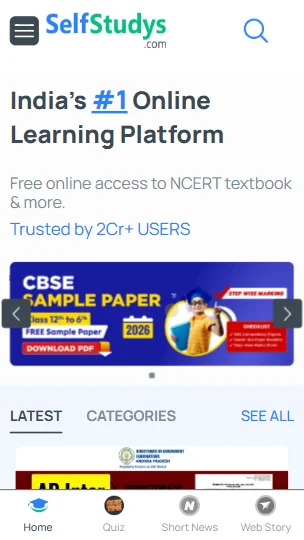
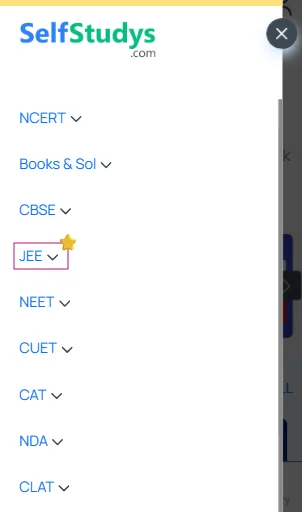
- On the main page, you can click on the ‘Navigation’ tab and select the ‘JEE’ section.
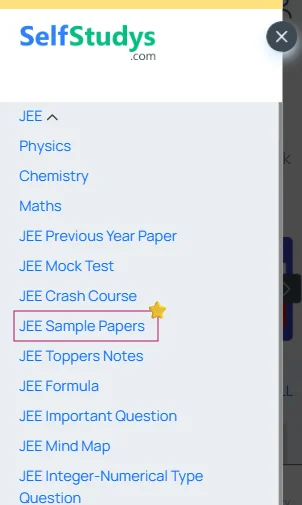
- Now, from the list of several resources, you need to tap on the ‘JEE sample paper’ option.
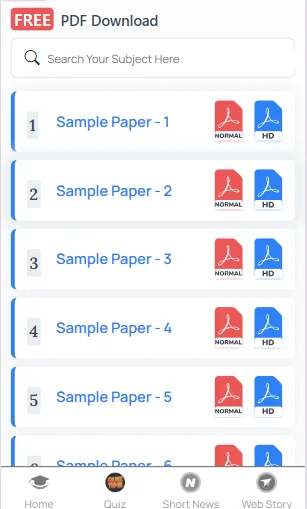
- Then, you will reach the page where you can access the year-wise IIT JEE sample paper.

- You should choose the year for which you want the series of JEE Mains sample question papers.
- After selecting the year, you can start with solving the JEE exam sample paper one by one or pick any one from the list.
Note: You can get the JEE Mains sample paper PDF free download from SelfStudys only after a Google Log In or Sign Up.
What Is The Difference Between The JEE Exam Sample Paper And Previous Year Paper?
The JEE Main sample paper and the PYPs are both very important resources that you must use during your preparation journey. However, there are some differences between the two that you must know. We have described them in a tabular format below.
|
FEATURE |
JEE Main Sample Paper |
JEE Main Previous Year Paper |
|
Purpose of the Resource |
The main purpose of the JEE sample paper is to make you familiar with the format of the exam as well as the types of questions that are asked. |
With the help of the JEE Main PYPs, you will be able to analyze trends in questions, difficulty level, exam pattern changes over time, and so on. |
|
Resource Content |
In the JEE Main sample paper PDF, you will find the questions that are freshly prepared. Due to this reason, they may not reflect the exact difficulty level of the actual exam. |
These papers have the actual questions that have been asked in the previous JEE Main exams. |
|
Difficulty Level |
The difficulty level of the JEE Main sample paper PDF with solutions can vary depending on the source. |
In the JEE previous year paper, you will see that they represent the actual difficulty level that was encountered in the exam. |
|
Predictability of Questions |
The questions that are included in the IIT JEE sample paper are unlikely to be repeated in the real examination. |
The past papers might have similar concepts or styles of questions as seen in previous years. But you still need to remember that the same question will not be repeated. |
|
Benefits of Time Management |
With the help of the JEE Mains sample question paper, you will learn a basic framework for time allocation. |
The JEE Main PYQs will give you a more realistic idea of the time that you should allocate to different sections and questions. |
|
Identifying Learning Gaps |
By solving the JEE exam sample paper, you will be able to find the broad areas that require revision. |
In the previous year papers for JEE Main, you might notice some specific topics or question styles that need your focused attention. |
|
Recommended Usage |
You should use the JEE Mains sample paper PDF free download throughout your preparation. Also, don’t forget to solve them, especially during the mid-preparation stage. |
You can use the JEE PYPs when you are in the phase of pre-examination. Also, you need to make sure that you replicate the environment of the exam and practice intensely. |
How To Combine JEE Mains Sample Paper PDF Free Download With PYPs And Mock Tests?
For the effective preparation of the exam, you need more than a single type of practice material. While the sample papers, PYPs, and mock tests are all important separately, the real benefit comes when you use them together in a proper manner. Below are some tips that you can utilize to combine these resources.
Use The JEE Main Sample Paper To Build A Strong Foundation
We advise you to start your preparation with the practice of the JEE Main sample paper once you have completed a major part of the syllabus. By doing so, you will be able to reinforce the concepts as well as improve your problem-solving skills across each subject. You can also prepare yourself for exam-level questions without the pressure of the real exam.
Solve The JEE Previous Year Paper To Understand The Actual Exam Trends
As you get comfortable with the JEE sample paper, you should shift your focus to JEE Main PYPs. With their help, you will know the real difficulty level, topics that are asked frequently, changes in the question patterns over the years, and so on. In this way, you can align your preparation with what is actually asked in the examination.
Introduce JEE Main Mock Tests To Simulate Real Exam Conditions
You must attempt the JEE mock test after doing enough practice with the JEE Main sample paper PDF and past papers. Also, you have to make sure that you take the tests in a strict environment that matches the real exam. This way, you will be able to assess your time management, endurance, accuracy, etc., under pressure.
Follow A Progressive Practice Sequence
Our experts say that a smart sequence that you should follow is the JEE Main sample paper PDF with solutions - PYPs - mock tests. Through this process, you can build your confidence, adapt to the patterns of the real exam, and finally test yourself under the full pressure of the examination.
Maintain Separate Analysis For Each Resource
It is recommended that you analyze the IIT JEE sample paper for errors in the concepts, PYPs for the trends in topics, and mock tests for your overall performance. When you maintain separate error logs, you will be able to understand the different areas of problems and improve in a systematic way.
Conclusion
In order to do effective as well as focused preparation, the JEE Mains sample question paper is a resource that you must utilize. As it gives an environment of the real examination, you can adapt to the pressure while applying concepts in a time-bound manner. Moreover, by solving the papers on a regular basis, you will be able to gain clarity, improve your understanding of the concepts, develop smart strategies for the real exam, and so on. Now is the time when you should access these sample papers from SelfStudys and get closer to achieving success in the Joint Entrance Examination (Main).
The JEE Mains sample question paper is a simulated practice exam designed to mimic the actual exam format, question types, and time constraints.
Both these approaches are useful. With subject-wise practice of the JEE exam sample paper, you can solidify the individual topics, and with full-length solving, you will be able to check your overall preparation as well as time management skills.
The JEE Mains sample question paper alone is not enough. No doubt it is a vital part of your preparation, but you must combine it with concept learning, revision, mock tests, etc. This way, you will be able to reinforce your knowledge as well as apply concepts in an effective manner.
Yes, you must analyze your JEE Main sample paper PDF with solutions performance. If you don’t do this, then the purpose of solving it is incomplete. With the help of a performance review, you can recognize your weak topics, improve your strategy, avoid repeating the same mistakes in the future, and so on.
The exact questions from the JEE sample paper might not be repeated in the actual exam. But you must know that their pattern, as well as difficulty level, often remains the same. Solving these papers will prepare you for the type of thinking and problem-solving that is required in the actual exam. This makes it a very important preparation resource.
It is advised to practice with the JEE Mains sample paper PDF free download regularly if you are in the final months of your preparation. Ideally, you can solve one paper every week in the initial stage and then increase its frequency as you get closer to the exam date.


 Home
Home
 Quiz
Quiz
 Short News
 Web Story
 Get latest Exam Updates