


 Sign in


 Profile
 Signout
ICSE Previous Year Question Papers Class 10
Board exam preparation can be quite a challenging task, but by solving the ICSE previous year question papers Class 10 on the SelfStudys website, you will be able to score better marks. This practice will give you a deeper understanding of the exam format, question types, time management techniques, and so on.
Here, we provide free access to a wide collection of the ICSE Class 10 PYQs for every important subject. With their help, you can enhance your exam preparation as well as boost your confidence. Moreover, this resource will not only give you a realistic idea of what to expect on the exam day but also allow you to check your strong and weaker areas. Then, you can make the necessary adjustments in your study plan and prepare in a better way.
Previous Year Question Paper Class 10 ICSE For Several Subjects
A variety of ICSE Class 10 PYQs for every important subject is available on SelfStudys. Also, these subjects include the papers from several past years. With this, you will get a complete understanding of the exam style, topic distribution, answer presentation, etc. Moreover, by solving the papers on subjects like Maths, Physics, Chemistry, and Computer Science, you can develop a strong command over theoretical as well as application-based questions. Here are the links to these subject-wise previous year papers.
Indian Certificate of Secondary Education 2027 Examination Timetable
The Council for the Indian School Certificate Examinations has announced the timetable for the class 10 examination. You should go through the table mentioned below for more information.
|
DATE & DAY |
TIME |
SUBJECT |
DURATION |
|
17th February, Tuesday |
11 am |
English Language- ENGLISH Paper 1 |
2 hours |
|
20th February, Friday |
11 am |
Literature in English- ENGLISH Paper 2 |
2 hours |
|
21st February, Saturday |
9 am |
Art Paper 1 (Still Life) |
3 hours |
|
23rd February, Monday |
11 am |
Group III: Elective- Section B Robotics and Artificial Intelligence, Basic Data Entry Operator, Dietetic Aide, Cashier, Early Years Physical Activity Facilitator, Auto Service Technician |
2 hours |
|
26th February, Thursday |
11 am |
Hindi |
3 hours |
|
27th February, Friday |
9 am |
Art Paper 2 (Nature Drawing/ Painting |
3 hours |
|
28th February, Saturday |
9 am |
Art Paper 3 (Original Composition) |
3 hours |
|
2nd March, Monday |
11 am |
Mathematics |
3 hours |
|
6th March, Friday |
11 am |
Ao-Naga, Assamese, Bengali, Dzongkha, Garo, Gujarati, Kannada, Khasi, Lepcha, Mizo, Malayalam, Marathi, Nepali, Odia, Punjabi, Sanskrit, Tamil, Tangkhul, Telugu, Urdu, Arabic, Chinese, French, German, Persian, Modern Armenian, Portuguese, Spanish, Thai, Tibetan |
3 hours |
|
7th March, Saturday |
9 am |
Art Paper 4 (Applied Art) |
3 hours |
|
9th March, Monday |
11 am |
Physics - SCIENCE Paper 1 |
2 hours |
|
11th March, Wednesday |
11 am |
Chemistry - SCIENCE Paper 2 |
2 hours |
|
13th March, Friday |
11 am |
Biology - SCIENCE Paper 3 |
2 hours |
|
16th March, Monday |
11 am |
History and Civics - H.C.G. Paper 1 History and Civics (Thailand) - H.G.T. Paper 1 |
2 hours |
|
18th March, Wednesday |
11 am |
Geography - H.C.G. Paper 2 Geography (Thailand) - H.G.T. Paper 2 |
2 hours |
|
23rd March, Monday |
11 am |
Group III: Elective- Section A Carnatic Music, Commercial Applications, Computer Applications, Cookery, Drama, Economic Applications, Environmental Applications, Fashion Designing, French, German, Hindustani Music, Home Science, Hospitality Management, Indian Dance, Mass Media and Communication, Physical Education, Spanish, Western Music, Yoga |
2 hours |
|
Technical Drawing Applications |
3 hours |
||
|
25th March, Wednesday |
11 am |
Commercial Studies (Group II Elective) French (Group II Elective) |
2 hours |
|
27th March, Friday |
11 am |
Economics (Group II Elective) |
2 hours |
|
30th March, Monday |
11 am |
Environmental Science (Group II Elective) |
2 hours |
Note:
- Apart from the duration mentioned for writing the paper in the above table, you will be given extra 15 minutes to read the question paper.
- For the 11 am examinations, reading time will start at 10:45 am, and for the 9 am examinations, it will start at 8:45 am.
- You should be seated in the exam hall or room by 10:30 for 11 am examinations, and by 8:30 am for the 9 am examinations.
Overview Of The ICSE Class 10 Examination
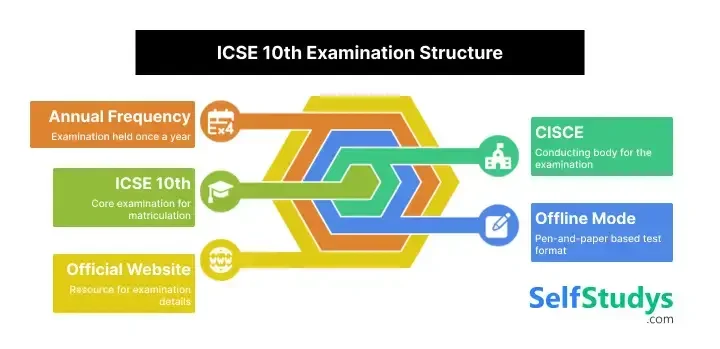
In the table below, you will get all the important details related to this examination clearly.
|
PARTICULARS |
DETAILS |
|
Full Name of the Examination |
Indian Certificate of Secondary Education |
|
Short Name of the Examination |
ICSE 10th |
|
Examination Conducting Body |
CISCE: Council for the Indian School Certificate Examinations |
|
Frequency of the Examination |
Annual |
|
Level of the Examination |
Matriculation |
|
Mode of the Examination |
Offline: Pen-and-paper based test |
|
Official Website |
Why Solving The ICSE Class 10 PYQs Is Crucial For Students?
There are many points that highlight how important it is for you to solve the previous year question paper Class 10 ICSE during your preparation journey. We have explained a few of them below for your reference.
- The ICSE previous year question papers offer you the most accurate representation of how the board structures the examination. Rather than learning the pattern theoretically, you will get a real-time knowledge of how questions are distributed. With this familiarity, you can reduce any surprises on the exam day.
- The true difficulty level of the board exams cannot be matched by the textbooks or sample papers. But the ICSE previous year question papers Class 10 with solutions PDF provides you with the exact challenges and depth of the concepts. By solving them, you will be able to make sure that you are not unprepared for the actual exam.
- One great advantage of practicing with the Class 10 ICSE previous year question paper is that you can notice patterns as well as concepts that are tested frequently. There are many chapters, formulas, grammar topics, map-based questions, etc., that reappear in different forms. Once you recognize these trends, you can revise in a more strategic way as well as focus on high-yield topics.
- The Council for the Indian School Certificate Examinations is known for testing your clarity of the concepts instead of rote learning. So, when you practice with the ICSE previous year question papers Class 10 PDF download repeatedly, you can learn to allocate time per section naturally. You will also be able to avoid unnecessary thinking and complete answers in an efficient manner.
- Another powerful advantage of solving the ICSE previous year question papers Class 10 is self-assessment. You can analyze your answers, notice repeated mistakes, check your accuracy, measure improvement over time, and so on. In this way, you will be able to create a proper strategy and make every study session productive.
How To Download The ICSE Previous Year Question Papers On SelfStudys?
The following are the steps that are required to be completed on our website if you want to download any previous year question paper Class 10 ICSE.
- You can type www.selfstudys.com in the search area of any web browser.
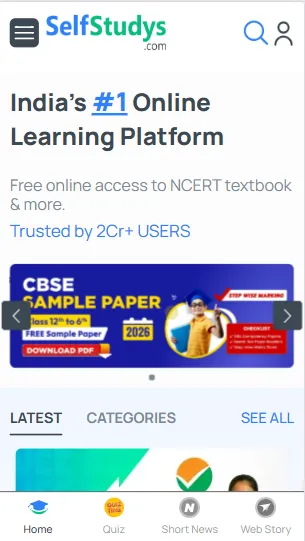
- As soon as you reach the homepage, you should open the menu and click on the ‘Quick Links’ section.
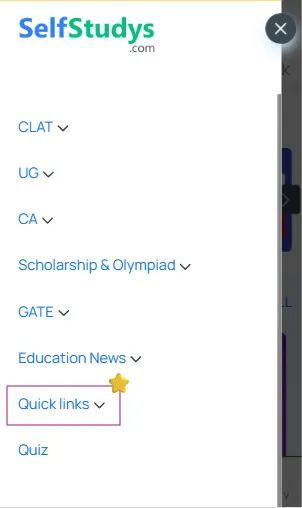
- Then, from its drop-down menu, you have to select the ‘State-Wise Books’ option.
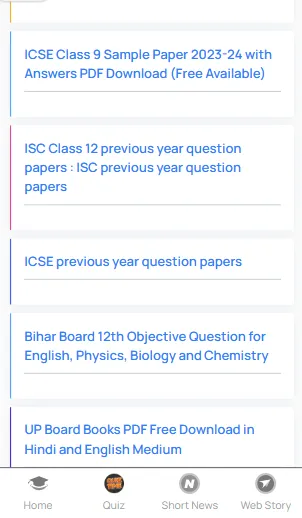
- Within a few seconds, a new page will load wherein you can tap on the ‘ICSE previous year question papers Class 10 with solutions PDF’.
- Now, you can select any subject for the Class 10 ICSE previous year question paper and download it free of cost.
Note: SelfStudys permits you to do the ICSE previous year question papers Class 10 PDF download only after Google Log In or Sign Up.
Syllabus Details For The Indian Certificate of Secondary Education (Class 10) Examination
Our team of subject-matter experts has collected the syllabus for this class and described it in a tabular format below.
|
SUBJECT |
UNITS & TOPICS |
|
Mathematics |
|
|
Physics |
|
|
Chemistry |
|
|
Biology |
|
|
Literature in English |
|
|
Computer Applications |
|
|
History and Civics |
Section A: Civics
Section B: History
|
|
Geography |
Part I: Map Work
Part II: Geography of India
|
|
Economics |
|
|
Home Science |
Part I: Theory
Part II: Practical Work Five practical-oriented assignments as prescribed by the teacher. The suggested assignments are:
|
|
Physical Education |
|
|
Economic Applications |
|
Note: You can find the ICSE Class 10 syllabus in PDF format for the rest of the subjects on the digital platform of SelfStudys.
Difference Between ICSE Sample Papers And ICSE Previous Year Question Papers Class 10 With Solutions PDF
In this section, we are going to explain to you what are the differences between the ICSE Class 10 sample papers and the ICSE previous year question papers Class 10.
|
CRITERIA |
SAMPLE PAPERS |
PREVIOUS YEAR PAPERS |
|
Purpose |
The sample papers are designed to give you an idea of the patterns that are expected in the upcoming exam. |
The ICSE Class 10 PYQs provide you with real exam questions that were used. |
|
Relevance to Latest Syllabus |
They always align with the latest syllabus as well as the blueprint of the exam. |
In the previous year question paper Class 10 ICSE, you will get the syllabus of that specific year, which might differ slightly. |
|
Difficulty Level |
In these papers, the level is usually set to match or exceed the expected difficulty. This is done to train you for tougher questions. |
The difficulty level in the ICSE previous year question papers varies on the basis of the year. It gives you an authentic difficulty range. |
|
Question Trends |
Some new question types, as well as updated formats that are expected, are introduced in the sample papers. |
The ICSE previous year question papers Class 10 with solutions PDF show the questions that are frequently asked, and the concepts that are commonly tested. |
|
Exam Practice Quality |
The sample papers are great for simulated practice with slight variations. |
The Class 10 ICSE previous year question paper is considered the best for real-exam experience, timing, performance evaluation, etc. |
|
Ideal Usage Stage |
You can solve the sample papers before the PYPs in order to build your confidence as well as adapt to the format. |
You should use the ICSE previous year question papers Class 10 PDF download ideally when the exams are closer. This will help you test your final readiness. |
|
Coverage of Concepts |
This resource makes sure to cover a wide range of topics throughout the syllabus with balanced distribution. |
In the ICSE previous year question papers Class 10, you will see which chapters get high weightage year after year. |
|
Student Benefits |
With the help of the sample papers, you will be able to build your initial confidence, understand the question formats, reduce any fear of new patterns, and so on. |
Through the practice of the ICSE Class 10 PYQs, you can improve your accuracy, recognize weaknesses, as well as enhance your time management techniques. |
Which One Should You First?
Our team of experts recommends that you always start with the ICSE sample papers. With them, you will be able to understand the latest patterns, updated typologies, marking guidelines, etc. Also, by solving them, you can build your conceptual confidence, make sure to cover the syllabus, and prepare yourself for the changes that the board might introduce in the upcoming exam. Once you get familiar as well as stable in your preparation, you can shift towards solving the previous year question paper Class 10 ICSE. This resource will help you to evaluate your true preparedness for the exam.
Why Are Both The Sample Papers And The Class 10 ICSE Previous Year Question Paper Important For Full Preparation?
Both of these resources (sample papers and ICSE previous year question papers) serve different but complementary purposes. This makes them equally important for complete preparation. Below are some more points on it:
- The sample papers prepare you for what might come as well as make sure that you are ready for new types of questions.
- The ICSE previous year question papers Class 10 with solutions PDF prepare you for what usually comes in the exam. Their main focus is on the repeated trends and commonly tested topics.
- By using both resources, you can make sure to have a balanced preparation- sample papers for learning as well as practice, and the Class 10 ICSE previous year question paper for revision as well as performance analysis.
- Together, they will help you build speed, accuracy, confidence, and familiarity with the real environment of the exam.
You need to practice with the sample papers and ICSE previous year question papers Class 10 PDF download in order to score high marks, because they cover the prediction of any new changes and mastery over traditional patterns. Overall, they give you a complete exam advantage.
Conclusion
To excel in your board examinations, it is very important to utilize the ICSE previous year question papers Class 10. With them, you will get a proper understanding of the exam pattern, question difficulty, chapter-wise weightage, and so on. These are the insights that no textbook or guide can give you. When you solve the papers consistently, you will also gain clarity on the questions that are asked frequently, improve your presentation skills, as well as learn to manage your time under exam-like pressure in an efficient manner.
From the educational websites like SelfStudys, you will be able to download the previous year question paper Class 10 ICSE for various subjects completely free. By having these PDFs, you will be able to practice anywhere without the need for the textbooks.
The ICSE previous year question papers Class 10 with solutions PDF will provide you with a strong foundation for scoring 95% or above in the exams. But you must combine them with a thorough study of the concepts, practice of sample papers, revision notes, textbook exercises, and so on. By doing so, you can enhance your conceptual understanding and have better chances of scoring top scores.
Ideally, you should solve around 5 to 10 ICSE previous year question papers Class 10 PDF download for all the major subjects. This way, you will be able to find the repeated questions, revise important concepts, improve your answer-writing skills, etc. Also, this will help you build speed, accuracy, as well as familiarity with the exam pattern.
You need to know that the ICSE Class 10 PYQs reflect the syllabus of the year in which they were conducted. While the overall exam style remains the same, the board updates the syllabus from time to time. That’s why you should cross-check the current syllabus and skip the topics that have been removed while solving the past papers.
For revision purposes, the best way to use the ICSE previous year question papers is to solve them under strict exam-like conditions. For this, you need to set a timer as well as avoid any distractions. Moreover, after solving each paper, you should compare your answers with the given solutions. This will help you find errors as well as solidify your weaker chapters.


 Home
Home
 Quiz
Quiz
 Short News
 Web Story
 Get latest Exam Updates