

 Sign in


 Profile
 Signout
CBSE 12 Physical Education 2025-26: Top 50 MCQs with Answers - Must Practice Before Exam
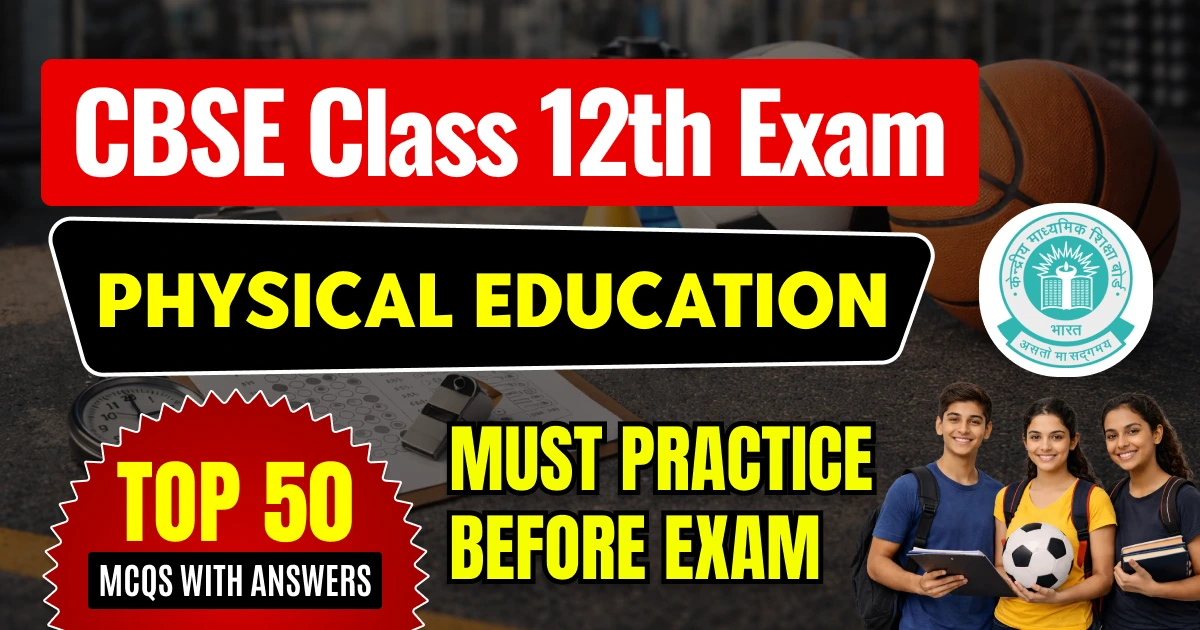


The CBSE Class 12 Physical Education exam is scheduled to be held on February 18, 2026. Section A of the exam is entirely MCQs, carrying a total of 18 marks. Therefore, MCQ preparation is crucial.
We have prepared the 50 most important MCQs with answers as per the latest CBSE syllabus 2025-26. These questions cover all chapters such as Management of Sporting Events, Yoga, Sports Nutrition, Biomechanics, Psychology, and Training in Sports.
These questions are based on a competency-based and application-oriented pattern. Be sure to solve these 50 MCQs before the exam. You can download the chapter-wise PDF from the table below to strengthen your preparation.
CBSE Class 12 Physical Education Top 50 MCQs with Answers PDF 2026
Unit 1: Management of Sporting Events
1. The fixed interval method in tournaments is used in:
A. Knock-out tournament
B. League tournament
C. Combination tournament
D. Challenge tournament
2. The formula to calculate the number of matches in a league tournament is:
A. N(N+1)/2
B. N(N–1)/2
C. N/2
D. N(N–2)/2
3. The number of matches in a knock-out tournament is:
A. N
B. N–1
C. N+1
D. N/2
4. A tournament in which a team gets eliminated after one loss is called:
A. League
B. Knock-out
C. Combination
D. Challenge
5. Intramural tournaments are conducted:
A. Between schools
B. Within the institution
C. At national level
D. International level
Unit 2: Children & Women in Sports
6. Female athlete triad includes:
A. Obesity
B. Amenorrhea
C. Hypertension
D. Diabetes
7. Menarche refers to:
A. First pregnancy
B. First menstruation
C. Menopause
D. Puberty in boys
8. Motor development in children improves through:
A. Inactivity
B. Physical activity
C. Sleeping
D. Dieting only
9. Women generally have higher percentage of:
A. Muscle mass
B. Fat
C. Height
D. Bone density
10. Special consideration for women athletes includes:
A. Ignoring nutrition
B. Strength training only
C. Proper diet and iron intake
D. No warm-up
Unit 3: Yoga as Preventive Measure
11. Pranayama is related to:
A. Meditation
B. Breathing techniques
C. Stretching
D. Diet
12. Tadasana helps in improving:
A. Balance
B. Vision
C. Hearing
D. Digestion only
13. Yoga helps in prevention of:
A. Obesity
B. Stress
C. Hypertension
D. All of these
14. Anulom Vilom is a type of:
A. Asana
B. Pranayama
C. Meditation
D. Exercise machine
15. Bhujangasana is helpful for:
A. Back pain
B. Cold
C. Fever
D. Toothache
Unit 4: Physical Education & Sports for CWSN
16. CWSN stands for:
A. Children With Special Needs
B. Children With Sports Nature
C. Creative Working Students
D. None
17. Inclusion in sports means:
A. Separate participation
B. Equal participation
C. No participation
D. Only competition
18. Paralympics are organised for:
A. Only women
B. Only men
C. Athletes with disabilities
D. Children
19. Intellectual disability affects:
A. Physical strength
B. Learning ability
C. Height
D. Weight
20. Deaflympics are for athletes with:
A. Visual impairment
B. Hearing impairment
C. Physical disability
D. Mental disability
Unit 5: Sports & Nutrition
21. Carbohydrates are the main source of:
A. Protein
B. Energy
C. Vitamins
D. Minerals
22. BMI stands for:
A. Body Mass Index
B. Body Muscle Intake
C. Basic Mass Indicator
D. None
23. Proteins are essential for:
A. Energy only
B. Growth & repair
C. Hydration
D. Sleep
24. Balanced diet includes:
A. Only carbohydrates
B. Only fats
C. All nutrients in proper proportion
D. Only proteins
25. Dehydration affects:
A. Performance
B. Vision
C. Height
D. Intelligence
Unit 6: Test & Measurement in Sports
26. Harvard Step Test measures:
A. Speed
B. Endurance
C. Strength
D. Flexibility
27. Sit and Reach test measures:
A. Strength
B. Flexibility
C. Agility
D. Speed
28. 50 meter dash measures:
A. Endurance
B. Speed
C. Balance
D. Coordination
29. Rockport test measures:
A. Agility
B. VO2 max
C. Height
D. Reaction time
30. Barrow’s test measures:
A. Agility
B. Strength
C. Speed
D. Balance
Unit 7: Physiology & Injuries in Sports
31. RICE stands for:
A. Rest, Ice, Compression, Elevation
B. Run, Ice, Care, Exercise
C. Rest, Injury, Compression, Exercise
D. None
32. Sprain affects:
A. Muscles
B. Ligaments
C. Bones
D. Tendons
33. Strain affects:
A. Ligaments
B. Muscles
C. Bones
D. Joints
34. Fracture means:
A. Muscle tear
B. Bone break
C. Joint pain
D. Ligament tear
35. Warming up helps to:
A. Increase injury
B. Reduce injury
C. Decrease blood flow
D. None
Unit 8: Biomechanics & Sports
36. Newton’s First Law is also called:
A. Law of Acceleration
B. Law of Inertia
C. Law of Action
D. Law of Gravity
37. Friction helps in:
A. Slipping
B. Running
C. Falling
D. None
38. Projectile motion is seen in:
A. Shot put
B. Yoga
C. Meditation
D. Warm-up
39. Speed is distance divided by:
A. Force
B. Time
C. Work
D. Mass
40. Momentum equals:
A. Mass × Velocity
B. Force × Time
C. Work × Time
D. Mass × Acceleration
Unit 9: Psychology & Sports
41. Motivation improves:
A. Performance
B. Fatigue
C. Stress
D. Injury
42. Anxiety before competition is called:
A. Trait anxiety
B. Competitive anxiety
C. Stress
D. Depression
43. Goal setting helps in:
A. Confusion
B. Performance enhancement
C. Failure
D. Fatigue
44. Self-talk is used for:
A. Distraction
B. Motivation
C. Injury
D. Weakness
45. Personality affects:
A. Performance
B. Height
C. Weight
D. Eye colour
Unit 10: Training in Sports
46. Fartlek training improves:
A. Flexibility
B. Endurance
C. Height
D. Vision
47. Interval training is based on:
A. Continuous rest
B. Work and rest intervals
C. Sleep
D. Meditation
48. Strength training improves:
A. Muscle power
B. Height
C. IQ
D. Skin colour
49. Circuit training combines:
A. Only strength
B. Only speed
C. Different exercises in sequence
D. Only rest
50. Overtraining leads to:
A. Better performance
B. Fatigue
C. Energy boost
D. Height increase
CBSE 12th Physical Education MCQs Questions with Answer Key PDF
| Download PDF |
| CBSE 12th Physical Education MCQs Questions with Answer Key: Download PDF |
CBSE Class 12 Physical Education MCQ Answer Key Table
| Question No. | Answer | Question No. | Answer |
| 1. | b | 26. | b |
| 2. | b | 27. | b |
| 3. | b | 28. | b |
| 4. | b | 29. | b |
| 5. | b | 30. | a |
| 6. | b | 31. | a |
| 7. | b | 32. | b |
| 8. | b | 33. | b |
| 9. | b | 34. | b |
| 10. | c | 35. | b |
| 11. | b | 36. | b |
| 12. | a | 37. | b |
| 13. | d | 38. | a |
| 14. | b | 39. | b |
| 15. | a | 40. | a |
| 16. | a | 41. | a |
| 17. | b | 42. | b |
| 18. | c | 43. | b |
| 19. | b | 44. | b |
| 20. | b | 45. | a |
| 21. | b | 46. | b |
| 22. | a | 47. | b |
| 23. | b | 48. | a |
| 24. | c | 49. | c |
| 25. | a | 50 | b |
---
👉 Also Check - CBSE 12 Physical Education 2025-26: Most Important Questions with Answers – Free PDF
👉 Also Check - CBSE 12 Physical Education 2025-26: Most Important Case-Based Questions with Answers – Free PDF
👉 Also Check - CBSE 12th Physical Education Exam 2025-26: Handwritten Notes & Important Questions
👉 Also Check - CBSE Class 12 Physical Education Most Expected Questions 2025-26: Download Free PDF
👉 Also Check - CBSE 12 Physical Education Exam 2025-26: Chapter Wise Most Repeated Questions – Free PDF



 Home
Home
 Quiz
Quiz
 Short News
 Web Story
 Get latest Exam Updates