


 Sign in


 Profile
 Signout

- 1. Maths
- 2. Physics
- 3. Chemistry
- 4. Biology
- 5. Applied Mathematics
- 6. English
- 7. Hindi
- 8. Accountancy
- 9. Business Studies
- 10. History
- 11. Geography
- 12. Political Science
- 13. Economics
- 14. Computer Science
- 15. Physical Education
- 16. Biotechnology
- 17. Engineering Graphics
- 18. Entrepreneurship
- 19. Home Science
- 20. Informatics Practices
- 21. Legal Studies
- 22. Psychology
- 23. Sociology
They are designed as per the latest curriculum and exam pattern. This further helps you understand the structure of the question paper, marking scheme, important topics, level of questions, and so on.
With the practice of the CBSE sample papers 2026-27 on a regular basis, you can improve your understanding of the concepts, problem-solving abilities, time management skills, etc. On our platform, you can access these papers for free across all major subjects and classes in one place. You may even use the CBSE Class 12 Sample Paper for self-assessment, finding your strong or weak areas, and developing an effective strategy.
Overview Of The CBSE Sample Papers 2026-27
In the table mentioned below, you will get the key highlights of the CBSE SQP available on SelfStudys.
|
PARTICULARS |
DETAILS |
|
Name of the Resource |
CBSE sample paper |
|
Academic Session |
2026-27 |
|
Supported Subjects |
CBSE sample question paper available for:
|
|
Format Available |
PDF: Portable Document Format |
|
Access Mode |
CBSE Board sample paper free download |
|
Number of Sets |
Multiple practice sets available |
|
Includes Solutions |
Yes |
|
Based On |
CBSE model papers based on the latest CBSE syllabus and exam pattern |
|
Questions Types |
|
|
Suitable For |
|
|
Benefits |
|
You can utilize the links mentioned below to access the CBSE sample paper with solutions for any class and its related subjects.
| CBSE Sample Papers for Class 12 | CBSE Sample Papers for Class 11 | CBSE Sample Papers for Class 10 | CBSE Sample Papers for Class 9 | CBSE Sample Papers for Class 8 | CBSE Sample Papers for Class 7 | CBSE Sample Papers for Class 6 |
| CBSE Class 8 English Sample Papers | ||||||
| CBSE Sample Paper Class 11 for Business Studies | CBSE Sample Paper Class 9 for Computer Applications | |||||
| CBSE Sample Paper Class 11 for Economics | ||||||
| CBSE Sample Paper Class 11 for English Core | ||||||
| CBSE Sample Paper Class 11 for Physical Education | ||||||
| CBSE Sample Paper Class 11 for Applied Mathematics | ||||||
| CBSE Sample Paper Class 11 for Geography | ||||||
| CBSE Sample Paper Class 11 for History | ||||||
| CBSE Sample Paper Class 11 for Hindi Core | ||||||
How CBSE SQP Supports Academic Success
If you just spend several hours studying through books or CBSE NCERT Revision Notes, then it will not determine your academic success. For this, the quality of your preparation as well as the ability to apply concepts in an effective way also matter a lot. The CBSE sample paper PDF plays a very important role in this process. They provide you with a structured platform to test your knowledge, find any weaknesses, refine your exam-taking strategies, and so on. Here are a few points in detail that explain how these papers support your success in academics.
|
Development Area |
How CBSE sample paper download help |
|
Conceptual Understanding |
With the free CBSE sample papers, you are encouraged to apply your knowledge of theory in practical situations. You learn how concepts are used in real scenarios rather than just memorizing the answers. Therefore, through this process, you are able to increase your understanding of the subject as well as build a solid foundation across all chapters and topics. |
|
Exam Pattern Familiarity |
When you solve the CBSE sample paper on a regular basis, you get familiar with the latest structure of the exam, distribution of questions, marking scheme, as well as the competency-based assessment approach. With this familiarity, you can eliminate any surprises during the real exam. It also allows you to approach the paper with confidence and readiness. |
|
Time Management Skills |
The CBSE sample papers 2026-27 provide you with an opportunity to practice under the conditions of the real exam. This helps you understand how much time you need to allocate to different sections as well as question types. Then, over time, you can develop the ability to complete the papers within the given time as well as maintain your accuracy and quality of the answers. |
|
Self-Assessment and Progress Tracking |
The CBSE SQP is considered to be a great tool for self-evaluation as it allows you to measure your preparation level before the exams. Through its regular practice, you will be able to identify any performance trends, monitor your improvement, determine whether strategies are working or not, and so on. |
|
Identification of Learning Gaps |
While solving the CBSE sample question paper, you might discover topics, concepts, or question types that are challenging. With this insight, you can focus your revision efforts on weaker areas. Then, you will be able to make sure to have a more balanced as well as comprehensive preparation strategy before the exams. |
How To Access The CBSE Sample Question Paper on SelfStudys?
For access to the CBSE Board sample paper, you can go through the steps given below and follow them one by one.
- Firstly, you should open the web browser that you prefer to use on the device where you want to solve or download the CBSE model papers.
- Next, you have to click on the search space of the browser and type www.selfstudys.com into it.
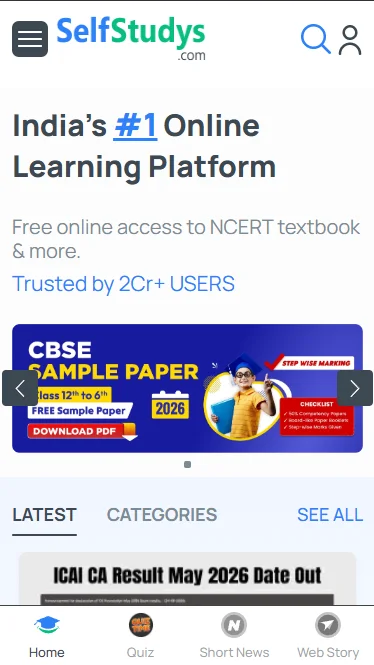
- In a short while, our website will be visible on your screen. Here, you need to tap on the ‘Navigation’ button and select the ‘CBSE’ section.
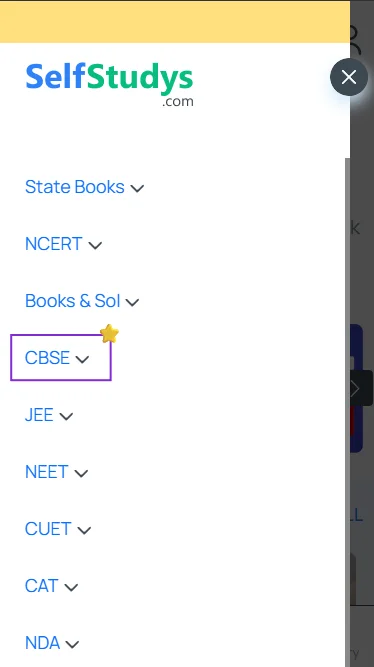
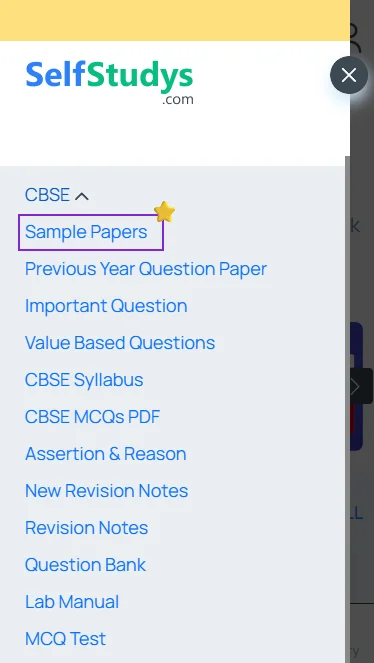
- Now, you will see a variety of resources related to CBSE that we provide for free. You can click on the ‘Sample Papers’ icon here.
- A new page will open up on your screen that has the CBSE sample paper with answers for several classes. You should select your class in this step.

- After selecting your class, you can go through the subjects for which we have the CBSE sample paper PDF.
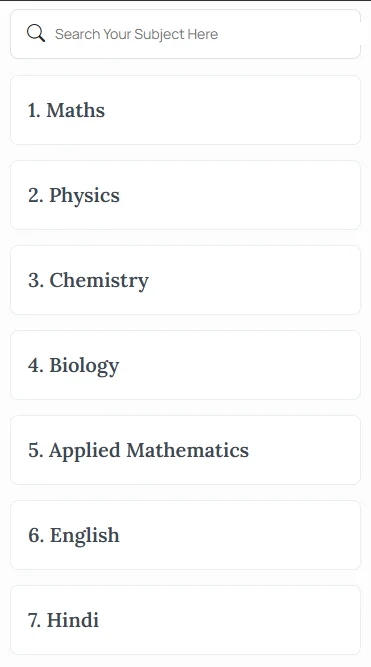
- Then, you can pick the subject and get the sets for the CBSE sample paper download.
- Finally, you have the option to either solve the free CBSE sample papers online or download them for offline practice.
Note: A simple registration with your Google account is required on SelfStudys to access the CBSE sample paper.
Important Chapters Reflected In CBSE Board Sample Paper
One valuable aspect of the CBSE sample papers 2026-27 is that they reflect the importance of different chapters within a subject. By solving and analyzing multiple papers, you will be able to find high-priority chapters, recurring themes of questions, competency-based areas, and so on. In this section, we have mentioned almost all the important chapters across various subjects in each class.
|
Class 6 |
||
|
Mathematics |
Science |
Social Science |
|
Knowing Our Numbers, Whole Numbers, Playing with Numbers, Basic Geometrical Ideas, Understanding Elementary Shapes, Integers, Fractions, Decimals, Data Handling, Mensuration, Algebra, Ratio and Proportion, Symmetry, Practical Geometry |
Components of Food, Sorting Materials into Groups, Separation of Substances, Getting to Know Plants, Body Movements, Living Organisms and Their Surroundings, Motion and Measurement of Distances, Light Shadows and Reflections, Electricity and Circuits, Fun with Magnets, Air Around Us |
What, Where, How, and When, From Hunting-Gathering to Growing Food, Kingdoms, Kings, and an Early Republic, New Questions and Ideas, Ashoka the Emperor, The Earth in the Solar System, Globe Latitudes and Longitudes, Major Domains of the Earth, Panchayati Raj, Rural Administration, Urban Administration |
|
Class 7 |
||
|
Mathematics |
Science |
Social Science |
|
Integers, Fractions and Decimals, Data Handling, Simple Equations, Lines and Angles, The Triangle and Its Properties, Comparing Quantities, Rational Numbers, Perimeter and Area, Algebraic Expressions, Exponents and Powers, Symmetry, Visualising Solid Shapes |
Nutrition in Plants, Nutrition in Animals, Heat, Acids, Bases, and Salts, Physical and Chemical Changes, Respiration in Organisms, Transportation in Animals and Plants, Reproduction in Plants, Motion and Time, Electric Current and Its Effects, Light, Winds, Storms, and Cyclones |
Tracing Changes Through a Thousand Years, New Kings and Kingdoms, The Delhi Sultans, The Mughal Empire, Interior of the Earth, Air, Water, Human Environment, On Equality, Role of Government in Health, State Government, Markets Around Us |
|
Class 8 |
||
|
Mathematics |
Science |
Social Science |
|
Rational Numbers, Linear Equations in One Variable, Understanding Quadrilaterals, Practical Geometry, Data Handling, Squares and Square Roots, Cubes and Cube Roots, Comparing Quantities, Algebraic Expressions and Identities, Mensuration, Exponents and Powers, Direct and Inverse Proportions |
Crop Production and Management, Microorganisms, Synthetic Fibres and Plastics, Materials, Metals and Non-Metals, Coal and Petroleum, Combustion and Flame, Conservation of Plants and Animals, Cell Structure and Functions, Force and Pressure, Friction, Sound, Light, Chemical Effects of Electric Current |
Resources, Land, Soil, Water, Natural Vegetation and Wildlife Resources, Agriculture, Industries, Human Resources, How the Constitution Came About, Understanding Secularism, Parliament and the Making of Laws, Judiciary, Understanding Marginalisation, Women, Caste and Reform |
|
Class 9 |
||
|
Mathematics |
Science |
Social Science |
|
Number Systems, Polynomials, Coordinate Geometry, Linear Equations in Two Variables, Introduction to Euclid's Geometry, Lines and Angles, Triangles, Quadrilaterals, Circles, Heron's Formula, Surface Areas and Volumes, Statistics, Probability |
Matter in Our Surroundings, Is Matter Around Us Pure, Atoms and Molecules, Structure of the Atom, Cell, The Fundamental Unit of Life, Tissues, Motion, Force and Laws of Motion, Gravitation, Work and Energy, Sound, Natural Resources |
The French Revolution, Socialism in Europe, and the Russian Revolution, Nazism and the Rise of Hitler, India Size and Location, Physical Features of India, Climate, Population, Constitutional Design, Electoral Politics, Working of Institutions, Poverty as a Challenge, Food Security in India |
|
Class 10 |
|||
|
Mathematics |
Science |
Social Science |
English |
|
Real Numbers, Polynomials, Pair of Linear Equations in Two Variables, Quadratic Equations, Arithmetic Progressions, Triangles, Coordinate Geometry, Introduction to Trigonometry, Applications of Trigonometry, Circles, Areas Related to Circles, Surface Areas and Volumes, Statistics, Probability |
Chemical Reactions and Equations, Acids, Bases, and Salts, Metals and Non-Metals, Carbon and Its Compounds, Periodic Classification of Elements, Life Processes, Control and Coordination, How Do Organisms Reproduce, Heredity and Evolution, Light Reflection and Refraction, Human Eye and Colourful World, Electricity, Magnetic Effects of Electric Current, Sources of Energy |
Rise of Nationalism in Europe, Nationalism in India, Resources and Development, Forest and Wildlife Resources, Water Resources, Agriculture, Minerals and Energy Resources, Manufacturing Industries, Lifelines of National Economy, Power Sharing, Federalism, Political Parties, Money and Credit, Globalisation and the Indian Economy |
A Letter to God, Nelson Mandela, Two Stories About Flying, Glimpses of India, Mijbil the Otter, Madam Rides the Bus, The Proposal, Reading Comprehension, Grammar, Formal Letter Writing, Analytical Paragraph Writing |
|
Class 11 |
|||
|
Mathematics |
Physics |
Chemistry |
Biology |
|
Sets, Relations and Functions, Trigonometric Functions, Principle of Mathematical Induction, Complex Numbers, Linear Inequalities, Permutations and Combinations, Binomial Theorem, Straight Lines, Conic Sections, Limits and Derivatives, Statistics, Probability |
Units and Measurements, Motion in a Straight Line, Motion in a Plane, Laws of Motion, Work, Energy, and Power, System of Particles and Rotational Motion, Gravitation, Mechanical Properties of Solids and Fluids, Thermodynamics, Oscillations, Waves |
Some Basic Concepts of Chemistry, Structure of Atom, Classification of Elements, Chemical Bonding, States of Matter, Thermodynamics, Equilibrium, Redox Reactions, Hydrogen, Organic Chemistry, Hydrocarbons |
Living World, Biological Classification, Plant Kingdom, Animal Kingdom, Morphology of Flowering Plants, Cell Structure and Function, Biomolecules, Cell Cycle and Cell Division, Photosynthesis, Respiration in Plants, Human Physiology |
|
Class 12 |
|||
|
Mathematics |
Physics |
Chemistry |
Biology |
|
Relations and Functions, Inverse Trigonometric Functions, Matrices, Determinants, Continuity and Differentiability, Applications of Derivatives, Integrals, Differential Equations, Vector Algebra, Three-Dimensional Geometry, Linear Programming, Probability |
Electric Charges and Fields, Electrostatic Potential and Capacitance, Current Electricity, Moving Charges and Magnetism, Magnetism and Matter, Electromagnetic Induction, Alternating Current, Ray Optics, Wave Optics, Dual Nature of Radiation, Atoms, Nuclei, Semiconductor Electronics |
Solutions, Electrochemistry, Chemical Kinetics, Surface Chemistry, General Principles of Metallurgy, Haloalkanes and Haloarenes, Alcohols, Phenols and Ethers, Aldehydes, Ketones and Carboxylic Acids, Amines, Biomolecules, Coordination Compounds |
Sexual Reproduction in Flowering Plants, Human Reproduction, Reproductive Health, Principles of Inheritance and Variation, Molecular Basis of Inheritance, Evolution, Biotechnology Principles and Processes, Biotechnology Applications, Human Health and Disease, Ecosystem, Biodiversity and Conservation |
|
More Subjects In Class 12 |
|||
|
Accountancy: Fundamentals of Partnership, Change in Profit Sharing Ratio, Admission of a Partner, Retirement of a Partner, Death of a Partner, Dissolution of Partnership Firm, Share Capital, Debentures, Financial Statements of Companies, Cash Flow Statement, Ratio Analysis |
|||
|
Business Studies: Nature and Significance of Management, Principles of Management, Business Environment, Planning, Organising, Staffing, Directing, Controlling, Financial Management, Marketing Management, Consumer Protection |
|||
|
Economics: National Income Accounting, Money and Banking, Government Budget and Economy, Balance of Payments, Determination of Income and Employment, Aggregate Demand and Supply, Development Experience of India, Economic Reforms Since 1991, Indian Economy on the Eve of Independence |
|||
|
Computer Science: Python Revision Tour, Functions, File Handling, Exception Handling, Stack Operations, Computer Networks, Structured Query Language (SQL), Database Concepts, MySQL Commands, Data Manipulation Using SQL, Computer Networking Fundamentals, Query Processing, Data Structures Using Python |
|||
|
Biotechnology: Biotechnology- Principles and Processes, Recombinant DNA Technology, Genetic Engineering, Molecular Biology Techniques, Enzymes in Biotechnology, Plant Biotechnology, Animal Biotechnology, Industrial Biotechnology, Environmental Biotechnology, Bioinformatics, Genomics and Proteomics, Ethical Issues in Biotechnology, Applications of Biotechnology in Healthcare and Agriculture |
|||
|
Entrepreneurship: Entrepreneurial Opportunity, Entrepreneurial Planning, Enterprise Marketing, Enterprise Growth Strategies, Business Arithmetic, Resource Mobilisation, Business Finance and Capital Planning, Market Research, Business Operations, Enterprise Management, Business Planning, and Project Report Preparation |
|||
|
Informatics Practices: Python Pandas, Data Visualization, NumPy Basics, Data Handling Using Pandas, Introduction to Computer Networks, Network Devices, Database Query Using SQL, Structured Query Language, Emerging Trends, Artificial Intelligence, Data Science Applications, Data Analysis Techniques |
|||
|
Legal Studies: Judiciary, Alternative Dispute Resolution, Legal Services, Human Rights in India, Legal Profession in India, Legal Maxims, International Context of Human Rights, Contract Law, Criminal Law, Property Law, Consumer Protection, Legal Research and Drafting |
|||
|
Psychology: Variations in Psychological Attributes, Self and Personality, Meeting Life Challenges, Psychological Disorders, Therapeutic Approaches, Attitude and Social Cognition, Social Influence and Group Processes, Psychology and Life, Developing Psychological Skills |
|||
|
Sociology: Structure of Indian Society, Social Institutions, Patterns of Social Inequality, Cultural Change, The Demographic Structure of Indian Society, Social Movements, Challenges of Cultural Diversity, Change and Development in Rural Society, Change and Development in Industrial Society, Globalisation and Social Change, Mass Media and Communications |
|||
Note: You will find the CBSE SQP in several sets for each subject that is mentioned in the table above for free on SelfStudys.
Best Time During The Academic Year To Start Solving CBSE Model Papers
Practice of the CBSE sample question paper is not just for the final phase of your exam strategy. It is a tool that will become more effective when you use it at the right stage of the academic year. You need to integrate these papers and the CBSE Important Questions into your preparation cycle in phases. They can start from concept building to final revision. Here is a strategic plan for the best timings when you can use these sample papers.
Concept Building Phase
-
When it happens: This is during the beginning of the academic session (April-June).
-
How to use: You can use selective questions from the chapter-wise CBSE Board sample paper rather than the full papers. You need to focus on understanding the patterns of the questions related to topics that are newly taught.
-
Key benefits: This will help you connect the concepts with real exam-style questions quite early. You will be able to improve your clarity of the foundation as well as reduce any fear of complex questions later on.
Mid-Year Learning Phase
-
When it happens: It is after completion of the first term or mid-term syllabus (July-September).
-
How to use: Now, you need to start attempting the section-wise or unit-wise CBSE model papers. You can avoid the full-length papers at this stage.
-
Key benefits: Through this practice, you can strengthen your retention of the chapters that you studied previously. You will also find any weak areas before moving to advanced topics.
Pre-Board Preparation Phase (Early)
-
When it happens: Once you have completed 70 to 80% of the syllabus (October-December).
-
How to use: This is the time when you begin with the full-length subject-wise practice of the CBSE sample paper with solutions. This should be done under timed conditions. You have to start analyzing your performance in detail.
-
Key benefits: In this way, you will be able to build your temperament for the exam, improve your speed, as well as understand how different chapters are covered in one paper.
Revision Phase
-
When it happens: This stage starts when you have completed the full syllabus (December-January).
-
How to use: Here, you have to solve multiple sets of the CBSE sample paper PDF as well as CBSE Previous Year Question Paper per subject. It is important that you focus on correcting your errors and do repeated revisions of the weak topics.
-
Key benefits: By doing so, you can enhance your accuracy, boost your confidence, and so on. You will also be able to make sure that you complete the syllabus before the final exams.
Final Exam Phase
- When it happens: This is the time when you have the last 2 to 4 weeks before the board exams.
- How to use: You need to attempt the CBSE sample paper download as mock tests only. You have to follow strict timing and evaluate yourself properly. Then, you should do a quick revision of your mistakes.
- Key benefits: In this way, you will be able to maximize your readiness for the exam, reduce any anxiety, and fine-tune your time management as well as your answer-writing strategy.
Last-Minute Reinforcement Phase
-
When it happens: It is when you are just 7 to 10 days away from the exams.
-
How to use: You can use the free CBSE sample papers in a selective manner for revision of the important questions, formulas, commonly repeated concepts, and so on.
-
Key benefits: During this phase, you can strengthen your memory retention as well as make sure to revise high-weightage topics before the exam.
Parents’ Guide To Using The CBSE Sample Paper With Solutions For Student Success
Active participation of parents in the preparation of students can increase the effectiveness of the CBSE sample paper in a significant manner. At the school level, a student might not always know how to plan a proper strategy or evaluate their performance. This is where the guidance of parents plays an important role. If you are a parent who wants to help your child with their studies and enhance his/her knowledge, then here are some points that you can follow.
-
You can help your child to schedule weekly or monthly practice sessions with the CBSE sample papers 2026-27. They can be based on the completion of the syllabus as well as the school timetable. This will build discipline in your child and help them progress throughout the academic year.
-
You must encourage them to solve the CBSE SQP in a quiet space with strict timing. There should be no interruptions, mobile phones, or external help. Through this practice, your child can improve their concentration as well as reduce any anxiety during the exams.
-
It is important that you monitor whether your child is practicing the CBSE sample question paper for different subjects rather than one. By doing so, you will be able to make sure that they don’t ignore any weak subject areas.
-
After attempting every CBSE Board sample paper, you should discuss the mistakes that your child made. You also need to encourage them to understand why an answer was wrong and not just check the scores.
-
You must appreciate their efforts as well as improvements in the CBSE model papers. Furthermore, you should encourage them for gradual progress and consistent practice habits. This way, your child can build confidence, reduce the pressure of the exam, as well as have a positive learning mindset.
Conclusion
The CBSE sample paper with answers is much more than just practice questions. It is a smart tool with which you can know about the pattern of the exam, solidify the concepts, improve your problem-solving skills, and so on. When you practice with this resource properly, you will be able to build your confidence, enhance your time management, as well as reduce exam stress. Moreover, by combining these papers with dedicated study and revision, you will get one step closer to academic success and excellence in the exams.
By reading the textbooks, you will improve your understanding of the concepts, and by solving the CBSE sample paper with answers, you will develop examination skills. Both are important, but you should practice the sample paper once you have understood the concepts.
You can attempt the CBSE Board sample paper without any revision to assess your current level of preparation. But by revising the important concepts beforehand, you will get more meaningful results. A quick revision will help you refresh formulas, definitions, diagrams, key concepts, and so on.
Absolutely! The CBSE SQP becomes even more valuable once you have covered the syllabus. After the finishing the theory part, you can practice these papers and transform your knowledge into exam-ready performance.
One effective approach to solving the CBSE sample paper is that you treat it like the real board exam. For this, you should sit in a quiet environment, avoid any interruptions, and complete the paper within the official time limit.
The CBSE sample paper download is, without any doubt, very important for exam preparation. But this should not be your only study resource. Its practice will be most effective when you combine it with thorough textbook study, classroom learning, regular revision, as well as concept-based practice.


 Home
Home
 Quiz
Quiz
 Short News
 Web Story
 Get latest Exam Updates