


 Sign in


 Profile
 Signout

FREE PDF Download
-
1Sanskrit - CBSE Model Question Papers - 2026 with Marking Scheme


-
2Sanskrit Communicative - CBSE Model Question Papers - 2026 with Marking Scheme
-
3Sanskrit - CBSE Model Question Papers - 2025 with Marking Scheme
-
4Sanskrit Communicative - CBSE Model Question Papers - 2025 with Marking Scheme
-
5Sanskrit - CBSE Model Question Papers - 2024 with Marking Scheme
-
6Sanskrit 2023 with Marking Scheme
-
7Sanskrit (Term-2) 2022 with Marking Scheme
-
8Sanskrit (Term 2) 2022 Set 3
-
9Sanskrit (Term 2) 2022 Set 2
-
10Sanskrit (Term 2) 2022 Set 1
-
11Sanskrit (Term-1) 2022 with Marking Scheme


You need to practise the CBSE Class 10 Sanskrit sample papers 2026-27 to get a clear understanding of what the actual board question paper will look and feel like. They mirror the actual exam paper and can help you do more exam-oriented preparation than any other study material you use. The Central Board of Secondary Education officially releases the sample papers to prevent confusion among board candidates. Ideally, you are ready to solve the official CBSE Class 10 Sample Papers after covering 60–70% of the syllabus. Every attempt teaches you what types of questions are asked, how they are structured, which topics are important, and how much you can score in each section.
Regular practice with the CBSE Sanskrit sample paper Class 10 2027 improves your speed, accuracy, and exam confidence. Although there are several sets of full-length sample papers available, you need to focus on analysing your performance more than counting the number of papers you have solved. The direct links available on this page will help you access the SQPs in PDF format for free.
Set-wise CBSE Sanskrit Sample Paper Class 10 with Marking Scheme
Those who solve the CBSE Class 10 Sanskrit SQPs or the CBSE Previous Year Question Papers Class 10 Sanskrit just as a formality do not need more than one set. However, serious students whose aim is to score above 80–90 marks in this subject need to prepare strategically and get plenty of exam-level question practice. Every set of sample papers is an opportunity for you to learn about your strengths and weaknesses. Additionally, it gives you clarity on how the board examiners structure the questions, how they allot marks across sections, and what the expected difficulty level will be.
-
Sanskrit - CBSE Model Question Papers - 2026 with Marking Scheme
-
Sanskrit Communicative - CBSE Model Question Papers - 2026 with Marking Scheme
-
Sanskrit - CBSE Model Question Papers - 2025 with Marking Scheme
-
Sanskrit Communicative - CBSE Model Question Papers - 2025 with Marking Scheme
- CBSE Sanskrit Model Question Papers 2025-26 with Marking Scheme
SelfStudys team has curated multiple sets of the CBSE Sanskrit sample paper Class 10, which are available here to download in PDF format for free. Ensure you use the provided solutions to identify mistakes and pinpoint areas that need more attention before you move on to solving another SQP set.
CBSE Class 10 Sanskrit Exam Pattern and Marking Scheme 2026-27
Board exam preparation requires more than completing the syllabus. You need to understand the frameworks, the structure, and the way examiners try to reward marks for each question. In technical terms, we call it the exam pattern and marking scheme. Before jumping into the Sanskrit CBSE Class 10 sample paper, you will have to understand the exam pattern and marking scheme.
Clarity about these will help you prepare strategically and in a structured manner. In Class 10, Sanskrit carries a total of 100 marks, in which 80 marks are reserved for the theory paper and the remaining for the internal assessment. Most students spend the majority of their preparation time on the theory paper, which is conducted for 3 hours.
|
CBSE Class 10 Sanskrit Marks Distribution 2026-27 |
|
|
Areas |
Marks |
|
Theory Examination |
80 |
|
Internal Assessment |
20 |
|
Total |
100 |
Note: The Sanskrit theory paper is prepared to test your reading comprehension, grammar application, writing skills, and textual understanding from the prescribed NCERT Class 10 Sanskrit textbook.
|
Class 10 Sanskrit Unit-Wise Marks Distribution (2026-27) |
||
|
Section |
Topics |
Marks |
|
A |
अपठित अवबोधनम् (Unseen Comprehension) |
10 |
|
B |
रचनात्मक कार्यम् (Writing Skills) |
15 |
|
C |
अनुप्रयुक्त व्याकरणम् (Applied Grammar) |
25 |
|
D |
पठित अवबोधनम् (Textbook-Based Questions) |
30 |
|
Total |
80 |
|
Understanding Sections of CBSE Sanskrit Sample Paper Class 10
The better you understand the question paper structure, the better you prepare for it. This section covers a detailed overview of all the sections available in the Class 10 Sanskrit CBSE sample paper.
Section A: अपठित अवबोधनम् (10 Marks)
This section tests your skills in reading comprehension through unseen passages. If you have a strong vocabulary base in Sanskrit, then you can score well in Section A. You may be asked to find correct answers from the given passage, understand the passage, and draw conclusions from the available evidence and reasoning. Also, you will need to answer short comprehension questions and extract information from the passages in the CBSE Class 10 Sanskrit sample paper with solution.
Section B: रचनात्मक कार्यम् (15 Marks)
Section B of the CBSE Class 10 Sanskrit sample papers PDF free examines your writing and language application skills. Important topics for this section are पत्र लेखन, संवाद पूर्ति, चित्रवर्णनम्, अनुच्छेद लेखनम्, and सूचना लेखनम्. To score a maximum of 15 marks in this section, you need to focus on forming correct sentences with high grammatical accuracy.
Section C: अनुप्रयुक्त व्याकरणम् (25 Marks)
You may secure up to 25 marks in Section C of the CBSE Class 10 Sanskrit sample paper 2027 PDFs download. This section is often considered the most scoring, and it carries a large portion of the total weightage. Regular grammar practice—either through the NCERT textbook, a Sanskrit grammar book, or question paper practice—can improve your overall marks in this section. A few important topics you should prioritise for Section C are सन्धि, समास, प्रत्यय, अव्यय, वाच्य परिवर्तन, समय लेखन, and अशुद्धि संशोधन.
Section D: पठित अवबोधनम् (30 Marks)
Section D carries questions from the prescribed Class 10 NCERT textbook and supplementary material. The question types you will solve in this section are गद्यांश आधारित प्रश्न, पद्यांश आधारित प्रश्न, भावार्थ आधारित प्रश्न, short-answer questions, character and theme-based questions, and extract-based questions. While preparing for Section D of the CBSE Sanskrit sample papers Class 10 2026-27, focus on understanding the meaning and context of the chapters rather than memorising answers. With effective preparation, you may get up to 30 marks in this section alone.
Internal Assessment Marks Distribution for Class 10 Sanskrit
You may get a maximum of 20 marks from your school based on how well you perform across periodic tests, subject enrichment activities, and more. Find the internal assessment mark distribution breakdown in the table below:
|
Particulars |
Marks |
|
Periodic Tests |
5 |
|
Multiple Assessments |
5 |
|
Portfolio |
5 |
|
Subject Enrichment Activities |
5 |
|
Total Internal Assessment |
20 |
CBSE Class 10 Sanskrit Sample Paper 2027 PDFs Download
To improve your exam preparation, start solving the CBSE Sanskrit sample paper Class 10 2027. Here are the steps to download multiple sets for free:
- Search for www.selfstudys.com on your smartphone or PC.

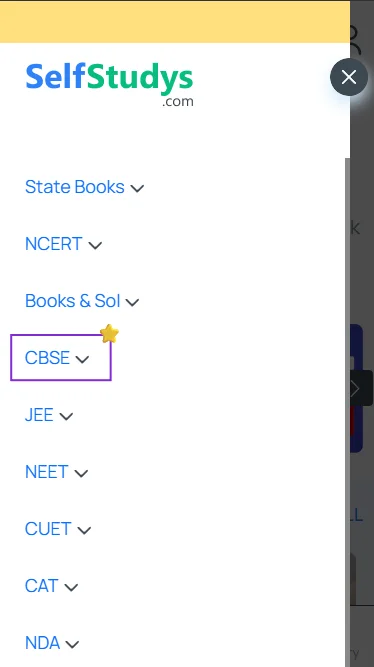
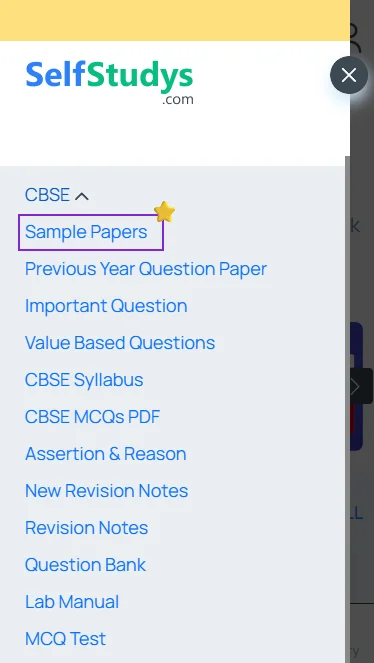
- Next, go to the menu section and click on ‘CBSE’, then ‘CBSE Sample Papers’.
- Now, you need to enter your class area, so click on the ‘10th’ button as mentioned.

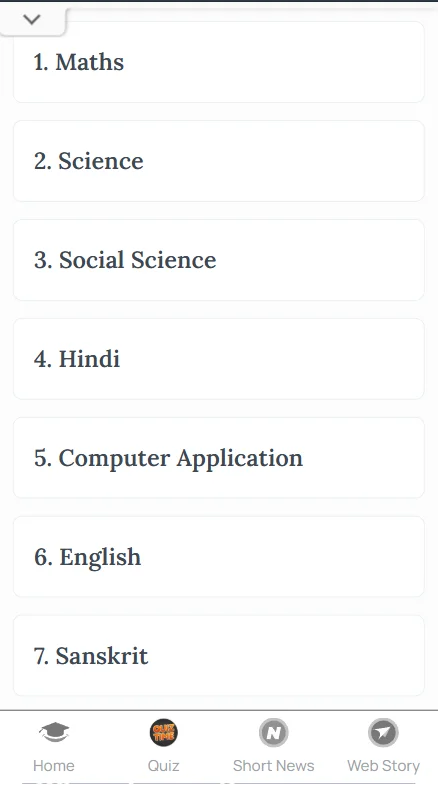
- You will see subject-wise Class 10 sample papers; find the specific subject from the list and click on that.
-
Now, you will see a complete list of CBSE Class 10 Sanskrit SQPs; choose any one and click on that link to access the PDF.
-
You can view the CBSE Sanskrit sample paper Class 10 online, or you can click on the ‘Download PDF’ button to store them for offline study.
How to Prepare for CBSE Class 10 Sanskrit Exam
CBSE Class 10 Sanskrit is usually considered one of the highest-scoring subjects, but it depends on how well a student prepares for it. Many students start their preparation by understanding the Class 10 Sanskrit Syllabus, studying the chapters, and practising textbook questions. These are important steps in the initial stage, but when you have about 3 months left for the exam preparation, you need to start section-wise preparation.
The CBSE Class 10 Sanskrit paper is divided into four sections: Unseen Comprehension, Writing Skills, Grammar, and Textbook-Based Questions. You should prepare for each of these sections separately and then combine them through Sanskrit CBSE Class 10 sample paper practice.
1. Start with Grammar (व्याकरण)
The grammar portion carries a total of 25 marks; it holds significant weightage and directly impacts multiple sections of the question paper. Many teachers and students have emphasised that scoring higher in Sanskrit largely depends on how strong your grammar fundamentals are. Topics such as सन्धि, समास, प्रत्यय, अव्यय, etc., are important. Ideally, you should revise one grammar topic daily. Also, create rule-based notes, practise 10–15 questions from each topic, and keep a separate notebook of common mistakes to track and correct them.
2. Strengthen Your Vocabulary
A strong grip on Sanskrit vocabulary will help you in अपठित अवबोधनम्, translation-based questions, textbook comprehension, and writing skills. You should maintain a chapter-wise शब्दार्थ notebook, revise new or challenging words weekly, and learn the most common Sanskrit verbs and expressions. Plus, practise recognising meanings from the context.
3. Complete All Chapters from शेमुषी
You should avoid preparing for only particular chapters because all of them are important. Instead of investing time in finding the important Sanskrit chapters for Class 10, focus on the story summary, important events, character traits, moral values, important extracts, and question-answer patterns for every lesson. If you have the latest NCERT textbooks, you will notice many questions are now extract-based rather than recall-based questions.
4. Practise अपठित अवबोधनम् Regularly
The unseen passage (अपठित अवबोधनम्) carries a total of 10 marks and can be very scoring. Therefore, use this strategy: read the questions before reading the passage and underline important words. Look for answers directly in the given passage. Avoid translating the entire passage. You may find it challenging initially, but regular practice will improve your speed, accuracy, and confidence in this section.
5. Prepare for Writing Skills Separately
You can get a maximum of 15 marks for writing skills. Some of the most important topics you should pay attention to are पत्र लेखनम्, संवाद पूर्ति, चित्रवर्णनम्, अनुच्छेद लेखनम्, and सूचना लेखनम्. An effective preparation strategy for this section is to memorise formats, practise one writing task every week, focus on grammatical accuracy, and learn common sentence patterns.
6. Follow a Weekly Revision Plan
Revision is non-negotiable. Create your personalised revision plan or follow this one:
|
Day |
Focus Area |
|
Monday |
Grammar |
|
Tuesday |
Literature Chapters |
|
Wednesday |
Unseen Passages |
|
Thursday |
Grammar Practice |
|
Friday |
Writing Skills |
|
Saturday |
Extract-Based Questions |
|
Sunday |
Revision & Test |
7. Solve CBSE Sanskrit Sample Paper Class 10 2027
After finishing the syllabus, start solving the Sanskrit CBSE Class 10 sample paper. Practise them while following the official time limit. After every attempt, review your answers using the marking scheme (expert-created solutions) and track your repeated mistakes. One of the most important contributions of SQPs to your exam preparation is that they help you improve your exam temperament and time management.
Methods to Solve Competency-Based Questions in CBSE Sanskrit Sample Paper Class 10
You cannot rely on memorised answers to solve competency-based questions. In the Class 10 Sanskrit CBSE sample paper, you need to understand, interpret, analyse, and apply concepts to solve these questions. You may encounter this question type in unseen passages, textbook extracts, grammar sections, and writing tasks. Since memorised answers cannot help you with this type of question, here are some proven methods to answer them:
-
Understand the meaning before looking for the answers: Competency-based questions often require interpretation. Instead of asking, "What is the answer from the textbook?", ask, "What is the passage trying to convey?"
-
Follow the context-question-answer method for extract-based questions: Step 1: Read the entire extract in the CBSE Class 10 Sanskrit sample paper with solution carefully. Step 2: Figure out the speaker, situation, main idea, and important keywords. Step 3: Read the question thoroughly. Step 4: Answer using the specific context of the extract. This systematic approach significantly reduces mistakes in गद्यांश and पद्यांश questions.
-
Explain the underlying reasoning: CBSE frequently asks questions that test reasoning. For example: बालकः गुरुम् आदरं करोति। किमर्थम्? Instead of simply repeating the sentence, directly explain the reason: गुरुः ज्ञानं ददाति, अतः बालकः गुरुम् आदरं करोति। To answer such questions in the CBSE Class 10 Sanskrit sample papers PDF free, always think: Why? How? What happened because of this?
-
Connect Sanskrit lessons with daily life: Some questions in the CBSE Class 10 Sanskrit sample paper 2027 PDFs download may connect the chapters to real-world scenarios. For example: अस्माकं जीवने सत्यस्य महत्त्वं कथम्? To answer this question, you should explain the practical importance of truthfulness rather than reproducing a line verbatim from the textbook.
-
Use the 'Keyword Method': When answering competency-based questions in the CBSE Sanskrit sample papers Class 10 2026-27, apply the 'Keyword Method'. In this method, you need to find the important keyword in the question, identify the relevant idea from the text, and write a concise answer around that particular idea. This method keeps your answers focused and prevents you from writing unnecessary sentences.
Note: There are several methods you can implement to master competency-based questions. Regular practice with CBSE Sanskrit sample paper Class 10 2027 alongside guidance from a teacher can help you learn more helpful ways to solve competency-based questions in Sanskrit.
Conclusion
The CBSE Class 10 Sanskrit SQPs are the ultimate practice material for board exam preparation. Beyond knowing what the board question paper will look like, you can self-assess your preparation and find weak areas to improve. In fact, regular practice with these sample papers under exam-like conditions improves your grammar accuracy, comprehension skills, writing ability, and confidence in handling competency-based questions in Sanskrit. To maximise the benefits, it is important to start solving the sample papers after completing a major portion of the prescribed syllabus. For each attempt, analyse your performance using the provided solutions, and revise the topics that need improvement. Along with consistent revision of grammar, vocabulary, textbook chapters, and writing skills, sample paper practice can help you develop the speed and exam temperament required to perform well. Make this resource a regular part of your preparation strategy and be prepared to achieve above 80–90% marks in the board examination.
Common mistakes include incorrect सन्धि identification, errors in समास formation, wrong verb forms, gender and number agreement mistakes and confusion in वाच्य परिवर्तन. Regular revision and practice with CBSE Class 10 Sanskrit SQPs can help students avoid these errors.
The grammar and unseen comprehension sections are often considered scoring because many questions are objective or rule-based. However, performance depends on how thoroughly students have revised the syllabus and practised the CBSE Sanskrit Sample Paper Class 10 2027.
Yes, competency-based questions may be included in the CBSE Class 10 Sanskrit Sample Papers PDF. To answer them effectively, students should focus on understanding concepts and applying their knowledge instead of memorising answers.
The CBSE Class 10 Sanskrit Sample Paper With Solution introduces students to different passage styles and question formats. Regular practice can improve vocabulary, contextual understanding, answer-extraction skills and time management. Students should focus on identifying relevant keywords directly from the passage.
Students should revise important Sanskrit grammar topics such as सन्धि, समास, प्रत्यय, अव्यय, वाच्य परिवर्तन, समय लेखन and अशुद्धि संशोधन. These topics commonly appear in the grammar section of the Sanskrit CBSE Class 10 Sample Paper.
Students should focus on understanding the meaning of sentences rather than memorising translations. They should revise basic Sanskrit vocabulary, understand sentence structure, practise translating short passages and review commonly used words from the prescribed textbook.


 Home
Home
 Quiz
Quiz
 Short News
 Web Story
 Get latest Exam Updates