


 Sign in


 Profile
 Signout

 Join Whatsapp For Exclusive Content
 Join Telegram For Exclusive Content

The AP Board 12th Sanskrit syllabus 2026-27 is the official outline that is prescribed by the Board of Intermediate Education, Andhra Pradesh (BIEAP). It has everything you need to study in this particular subject, like units and topics on which board exam questions are based. By going through the AP Board Class 12th Syllabus before the classes start, you will be able to plan your time across all units rather than spending too long on a few chapters and rushing through the rest. Moreover, it is just as useful during your revision phase, as you can use it as a checklist to make sure that you don’t leave any topic. You can also practise with the AP Board Class 12 Model Papers 2026-27 to understand the exam pattern and improve your preparation. On this page, you can download the PDF for the syllabus completely free of cost.
Highlights Of The AP Inter 2nd Year Sanskrit 2026-27 Syllabus
With the help of the table below, you will get a quick overview of this AP Board Class 12th Study Material.
|
PARTICULARS |
DETAILS |
|
Board |
Board of Intermediate Education, Andhra Pradesh (BIEAP) |
|
Class |
12 (Intermediate 2nd Year) |
|
Resource |
AP Inter 2nd Year Sanskrit 2026-27 syllabus |
|
What it Includes |
Unit-wise list of topics prescribed for the board exam |
|
Format |
|
|
Cost |
Free |
|
How to Download |
Log in or sign up on the SelfStudys website |
Unit-Wise AP Intermediate Sanskrit Syllabus 2026-27
The following table lists out the units included in the AP Intermediate Sanskrit syllabus 2026-27 along with their primary areas of study. The order of the units listed in the following table is the same order in which the units are presented in the syllabus, which is generally in accordance with the order of the chapters in your book. Make sure to study the units thoroughly before beginning with them.
|
Section |
Topics Covered |
How to Study It |
|
Poetry (Padyabhagah) |
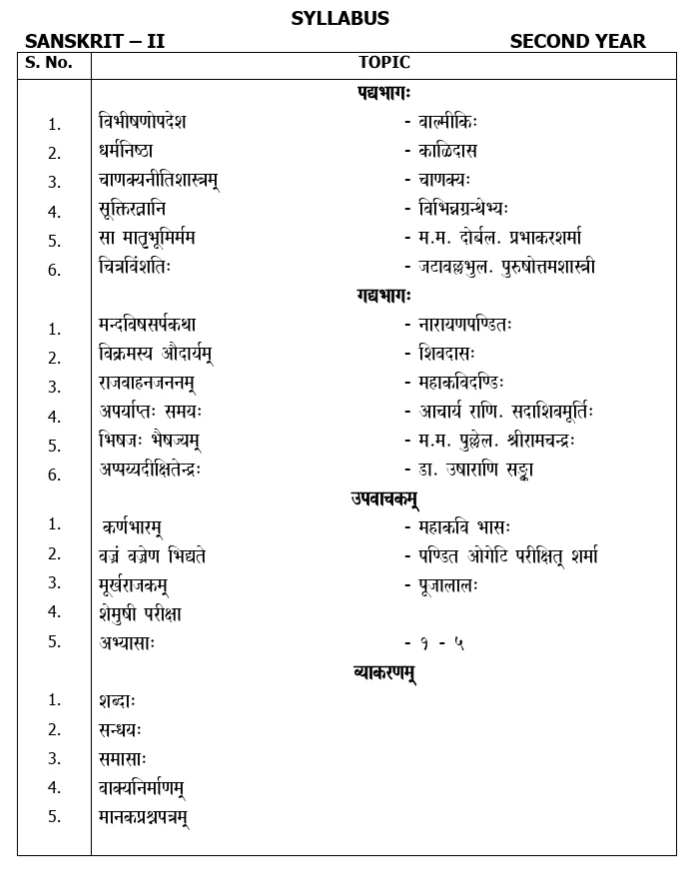
Vibhishanopadeshah (Vibhishana’s Advice) by Valmiki; Dharmanishtha (Devotion to Duty) by Kalidasa; Chanakya Nitishastram (Chanakya’s Principles of Conduct) by Chanakya; Suktiratnani (Gems of Wise Sayings); Sa Matribhumirmama (That Is My Motherland) by Dorbala Prabhakara Sharma; Chitravimshatih (Twenty Pictures) by Jatavallabhula Purushottama Shastri |
Learn the important shlokas along with their meanings and practise translation of each shloka line by line. Know the poet and source of each lesson. |
|
Prose (Gadyabhagah) |
Mandavisha Sarpa Katha (The Story of the Snake Mandavisha); Vikramasya Audaryam (The Generosity of Vikrama); Rajavahana Jananam (The Birth of Rajavahana); Aparyaptah Samayah (Not Enough Time); Bhishajah Bhaishajyam (The Physician’s Remedy); Appayya Dikshitendrah (Appayya Dikshita) |
Read each lesson along with its translation. Then, you should make a short summary. Practise answering simple questions in Sanskrit. |
|
Supplementary Reader (Upavachakam) |
Karnabharam (Karna’s Burden) by Bhasa; Vajram Vajrena Bhidyate (Diamond Cuts Diamond); Murkharajakam (The Kingdom of Fools); Shemushi Pariksha (A Test of Wisdom) |
You have to know the stories of each lesson along with their main characters and moral values. |
|
Grammar (Vyakaranam) |
Word forms (shabdah), sandhi, samasa, and sentence formation |
You should practise shabd roop and sandhi rules regularly because almost all questions are based on these. Also, make sure to practise forming sentences. |
Timeline To Complete The AP Board Class 12th Sanskrit 2026-27 Syllabus
You can easily finish the AP Board Class 12th Sanskrit 2026-27 syllabus when you divide the year into phases. In this section, we have mentioned a timeline that you can follow from the start of your academic year till the board exams.
Phase 1: The First Three Months (June to August)
In order to know every unit that you have to cover, you should go through the entire syllabus once. Then, you may start studying in the sequence your teacher teaches in class. It is advised that you aim to finish about a third of the syllabus in this phase, as well as solve questions for every unit that is taught.
Phase 2: The Middle of the Year (September to November)
Now, you should continue with the next set of units and aim to cover about two-thirds of the AP Board 12th Class Sanskrit 2026-27 syllabus. This needs to be done by the end of November month. You should revise the units that you have already covered before any quarterly or half-yearly exams. Additionally, during this time, you can mark the units that you find difficult so that you can give them extra time later.
Phase 3: Completing The Syllabus (December to January)
You have to finish the remaining units by the end of January at the latest. Make sure that you don’t leave any unit for the final month, as you need to dedicate the last few weeks to revision and not to learning anything new.
Phase 4: Revision (February till the Exam)
You can use the AP Inter 2nd Year Sanskrit syllabus PDF 2026-27 as a checklist in this phase and tick off the units that you revise. Also, you have to start with the topics that you marked as difficult and then move to the rest. This is a great time to solve the AP Inter 2nd Year Previous Question Papers as well as model papers under exam conditions.
Conclusion
With the help of the syllabus, you get a clear picture of the whole year in one place. You will learn what each unit covers, how to study it, as well as when you should finish it. Our experts recommend that you keep the PDF with you throughout the year and come back to the unit-wise table when you start a new one or begin your revision. You can only walk into the board exam fully prepared if you complete the syllabus early and leave time for at least two revisions.




 Get latest Exam Updates