


 Sign in


 Profile
 Signout

Many students find it difficult to go through every important concept, formula, or key point again and again. This is where you should use SelfStudys’ JEE Main one page notes 2027. They include important information from a topic or a chapter in a quick-to-revise format. Here, you can access these latest notes for Physics, Chemistry, and Maths. We organize them subject-wise as well as chapter-wise so that you can easily find the topics that you want to revise.
Moreover, you can use the one page notes for JEE Main to recall the important formulas, concepts, definitions, reactions, and other essential points quickly rather than going through lengthy study material every time. You can even study these notes while you are preparing for the JEE Main Mock Test, regular revision sessions, the final stages of preparation, and so on.
Highlights Of The One Page Notes For JEE Main
In the table mentioned below, you can find all the important highlights of this resource easily.
|
FEATURE |
DETAILS |
|
Name of the Resource |
JEE one page notes |
|
Subjects Covered |
|
|
Format |
PDF: Portable Document Format |
|
Availability |
The JEE one page notes PDF is free to access and download. |
|
Organization |
Subject-wise and chapter-wise |
|
Main Purpose |
Quick revision of important concepts and topics. |
|
Content |
Important formulas, concepts, definitions, reactions, and key points. |
|
Best For |
JEE Main 2027 aspirants |
|
Useful During |
Regular revision, JEE Main Previous Year Question Paper practice, mock test preparation, and final revision. |
|
Recommended Use |
The JEE one page notes PDF free download should be used after studying the chapter in detail and practicing JEE Mains Important Questions. |
|
Exam Relevance |
They are designed to support revision for JEE Main preparation. |
Subject-Wise JEE One Page Notes
Your preparation strategy for each subject in the JEE exam is different. Therefore, by using the IIT JEE one page notes, you will be able to make your revision more focused. On our platform, they are arranged as per the three main subjects, which are Physics, Chemistry, and Maths. You can select the notes for the chapter that you have studied and use them as a reference during your preparation. In this way, you can revisit the most important information without searching through multiple pages of the books.
| Sr No. | JEE One Page Notes Subject-wise |
| 1 | JEE Physics One Page Notes |
| 2 | JEE Chemistry One Page Notes |
| 3 | JEE Maths One Page Notes |
Physics JEE One Page Notes PDF
For this subject, you have to understand the concepts as well as remember the relationships and formulas that are used to solve numerical or conceptual questions. The single page notes JEE Main for Physics provide you with chapter-specific revision material. You can refer to it after completing the detailed study and question practice.
Units and Measurements JEE One Page Notes PDF Free Download
The one sheet notes JEE Main on Units and Measurements give you a compact reference for revising the fundamental measurement-related concepts of Physics. This resource brings important definitions, formulas, measurement principles, dimensional relationships, JEE Main-focused areas, and so on together for proper revision.
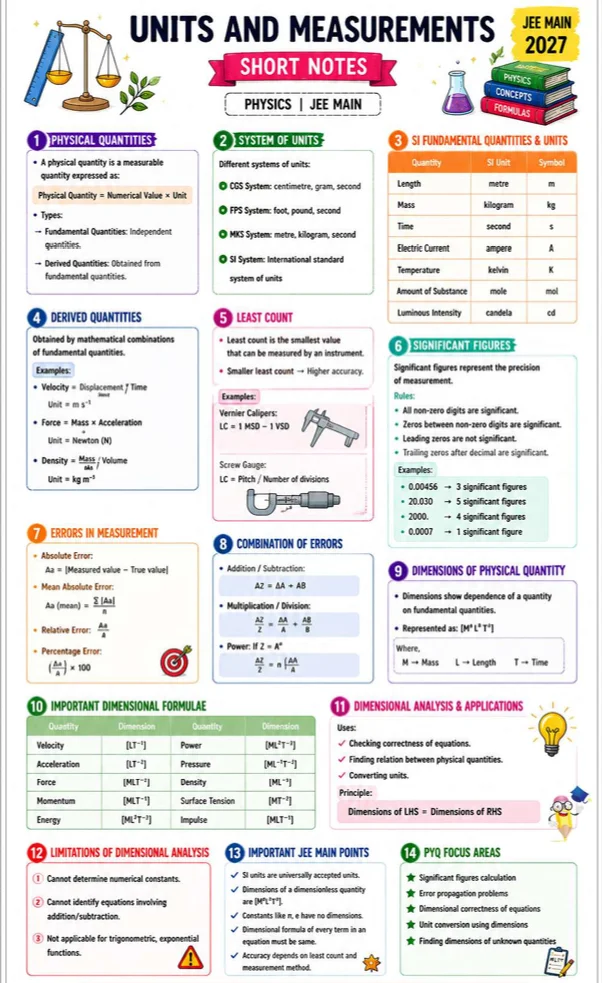
Here is the key information covered in these notes.
|
Topic |
Key Information |
|
Physical Quantities and Units |
Physical quantity = Numerical Value × Unit. The SI base quantities include length (m), mass (kg), time (s), electric current (A), temperature (K), amount of substance (mol), and luminous intensity (cd). |
|
Measuring Instruments |
Vernier calipers: LC = 1 MSD − 1 VSD. Screw gauge: LC = Pitch / Number of divisions. Least count represents the smallest measurement that an instrument can measure. |
|
Errors |
Percentage error = Relative error × 100. For addition/subtraction, absolute errors are combined; for multiplication/division, relative errors are combined. |
|
Important Dimensions |
Velocity = [LT⁻¹], acceleration = [LT⁻²], force = [MLT⁻²], energy = [ML²T⁻²], power = [ML²T⁻³], pressure = [ML⁻¹T⁻²]. |
|
Dimensional Analysis |
Used for checking dimensional consistency, deriving relationships, and converting units. It cannot determine numerical constants or handle equations involving functions such as trigonometric, exponential, or logarithmic terms directly. |
Properties of Solids and Liquids IIT JEE One Page Notes
The properties of Solids and Liquids JEE Main one page notes 2027 provide you with important laws, relationships, as well as formulas that are associated with elasticity, fluids, surface tension, thermal properties, etc. If you wish to refresh the key concepts before solving questions, you can revise these notes after completing the chapter.
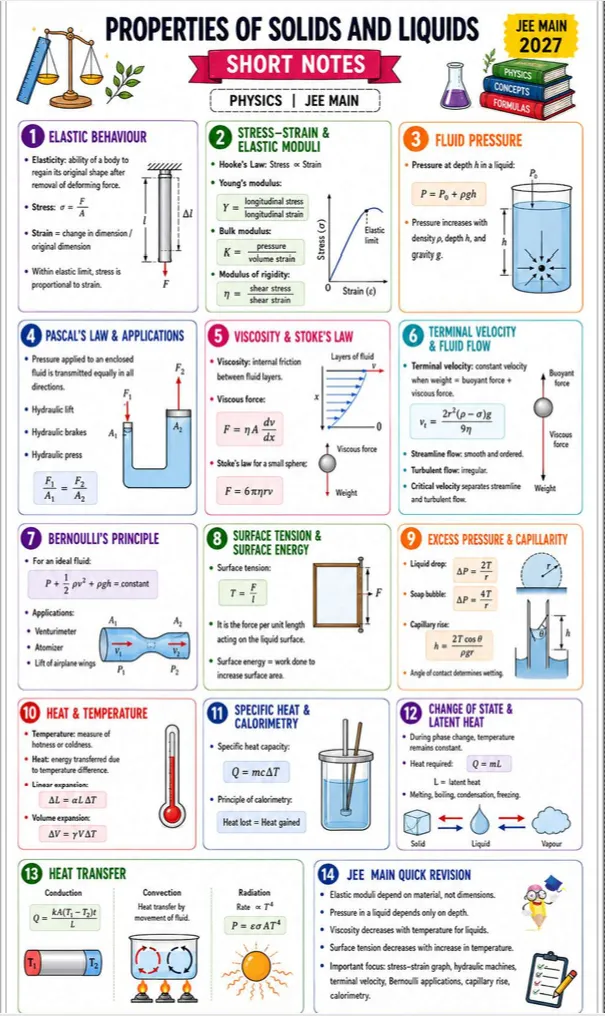
You can find the important concepts and formulas in the table below.
|
Topic |
Important notes, formulas, and points |
|
Stress, Strain & Elasticity |
Stress = Force / Area, and strain = Change in dimension / Original dimension. Within the elastic limit, stress is proportional to strain according to Hooke's law. |
|
Elastic Moduli |
Young's modulus = Longitudinal stress / Longitudinal strain. Bulk modulus and modulus of rigidity describe the response of a material to volume and shape deformation, respectively. |
|
Fluid Pressure & Viscosity |
Pressure at depth h: P = ρgh. Stokes' law gives viscous force as F = 6πηrv for a small sphere moving through a viscous fluid. |
|
Bernoulli & Fluid Flow |
Bernoulli's principle relates pressure, kinetic energy, and potential energy per unit volume. It is applied to systems such as venturimeters and atomizers. |
|
Surface Tension & Capillarity |
Surface tension is force per unit length along a liquid surface. Excess pressure occurs across curved surfaces, while capillary rise or fall depends on surface tension, contact angle, density, gravity, and capillary radius. |
|
Heat & Calorimetry |
Thermal expansion includes linear and volume expansion. In calorimetry, the basic principle is heat lost = heat gained. Latent heat is involved in a change of state without a temperature change. |
Chemistry Single Page Notes JEE Main
The one page notes for JEE Main Chemistry have important concepts, equations, principles, and relationships in one place. You can use them to solidify all the material that you studied before practicing questions.
One Sheet Notes JEE Main For Atomic Structure
With the JEE one page notes on Atomic Structure, you will understand the development of atomic theory as well as the concepts that are used to describe the behaviour and arrangement of electrons.
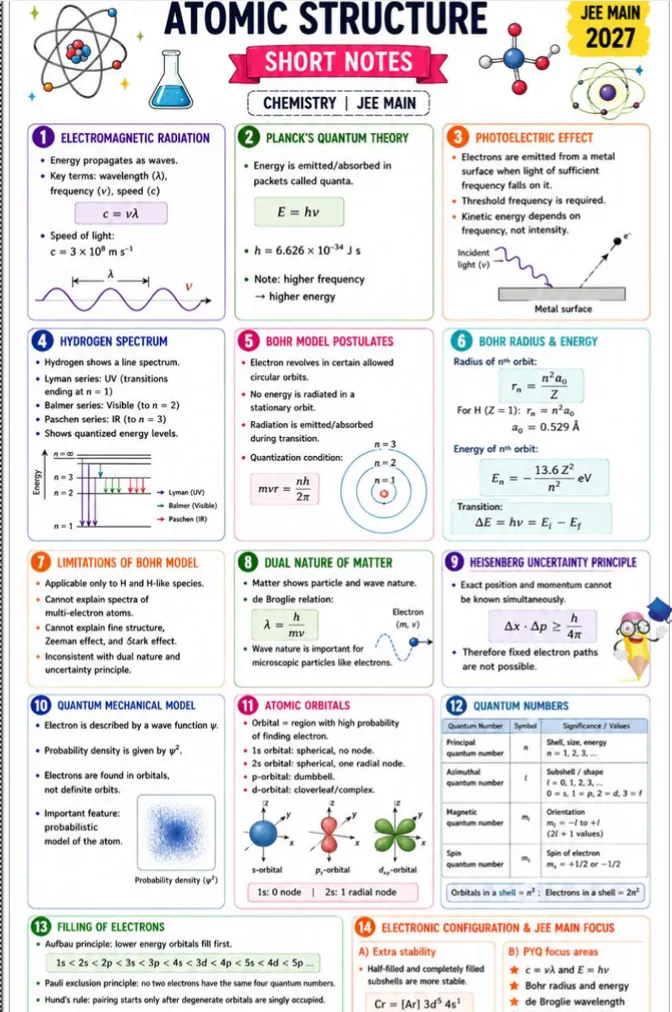
Important concepts and formulae.
|
Topic |
Important notes, formulas, and points |
|
Electromagnetic Radiation |
The relationship between speed, wavelength, and frequency is c = νλ, where c is the speed of light, ν is frequency, and λ is wavelength. |
|
Planck & Photoelectric Effect |
Planck's quantum theory gives E = hν for the energy of a quantum. In the photoelectric effect, electrons are emitted when incident radiation has a frequency above the threshold frequency. |
|
Hydrogen Spectrum & Bohr Model |
Hydrogen produces a line spectrum due to transitions between quantised energy levels. The Bohr model explains permitted stationary orbits and the emission or absorption of energy during transitions. |
|
Dual Nature & Uncertainty |
The de Broglie relation is λ = h/p. The Heisenberg principle states that position and momentum cannot both be determined with unlimited precision simultaneously. |
|
Quantum Numbers |
The four quantum numbers are principal (n), azimuthal (l), magnetic (m), and spin (s). They describe the state and characteristics of an electron in an atom. |
|
Electronic Configuration |
Electron distribution follows the Aufbau principle, Pauli exclusion principle, and Hund's rule. Half-filled and completely filled subshells have additional stability; Cr and Cu are important exceptional configurations. |
Equilibrium JEE Main One Page Notes 2027
The Equilibrium JEE one page notes PDF gives you a concise revision reference for the principles and relationships that are involved in physical, chemical, and ionic equilibrium. The notes connect the equilibrium constants with acid-base equilibria, pH buffers, solubility, changes in equilibrium conditions, and so on.
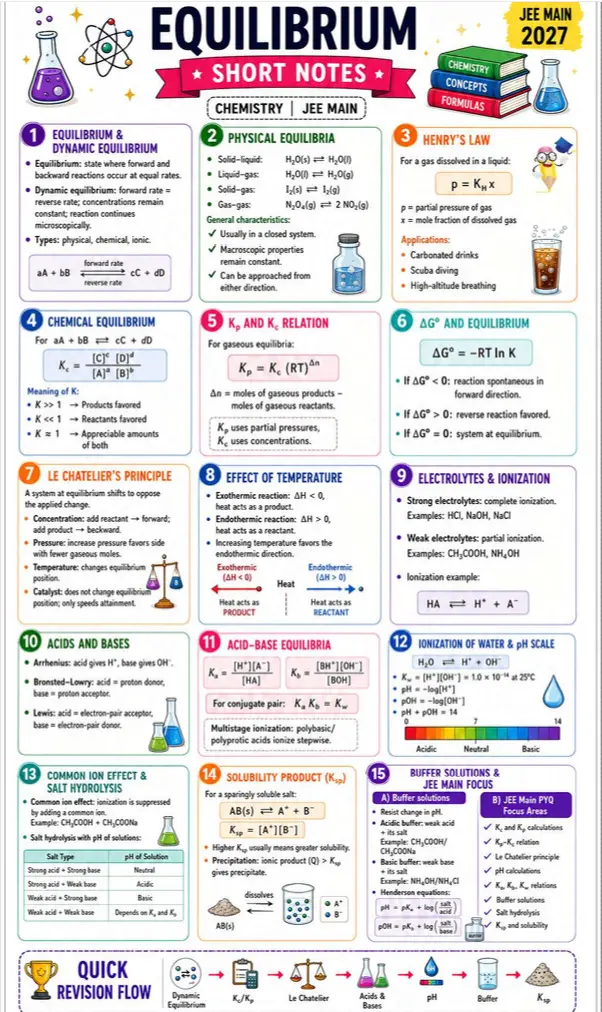
Important concepts and formulae are explained further in the table below.
|
Topic |
Important notes, formulas, and points |
|
Chemical Equilibrium |
At dynamic equilibrium, forward and reverse reactions continue at equal rates. The equilibrium constant Kc relates equilibrium concentrations of products and reactants, while Kp is used for gaseous equilibria. |
|
Le Chatelier's Principle |
A change in concentration, pressure, or temperature causes an equilibrium system to shift in a direction that tends to oppose the imposed change. A catalyst changes the rate of reaching equilibrium but does not change the equilibrium position. |
|
Acids, Bases & Ionisation |
Arrhenius, Brønsted-Lowry, and Lewis theories describe acids and bases. Acid-base equilibria involve Ka and Kb, with their relationship to Kw. |
|
pH & Water Ionisation |
Water has an ionic product represented by Kw. The pH scale expresses hydrogen-ion concentration; acidic, neutral, and basic solutions are distinguished by their pH values. |
|
Common Ion & Solubility |
The common-ion effect suppresses the ionisation of a weak electrolyte. Ksp is used for sparingly soluble salts and helps determine whether precipitation can occur. |
|
Buffers & Salt Hydrolysis |
Buffer solutions resist changes in pH. Salt hydrolysis explains the interaction of salt ions with water and helps determine the acidic, basic, or neutral nature of the resulting solution. |
Maths One Page Notes For JEE Main
Maths is a subject for which you have to revise the formulas, identities, properties, standard results, concepts, and so on on a regular basis along with continuous solving of the problems. The Maths JEE one page notes PDF free download provides you with chapter-wise revision material. You can use them to revise important mathematical information before solving questions, PYQs, or mock tests.
Sets, Relations, and Functions JEE One Page Notes
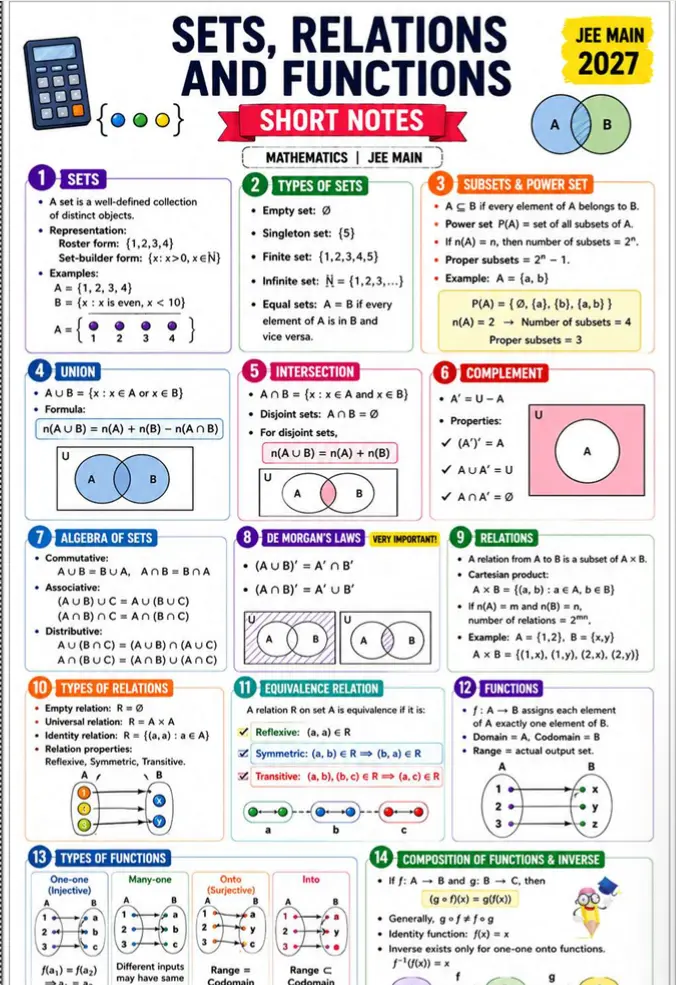
The IIT JEE one page notes on Sets, Relations, and Functions include all the important concepts and results from this chapter. You can use this sheet to refresh the basic definitions, set operations, relation properties, function concepts, and so on before moving on to problem-solving.
|
Topic |
Important notes, formulas, and points |
|
Sets & Subsets |
A set is a well-defined collection of distinct objects. If a set has n elements, the number of subsets is 2^n, while the number of proper subsets is 2^n − 1. |
|
Union & Intersection |
For finite sets, n(A ∪ B) = n(A) + n(B) − n(A ∩ B). Also, A ∪ A' = U and A ∩ A' = ∅. |
|
De Morgan's Laws |
The important results are (A ∪ B)' = A' ∩ B' and (A ∩ B)' = A' ∪ B'. |
|
Relations |
A relation from set A to set B is a subset of A × B. Important properties include reflexive, symmetric, and transitive relations. |
|
Equivalence Relation |
A relation is an equivalence relation when it satisfies all three conditions: reflexive, symmetric, and transitive |
|
Functions |
A function assigns exactly one element of the codomain to every element of the domain. Important types include one-one, many-one, into, and onto functions. |
|
Composition & Inverse |
Function composition is represented by (f o g)(x) = f(g(x)). An inverse function requires the appropriate one-to-one correspondence between domain and range. |
|
JEE Main Focus Areas |
Important areas for practice include number of subsets, power sets, set operations, De Morgan's laws, number and types of relations, equivalence relations, domain and range, one-one/onto functions, and composition of functions. |
Permutations and Combinations JEE One Page Notes PDF
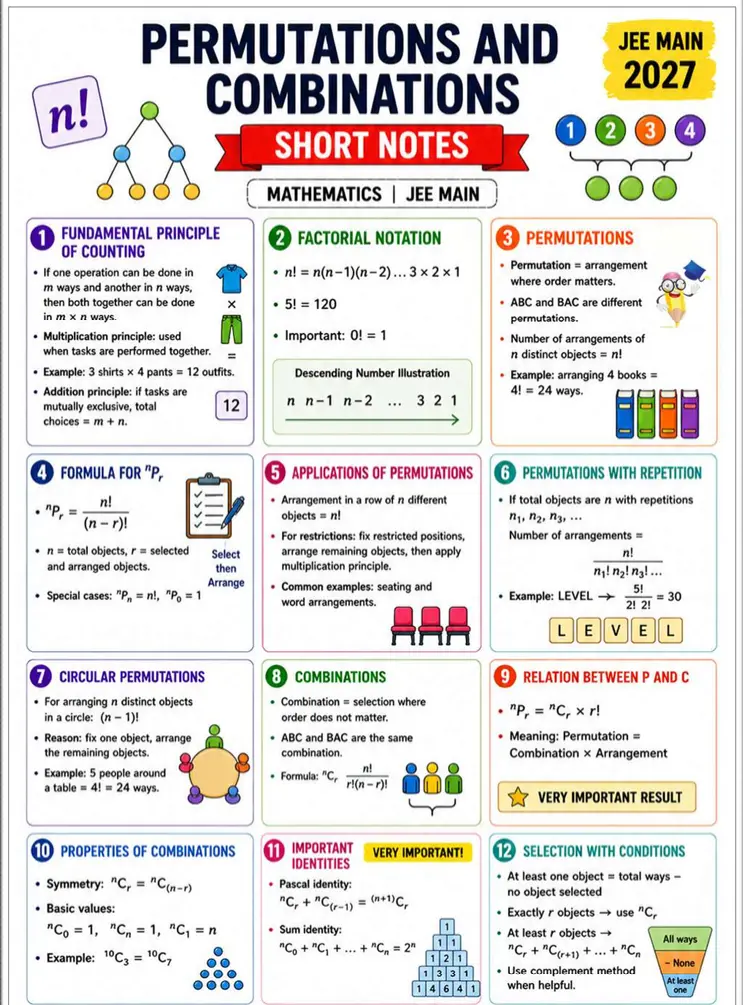
The Permutations and Combinations single page notes JEE Main will help you understand the counting methods and solve arrangement as well as selection-based problems. The one-page format of these notes is quite useful before you attempt any JEE Main PYQs or mock tests.
|
Topic |
Important notes, formulas, and points |
|
Counting Principle & Factorial |
For successive tasks with m and n possible ways, total ways = m × n; for mutually exclusive choices, total ways = m + n. Also, n! = n(n − 1)...2 × 1 and 0! = 1. |
|
Permutations |
A permutation is an arrangement where order matters. nPr = n! / (n − r)!, with nPn = n! and nP0 = 1. |
|
Repeated & Circular Arrangements |
For repeated objects, arrangements are counted using n! / (n1! × n2! × n3! ...). For n distinct objects arranged in a circle, the number of arrangements is (n − 1)!. |
|
Combinations |
A combination is a selection where order does not matter. nCr = n! / [r! × (n − r)!] and nPr = nCr × r!. |
|
Important Identities |
nCr = nC(n − r), nC0 = nCn = 1, nC1 = n, and nCr + nC(r − 1) = (n + 1)Cr. Also, the sum of all combinations is 2^n. |
|
Conditional Selection |
Problems involving “at least,” “exactly,” or “at most” can be solved by counting the required cases or using the complement method: Total ways − unwanted ways. |
|
Permutation vs Combination |
Permutation → arrangement → order matters → nPr. Combination → selection → order does not matter → nCr. A useful check is: Does changing the order create a different outcome? |
|
JEE Main Focus |
Focus on counting principles, repeated objects, circular arrangements, restricted arrangements, word problems, complementary selection, and applications of nPr and nCr. |
How To Get The JEE One Page Notes PDF Free Download?
The process to access and utilize the one sheet notes JEE Main from our platform is mentioned in detail below.
-
First, you have to open a web browser on your device and type www.selfstudys.com in the address bar.

-
Once the website is open, you can click on the ‘Navigation’ tab and select the ‘JEE’ section from the menu.

-
This section will further showcase a list from which you can tap on the ‘JEE one page notes’ option.

-
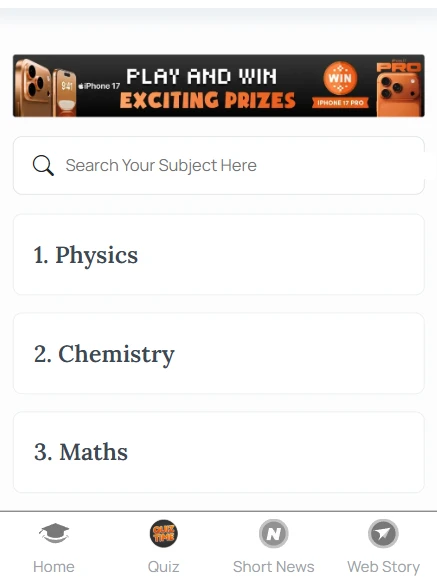
A new web page will load up where you can access the subjects for the JEE Main one page notes 2027.
-
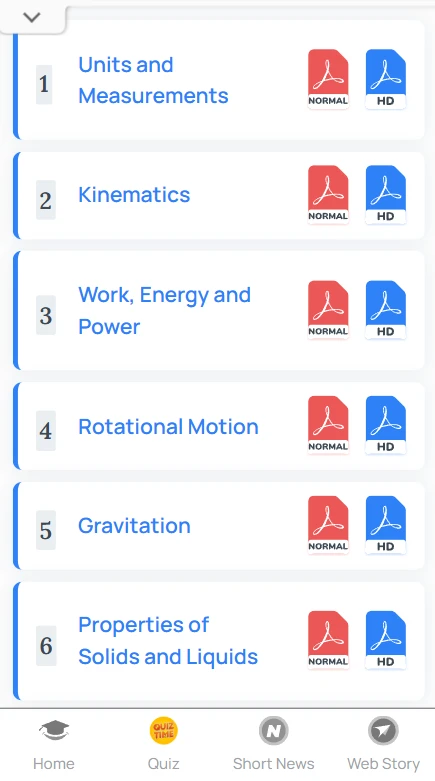
You need to click on any subject to get the chapter-wise one page notes for JEE Main.
-
Finally, you can choose any chapter and start studying its JEE one page notes PDF. You can even download it by clicking on the ‘Download PDF’ button.
Note: At SelfStudys, the JEE one page notes PDF free download is only possible after a Google Log In or Sign Up.
Benefits Of The IIT JEE One Page Notes
With the help of the IIT JEE one page notes, you can make your learning process more manageable. This is because they have all the important information of a chapter in a compact form. They are quite useful when you have already studied a chapter and want to refresh the key points before solving the questions. Some more benefits of this resource are mentioned in detail below.
-
A number of students waste their time on deciding what to study from a lengthy chapter during revision. But with our chapter-wise single page notes JEE Main, you can select the chapter you wish to revise directly. For example, if you have completed the Units and Measurements in Physics, then you can revise its points without going through the complete study material.
-
It is quite important to remember the correct formulas for solving the questions in an efficient manner for subjects like Maths and Physics. So, before you start your practice session, you can review the relevant formulas as well as relationships with the one sheet notes JEE Main.
-
In the Chemistry subject, you will find different kinds of information like concepts, equations, reactions, properties, principles, relationships, and so on. For this, the JEE Main one page notes 2027 can help you revisit such information quickly rather than searching through multiple pages again and again.
-
Before you solve the previous year questions, you can use the one page notes for JEE Main to go through the concepts and formulas for each chapter. This way, you can enhance your skills between learning and question practice. After solving them, you may return to these notes to find a formula or concept that you need to revise more.
-
When you are in the final stages of your exam preparation, you need to revise instead of learning every chapter from the beginning. Therefore, the JEE one page notes become a convenient revision tool to go through essential points across Physics, Chemistry, and Maths.
Single Page Notes JEE Main Vs. Detailed JEE Study Material
The JEE one page notes PDF as well as detailed study material both play an important role when you are preparing for the Joint Entrance Examination. But you need to remember that they both serve different purposes. Here, we have explained their differences for your reference.
|
Basis |
One Page Notes |
Detailed Study Material |
|
Main Purpose |
You can use the JEE one page notes PDF free download for quick revision of important information. |
They are good for in-depth learning as well as understanding of the concepts. |
|
Content |
In the notes, you will find key concepts, formulas, reactions, identities, essential points, etc. |
It includes detailed explanations, examples, derivations, and concepts. |
|
Best Used |
The IIT JEE one page notes are great to use after completing a chapter. |
You can use the detailed study material while you are learning a chapter for the first time. |
|
Time Required |
They require quite less time to revise everything. |
They need more time for thorough study. |
|
Question Practice |
With the help of the single page notes JEE Main, you can recall information before JEE Main Sample Papers, PYQs, or mock tests. |
The detailed study material will help you build the understanding that is required to solve the questions. |
|
Final Revision |
These notes are highly convenient for quick revision. |
During your final revision, this material can be time-consuming. |
|
Role in Preparation |
The role of the one sheet notes JEE Main is for revision as well as recall. |
These are primary resources for learning. |
When Should You Revise The One Sheet Notes JEE Main?
Your revision will become more effective when you do it at the right stages of your preparation and not just during the final days. Since this exam has a vast syllabus, you can use the JEE Main one page notes 2027 at different points in your preparation and refresh the studied concepts as well as formulas. Below are some tips on when to use them properly.
-
Once you have finished a chapter from your study material, you can revise its one page notes for JEE Main. In this way, you will be able to revisit the important formulas, definitions, concepts, reactions, identities, and other key information while the chapter is still fresh in your memory. It can also help you find the topics that you need to study again before moving ahead.
-
You should go through the JEE one page notes before solving the questions from a specific chapter. With a quick review, you can refresh the formulas as well as concepts that you might need while solving the problems. This is quite useful in Physics and Maths as you need to recall the right relationships or formula in order to approach a numerical efficiently.
-
With the JEE PYQs, you can see how concepts are applied in the real examination. So, before attempting them, you can revise the JEE one page notes PDF so that you can have all the important information in your memory. Then, after solving them, you can revise the notes again if you find that you don’t remember a formula or concept.
-
You should never wait until the end of your preparation to revise the chapters. Instead, you must include the JEE one page notes PDF free download in your weekly revision routine and revise the chapters that you studied during the week. By doing so, you will be able to create a regular recall cycle as well as reduce the chances of forgetting concepts.
-
As the exam comes near, you need to increase the frequency of your revision and continue practicing the questions. With the IIT JEE one page notes, you can revise the already studied chapters quickly without spending a lot of time as you do on detailed theory. Therefore, this resource can become a very useful part of your final revision routine.
Conclusion
The single page notes JEE Main available on SelfStudys can make your revision process more focused as well as manageable. They bring the important formulas, concepts, definitions, reactions, identities, key points, etc. in a compact format. You can use them after completing a chapter, before solving PYQs, during mock test preparation, as well as in the final stages of your exam preparation. However, you should use these notes alongside other study materials and regular practice of the questions.
The primary purpose of the JEE Main one page notes 2027 is for revision rather than first-time learning. So, you should first understand the chapter through detailed study material, lectures, or textbooks. Then, you can use these notes to recall the important information.
You can revise with the JEE one page notes before you attempt the past papers. This will help you refresh the formulas, concepts, reactions, important results, and so on that are related to the chapter. By doing so, you will be able to begin your PYQ practice with relevant information.
No, the JEE one page notes PDF free download should not replace the detailed study material. The detailed resources are quite important for developing understanding of the concepts, learning derivations, studying examples, building problem-solving skills, and so on. Whereas the one-page notes are suitable for quick revision purposes.
Yes, the single page notes JEE Main are very useful when you are preparing for mock tests. This is because they allow you to revise information from several chapters quickly. After the mock test analysis, you can even return to these notes to revise the points where you made mistakes.
You can access the one sheet notes JEE Main for every subject and chapter that you wish to revise in PDF format on SelfStudys. Our experts advise that you keep your preparation aligned with the applicable syllabus for JEE Main as well as exam information that is released by NTA.


 Home
Home
 Quiz
Quiz
 Short News
 Web Story
 Get latest Exam Updates