

 Sign in


 Profile
 Signout


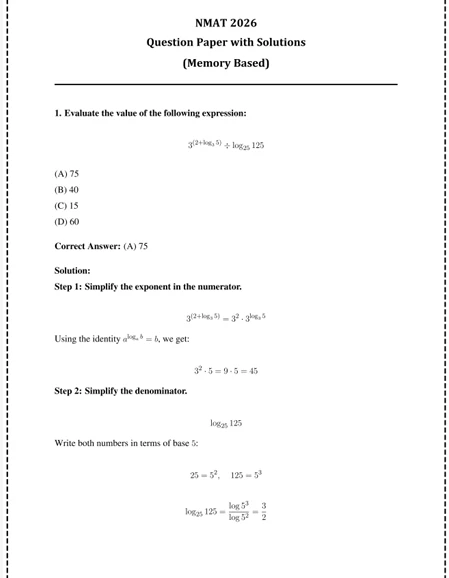
Since no two candidates take the same paper, GMAC does not release any official previous year papers. But the coaching organisations release their own memory-based NMAT previous year papers, which are available on SelfStudys. You can refer to these resources to get an idea of the exam accepted by different business schools. This will help you become confident in appearing for the exam and get admission into top MBA schools.
| Sr No. | NMAT Previous Year Papers Year-wise |
| 1 | NMAT 2026 Previous Year Paper |
| 2 | NMAT 2025 Previous Year Paper |
| 3 | NMAT 2024 Previous Year Paper |
| 4 | NMAT 2023 Previous Year Paper |
| 5 | NMAT 2022 Previous Year Paper |
NMAT Important Dates
The table below mentions the important dates you should consider for the NMIMS Management Aptitude Test.
|
Event |
From |
To |
|
Registration |
Aug 20, 2026 |
Oct 10, 2026 |
|
Scheduling |
Aug 20, 2026 |
Oct 22, 2026 |
|
Rescheduling |
Aug 20, 2026 |
Dec 17, 2026 |
|
Exam Delivery |
Nov 2, 2026 |
Dec 20, 2026 |
|
Retake - Registration |
Nov 3, 2026 |
Dec 17, 2026 |
|
Retake - Scheduling |
Nov 3, 2026 |
Dec 17, 2026 |
NMAT Exam Overview
Your scorecard is available to download within 48 hours of the exam, and you’ll be notified by email when it’s ready. Here is the important information you should know about the exam.
|
Particulars |
Details |
|
Exam |
NMIMS Management Aptitude Test (NMAT) |
|
Mode of Exam |
Online |
|
Conducting Body |
GMAC (Graduate Management Admission Council) |
|
Retakes Allowed |
3 (First Attempt + 2 Retakes) |
|
Top MBA Schools |
NMIMS and other participating business schools |
|
Total Score |
36-360 |
|
Time Allowed |
120 minutes |
|
Negative Marking |
No |
NMAT by GMAC Exam Structure
The exam is distributed across three sections, comprising 36 questions each. The difficulty level of these questions depends on how you answered the previous questions, since the exam is computer-adaptive. You can also attempt NMAT Mock Tests if you want to gain experience before appearing for the final exam. The details are mentioned in the table.
|
Section |
Total Questions |
Time Limit |
Score Range |
|
Language Skills |
36 |
28 minutes |
12-120 |
|
Quantitative Skills |
36 |
52 minutes |
12-120 |
|
Logical Reasoning |
36 |
40 minutes |
12-120 |
|
Totals |
108 |
120 minutes |
36-360 |
Note:
-
NMAT is computer-adaptive. This means that each question is chosen based on your answers to the previous ones, and your final score is a scaled score based on your overall ability level, not a fixed number of marks per question.
-
The questions you solve in the exam are randomly selected from a pool of questions. Additionally, you can choose the order of sections before beginning the exam.
Important Topics Based on NMAT PYQs
While the syllabus for the NMAT exam is much wider, here are the important topics you should consider for each section. Practise multiple NMAT previous year question papers in order to become efficient at solving them.
Language Skills
The section tests your reading and writing abilities, necessary for business communication.
|
Key Areas |
Important Topics |
|
Reading Comprehension |
Main idea, supporting details, inference-based questions, tone and purpose, passage-based vocabulary, conclusions |
|
Language |
Vocabulary, synonyms and antonyms, contextual meanings, sentence completion, grammar, sentence correction |
|
Verbal Ability |
Para jumbles, sentence formation, identifying the correct sentence, usage of words and phrases |
Quantitative Skills
This section tests your speed and accuracy with numbers, data, and calculations.
|
Key Areas |
Important Topics |
|
Arithmetic |
Percentages, profit and loss, ratio and proportion, averages, simple and compound interest, time and work, time-speed-distance |
|
Algebra |
Linear equations, quadratic equations, inequalities, algebraic expressions, sequences and series |
|
Number System |
HCF and LCM, divisibility, factors and multiples, remainders, integers |
|
Geometry & Mensuration |
Lines and angles, triangles, circles, quadrilaterals, area, perimeter and volume |
|
Data Interpretation |
Tables, bar graphs, line graphs, pie charts, data comparison and calculation-based sets |
|
Data Sufficiency |
Sufficiency of statements, logical evaluation of given information |
Logical Reasoning
This section tests how well you analyse information and reach logical conclusions.
|
Key Areas |
Important Topics |
|
Analytical Reasoning |
Arrangements, seating arrangements, ranking, sequencing, and selection |
|
Logical Puzzles |
Blood relations, direction sense, coding-decoding, puzzles, and conditional reasoning |
|
Verbal Reasoning |
Statement and conclusion, statement and assumption, argument-based questions, inference |
|
Analytical Decision Making |
Identifying relationships, choosing valid conclusions, and solving structured reasoning problems |
How do NMAT Previous Year Question Papers Help in Exam Preparation?
It is always a good idea to practise some question papers before appearing in the final exams. Instead of solving some random questions, use NMAT previous year papers PDF to get an idea of the original exam. This is how they will help in preparing for the exam:
-
Understand the Type of Questions Asked: The NMAT exam usually requires you to answer multiple-choice questions. But the way they are asked may be different. Regular practice with PYQs will help you know the level of thinking required to answer them.
-
Identify Important Topics: Frequently asked concepts in the exam are considered important from an exam point of view. Learn and understand these topics well before trying to solve the related questions.
-
Improve Question-Solving Speed: The more you solve NMAT past year papers, the more your ability to answer a question quickly increases. This happens because you become familiar with the concepts and the way questions are asked in the exam.
-
Find Your Weak Areas: If you get stuck while solving a question even after several attempts, you need to practise this concept again. Refer to your reference materials and solve the questions again.
-
Learn How to Approach Different Questions: The method you adopt to answer a question depends on how it is asked. Practising NMAT PYQs will provide you with experience to solve different questions with varied approaches. This will eventually help you in the real exam.
Conclusion
SelfStudys has provided NMAT previous year papers with solutions to improve your exam preparation. This does not mean you have to solve hundreds of questions before the exam without learning anything. But if you can learn something after every attempt, it will be worth it. Compiled from memory-based questions, with solutions, these resources offer you a great advantage to experience solving exam-focused problems and improve your strategy. Identify where you are going wrong and improve your approach to solve the questions in the next attempt.
Before appearing for the exam directly, you get a chance to practise questions, understand their patterns, improve solving efficiency, identify weak areas, and assess your preparation with the past questions of the NMAT exam.
NMAT exam has three equally important sections, so it is not advisable to skip any. You should practise questions from all major sections of the NMAT previous year papers PDF free, including Language Skills, Quantitative Skills, and Logical Reasoning.
To analyse an answer after solving NMAT PYQs, check how many questions you answered correctly. Note which questions were incorrect, which took extra time, which concepts caused difficulty, and whether the mistake was due to a knowledge gap or an avoidable error.
It is better to attempt the questions given in the NMAT previous year papers independently first. You can later check the solutions to see if you have answered them appropriately. Focus on following the right approach while solving them.
Keep a performance tracker for this purpose. Finish PYQs and write the number of correct questions you attempted in each. Moreover, track your accuracy, time taken, number of questions attempted, and recurring mistakes. All of this will help you know if you are actually improving.


 Home
 Quiz
 Short News
 Web Story
 Get latest Exam Updates