


 Sign in


 Profile
 Signout


Many of them failed to qualify because of making mistakes they could have easily avoided. Today, we will be discussing JEE common mistakes 2027 to avoid and make your preparation effective.
Plus, our team has prepared separate PDFs for the JEE common mistakes for Physics, Chemistry, and Mathematics. You can access them chapter-wise here and go through them to find the common errors you need to avoid.
Subject-Wise Common Mistakes in JEE Mains
Physics, Chemistry, and Mathematics require different skills, but each subject has its own set of JEE common errors that can lead to negative marking and lost ranks. Identifying and improving these mistakes early can help you achieve both improved accuracy and better exam performance. For subject wise useful resources, the links are provided below.
| Sr No. | JEE Common Mistakes Subject-wise |
| 1 | JEE Physics Common Mistakes |
| 2 | JEE Chemistry Common Mistakes |
| 3 | JEE Maths Common Mistakes |
Physics Common Mistakes in JEE Main
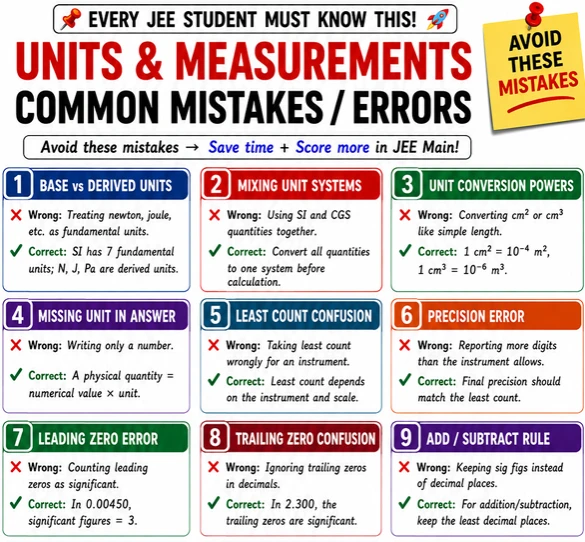
Many students memorise formulas and apply them without understanding the concepts. This often leads to choosing the wrong equation for the problem. Along with this, there are several common mistakes in JEE Main you can avoid, such as ignoring units and conversions, skipping free-body diagrams in Mechanics questions, and making sign convention mistakes (such as using a negative sign incorrectly in work, energy, current direction, velocity, etc.). During preparation, it sometimes becomes difficult to identify such mistakes in Physics, but you can use our PDF to find and rectify them.
Chemistry Common Mistakes in JEE Main
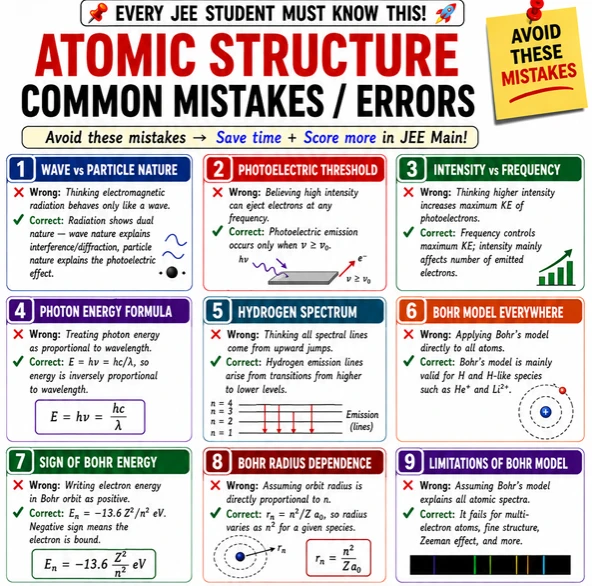
Ignoring NCERT, especially for Inorganic Chemistry, is the biggest mistake one can make in JEE Main Chemistry. No matter how many coaching notes and reference books you use for preparation, numerous Chemistry questions are directly or indirectly based on NCERT concepts and statements. Other silly mistakes in JEE include remembering reaction products without understanding why the reaction occurs. Incorrect mole conversions, molecular weight calculations, and mole-ratio assumptions are also major reasons for mistakes in Physical Chemistry.
Furthermore, this subject has lots of exceptions and special cases; many candidates who rely only on memorising general rules get trapped by exception-based questions in Inorganic Chemistry. You can browse our how to avoid silly mistakes in JEE Main PDF for Chemistry to find and prevent yourself from making them.
Mathematics Common Mistakes in JEE Main
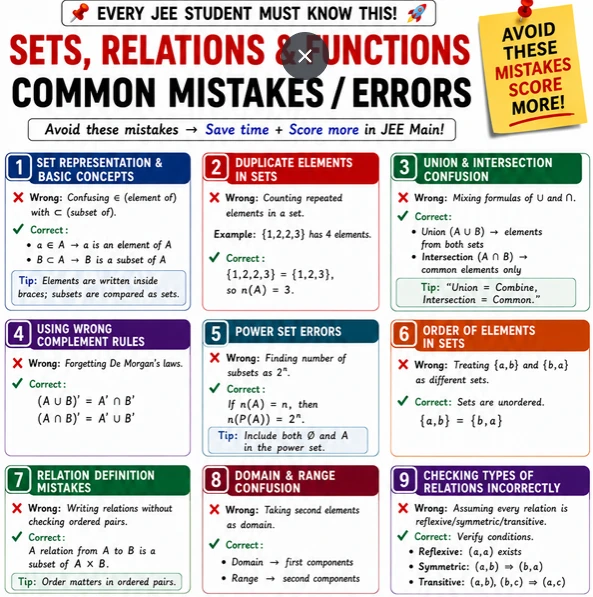
A few noticeable JEE common mistakes PDF Mathematics include calculation errors in multi-step questions. Due to this, many students lose marks in Maths despite knowing the concepts and formulas. Another common error is using the wrong formula, especially in Calculus, Coordinate Geometry, and Probability questions. Many students also think that they can save time by skipping a few steps, but doing so increases the risk of sign errors, algebraic mistakes, and incorrect simplifications.
Messy rough work also becomes a reason for losing marks, because poor rough work management leads to copied values being misplaced, missed calculations, and confusion during answer verification. You can improve on common errors by going through our chapter-wise JEE common mistakes PDF download.
How to Get JEE Common Mistakes PDF Download Links
Follow these steps to access the JEE common mistakes 2027 for all three subjects:
-
Open Selfstudys.com and go to the menu section.

-
Within the menu, click on ‘JEE’, then ‘JEE common mistakes’.


-
A new page will open, where you need to select a subject to continue with the JEE common errors resource.

-
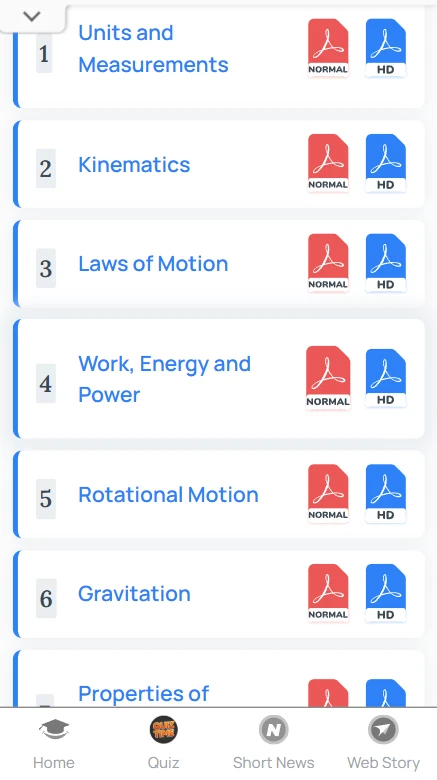
Now, choose the chapter to view the PDF for silly mistakes in JEE that many students make.
-
You can study the JEE common mistakes PDF online or save it by clicking on the ‘Download PDF’ button.
How to Avoid Silly Mistakes in JEE Main
We have listed more than 10 common mistakes in JEE Main. Learn about them to prevent yourself from making those mistakes and to secure better marks.
1. Before Fixing Any Mistakes, Identify Their Type
It is important for you to keep track of all the mistakes you make so that you can work on them better. To do this, keep a Mistake Notebook dedicated to recording every avoidable error and JEE Mains Important Questions from mock tests and practice sessions. You can categorize those mistakes as calculation errors, misread questions, marking the wrong option, unit conversion mistakes, and so on. Tracking how to avoid silly mistakes in JEE for a few weeks gives you a clear pattern in your errors.
2. Read Questions Completely Before Solving
If you are among those students who start solving a question after reading only half of it, then you need to stop doing so. Spending 5 extra seconds reading a question properly can save you several marks. Therefore, train yourself to underline keywords such as NOT, INCORRECT, EXCEPT, Maximum, Minimum, Positive Integer, Nearest Value, etc with the help of the JEE common mistakes PDF download.
3. Avoid Solving Too Fast
Speed is crucial for the JEE exam, but uncontrolled speed can lead to errors. Therefore, during practice, focus on accuracy first, then increase speed gradually. A student with 90% accuracy scores better than those who attempt more questions with numerous mistakes. While reviewing your test performance, you can also use JEE Main Mind Maps to quickly revise concepts and identify areas that need more attention. Always track whether the wrong answers were due to a lack of knowledge or carelessness. This will help you prevent JEE common mistakes 2027.
4. Write Important Steps on Paper
For lengthy calculations, don’t rely on mental calculation, as it can lead to errors—especially for Physics and Mathematics, where one missed or skipped step can change the answer completely. A good practice includes writing out all the steps, calculations, unit conversions, and final expressions before submitting values.
5. Verify Answers Before Submitting an Answer
Even spending 10 seconds checking the final answer before submitting can help you catch many mistakes. So, before submitting an answer, verify these points:
-
Is the sign positive or negative?
-
Are the units correct?
-
Is the decimal placed correctly?
-
Did you copy the value accurately?
-
Does the answer seem reasonable?
6. Use JEE Main Mock Tests to Improve Accuracy
If you really want to avoid JEE common mistakes, you should treat every JEE Main Mock Test as a real exam. After every test attempt, separate conceptual mistakes from silly errors, calculate marks lost due to carelessness, and focus on reducing those losses in subsequent mock attempts. Aim to reduce silly mistakes by a minimum of 20% every few tests.
7. Work on Time Management
Panic near the end of the exam is another reason why many students make JEE common errors. Your approach should focus on solving easy questions first, attempting moderately difficult questions next, and leaving plenty of time for doubtful questions later. This will keep your confidence high and prevent rushed decision-making.
8. Be Extra Careful in Numerical Questions
Students often lose marks due to common mistakes in JEE Main numericals. For numerical-value questions, make sure you recheck decimal points, verify powers of 10, confirm rounding rules if required, and ensure the final value is entered correctly.
9. Revise Formulas Weekly
If you forget a formula while answering a question, your brain will start doing guesswork. This is another silly mistakes in JEE to avoid. You must create a concise JEE Mains Formula Sheet for Physics equations, Chemistry reactions and relations, and Mathematics identities and standard results. Perform a quick revision every week and especially before attempting mock tests.
10. Practise Being Calm During the Exam
Anxiety increases the chances of making careless mistakes. Therefore, you have to practise staying calm during the exam. Use JEE Main Sample Paper and JEE Main Previous Year Question Paper to develop this skill. A good practice is to move to the next question when you get stuck, returning to it later with a fresh mind rather than spending too much time on a single question.
11. Don’t Keep Backlogs
Try not to pile up unstudied topics. No matter what, your duty is to continue your study sessions without stacking up backlogs. Otherwise, you’ll end up having too many topics to handle in a short period and, as a result, you will rush to complete them—which increases the chances of making major mistakes. Suppose, for any reason, you can’t cover topics as planned (like two to four topics a day); aim for at least one. Find ways to quickly cover them or revise them without fail.
Conclusion
How well you study definitely matters for success in the exam, but it's not always limited to that. How to avoid silly mistakes in JEE Main that cost you the most valuable marks also matters. During preparation, watch for calculation mistakes, poor time management, misreading questions, incorrect unit conversions, and rushed decision-making. Identifying these mistakes early and working on them regularly can help you improve your accuracy and overall score. Therefore, our team also provides expert-curated mistake PDF links on this page. Get them today and learn how to score well in your upcoming examinations.
The JEE common mistakes PDF includes calculation errors, incorrect unit conversions, marking the wrong option, misreading keywords such as "NOT" or "INCORRECT", and entering wrong numerical values. Many candidates lose marks due to carelessness rather than a lack of preparation.
To prevent yourself from making calculation mistakes, you should avoid doing lengthy calculations mentally. Instead, write steps clearly, especially in Coordinate Geometry, Calculus, and Algebra. Furthermore, during mock tests, notice whether wrong answers came from conceptual or arithmetic mistakes.
Yes, it is one of the serious JEE common mistakes. When you spend 10–15 minutes on a single difficult JEE question, it will affect your performance across the entire paper. To deal with those questions, mark them for review and move ahead.
Yes. Many students change a correct answer due to last-minute self-doubt. You must avoid changing answers during the final review, or change an answer only if you find a clear mistake in your solution.
Just avoid random guesswork. To reduce negative marking in JEE Main, attempt questions only when you can solve them confidently or eliminate at least two options logically. You can improve accuracy without unnecessary risk by using several techniques, such as dimensional analysis, approximation techniques, or option elimination.
Take full-length JEE mock tests under actual exam conditions and categorise every mistake. You can name categories such as Conceptual, Calculation, Reading, or Time Management. After that, work immediately on those categories that caused you the highest mark loss.


 Home
 Quiz
 Short News
 Web Story
 Get latest Exam Updates