


 Sign in


 Profile
 Signout


This was a significant increase of over 15% from 2025, when 10.71 lakh students appeared for the examination. When there are so many aspirants fighting for a limited number of seats in central, state, and deemed universities, and only some are able to score 100 percentile even in one subject, each mark matters a lot.
As the CUET paper is prepared on the basis of the Class 12 NCERT syllabus, the same concepts, formulas, and types of questions keep repeating over the years. SelfStudys' CUET most repeated questions are collected by analyzing the 2022–2026 exam papers so that you can focus on the important topics, which are most likely to be repeated in the coming examinations. Here, you will get free PDFs of Mathematics, Physics, Chemistry, Biology, Economics, Political Science, History, Business Studies, Psychology, Sociology, and English. You may solve them online or download them for free with the help of the links mentioned below. You can also use CUET Mind Maps to revise important concepts and formulas quickly.
Overview Of The CUET UG Most Repeated Questions
In the table below, you can get a quick overview of this resource on our platform.
|
PARTICULARS |
DETAILS |
|
Exam Name |
CUET: Common University Entrance Test |
|
Resource |
CUET UG most repeated questions |
|
Subjects Covered |
Maths, Physics, Chemistry, Biology, Economics, Political Science, History, Business Studies, Psychology, Sociology, and English. |
|
Coverage |
2022-2026 |
|
Format |
PDF: Portable Document Format |
|
Solutions |
Available |
|
Medium |
English |
|
Availability |
Free (Google Log In/Sign Up required) |
CUET Most Repeated Questions PDF: Subject-Wise Question Count
The PDFs of most repeated questions contain subject-wise sets. We have provided the total number of questions included in each subject PDF in the table below.
|
SUBJECT |
TOTAL QUESTIONS |
|
Mathematics |
235 questions |
|
Physics |
93 questions |
|
Chemistry |
102 questions |
|
Biology |
306 questions |
|
Economics |
200 questions |
|
Political Science |
219 questions |
|
History |
372 questions |
|
Business Studies |
185 questions |
|
Psychology |
32 questions |
|
Sociology |
92 questions |
|
English |
38 questions |
Note: In every subject’s CUET most repeated questions PDF, you will also find similar CUET Important Questions for practice. These are based on the same concepts or question patterns. With them, you can practice different variations of the concepts that are tested frequently.
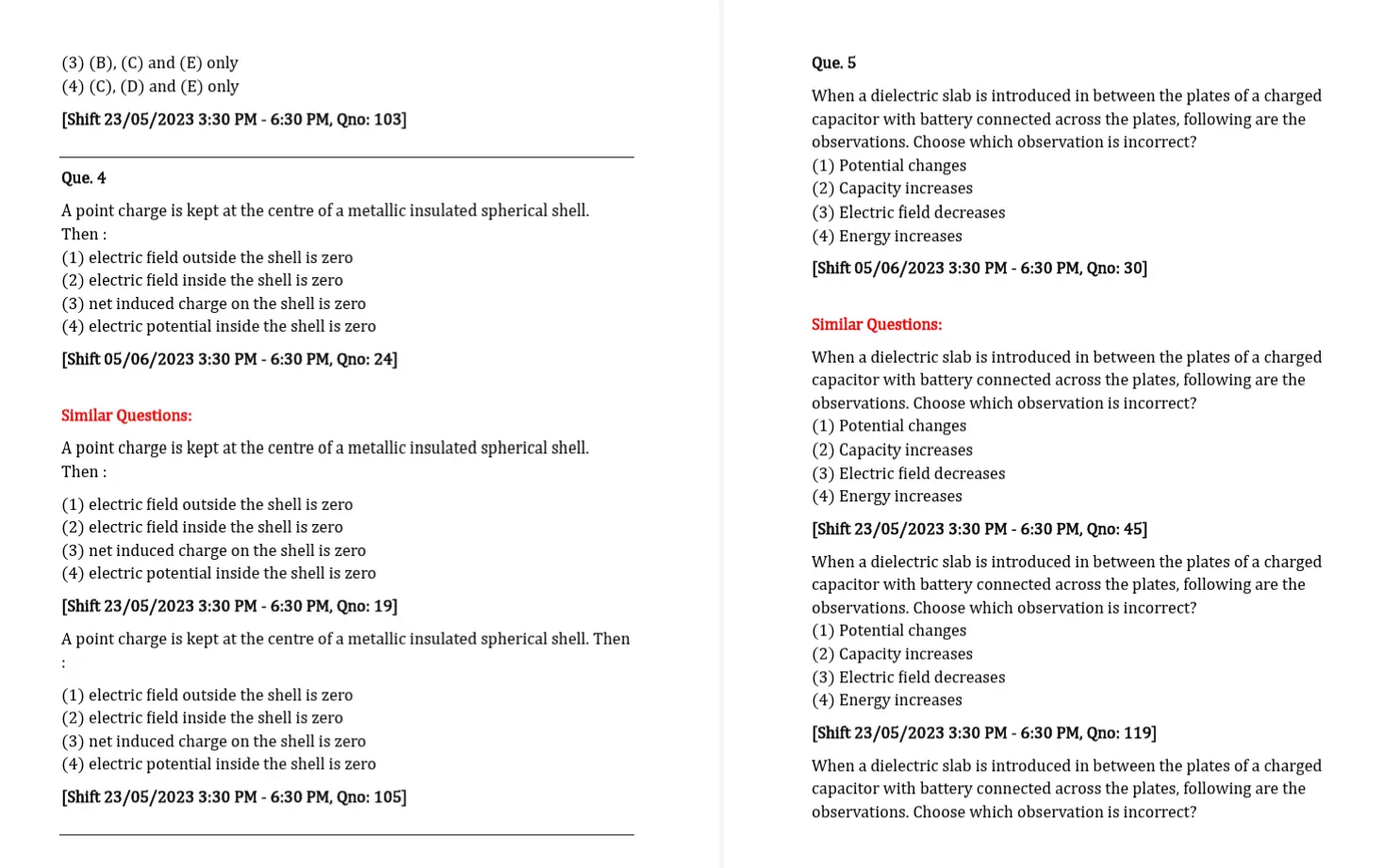
Most Repeated Questions In CUET Exam Vs. Previous Year Questions
Our experts have noticed that many students get confused between the most repeated questions and the CUET Previous Year Question Paper. They are both quite important resources, but they serve different purposes. In the table below, we have done a detailed comparison between the two.
|
Basis of Comparison |
CUET Most Repeated Questions With Solutions |
CUET Previous Year Questions |
|
Meaning |
It is a collection of questions or concepts that have appeared repeatedly in the exam. They are also considered important on the basis of past question patterns. |
These are the questions that were actually asked in the previous CUET examinations. |
|
Primary Purpose |
They give focused practice and revision of the concepts as well as the question types that are tested on a frequent basis. |
They help you understand the nature of questions that have appeared in the Common University Entrance Test. |
|
Source |
The PDF is usually compiled after the analysis of past papers, question patterns, important topics, commonly tested concepts, and so on. |
The PYQs are based directly on the questions from earlier papers. |
|
Question Selection |
The most repeated questions in CUET exam are quite selective, with a focus on questions or concepts that are considered useful for targeted practice. |
This includes questions as per the actual structure as well as the content of the respective previous year. |
Examples Of CUET Most Repeated Question Patterns (2022-2026)
In this section, we have mentioned some examples of repeated question patterns from different subjects.
Mathematics
Question: If the order of matrix A is m × p and the order of matrix B is p × n, then what is the order of matrix AB?
Options:
-
m × p
-
m × n
-
p × n
-
m × 2
Answer: m × n
Similar Question Patterns:
-
Variation 1: If A is an m × n matrix and B is a matrix such that AB and BA are both defined, then determine the order of matrix B.
-
Variation 2: If two matrices A and B can be multiplied, determine the possible order of the resulting matrix AB.
Physics
Question: A telescope has an objective of focal length 30 cm and an eyepiece of focal length 3.0 cm. It is focused on a scale distant 2.0 m. For seeing with a relaxed eye, the separation between the objective and eyepiece would be:
Options:
-
35.3 cm
-
38.3 cm
-
37 cm
-
30 cm
Answer: 38.3 cm
Similar Question Patterns:
-
Variation 1: A telescope has an objective lens of focal length 40 cm and an eyepiece of focal length 4 cm. If the telescope is adjusted for normal vision, what will be the distance between the objective and eyepiece?
-
Variation 2: A telescope is adjusted for viewing a distant object with a relaxed eye. If the focal lengths of the objective and eyepiece are given, determine the separation between both lenses.
Chemistry
Question: Which of the following is not correct?
-
La(OH)₃ is less basic than Lu(OH)₃
-
In lanthanides, the ionic radius of the M³⁺ ion decreases from La to Lu.
-
La is an element of transition series rather than the lanthanoid series.
-
Atomic radii of Zr and Hf are the same because of Lanthanoid contraction.
Choose the correct answer from the options given below:
-
B and C only
-
C and A only
-
A only
-
D and B only
Answer: 3. A only
Similar Question Patterns:
- Variation 1: Which of the following statements regarding lanthanide elements is correct?
-
The ionic radius of lanthanides increases from La to Lu.
-
Lanthanide contraction occurs due to the poor shielding effect of 4f electrons.
-
All lanthanides show only +2 oxidation state.
-
The atomic size of Zr and Hf differs significantly due to their positions in the periodic table.
Answer: B
- Variation 2: The similarity in the atomic sizes of zirconium and hafnium is mainly due to:
-
Similar electronic configuration
-
Lanthanide contraction
-
High nuclear charge of zirconium
-
Difference in shielding effect of d-electrons
Answer: B
Biology
Question: Extinction of Steller's sea cow and passenger pigeon is due to:
Options:
-
Invasion of alien species
-
Overexploitation by humans
-
Habitat loss and fragmentation
-
Co-extinction
Answer: 2. Overexploitation by humans
Similar Question Patterns:
- Variation 1: Which of the following is the major cause of extinction of many species due to excessive hunting and utilization by humans?
Options:
-
Over-exploitation
-
Mutation
-
Natural selection
-
Genetic variation
Answer: 1. Over-exploitation
- Variation 2: Steller's sea cow and passenger pigeon are examples of species that became extinct mainly because of:
Options:
-
Climate change
-
Human activities leading to population decline
-
Competition with similar species
-
Disease outbreaks
Answer: B. Human activities leading to population decline
Conclusion
With the help of the CUET most repeated questions PDF free download, you will get to practice recurring concepts and question patterns from different subjects in a focused way. They will further make you familiar with frequently tested areas and revise important topics properly. However, you should use this resource as a revision tool and not the only source of your preparation. For a balanced approach, you should combine the syllabus, NCERT concepts, past year questions, CUET Mock Test, and regular revision.
You need to remember that the questions might not always be repeated word-for-word. But the same concepts, topics, formulas, facts, question patterns, etc. can appear again with different wording or options.
With the practice of the repeated questions, you will be able to understand commonly tested concepts, recognize any patterns in questions, improve your speed, as well as find the topics that require more revision.
The previous year questions are the ones that we actually asked in the exams. Whereas, the most repeated questions focus on frequently tested concepts, recurring question patterns, similar questions based on past exam trends, etc.
Repeated questions alone cannot guarantee you a particular score. For this, you also need conceptual understanding, regular practice, accuracy, effective time management, etc.


 Home
 Quiz
 Short News
 Web Story
 Get latest Exam Updates