

 Sign in


 Profile
 Signout

 Join Whatsapp For Exclusive Content
 Join Telegram For Exclusive Content

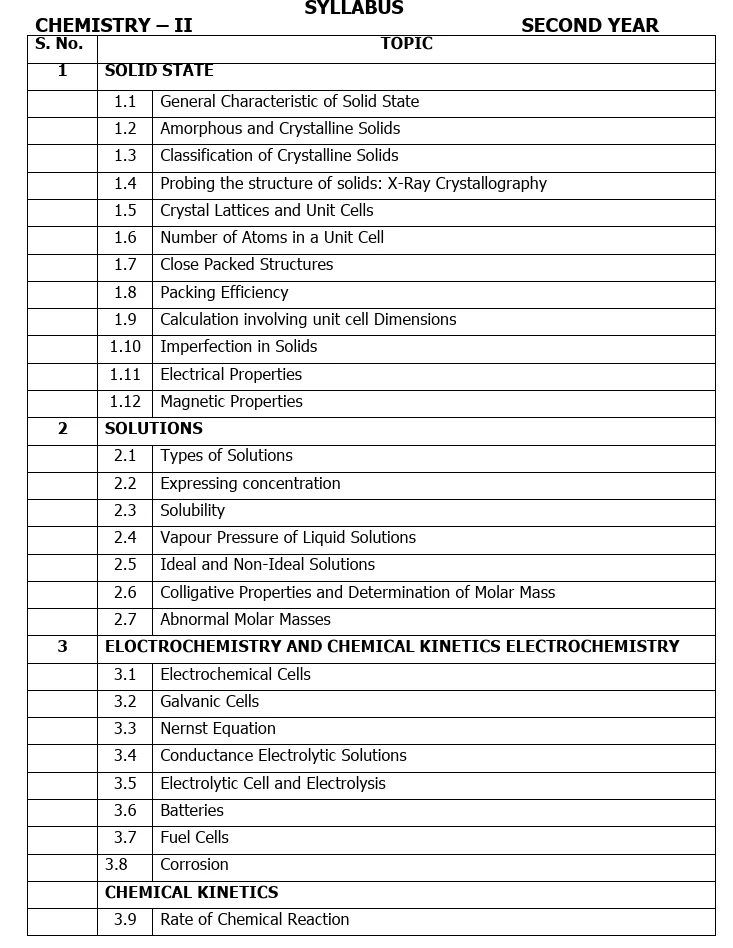
The AP Board 12th Chemistry syllabus 2026-27 is the official outline that is prescribed by the Board of Intermediate Education, Andhra Pradesh (BIEAP). It has everything you need to study in this particular subject, like units and topics on which board exam questions are based. By going through the AP Board Class 12th Syllabus before the classes start, you will be able to plan your time across all units rather than spending too long on a few chapters and rushing through the rest. Moreover, it is just as useful during your revision phase, as you can use it as a checklist to make sure that you don’t leave any topic. You can also practise with the AP Board Class 12 Model Papers to understand the exam pattern and improve your preparation. On this page, you can download the PDF for the syllabus completely free of cost.
Highlights Of The AP Inter 2nd Year Chemistry 2026-27 Syllabus
With the help of the table below, you will get a quick overview of this AP Board Class 12th Study Material.
|
PARTICULARS |
DETAILS |
|
Board |
Board of Intermediate Education, Andhra Pradesh (BIEAP) |
|
Class |
12 (Intermediate 2nd Year) |
|
Resource |
AP Inter 2nd Year Chemistry 2026-27 syllabus |
|
What it Includes |
Unit-wise list of topics prescribed for the board exam |
|
Format |
|
|
Cost |
Free |
|
How to Download |
Log in or sign up on the SelfStudys website |
Unit-Wise AP Intermediate Chemistry Syllabus 2026-27
The following table lists out the units included in the AP Intermediate Chemistry syllabus 2026-27 along with their primary areas of study. The order of the units listed in the following table is the same order in which the units are presented in the syllabus, which is generally in accordance with the order of the chapters in your book. Make sure to study the units thoroughly before beginning with them.
|
Section |
Topics Covered |
How to Study It |
|
Solid State |
Types of solids, crystal lattices, and defects in solids |
You have to learn the unit cells with their numbers of atoms as well as packing efficiency. Then, you can practise solving numericals on density. |
|
Solutions |
Concentration terms, Raoult’s law, and colligative properties |
Practise solving numericals based on molarity, molality, and colligative properties, and memorise the definitions accurately. |
|
Electrochemistry and Chemical Kinetics |
Electrochemical cells, conductance, and rates of reactions |
You should practise solving numericals on the Nernst equation, and then learn the integrated rate equations for zero- and first-order reactions. |
|
Surface Chemistry |
Adsorption, catalysis, and colloids |
You can prepare a comparison table of physical and chemical adsorption. Also, learn the classification of colloids along with examples. |
|
General Principles of Metallurgy |
Methods of extracting and refining metals |
You need to learn the extraction process in order (concentration, roasting/calcination, reduction, and refining) with one example of each. |
|
p-Block Elements |
Groups 15 to 18 and their compounds |
Learn the trends in properties group-wise, and the preparation and structure of important compounds such as ammonia, nitric acid and sulphuric acid. |
|
d- and f-Block Elements and Coordination Compounds |
Transition elements, lanthanoids, and coordination compounds |
You have to learn the IUPAC naming rules of coordination compounds and then practise them, as there are plenty of naming questions in the papers. |
|
Polymers |
Types of polymers and polymerization |
Learn the monomers and uses of polymers such as nylon, bakelite, and polythene. |
|
Biomolecules |
Carbohydrates, proteins, vitamins, and nucleic acids |
Learn the classification of each biomolecule with their examples and the structure of glucose. |
|
Chemistry in Everyday Life |
Chemicals in medicines, food, and cleansing agents |
You may prepare a list of drugs (analgesics, antibiotics, and antacids) along with their examples. It is a quick revision topic. |
|
Haloalkanes and Haloarenes |
Preparation, properties, and reactions of halogen compounds |
Learn the SN1 and SN2 mechanisms clearly and then practise the named reactions in this chapter. |
|
Organic Compounds Containing C, H and O |
Alcohols, phenols, ethers, aldehydes, ketones, and carboxylic acids |
You should create a chart of preparation methods and named reactions of each group and then practise conversion problems. |
|
Organic Compounds Containing Nitrogen |
Amines, diazonium salts, and related compounds |
You need to learn the tests to distinguish primary, secondary, and tertiary amines, and the reactions of diazonium salts. |
Timeline To Complete The AP Board Class 12th Chemistry 2026-27 Syllabus
You can easily finish the AP Board Class 12th Chemistry 2026-27 syllabus when you divide the year into phases. In this section, we have mentioned a timeline that you can follow from the start of your academic year till the board exams.
Phase 1: The First Three Months (June to August)
In order to know every unit that you have to cover, you should go through the entire syllabus once. Then, you may start studying in the sequence your teacher teaches in class. It is advised that you aim to finish about a third of the syllabus in this phase, as well as solve questions for every unit that is taught.
Phase 2: The Middle of the Year (September to November)
Now, you should continue with the next set of units and aim to cover about two-thirds of the AP Board 12th Class Chemistry 2026-27 syllabus. This needs to be done by the end of November month. You should revise the units that you have already covered before any quarterly or half-yearly exams. Additionally, during this time, you can mark the units that you find difficult so that you can give them extra time later.
Phase 3: Completing The Syllabus (December to January)
You have to finish the remaining units by the end of January at the latest. Make sure that you don’t leave any unit for the final month, as you need to dedicate the last few weeks to revision and not to learning anything new.
Phase 4: Revision (February till the Exam)
You can use the AP Inter 2nd Year Chemistry syllabus PDF 2026-27 as a checklist in this phase and tick off the units that you revise. Also, you have to start with the topics that you marked as difficult and then move to the rest. This is a great time to solve the AP Inter 2nd Year Previous Question Papers as well as model papers under exam conditions.
Conclusion
With the help of the syllabus, you get a clear picture of the whole year in one place. You will learn what each unit covers, how to study it, as well as when you should finish it. Our experts recommend that you keep the PDF with you throughout the year and come back to the unit-wise table when you start a new one or begin your revision. You can only walk into the board exam fully prepared if you complete the syllabus early and leave time for at least two revisions.




 Get latest Exam Updates