

 Sign in


 Profile
 Signout

 Join Whatsapp For Exclusive Content
 Join Telegram For Exclusive Content

The AP Board 12th Physics syllabus 2026-27 is the official outline that is prescribed by the Board of Intermediate Education, Andhra Pradesh (BIEAP). It has everything you need to study in this particular subject, like units and topics on which board exam questions are based. By going through the AP Board Class 12th Syllabus before the classes start, you will be able to plan your time across all units rather than spending too long on a few chapters and rushing through the rest. Moreover, it is just as useful during your revision phase, as you can use it as a checklist to make sure that you don’t leave any topic. You can also practise with the AP Board Class 12 Model Papers 2026-27 to understand the exam pattern and improve your preparation. On this page, you can download the PDF for the syllabus completely free of cost.
Highlights Of The AP Inter 2nd Year Physics 2026-27 Syllabus
With the help of the table below, you will get a quick overview of this AP Board Class 12th Study Material.
|
PARTICULARS |
DETAILS |
|
Board |
Board of Intermediate Education, Andhra Pradesh (BIEAP) |
|
Class |
12 (Intermediate 2nd Year) |
|
Resource |
AP Inter 2nd Year Physics 2026-27 syllabus |
|
What it Includes |
Unit-wise list of topics prescribed for the board exam |
|
Format |
|
|
Cost |
Free |
|
How to Download |
Log in or sign up on the SelfStudys website |
Unit-Wise AP Intermediate Physics Syllabus 2026-27
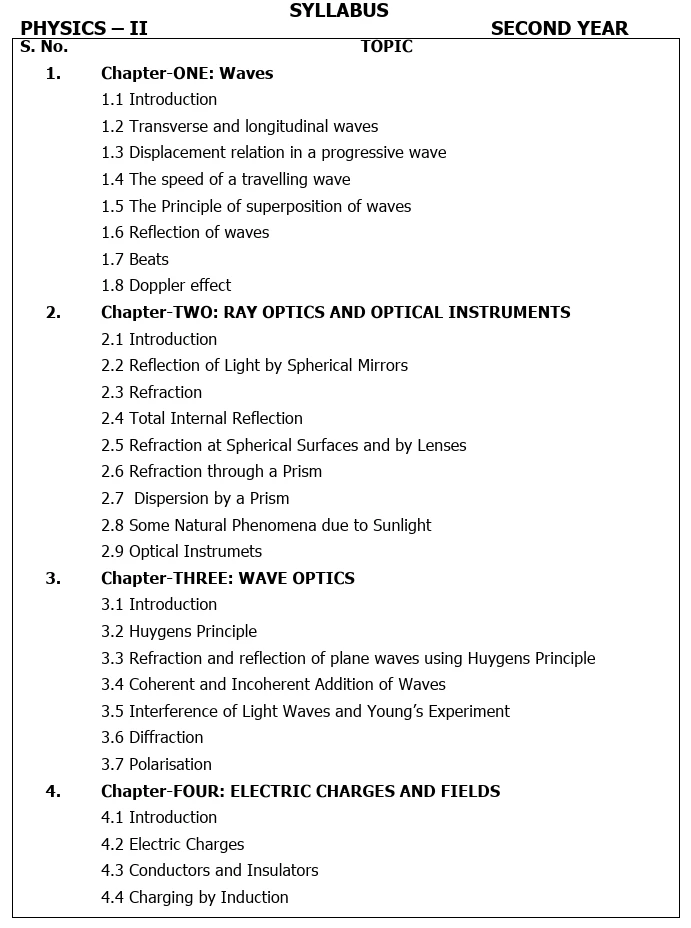
The following table lists out the units included in the AP Intermediate Physics syllabus 2026-27 along with their primary areas of study. The order of the units listed in the following table is the same order in which the units are presented in the syllabus, which is generally in accordance with the order of the chapters in your book. Make sure to study the units thoroughly before beginning with them.
|
Section |
Topics Covered |
How to Study It |
|
Waves |
Transverse and longitudinal waves, standing waves, beats, and the Doppler effect |
You should draw the diagrams of standing waves in strings and pipes, as well as practise solving the numericals that are based on the Doppler effect by using the sign convention. |
|
Ray Optics and Optical Instruments |
Reflection, refraction, lenses, prisms, and optical instruments |
You have to practise ray diagrams until you can do it fast. Also, make sure to learn the lens and mirror formulas with their sign conventions. |
|
Wave Optics |
Interference, diffraction, and polarization of light |
Study Young’s double-slit experiment thoroughly along with the derivation of fringe width as it is a common long answer question. |
|
Electric Charges and Fields |
Coulomb’s law, electric field, and Gauss’s law |
You need to learn the derivation of Gauss’s law for a wire, a plane sheet, and a spherical shell. These derivations are commonly asked. |
|
Electrostatic Potential and Capacitance |
Electric potential, capacitors, and dielectrics |
Practise numericals on capacitors connected in series and parallel and learn the derivation of the capacitance of a parallel plate capacitor. |
|
Current Electricity |
Ohm’s law, Kirchhoff’s laws, and the Wheatstone bridge |
Apply Kirchhoff's laws in circuit problems after labeling every current and loop. |
|
Moving Charges and Magnetism |
Biot-Savart law, Ampere’s law, and force on moving charges |
You should learn the derivations of the magnetic fields of a circular loop and a straight wire, and use the right-hand thumb rule for direction. |
|
Magnetism and Matter |
Bar magnets, Earth’s magnetism, and magnetic materials |
You can prepare a comparison table of diamagnetic, paramagnetic, and ferromagnetic materials, as it is a quick-scoring topic. |
|
Electromagnetic Induction |
Faraday’s and Lenz’s laws, and self and mutual induction |
Understand Lenz's law through examples and then practise solving numericals based on induced EMF. |
|
Alternating Current |
AC circuits, resonance, and transformers |
You should study the phase relations of R, L, and C circuits by using the phasor diagrams and the working of a transformer. |
|
Electromagnetic Waves |
Properties of EM waves and the electromagnetic spectrum |
Memorize the order of the spectrum along with one use of each type of electromagnetic waves. |
|
Dual Nature of Radiation and Matter |
Photoelectric effect and de Broglie waves |
You need to study Einstein's photoelectric equation and then practise solving numericals that are based on work function as well as threshold frequency. |
|
Atoms |
Rutherford and Bohr models of the atom and the hydrogen spectrum |
Learn the postulates of Bohr theory and the derivation of radius and energy of orbits, as these derivations are asked frequently. |
|
Nuclei |
Nuclear structure, radioactivity, fission, and fusion |
You should practise solving half-life numericals as well as learn the difference between fission and fusion reactions with examples. |
|
Semiconductor Electronics |
Semiconductors, diodes, transistors, and logic gates |
Draw the circuit diagrams of rectifiers and transistor amplifiers. Additionally, learn the truth tables of all logic gates. |
|
Communication Systems |
Basic elements of communication and modulation |
You need to learn the block diagram of a communication system and the importance of modulation, as they are short and direct questions. |
Timeline To Complete The AP Board Class 12th Physics 2026-27 Syllabus
You can easily finish the AP Board Class 12th Physics 2026-27 syllabus when you divide the year into phases. In this section, we have mentioned a timeline that you can follow from the start of your academic year till the board exams.
Phase 1: The First Three Months (June to August)
In order to know every unit that you have to cover, you should go through the entire syllabus once. Then, you may start studying in the sequence your teacher teaches in class. It is advised that you aim to finish about a third of the syllabus in this phase, as well as solve questions for every unit that is taught.
Phase 2: The Middle of the Year (September to November)
Now, you should continue with the next set of units and aim to cover about two-thirds of the AP Board 12th Class Physics 2026-27 syllabus. This needs to be done by the end of November month. You should revise the units that you have already covered before any quarterly or half-yearly exams. Additionally, during this time, you can mark the units that you find difficult so that you can give them extra time later.
Phase 3: Completing The Syllabus (December to January)
You have to finish the remaining units by the end of January at the latest. Make sure that you don’t leave any unit for the final month, as you need to dedicate the last few weeks to revision and not to learning anything new.
Phase 4: Revision (February till the Exam)
You can use the AP Inter 2nd Year Physics syllabus PDF 2026-27 as a checklist in this phase and tick off the units that you revise. Also, you have to start with the topics that you marked as difficult and then move to the rest. This is a great time to solve the AP Inter 2nd Year Previous Question Papers as well as model papers under exam conditions.
Conclusion
With the help of the syllabus, you get a clear picture of the whole year in one place. You will learn what each unit covers, how to study it, as well as when you should finish it. Our experts recommend that you keep the PDF with you throughout the year and come back to the unit-wise table when you start a new one or begin your revision. You can only walk into the board exam fully prepared if you complete the syllabus early and leave time for at least two revisions.




 Get latest Exam Updates