


 Sign in


 Profile
 Signout


FREE PDF Download
-
1Bricks, Beads And Bones


-
2Kings, Farmers And Towns
-
3Kinship, Caste And Class
-
4Thinkers, Beliefs And Buildings
-
5Through The Eyes Of Travellers
-
6Bhakti-Sufi Traditions
-
7An Imperial Capital Vijayanagara
-
8Peasants, Zamindars And The State
-
9Colonialism And The Countryside
-
10Rebels And The Raj
-
11Mahatma Gandhi & The Nationalist Movement
-
12Framing The Constitution

The Central Board of Secondary Education (CBSE) usually conducts the annual exams in Feb-March every year. For better preparation, you can start your revision with CBSE Class 12 Themes in Indian History one page notes given by SelfStudys. However, it is recommended that you go through your textbooks first. With the right strategy, you can prepare effectively and score the desired marks in your final examinations. The PDFs available on our platform are arranged according to the original sequence of chapters as mentioned below.
What Is The Purpose of CBSE Class 12 Themes in Indian History One Page Notes 2026-27?
These one-page notes serve as a bridge between your textbook and practice questions. You learn from your textbooks and go through these notes. The following points describe their purpose in detail:
-
Quick recall: When you have already covered the topics included in your CBSE Class 12 Syllabus, you can use Class 12 Themes in Indian History one page notes 2026-27 to recall what you have studied. This way, you do not need to reread the CBSE Class 12 Textbooks if you want to remember something.
-
Focused revision: Some concepts might be confusing in the textbooks. You can use these notes to cover the topics without any confusion. Just learn the concept and repeat.
-
Self-checking: Once you have learnt it, you should practise some questions that can strengthen your learning. This will reflect how well you have prepared so far.
What Important Concepts Are Covered in One Page Notes CBSE Class 12 Themes in Indian History?
Textbooks provide you with the complete theory for the concepts. However, CBSE One Page Notes make them concise and fit on one page. The PDF should be analysed to recall the important concepts, and then you can use CBSE Class 12 Important Questions to check your preparation further.
Here are the important topics included in these notes:
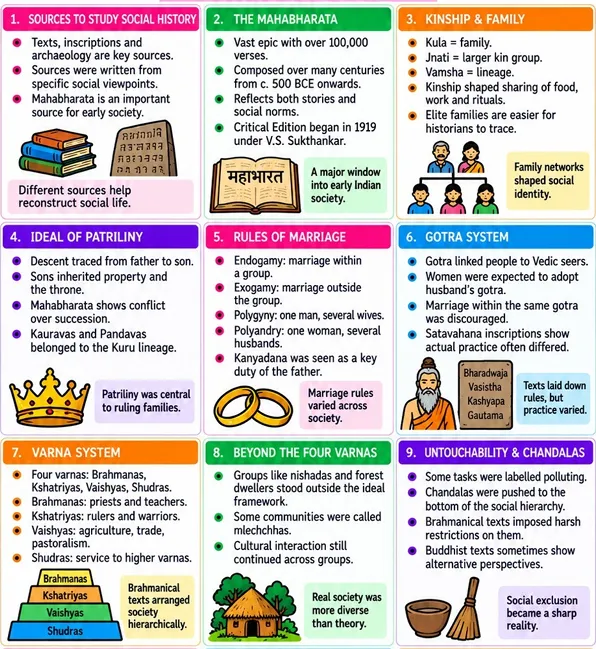
|
Concept |
Formula/Condition |
|
Sources to Study Social History |
Texts, inscriptions, and archaeology are key sources. Sources were written from specific social viewpoints. The Mahabharata is an important source for early society. |
|
The Mahabharata |
A vast epic with over 100,000 verses, composed over many centuries from c. 500 BCE onwards. It reflects both stories and social norms. The Critical Edition began in 1919 under V. S. Sukthankar. |
|
Kinship and Family |
Kula: Family. Jati: Larger kin group. Vamsha: Lineage. Kinship shaped the sharing of food, work, and rituals. Elite families are easier for historians to trace. |
|
Ideal of Patriliny |
Descent was traced from father to son. Sons inherited property and the throne. The Mahabharata shows conflicts over succession. Kauravas and Pandavas belonged to the Kuru lineage. |
|
Rules of Marriage |
Endogamy: Marriage within a group. Exogamy: Marriage outside the group. Polygyny: One man, several wives. Polyandry: One woman, several husbands. Kanyadana was seen as a key duty of the father. |
|
Gotra System |
Gotra linked people to Vedic seers. Women were expected to adopt their husband's gotra. Marriage within the same gotra was discouraged. Satavahana inscriptions show that actual practices sometimes differed. |
|
Varna System |
Four varnas: Brahmanas, Kshatriyas, Vaishyas, and Shudras. Brahmanas: priests and teachers; Kshatriyas: rulers and warriors; Vaishyas: agriculture, trade, and pastoralism; Shudras: service to higher varnas. |
|
Beyond the Four Varnas |
Groups like Nishadas and forest dwellers stood outside the ideal framework. Some communities were called mlechchhas. Cultural interaction continued across groups. |
|
Untouchability and Chandalas |
Some tasks were labelled polluting. Chandalas were pushed to the bottom of the social hierarchy. Brahmanical texts imposed harsh restrictions, while Buddhist texts sometimes showed alternative perspectives. |
How To Use CBSE Class 12 Themes in Indian History One Page Notes PDF During Board Exam Revision?
One-page notes can help you revisit important formulas, concepts, definitions, and results without reading every chapter from the beginning. When you know how to use them correctly, it makes all the difference. Using them appropriately basically relies on how prepared you feel to answer related questions.
-
Revise Important Terms/Formulas Before Solving Questions: The whole chapter is based on the conceptual terms that need to be explained and understood. Make sure you revise the important terms or formulas, if any, from the textbooks.
-
Use the Notes for Chapter-Wise Revision: You can use these CBSE Class 12 Themes in Indian History one page notes PDF for chapter-wise preparation. As you already know, the platform offers them as per the chapter sequence included in the latest syllabus. Revise the same chapter notes as you are currently reading or revising. You can also practise CBSE Class 12 Worksheets to strengthen your understanding of each chapter.
-
Practise Recalling Concepts Without Looking at the PDF: When it comes to remembering the key concepts, you should be able to recall them without looking at the PDF. This ensures that your preparation is going well. You can then solve CBSE Class 12 PYQ's to check how well you can apply these concepts.
-
Use One-Page Notes Alongside Sample Papers: It’s equally important to combine other additional resources like CBSE Class 12 Sample Papers with CBSE Class 12 Themes in Indian History one page notes all chapters. This makes sure that you can apply what you have learned so far.
-
Follow a Simple Revision Tracker: You can also use a CBSE Class 12 Study Planner to observe your progress over time. Mention all the chapters in it and prepare a checklist to maintain the record regularly.
Conclusion
You should understand that Class 12 is the last year of your school, and you should put more effort so that you can make the right choices for your career. One-page notes might look shorter but cover the whole chapter within a single page. You need to be very focused while learning through them. Combine other resources with these Class 12 Themes in Indian History one page notes CBSE and appear for your final exams confidently.


 Home
 Quiz
 Short News
 Web Story
 Get latest Exam Updates