


 Sign in


 Profile
 Signout

FREE PDF Download
-
1Chapter 22: Chemical Coordination and integration


-
2Chapter 21: Chemical Coordination and integration
-
3Chapter 1 The Living World
-
4Chapter 2 Biological Classification
-
5Chapter 3 Plant Kingdom
-
6Chapter 4 Animal Kingdom
-
7Chapter 5 Morphology of Flowering Plants
-
8Chapter 6 Anatomy of Flowering Plants
-
9Chapter 7 Structural Organisation in Animals
-
10Chapter 8 Cell: The Unit of Life
-
11Chapter 9 Biomolecules
-
12Chapter 10 Cell Cycle and Cell Division
-
13Chapter 11 Transport in Plants
-
14Chapter 12 Mineral Nutrition
-
15Chapter 13 Photosynthesis in Higher Plants
-
16Chapter 14 Respiration in Plants
-
17Chapter 15 Plant Growth and Development
-
18Chapter 16 Digestion and Absorption
-
19Chapter 17 Brething and Exchange of Gases
-
20Chapter 18 Body Fluids and Circulation
-
21Chapter 19 Excretory Products and Their Elimination
-
22Chapter 20 Locomotion and Movement

At SelfStudys, you get the Class 11 Biology NCERT solutions, which are a comprehensive study resource that provides you with accurate, step-by-step answers to all the questions. With their design, you can understand the fundamental concepts like cell structure, plant physiology, human physiology, etc., in a clear as well as simplified manner.
The biology subject is considered to be the most important source of conceptual and factual knowledge. However, our experts have noticed that many students struggle to interpret the questions in the textbooks or frame accurate answers. This is where our Class 11 Biology NCERT solutions 2026-27 come into play. They not only provide you with correct answers but also explain the reasoning behind every concept. This makes your learning more effective and exam-oriented.
Why Biology In Class 11 Is Considered The Most Important Foundation Year?
Class 11 Biology is the stage where you move from basic school-level science to a deeper, as well as concept-driven understanding of the life processes. This subject introduces you to core topics that form the backbone of the advanced studies in class 12 and competitive exams. If you don’t have a strong grasp of these fundamentals, then it is possible that you might struggle with complex topics later. This is why using a resource like Class 11 Biology NCERT solutions PDF becomes very essential. It is not just for solving questions, but to build your clarity, accuracy, long-term retention, and so on. A few more points on the subjects’ importance are mentioned in detail below.
-
Most topics in Class 12 Biology are direct add-ons of what you study in Class 11. For example, you need to understand DNA, cell structure, and basic physiology before you move on to genetics, biotechnology, and evolution. When you use the Class 11 Biology NCERT book solutions on a regular basis, you can make sure that your foundational concepts are clear. Then, you will be able to grasp the advanced topics much more easily.
-
In Class 11, you will face some complex processes like photosynthesis, respiration, transport in plants, human body functions, etc., for the first time. You need to know that these are not surface-level topics and require step-by-step understanding. Our NCERT Biology Class 11 solutions PDF download helps in dividing these processes into simple explanations. With this, you can follow the sequences, mechanisms, cause-and-effect relationships, etc., effectively.
-
In this subject, correct terminology plays a major role in scoring marks. You need to use terms like protoplasm, “xylem,” “phloem,” and “mitochondria” accurately. With the help of the NCERT solutions for Class 11 Biology, you can learn how to include the right terms in your responses. This is quite important for school exams as well as competitive tests in the future.
-
You cannot master Biology only through memorization, as you did in the past classes. This is the stage where you need to understand how and why processes occur. At SelfStudys, you get the NCERT Class 11 Biology solutions chapterwise that have well-structured explanations. By going through them, you will be able to move beyond rote learning and understand the concepts truly. This will further lead you to better retention as well as application.
-
A significant portion of this subject in the NEET exam is based on the NCERT concepts from both Class 11 and 12. So, if your base is weak in Class 11, then you might face difficulties in handling higher-level questions. That’s why you need to practice with the latest Biology NCERT solutions for Class 11 consistently. They will help you build a strong conceptual base early on as well as reduce the pressure when you are doing serious exam preparation.
Chapter-Wise Class 11 Biology NCERT Solutions PDF
The syllabus of this subject is quite vast and driven by concepts. It covers everything from the diversity of living organisms to human physiology and plant processes. In order to make your learning more effective, you have to focus on each chapter separately as well as master its core concepts. With our Class 11 Biology NCERT solutions, you can access accurate, step-by-step answers for every chapter in a clear format. Here is a list of all the chapters, along with their most important subtopics and concepts that you should focus on while using these solutions.
|
Chapter Name |
Important Subtopics |
Approx. Weightage |
|
Characteristics of living organisms, taxonomy, binomial nomenclature, species concept, biodiversity, taxonomical hierarchy, systematics, tools for the study of taxonomy (herbaria, botanical gardens, museums, zoological parks) |
2 to 3% |
|
|
Five Kingdom classification, Monera, Protista, Fungi, viruses, viroids, lichens, cyanobacteria, modes of nutrition, reproduction in microorganisms, phylogenetic classification |
4 to 5% |
|
|
Algae, Bryophytes, Pteridophytes, Gymnosperms, Angiosperms, plant life cycles, alternation of generations, economic importance, classification systems |
4 to 5% |
|
|
Basis of classification, levels of organization, symmetry, coelom, non-chordates vs chordates, phylum-wise features, examples, vertebrate classification, notochord, body plan |
5 to 6% |
|
|
Root, stem, leaf, flower structure, inflorescence, modifications, venation, phyllotaxy, floral formula, aestivation, placentation, fruit, and seed types |
5 to 6% |
|
|
Tissue types (meristematic & permanent), plant anatomy, dicot vs monocot stem/root, vascular bundles, secondary growth, xylem and phloem structure, wood formation |
4 to 5% |
|
|
Animal tissues (epithelial, connective, muscular, neural), cockroach morphology, frog anatomy, organ systems, histology basics |
3 to 4% |
|
|
Cell theory, prokaryotic vs eukaryotic cells, cell organelles, plasma membrane, cell wall, nucleus, cytoplasm, cell transport, endomembrane system |
5 to 6% |
|
|
Carbohydrates, proteins, lipids, nucleic acids, enzymes, metabolism, primary & secondary metabolites, biomolecular structure, enzyme kinetics, factors affecting enzymes |
6 to 7% |
|
|
Cell cycle phases (G1, S, G2, M), mitosis, meiosis, significance, checkpoints, cytokinesis, chromosomal behavior, cell regulation |
5 to 6% |
|
|
Diffusion, osmosis, transpiration, imbibition, xylem & phloem transport, water potential, cohesion-tension theory, translocation of food |
4 to 5% |
|
|
Essential elements, macro & micronutrients, deficiency symptoms, nitrogen cycle, nutrient uptake, hydroponics, mineral toxicity, role of nutrients |
3 to 4% |
|
|
Light reaction, dark reaction, C3 & C4 cycles, CAM pathway, photosystems, factors affecting photosynthesis, photorespiration, pigments |
6 to 7% |
|
|
Glycolysis, Krebs cycle, electron transport chain, aerobic vs anaerobic respiration, fermentation, energy balance, respiratory quotient |
5 to 6% |
|
|
Growth phases, plant hormones (auxins, gibberellins, cytokinins, ethylene, ABA), photoperiodism, vernalization, growth regulators, differentiation |
3 to 4% |
|
|
Human digestive system, enzymes, digestion process, absorption mechanisms, disorders, alimentary canal, role of liver and pancreas |
5 to 6% |
|
|
Respiratory organs, mechanism of breathing, gas exchange, oxygen transport, lung volumes, respiratory disorders, regulation of respiration |
4 to 5% |
|
|
Blood composition, heart structure, cardiac cycle, lymphatic system, blood groups, coagulation, double circulation, disorders |
5 to 6% |
|
|
Kidney structure, urine formation, nephron, excretory system, osmoregulation, dialysis, disorders like uremia |
4 to 5% |
|
|
Types of movement, muscle structure, skeletal system, sliding filament theory, joints, disorders (arthritis, osteoporosis) |
3 to 4% |
|
|
Neuron structure, nervous system, reflex action, brain functions, synapse, impulse transmission, spinal cord, disorders |
5 to 6% |
|
|
Endocrine glands, hormones, mechanism of hormone action, feedback mechanism, disorders (diabetes, thyroid imbalance), coordination |
4 to 5% |
Common Keywords And Terms You Must Learn From The Class 11 Biology NCERT
In the table below, we have made it easier for you to know which are the keywords and terms you need to learn from the NCERT textbook of Biology in Class 11 before the exams.
|
Chapter |
Keywords/Terms |
Importance |
|
The Living World |
Taxonomy, Species, Genus, Family, Biodiversity, Systematics, Binomial Nomenclature |
Helps in classification-based questions and understanding the diversity of life. |
|
Biological Classification |
Monera, Protista, Fungi, Viruses, Viroids, Lichens, Cyanobacteria |
Essential for understanding microbial diversity and evolutionary relationships. |
|
Plant Kingdom |
Algae, Bryophytes, Pteridophytes, Gymnosperms, Angiosperms, Alternation of Generations, Gametophyte, Sporophyte |
Useful for comparative questions and life cycle diagrams. |
|
Animal Kingdom |
Non-chordates, Chordates, Coelom, Symmetry, Phylum, Vertebrates, Notochord |
Important for classification and descriptive answers in exams. |
|
Morphology of Flowering Plants |
Root, Stem, Leaf, Flower, Inflorescence, Venation, Phyllotaxy, Placentation, Fruit types, Seed types |
High weightage for diagrams and definitions. |
|
Anatomy of Flowering Plants |
Xylem, Phloem, Vascular Bundles, Meristem, Parenchyma, Collenchyma, Sclerenchyma, Secondary Growth |
Diagrams + functional understanding are critical. |
|
Structural Organisation in Animals |
Epithelial tissue, Connective tissue, Muscular tissue, Nervous tissue, Organ system |
Helps in scoring diagram and short-answer questions. |
|
Cell: The Unit of Life |
Prokaryotic, Eukaryotic, Organelle, Nucleus, Mitochondria, Ribosome, Endoplasmic Reticulum, Lysosome |
Fundamental for higher-level chapters; frequently asked. |
|
Biomolecules |
Carbohydrates, Proteins, Lipids, Nucleic Acids, Enzymes, Metabolism, Monosaccharide, Polysaccharide |
Important for both conceptual and diagram-based questions. |
|
Cell Cycle and Cell Division |
Mitosis, Meiosis, Cytokinesis, Chromosomes, Chromatin, Checkpoints, Spindle Fibers |
Essential for diagrams and mechanism-based questions. |
|
Transport in Plants |
Diffusion, Osmosis, Transpiration, Cohesion-Tension Theory, Xylem, Phloem, Water Potential |
High marks for flowchart-based answers. |
|
Mineral Nutrition |
Macronutrients, Micronutrients, Nitrogen Cycle, Deficiency Symptoms, Hydroponics |
Required for applied questions in exams. |
|
Photosynthesis in Higher Plants |
Chlorophyll, Photosystem I & II, Light Reaction, Dark Reaction, Calvin Cycle, C3 & C4 Pathway, CAM Pathway |
Key for process diagrams and long-answer questions. |
|
Respiration in Plants |
Glycolysis, Krebs Cycle, Electron Transport Chain, Aerobic, Anaerobic, Fermentation |
High weightage in diagrams and problem-solving. |
|
Plant Growth and Development |
Auxins, Gibberellins, Cytokinins, Ethylene, ABA, Photoperiodism, Vernalization |
Important for mechanism-based questions. |
|
Digestion and Absorption |
Enzymes (Amylase, Lipase, Pepsin), Small Intestine, Large Intestine, Absorption, Bile |
Diagrams + process understanding crucial. |
|
Breathing and Exchange of Gases |
Alveoli, Hemoglobin, Oxygen Transport, Carbon Dioxide Transport, Pulmonary Ventilation |
Exam-focused; diagrams & short notes essential. |
|
Body Fluids and Circulation |
Blood, Plasma, RBC, WBC, Platelets, Heart, Cardiac Cycle, Lymph |
Frequently appears in diagrams and long answers. |
|
Excretory Products and Their Elimination |
Kidney, Nephron, Glomerulus, Filtration, Reabsorption, Urea |
Diagrams + functional flow of urine formation are key. |
|
Locomotion and Movement |
Skeletal Muscle, Cardiac Muscle, Smooth Muscle, Sliding Filament Theory, Joints |
High-scoring diagram + process-based questions. |
|
Neural Control and Coordination |
Neuron, Synapse, Reflex Arc, CNS, PNS, Brain, Spinal Cord |
Must know for diagrams and MCQs |
|
Chemical Coordination and Integration |
Endocrine Glands, Hormones, Feedback Mechanism, Pituitary, Thyroid, Insulin, Glucagon |
High probability of long-answer + MCQs in exams. |
Which Chapters In Class 11 Biology Need Extra Focus?
You must understand that not all the chapters carry the same level of difficulty or exam importance in this subject. There are some chapters that are heavy in concepts, some are driven by the processes, and some require practice with the diagrams. It is important that you focus on these chapters to score higher. We have mentioned all these chapters in the table, along with how you can use the Class 11 Biology NCERT solutions 2026-27 with them.
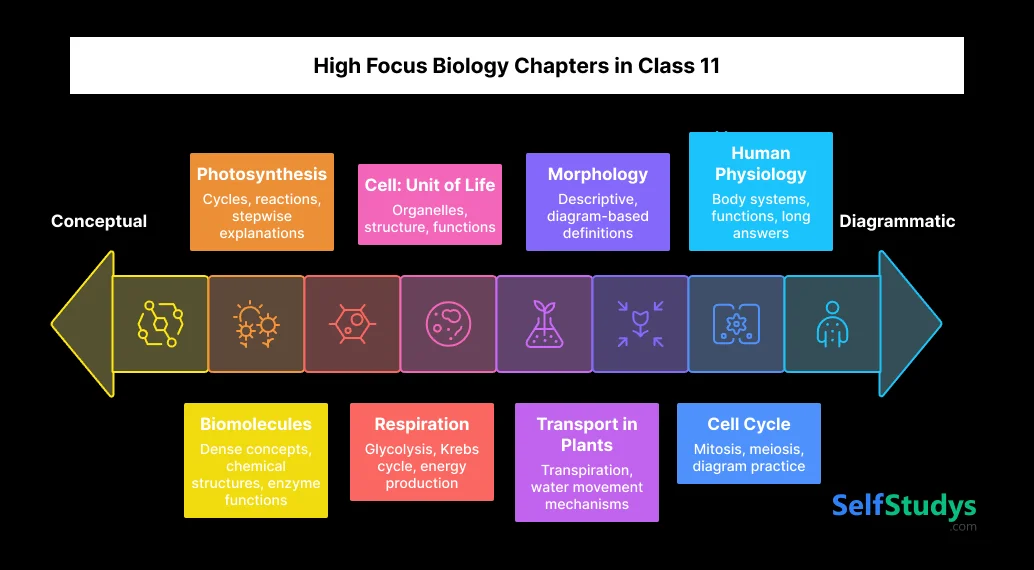
|
Chapter Name |
Why it Needs Extra Focus |
How to Use the Solutions |
|
Cell: The Unit of Life |
This is the foundation for all the concepts in Biology. It includes cell organelles and structure. |
You can use the Class 11 Biology NCERT solutions PDF to understand the functions of organelles as well as practice the questions that are based on diagrams stepwise. |
|
Biomolecules |
This chapter is quite dense in concepts with chemical structures as well as enzyme functions. |
By referring to the Class 11 Biology NCERT book solutions, you need to learn the simple explanations, key definitions, functions, etc. |
|
Cell Cycle and Cell Division |
It is quite frequently asked; it also includes mitosis and meiosis with diagrams. |
Here, you have to use the NCERT Biology Class 11 solutions PDF download to divide the stages into sequences as well as practice the diagrams. |
|
Photosynthesis in Higher Plants |
The chapter is very process-heavy with cycles and reactions. |
With the help of the NCERT solutions for Class 11 Biology, you should study the flowcharts and stepwise explanations. |
|
Respiration in Plants |
There are multiple pathways, like glycolysis and the Krebs cycle, included in this chapter. |
By using the NCERT Class 11 Biology solutions chapterwise, you need to understand the step-by-step processes of energy production. |
|
Transport in Plants |
This is the chapter that involves concepts like transpiration and water movement. |
In the latest Biology NCERT solutions for Class 11, you have to learn the mechanisms as well as practice conceptual questions. |
|
Human Physiology (All Chapters) |
They are quite high in weightage as well as covering body systems and functions. |
With the usage of the Class 11 Biology NCERT solutions, you should understand the system-wise processes, practice long answers, etc. |
|
Morphology of Flowering Plants |
This chapter is descriptive and mostly based on diagrams. |
You have to practice diagrams as well as definitions by using the Class 11 Biology NCERT solutions 2026-27 to score better. |
How Are SelfStudys’ Class 11 Biology NCERT Book Solutions Designed For Faster Learning?
In today's time, you need the resources that are not only accurate but also efficient to use. And at SelfStudys, we understand this need, which is why our experts design the Class 11 Biology NCERT solutions PDF to accelerate your learning. This resource can act as your roadmap for revision, practice, exam preparation, etc. You can explore some more features of these solutions in detail below.
-
Every chapter in our Class 11 Biology NCERT book solutions is divided into smaller sections that match the textbook. You will find that questions are answered stepwise with points so that you can follow and remember them easily. You can also focus on one concept at a time and avoid any confusion.
-
Our experts make sure that difficult topics like cell division, photosynthesis, human physiology, etc., are explained in a simple and easy-to-understand language in the NCERT Biology Class 11 solutions PDF download. With the focus on the cause-and-effect relationships and sequences, you will be able to visualize the processes properly.
-
The NCERT solutions for Class 11 Biology underline all the scientific terms, keywords, definitions, etc. that are required for the exams. Through this approach, we make sure that you recall them quickly during exams as well as improve your accuracy in answer writing.
-
The NCERT Class 11 Biology solutions chapterwise for important chapters like morphology, anatomy, physiology, and so on include diagrams and flowcharts that are fully labelled. With this visual learning, you will be able to grasp mechanisms like the Calvin Cycle, the Krebs Cycle, and the Reflex Arc quickly.
-
You will see that our latest Biology NCERT solutions for Class 11 highlight all the important points, questions that are asked frequently, common mistakes, etc. With their help, you can revise entire chapters without rereading the long paragraphs.
Steps To Access The NCERT Biology Class 11 Solutions PDF Download
Once you reach our platform, you just need to follow a few easy steps and get your hands on the Class 11 Biology NCERT solutions for free.
- You can use any web browser on your device and type www.selfstudys.com in the search area.

- This way, our website will open up, and you can go through it once. Then, you can simply click on the ‘Navigation’ tab to access the main menu.
- From this menu, you have to select the ‘NCERT’ section as highlighted in the image below.

- We have various study resources in this section, from which you need to click on the ‘NCERT Solutions’ icon.
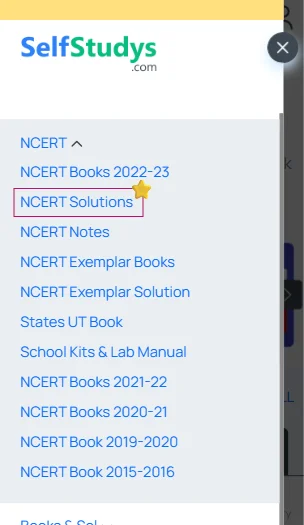
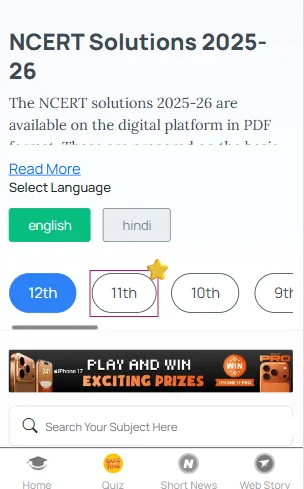
- Now, you can have a look at all the classes for which we provide these solutions and select the ‘Class 11’ option.
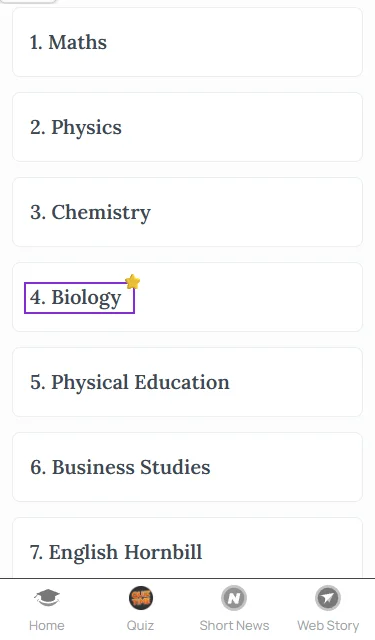
- You will now get a list of subjects wherein you should tap on the ‘Biology’ one to proceed further.
- Finally, all the chapters related to the Class 11 Biology NCERT solutions 2026-27 will be visible on your screen.
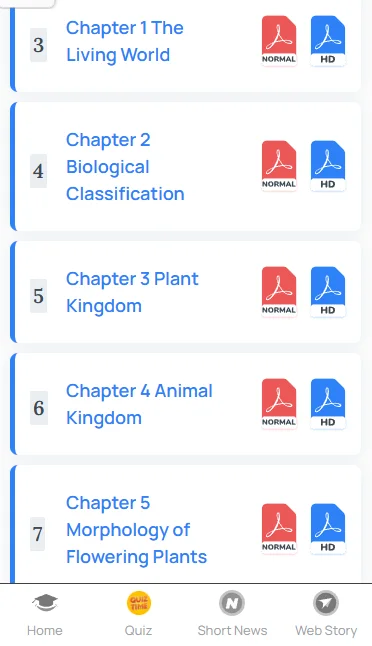
- You can start with any of the Class 11 Biology NCERT solutions PDF and utilize it for higher scores.
Note: Just before you click on the ‘Download PDF’ icon of any Class 11 Biology NCERT book solutions, you will be asked to Sign Up or Log In with your Google account on SelfStudys.
How To Combine Textbook + NCERT Solutions For Class 11 Biology For Maximum Marks?
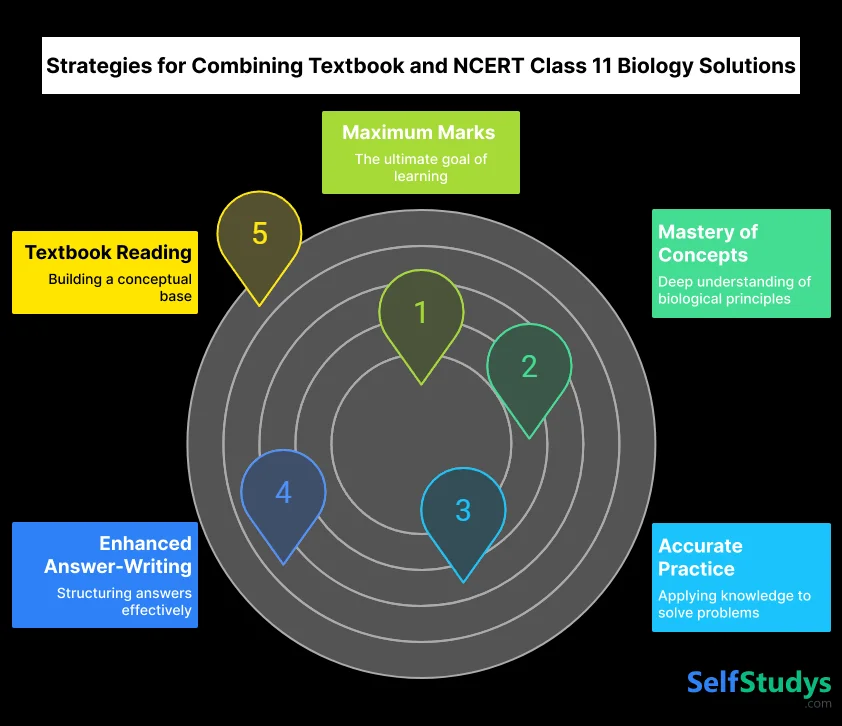
For scoring top marks in this subject, you need to have a strategic approach towards learning. While you will have a foundation of the concepts with the textbooks as well as the NCERT notes, the NCERT Biology Class 11 solutions PDF download will give you structure, clarity, as well as guidance for the exam. And by combining them both, you will be able to master the concepts, practice accurately, enhance your answer-writing skills, and so on. Here are strategies to combine them properly.
-
Firstly, you have to begin with a careful reading of the textbook so that you can understand the definitions, processes, and examples. You should also highlight the diagrams, keywords, and headings as you read them. In this way, you will build a strong conceptual base before you refer to the NCERT solutions for Class 11 Biology.
-
As soon as you read a chapter, you should attempt the questions given in the exercises by yourself. You can write the answers in a notebook by using your understanding. It will encourage you to be active in learning as well as help you find the areas where you might need clarity.
-
Now is the time when you need to compare your answers with the NCERT Class 11 Biology solutions chapterwise and check for accuracy, completeness, correct terminology, and so on. You should also notice how SelfStudys’ solutions structure the answers in a stepwise manner. You have to include any missing points in your notes.
-
The diagrams in the textbooks give you a base, and our latest Biology NCERT solutions for Class 11 enhance them with labels, steps, explanations, etc. You need to make sure that you practice these diagrams during your revision sessions. It will help in improving your retention as well as exam recall.
-
In our Class 11 Biology NCERT solutions, you will find tips for the exam as well as questions that are asked again and again. So, when you revise the topics, you should check which questions link to the textbook sections directly. Then, you must practice them by using these solutions for proper answers.
Conclusion
The Class 11 Biology NCERT solutions 2026-27 are not just a guide to answer the textbook questions. They are a bridge between conceptual understanding and exam excellence. Our experts provide them with clear, accurate, and well-structured explanations with which you can build a strong foundation in the principles of Biology. Furthermore, this resource will also encourage your analytical thinking and curiosity about the living world. By using these solutions on a consistent basis, you will be able to enhance your problem-solving skills, build your confidence, as well as tackle complex problems in an effective manner.
For the effective use of the Class 11 Biology NCERT solutions PDF, it is important that you first attempt the questions by yourself. Then, you should refer to this PDF and verify your responses. With this method, you can find your mistakes and improve your understanding.
In the Class 11 Biology NCERT solutions 2026-27, you will see that every concept is explained in detail along with proper reasoning and examples. Through this approach, you will be able to understand the ‘why’ behind every answer. This will lead you to better conceptual clarity as well as long-term retention.
Yes, in our latest Biology NCERT solutions for Class 11, you will find well-labeled diagrams wherever they are necessary. This is a visual subject, and the diagrams will help you in better understanding as well as scoring marks. With the usage, you can improve your presentation skills for the exams
Absolutely! For your NEET preparation, the NCERT solutions for Class 11 Biology are considered to be extremely beneficial. The questions in the National Eligibility cum Entrance Test are derived mostly from the NCERT textbooks. With the help of these solutions, you can understand the concepts deeply. Their regular usage will also improve your clarity of the concepts and application skills that are required for the competitive exams.
The Class 11 Biology NCERT book solutions are quite effective in scoring higher marks, especially in CBSE exams. This is because most of the questions are directly or indirectly based on the content from the NCERT, and by mastering these solutions, you can make sure to have thorough preparation.


 Home
Home
 Quiz
Quiz
 Short News
 Web Story
 Get latest Exam Updates