


 Sign in


 Profile
 Signout


FREE PDF Download
-
1Chapter 1 Number Systems


-
2Chapter 2 Polynomials
-
3Chapter 3 Coordinate Geometry
-
4Chapter 4 Linear Equations in Two Variables
-
5Chapter 5 Introduction to Euclid's Geometory
-
6Chapter 6 Lines and Angles
-
7Chapter 7 Triangles
-
8Chapter 8 Quadrilaterals
-
9Chapter 9 Areas of Parallelograms and Triangles
-
10Chapter 10 Circles
-
11Chapter 11 Constructions
-
12Chapter 12 Heron's Formula
-
13Chapter 13 Surface Areas and Volumes
-
14Chapter 14 Statistics
-
15Chapter 15 Probability

The highly professional team of subject-matter experts at SelfStudys presents you with the NCERT solutions for Class 9 Maths completely free of cost. In this subject, you need to think through a problem rather than just apply a formula. You have to find the information that is given, choose a proper approach, represent the problem correctly, perform calculations carefully, and then verify whether your answer makes sense or not. This is why you should have access to the solutions and make your everyday practice much more effective.
Here, you will get the NCERT solutions for Class 9 Maths 2026-27 for all the chapters that are included in the new book, ‘Ganita Manjari’. With this, you can understand how to approach the textbook questions in a step-by-step manner. You can also use them to follow the reasoning behind every stage, identify any errors in calculations, as well as learn how to present your work clearly.
Explore Class 9 Maths Study Materials
Use the links given below to access Class 9 Maths study resources, including textbooks, syllabus, worksheets, sample papers, and previous year question papers. These materials can help you strengthen your mathematical concepts, practise different types of questions, and prepare effectively for your examinations.
Chapter-Wise NCERT Solutions For Class 9 Maths 2026-27
On our platform, all eight chapters are solved in the same order as the NCERT Mathematics Class 9 Textbook. In the table below, you can find more information about these chapters and their NCERT solutions for Class 9 Maths PDF.
|
Sr. No. |
Chapter Name |
Details |
|
1 |
Orienting Yourself: The Use of Coordinates |
In NCERT solutions for Class 9 Maths PDF download Chapter 1, you learn how every point in a plane has a unique address consisting of two numbers. You will come to know about two axes, the origin, four quadrants, and the significance of the sign of a coordinate being equal to the value of that coordinate. In this chapter, you are required to do reasoning about what would have happened if negative numbers did not exist. This chapter comes late in the old textbook but is found right in the beginning in the revised version. |
|
2 |
Introduction to Linear Polynomials |
In this chapter, you will come across the topic of polynomials, where the main focus is on linear polynomials. The concepts related to terms, coefficients, degree, linear polynomial, its graph, slope, and intercepts are all discussed. Students most often confuse the slope with the intercept, so our Class 9 Maths NCERT solutions chapterwise identify each one before the working begins. |
|
3 |
The World of Numbers |
This chapter was Chapter 1 in the old textbook but comes in the third position in this book. Here, you progress from rational numbers to irrational numbers and learn that some numbers cannot be expressed as a fraction, and together rational numbers and irrational numbers occupy the real number line. The proof of the irrationality of root two appears here, and it is one of the few places in Class 9 where you argue a result instead of calculating it. |
|
4 |
Exploring Algebraic Identities |
Algebraic identities were in the chapter on polynomials in the previous version of the book but now have been given their separate place. You learn about the expansions of squares and cubes, which identity is used on which expansion, and use them to simplify expressions. Here, it is expected of you to observe the pattern rather than remembering formulas. Our latest Maths NCERT solutions for Class 9 help you in learning how the identity is derived. Therefore, there won't be any confusion about the expansion of a cube. |
|
5 |
I'm Up and Down, and Round and Round |
This chapter has an unusual name but has everything to do with circles. You will learn about the chords, arcs, angles made at the centre and on the circumference, circles passing through the given points, and cyclic quadrilaterals. Nearly everything in this chapter has its converse. Both of them are applied to different problems. This is where maximum marks are deducted because every step has a reason behind it. Therefore, we provide reasons for every step in our solutions. |
|
6 |
Measuring Space: Perimeter and Area |
This chapter covers the topic of perimeter and area of plane figures like triangles in which only the side lengths are known, and no height is given, Heron's formula for this case, quadrilaterals, and problems related to circles. It is the chapter with maximum calculation in Part 1, and forgetting to divide the perimeter by 2 before applying the formula is the biggest mistake. Every step and unit is clearly stated in our NCERT solutions for Class 9 Maths to prevent this mistake. |
|
7 |
The Mathematics of Maybe: Introduction to Probability |
Probability used to be the last chapter of the previous book and was usually covered near the end of the session. However, it has now become the seventh chapter, which means that you will be studying it much sooner than before. In the first place, you arrange the events along a scale from impossible to certain and then determine the likelihood of an event using figures and calculating its probability using the available data. The theory itself is fairly easy, but the problem statements are phrased in such a way that they can easily be misunderstood. |
|
8 |
Predicting What Comes Next: Exploring Sequences and Progressions |
It is an entirely new chapter in Class 9. Here, you examine the sequences of numbers, find the rule that gives rise to these numbers, and find a general expression for it. It is a common mistake among students to jump to the formula. NCERT solutions for Class 9 Maths 2026-27 on this chapter: find the differences between the consecutive terms first and then construct the expression. |
Where Each Chapter Sat In The Old Book
If you are searching for a chapter by its number, then this is the section that you should check first. You need to know that the order in the ‘Ganita Manjari’ is different from the earlier textbook. So, the chapter that you are looking for carries a new number as well as a different name now. In the table below, we have mentioned the old chapters against the new ones so that you can find the NCERT solutions for Class 9 Maths PDF for any chapter quickly.
|
Old Book |
New Book |
|
Chapter 1: Number Systems |
Chapter 3: The World of Numbers |
|
Chapter 2: Polynomials |
Chapter 2: Introduction to Linear Polynomials |
|
Part of Chapter 2: Polynomials |
Chapter 4: Exploring Algebraic Identities |
|
Chapter 3: Coordinate Geometry |
Chapter 1: Orienting Yourself: The Use of Coordinates |
|
Chapter 10: Circles |
Chapter 5: I'm Up and Down, and Round and Round |
|
Chapter 9: Areas of Parallelograms and Triangles, and Chapter 11: Heron's Formula |
Chapter 6: Measuring Space: Perimeter and Area |
|
Chapter 15: Probability |
Chapter 7: The Mathematics of Maybe: Introduction to Probability |
|
Not in the old Class 9 book |
Chapter 8: Predicting What Comes Next: Exploring Sequences and Progressions |
Note: There are two observations to be made at this point. The topic of probability used to come at the end of the book and was studied towards the end of the year. Now, the topic has been brought forward to Chapter 7, and thus, you shall cover it early in the year. On the other hand, the topic of sequences and progressions is something which is introduced to the Class 9 syllabus for the first time.
The rest of the topics, namely linear equations in two variables, Euclid's geometry, lines and angles, triangles, quadrilaterals, surface areas and volumes, and statistics, do not appear in Part 1 of the Ganita Manjari.
How Are Our NCERT Solutions For Class 9 Maths PDF Prepared?
The NCERT solutions for Class 9 Maths PDF download are prepared with a particular method that works and shows how every step leads to the next. Our experts focus on making every solution accurate, logically organized, easy to follow, and useful for both learning as well as revision. Here are more details on how we prepare them.
-
First, we understand what a question is actually asking before deciding how to solve it. This is quite important in Class 9 because the question might test more than one skill. For example, it can be interpretation, calculation, logical reasoning, or the application of a mathematical property. During the Class 9 Maths NCERT solutions chapterwise preparation, we give attention to the information that is provided in the question, what needs to be calculated, the mathematical concept that is involved, whether a diagram, table, expression, etc. is required, the sequence of steps to reach the answer, and so on.
-
Before we select the method, we identify the underlying concept. There might be two questions that look similar but require different approaches. Also, a difficult question may be simple that it seems. The latest Maths NCERT solutions for Class 9 make the connection between the question as well as the concept clear. In this way, you can understand not only how a specific question is solved but also how to recognize similar problems at a later stage.
-
Sometimes, a problem in this subject can be approached in different ways. Our experts focus on selecting a method that is appropriate for your level and aligns with the concept that is being tested. We keep the chosen approach valid, logical, suitable for the question, easy for you to understand, practical, etc. We try not to make the NCERT solutions for Class 9 Maths unnecessarily long and include only the proper reasoning.
-
Our NCERT solutions for Class 9 Maths 2026-27 show the important stages of the calculation or reasoning. We also explain how an expression was transformed, how a value was substituted, how a property was applied, or how one mathematical statement follows from another. In this way, we make the solution useful for learning as well as verifying the answer.
-
Just mentioning a theorem or property is not always enough. You also need to understand why it is relevant to the question. Therefore, the NCERT solutions for Class 9 Maths PDF show where a mathematical property, rule, identity, theorem, relationship, and so on is applied. It also helps to move the solution forward. This will help you develop the habit of asking: ‘which concept to use here and why’ instead of just trying to memorize a fixed procedure for every question.
How To Get The NCERT Solutions For Class 9 Maths PDF Download?
We have explained the steps that you need to follow for getting the NCERT solutions for Class 9 Maths PDF download from our platform below.
- You should first open a web browser and type www.selfstudys.com in the search space.

- Once you are on the website, you have to click on the ‘Navigation’ tab and select the ‘NCERT’ section from the main menu.
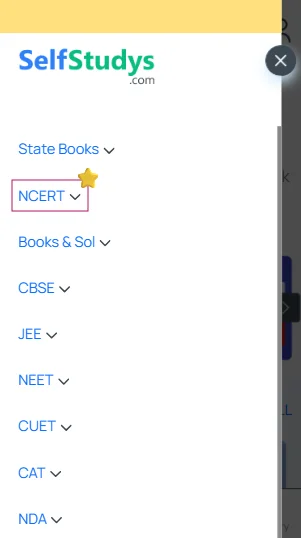
- This will open a list of resources, and you need to select the ‘NCERT Solutions’ option.
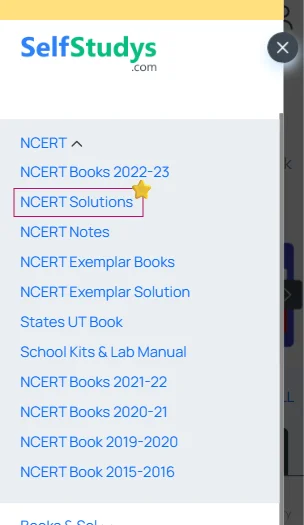
- Now, you can tap on your ‘NCERT Solutions Class 9’ to get the subjects for these solutions.

- Then, you have to click on ‘Maths’ for the latest Maths NCERT solutions for Class 9 for each chapter.

- Finally, you can select any chapter to access its NCERT solutions for Class 9 Maths in HD quality.
Note: Before you download the NCERT solutions for Class 9 Maths 2026-27, you have to Log In or Sign Up on the platform.
Sample Of The Class 9 Maths NCERT Solutions Chapterwise
In this section, we have mentioned a few questions along with their solutions from different chapters of the book. With this, you can see how the method is structured before you download any NCERT solutions for Class 9 Maths PDF.
Chapter 2: Introduction to Linear Polynomials
Question: A farmer cuts a 300 feet fence into two pieces of different sizes. The longer piece is four times as long as the shorter piece. How long are the two pieces?
Solution:
- Step 1: Decide what to call the unknown
Two lengths are unknown, but they are connected, so only one letter is needed. The longer piece is described in terms of the shorter one, so we name the shorter piece.
Let the shorter piece be x feet.
Then the longer piece is 4x feet.
- Step 2: Form the equation
The two pieces together make up the whole fence.
x + 4x = 300
- Step 3: Solve
5x = 300
x = 60
- Step 4: Find both lengths
Shorter piece = 60 feet
Longer piece = 4 × 60 = 240 feet
- Step 5: Check
60 + 240 = 300, and 240 is four times 60. Both conditions hold.
The two pieces are 60 feet and 240 feet.
Chapter 3: The World of Numbers
Question: A merchant in the port city of Lothal is exchanging bags of spices for copper ingots. He receives 15 ingots for every 2 bags of spices. If he brings 12 bags of spices to the market, how many copper ingots will he leave with?
Solution:
- Step 1: Understand the relationship
The exchange rate stays the same, however many bags are brought. So the ratio of ingots to bags does not change.
15 ingots for 2 bags.
- Step 2: Set up the proportion
Let the number of ingots for 12 bags be n.
15 : 2 = n : 12
- Step 3: Solve
Cross-multiplying gives 2n = 15 × 12
2n = 180
n = 90
- Step 4: Check by scaling
12 bags is 6 times 2 bags, so the ingots should also be 6 times.
15 × 6 = 90. This matches.
He will leave with 90 copper ingots.
Chapter 5: I’m Up and Down, and Round and Round
Question: Two parallel chords of lengths 6 cm and 8 cm are on opposite sides of the centre of a circle. If the radius of the circle is 5 cm, find the distance between the midpoints of the chords.
Solution:
- Step 1: Identify the property to use
A perpendicular drawn from the centre to a chord bisects that chord. So the perpendicular distance from the centre reaches the midpoint of each chord, and it splits the chord into two equal halves.
This gives us a right triangle for each chord, with the radius as the hypotenuse.
- Step 2: Find the distance of the 6 cm chord from the centre
Half of the chord = 3 cm, radius = 5 cm.
Let the distance be d₁.
d₁² + 3² = 5²
d₁² = 25 − 9 = 16
d₁ = 4 cm
- Step 3: Find the distance of the 8 cm chord from the centre
Half of the chord = 4 cm, radius = 5 cm.
Let the distance be d₂.
d₂² + 4² = 5²
d₂² = 25 − 16 = 9
d₂ = 3 cm
- Step 4: Combine the two distances
The chords lie on opposite sides of the centre. So the centre lies between them, and the two distances add.
Distance between the midpoints = 4 + 3 = 7 cm
The distance between the midpoints of the chords is 7 cm.
Chapter 7: The Mathematics of Maybe: Introduction to Probability
Question: Rank the following events on a scale from 0 (Impossible) to 1 (Certain). Label each event: Impossible, less likely, equally likely (even chance), more likely, certain. Give reasons why you gave each event its ranking.
-
The next Monday will come after Sunday.
-
It will snow in Mumbai in July.
-
An elephant will walk through your classroom today.
-
You will greet at least one friend at school tomorrow.
Solution:
This question does not ask for a calculation. It asks you to judge how likely each event is and then justify that judgement, so the reason carries as much weight as the label.
- The next Monday will come after Sunday- certain, probability 1
The days of the week follow a fixed order that never changes. Monday always follows Sunday, so there is no situation in which this can fail to happen.
- It will snow in Mumbai in July- Impossible, probability 0
Mumbai lies in a hot coastal region where temperatures stay far above freezing, and July falls in the monsoon season. Snow requires conditions that simply do not occur there, so this event cannot happen.
- An elephant will walk through your classroom today- less likely, close to 0
This is not impossible, since an elephant could in principle enter a classroom, and it has happened in a few places near forests. But for almost every school, it is extremely unlikely, so it sits very close to zero without actually being zero.
- You will greet at least one friend at school tomorrow- more likely, close to 1
If you go to school, you will almost certainly meet and greet at least one friend, since that is what happens on an ordinary day. It is not certain, because you might be absent or your friends might be, so it stays a little below 1.
Common Mistakes To Avoid With The Latest Maths NCERT Solutions For Class 9
The questions of this subject require you to combine calculation, reasoning, formulas, diagrams, logical steps, and so on. As a result, it does not mean that you don’t understand an entire concept if you get a wrong answer. Sometimes, a few small mistakes in reading the question, choosing a method, drawing a figure, etc. can affect the final result. The NCERT solutions for Class 9 Maths PDF download are quite useful in such situations. With them, you can compare your approach with a proper solution and find the step where it's different. Some more mistakes and how to avoid them are mentioned in detail below.
|
Chapter Name |
Common Mistake |
How to Avoid It |
|
Orienting Yourself: The Use of Coordinates |
The writing of the vertical value first such that (4, 3) and (3, 4) are viewed as one. |
Horizontal distance comes first always. Name the pair as "across, then up" before writing it. |
|
Introduction to Linear Polynomials |
Confusion between slope and the y-intercept in a linear expression. |
The number that comes with x represents the slope. The number without x is the intercept. The Class 9 Maths NCERT solutions chapterwise denote both on the expression before solving. |
|
The naming of the incorrect quantity as the x in a word problem. |
Name the quantity in terms of which the other is expressed. In case the longer piece is four times the shorter, the shorter piece should be named. |
|
|
The World of Numbers |
Multiplication with the wrong value in case there is a rate of two items and not one. |
Note which rate is given. In case 15 ingots cost 2 bags, then 12 bags cost six times 2 bags, and not twelve times. |
|
Rote learning of the root two proof and inability to apply it to root three. |
Understand the structure of the proof and not the sentences used. It is assumed that it can be represented as a fraction, a contradiction is drawn, and the conclusion is made. The three steps work equally well for any of the statements. |
|
|
Exploring Algebraic Identities |
Expansion of the cube of the sum as a sum of the cubes; the most common error in Class 9. |
Derive the expansion twice independently by expanding the brackets. The latest Maths NCERT solutions for Class 9 derive the formula rather than use an identity so that the middle term is not lost in the process. |
|
Considering the identity of the difference as addition with a minus sign. |
These are two distinct formulas. Both of them are to be written side by side and the differences in signs noted carefully. |
|
|
I'm Up and Down, and Round and Round |
Addition of the two chord lengths when the chords are on the same side as the center, subtraction of the two chord lengths when on the other side of the center. |
This phrase in the problem is important to remember. The opposite sides mean that the center lies between the chords; therefore, their distances are added. On the contrary, the same side means that they are subtracted. |
|
Usage of a particular result where the converse of the result should be used. |
Almost all results have their converses. One should see what is given and what needs to be proven and pick the appropriate statement. The NCERT solutions for Class 9 Maths mention the reason for each step for this purpose. |
|
|
Measuring Space: Perimeter and Area |
Usage of the total perimeter in Heron’s formula instead of the semi-perimeter. |
The semi-perimeter is half the sum of all sides. This value should be computed first separately from the rest of the expression. |
|
Forgetting the units in between or at the end, such that an area is given in cm instead of square cm. |
The unit should accompany each step of the computation. The NCERT solutions for Class 9 Maths 2026-27 always include the unit in order to instill the good practice. |
|
|
The Mathematics of Maybe: Introduction to Probability |
The tagging of a low-likelihood event as impossible. |
The event is impossible if and only if it cannot occur under any circumstances. Even though an elephant entering the classroom is extremely unlikely, it is still not impossible; therefore, it is near zero but not at zero. |
|
Tagging of the label without the reason. |
The problem asks to justify the ranking; therefore, the reason holds the marks. You should explain in the solution why the particular event is positioned where it is. |
|
|
Predicting What Comes Next: Exploring Sequences and Progressions |
Applying the formula without considering how the pattern works. |
Find the difference of two consecutive terms first. In NCERT solutions for Class 9 Maths PDF, this is done before building a general expression. |
Tips To Use The NCERT Solutions For Class 9 Maths Effectively
The NCERT solutions for Class 9 Maths PDF download will be much more valuable when you use them as a learning tool and not just a shortcut to complete the exercises. You should use it to understand the approach to a question, find the concept being tested, compare different steps, locate your mistakes, as well as learn how to present the reasoning. Here are some methods that can help you get more value from every solution.
-
The first step you should always take is to attempt the problem by yourself. You should write down what is given, identify what needs to be found, and think about the relevant concepts even if a question seems difficult. You don’t have to complete the entire question before referring to the Class 9 Maths NCERT solutions chapterwise. You just need to understand where you are getting stuck. Once you know the exact difficulty, the solution will be more useful.
-
You need to ask which mathematical idea the question is testing rather than just what the answer is. You should look at the information that is provided and determine what the question requires. It can be calculation, algebraic manipulation, geometric reasoning, interpretation, a particular property, or another mathematical approach. Once you find the concept, you can use the latest Maths NCERT solutions for Class 9 to confirm or correct your thinking.
-
You do not always have to read all the NCERT solutions for Class 9 Maths from start to end. If you are stuck after two or three steps, then you should look only at the next part of the solution. It is important that you understand what move has been made and then return to your question. For example, you can attempt > get stuck > check the next step > understand it > continue by yourself.
-
Once you have attempted the questions, you should place your response alongside the NCERT solutions for Class 9 Maths 2026-27. Then, you have to compare them very carefully. You need to check how the question was interpreted, which information was used, which concept was selected, how the calculation was started, how expressions were simplified, which property or formula was applied, and so on. This way, you might find that your method is also correct even though it looks different from the given solution. You will become more confident in your own reasoning.
-
If your answer is incorrect, then you should not erase everything and copy the NCERT solutions for Class 9 Maths PDF. You have to locate the first step that is different from the solution. This is the most useful part of checking the answer because it tells you what actually went wrong. You will also be able to make your error correction more precise and then go through the NCERT Class 9 Maths Notes.
Conclusion
With the help of the NCERT solutions for Class 9 Maths PDF download from SelfStudys, you can make your learning process more structured by moving beyond just the final answer. When you use them properly, you will understand the approach behind the question, follow important steps, identify any mistakes, as well as learn how a concept can be applied to different problems. You should use these solutions to compare your own attempts, understand where you went wrong, and develop better problem-solving habits rather than treating them as something to copy.
Yes, the latest Maths NCERT solutions for Class 9 can be quite useful even if you are weak in this subject. If you find the questions difficult, then you can study the solution step by step to see how the problem is divided into smaller parts. With them, you can find your recurring mistakes as well as understand the concepts at your own pace.
Ideally, you should attempt every question before opening the NCERT solutions for Class 9 Maths 2026-27. First, you have to read the question carefully, identify what is given as well as what needs to be found, and try to solve it by yourself. If the answer is incorrect or you get stuck, then you can refer to the relevant solution.
Yes, the NCERT solutions for Class 9 Maths PDF download can make difficult questions easier to understand. They break down the answer into logical as well as manageable steps. By studying the solution carefully, you can compare the explained method with your own attempt.
Absolutely! The Class 9 Maths NCERT solutions chapterwise can be quite useful for targeted revision when you have limited time for the exam. Rather than reading every solution, you should first find the chapters, concepts, and types of questions that require the most attention. You also need to focus on the questions that you answered incorrectly or could not solve by yourself.
The best study routine to use the NCERT solutions for Class 9 Maths is by following a five-stage plan. It includes learning, attempting, comparing, correcting, and reattempting. By repeating this process with all the questions, you will be able to develop independent problem-solving habits.


 Home
 Quiz
 Short News
 Web Story
 Get latest Exam Updates