Let q be the charge on capacitor plates, then required ratio \(=\frac{\frac{\mathrm{q}}{\mathrm{K}_{1} \varepsilon_{0} \mathrm{A}} \cdot \mathrm{a}}{\frac{\mathrm{q}}{\mathrm{K}_{2} \cdot_{0} \mathrm{A}} \cdot \mathrm{b}}=\frac{\mathrm{K}_{2} \mathrm{a}}{\mathrm{K}_{1} \mathrm{b}}\)
KEY CONCEPTS
Parallel Plate Capacitor Parallel Plate Capacitor It consists of two parallel metallic plates (may be circular, rectangular, square) separated by a small distance
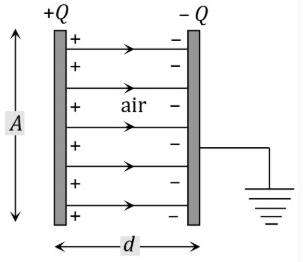
\(A=\) Effective overlaping area of each plate \(\mathrm{d}=\) Separation between the plates \(Q=\) Magnitude of charge on the inner side of each plate \(\sigma=\) Surface density of charge of each plate \(\left(=\frac{Q}{A}\right)\) \(\mathrm{V}=\) Potential difference across the plates \(\mathrm{E}=\) Electric field between the plates \(\left(=\frac{\sigma}{\varepsilon_{0}}\right)\) Capacitance : \(\mathrm{C}=\frac{\varepsilon_{0} A}{d}\) in \(\mathrm{C} . \mathrm{G}\). S. \(\cdot \mathrm{C}=\frac{A}{4 \pi d}\) If a dielectric medium of dielectric constant \(\mathrm{K}\) is filled completely between the plates then capacitance increases by \(\mathrm{K}\) times \(C^{\prime}=K C\)
Dielectric Dielectric
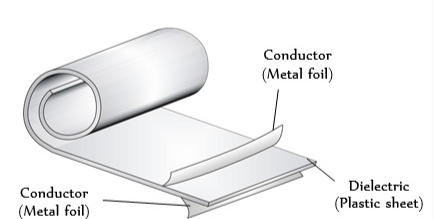
Dielectrics are insulating (non-conducting) materials which transmits electric effect without conducting.
Dielectrics are of two types
(1) Polar dielectrics: A polar molecule has permanent electric dipole moment ( \(\rho\) ) in the absence of electric field also, But a polar dielectric has net dipole moment zero in the absence of electric field because polar molecules are randomiy oriented as shown in figure.
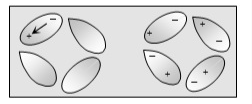
In the presence of electric field polar molecules tends to line up in the direction of electric field,
and the substance has finite dipole moment e.g. water, Alcohol, \(C O_{2}, N H_{3}, H C I\) etc. are made of polar atoms/molecules
(2) Non polar dielectric: In non-polar molecules, each molecule has zero dipole moment in its normal state. When electric field is applied, molecules becomes induced electric dipole e.g. \(\mathrm{N} 2, \mathrm{O} 2,\) Benzene, Methane etc. are made of non-polar atoms molecules
In general, any non-conducting, material can be called as a dielectric but broadly non conducting material having non polar molecules referred to as dielectric.





 Get latest Exam Updates


 ×





 Sign in


 Profile
 Signout