


 Sign in


 Profile
 Signout
 No Hidden Charges, 100% Free

JEE Main Rank Predictor 2026 Free, Marks or Percentile
Predict your Get accurate rank predictions using our JEE Main rank predictor. The tool showcases your probable rank based on your expected JEE marks or percentile before the release of the actual results. This tool runs on an advanced data-driven algorithm that our engineers have developed for your help. In fact, more than 76,000 JEE 2026 aspirants have already predicted their rank using the SelfStudys Engineering Rank Predictor. This tool is 100% free.
The rank predictor JEE Main 2026 offers great help in planning the next steps you can take. For instance, the estimated rank tells you whether you should plan for counselling sessions, prepare for JEE Advanced, or wait for another attempt. This saves time and helps you move quickly into the next phase. However, no tool is a hundred percent accurate, so do not make impulsive decisions based on the predicted rank.
Key Features:
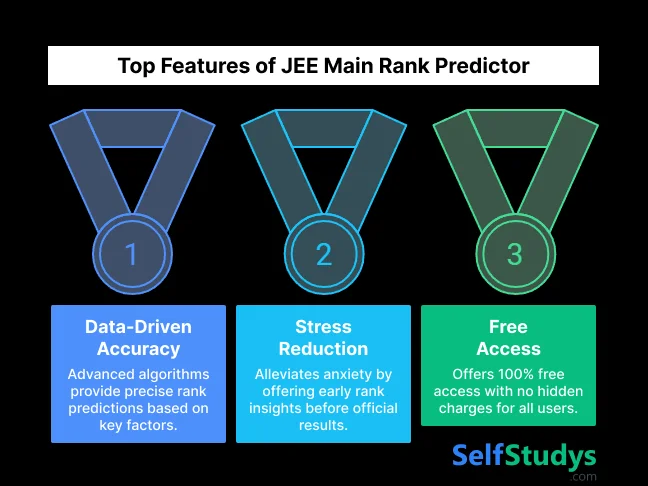
Data-driven rank prediction: Our JEE Main rank predictor from percentile is designed to use advanced algorithms that analyse your estimated marks or percentile, category, seat pool (gender), and 12th-class domicile to generate one of the closest and most accurate rank predictions.
Reduces Anxiety or Stress: The JEE Main rank predictor 2026 by percentile is developed to help you reduce your stress about knowing your AIR (All India Rank) before the release of the official results.
100% Free: We have a ‘no hidden charges’ policy, which makes our JEE Main rank predictor category wise 100% free to use.
Get a Personalised Experience: To be precise and offer a personalised experience, our JEE Main 2026 rank predictor asks you to log in to SelfStudys and verify your mobile number.
What is the JEE Main Rank Predictor
The JEE Main rank predictor from marks is an online calculator that estimates your expected All India Rank (AIR) in the exam using your marks or percentile. It helps you understand where you might stand among lakhs of candidates before the official results are announced. After attempting JEE Main, you can calculate your approximate marks from the answer key, which you can then use in the tool to know the following:
Your percentile
Your expected rank (AIR)
How JEE Main Rank Predictor Work?
SelfStudys JEE Main rank predictor 2026 category wise uses a data-driven analysis algorithm to estimate a student's rank. Our tool considers multiple factors to provide an accurate prediction. These are the key factors considered:
Normalization Logic: The JEE Main rank predictor mimics the NTA’s multi-session normalization process. This method helps the system to convert raw marks into a percentile score so that students from different shifts can be compared fairly.
Historical Data Analysis: Our rank predictor JEE Main 2026 also compares your raw marks with 5–7 years of past ‘Marks vs Percentile’ and ‘Percentile vs Rank’ trends.
Competition Density: This is a core part of the JEE Main rank predictor from percentile tool. The system attempts to estimate the total number of candidates (expected to exceed 16 lakh in 2026) to calculate the rank using this formula:
Estimated Rank = (100-Percentile) x Total Candidates / 100
Category-Specific Logic: To provide a more precise ‘Category Rank’ estimate, our JEE Main rank predictor 2026 by percentile considers quotas (OBC-NCL, SC, ST, EWS) and Home State preferences.college with JEE Main scores.
How to Use JEE Main 2026 Rank Predictor (Step-by-step Guide)
The JEE Main rank predictor category wise by SelfStudys, helps you estimate your probable rank based on your expected score in the exam. Using previous years’ data, difficulty level analysis, and normalisation trends, our tool gives a quick prediction. Follow the steps below to use it for free:
Step 1: Visit the SelfStudys Website
Open your internet browser and go to the official SelfStudys.com website. On the homepage, navigate to the 'Rank Predictor' link from the menu section.


Step 2: Select a Course & Exam
The 'Rank Predictor' link will lead you to a page where you need to select a course (e.g., B.Tech) and the exam name (e.g., JEE Main). This will open the JEE Main 2026 rank predictor tool.


Step 3: Enter Your Expected Marks
In the input fields provided on the JEE Main rank predictor from marks page, enter your expected score out of 300. You can calculate your expected marks using your answer key and response sheet.
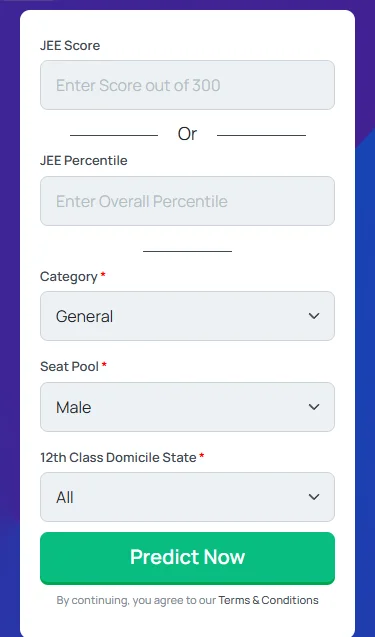
Step 4: Provide Additional Details
To offer a more accurate rank, our JEE Main rank predictor from marks requires some extra details, such as:
Category (General, OBC, SC, ST, etc.)
Seat Pool (Male, Female, Other)
12th Class Domicile State (Choose your state)
Step 5: Click on the “Predict Now” Button
After entering all the required information, click the “Predict Now” button. You will be asked to log in or Sign Up. Sign up quickly if you do not already have an account. Ensure you verify your mobile number to get a more personalised experience.
Step 6: View Your Predicted Rank
Within seconds, the JEE Main rank predictor 2026 category wise will display your estimated All India Rank (AIR) along with a possible rank range.
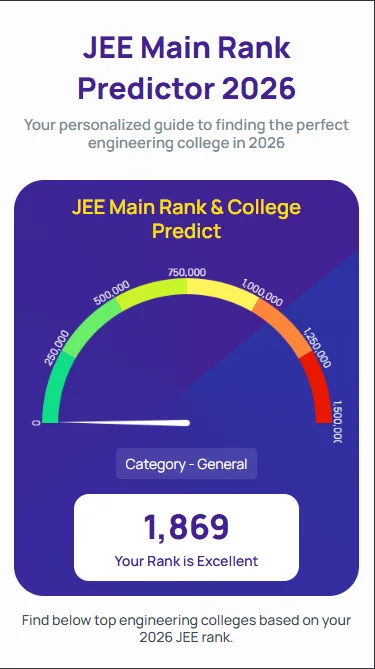
Step 7: Analyse Your Result
Use the predicted rank to:
Estimate your chances of getting into NITs, IIITs, and GFTIs.
Plan your JoSAA counselling choices.
Decide if you should continue preparation for the next attempt.
Note: SelfStudys' JEE Main rank predictor gives an estimate based on available data. Actual ranks may vary.
JEE Main Rank Predictor 2026 Category Wise
The category you belong to matters when it comes to JEE Main exam ranking predictions. To provide you with a more precise estimate of your rank based on your category, our rank predictor JEE Main 2026 input field asks you to enter your category. This also helps us deliver the estimated rank specific to the reservation criteria. Below is the table indicating the predicted rank range for each category.
JEE Main Rank Predictor (Category-wise) | |
Category | Predicted Rank Range |
General | 14,500 – 15,000 |
OBC | 3,800 – 4,500 |
SC | 800 – 1,200 |
ST | 350 – 500 |
JEE Main Percentile vs Rank Analysis
Previous data are an important part of the JEE Main rank predictor from percentile algorithms, which allow the tool to predict ranks accurately. The SelfStudys Rank Predictor considers previous exam trends to decide how percentile scores are converted into ranks.
Because the number of applicants increases every year, the rank linked with a specific percentile often increases. By studying several years of data, the SelfStudys JEE Main rank predictor 2026 by percentile provides a reliable estimate that closely reflects real ranking patterns. Below is the expected analysis for 2026 based on current session trends:
JEE Main Percentile | Estimated AIR Range (2026) | Note |
99.9+ | 1 – 1,500 | Top 0.1% candidates; Eligible for top NITs (CSE) |
99.5 | 1,501 – 7,500 | Very Competitive. It’s best for IIITs/NITs |
99.0 | 7,501 – 15,000 | Safe for Tier-1 NITs (Core branches) |
98.0 | 15,001 – 30,000 | Good for mid-tier NITs/IIITs |
97.0 | 30,001 – 45,000 | Mid-to-Lower tier NITs or GFTIs |
95.0 | 45,001 – 75,000 | Competitive for GFTIs and State Colleges |
93.3 – 94.0 | 75,001 – 1,00,000 | General Category Qualifying Cutoff Zone |
JEE Main Rank 2026: Marks vs All India Rank (AIR)
Many candidates are excited to know what their All India Rank (AIR) could be if they score particular marks out of 300. Therefore, we have shared this table, which represents the total raw marks (out of 300) required to hit specific rank brackets. Note that these are averages; a tough shift in the JEE Main exam may help you get a better rank with lower marks.
Raw Marks (Out of 300) | Expected AIR (2026) | Status |
285 – 300 | 1 – 100 | Topper Zone |
260 – 284 | 101 – 1,000 | Exceptional |
230 – 259 | 1,001 – 5,000 | Highly Competitive |
200 – 229 | 5,001 – 15,000 | Very Good |
170 – 199 | 15,001 – 35,000 | Good |
140 – 169 | 35,001 – 65,000 | Average |
110 – 139 | 65,001 – 1,10,000 | Qualifying Zone |
Below 100 | Above 1,20,000 | Participation Zone |
JEE Main 2026 Rank Predictor: Marks vs Percentile
Candidates who have calculated their scores using the JEE Main 2026 answer keys will find this table very helpful, as it represents Marks vs Percentile. This table will help you understand how raw marks convert into an NTA percentile across various difficulty levels.
Expected Percentile | Marks (Tough Shift) | Marks (Average Shift) | Marks (Easy Shift) |
99.9 | 245+ | 265+ | 285+ |
99.5 | 210 – 225 | 230 – 245 | 255 – 270 |
99.0 | 175 – 190 | 195 – 210 | 220 – 235 |
98.0 | 155 – 170 | 175 – 190 | 200 – 215 |
97.0 | 140 – 155 | 160 – 175 | 185 – 195 |
95.0 | 115 – 125 | 135 – 145 | 160 – 170 |
90.0 | 85 – 95 | 105 – 115 | 130 – 140 |
Note: In the JEE Main 2026 Session 1, Mathematics was lengthy and complex. If you have scored higher in Maths, your percentile may be a little higher than the average for those marks because of the tie-breaking rules.
What Rank is Good in JEE Main
A good rank in JEE Main depends on your target college and branch. However, there are certain rank ranges that generally offer better admission opportunities. Here is a standard rank range for the Unreserved (General) category:
1. JEE Main Rank Under 5,000 (Excellent)
Candidates who get a rank under 5,000 have strong chances of getting admission into top-tier NITs like Trichy, Surathkal, or Warangal. For such candidates, admission to Computer Science (CSE) is guaranteed.
2. JEE Main Rank 5,000 – 15,000 (Very Good)
Candidates who have secured a rank within this range can get admission into core branches at top NITs or CSE at reputable IIITs like IIIT Allahabad or Lucknow.
3. JEE Main Rank 15,000 – 35,000 (Good)
With this rank range, it is possible to get into Tier-2 NITs (Mechanical, Electrical) and several newer IIITs.
4. JEE Main Rank 35,000 – 60,000 (Decent)
Many candidates within this rank range lose hope, but they still have opportunities to pursue engineering in various government institutes and reputable private engineering colleges that participate in JoSAA Counselling.
Advantages of Using Rank Predictor JEE Main 2026
The use of the JEE Main 2026 rank predictor offers several benefits for candidates after appearing for the exam or while estimating their test performance. Here are the key benefits:
Understand Your Standing: Using your raw marks or percentile, you can understand where you stand among millions of JEE Main candidates with the JEE Main rank predictor from marks.
College Shortlisting: Once you know the predicted rank through the JEE Main rank predictor 2026 category wise, you can check which colleges you might get into—for instance, NITs, IIITs, or GFTIs. This information also helps you prepare your JoSAA counselling preference list early.
Strategic Decision Making: JEE Main has two sessions (January & April). Using the JEE Main rank predictor, you can determine whether to attempt Session 2 or not. If the predicted rank is lower than your target, you can decide to improve your preparation and retake the exam in the April session. This saves you a lot of time, too.
Realistic Expectations: Most candidates expect their ranks to be very high, but a JEE Main rank predictor tool shows a realistic rank range. This helps you prepare for backup college options and plan for alternate exams or state counselling.
Limitations of JEE Main Rank Predictor
Although the rank predictor JEE Main 2026 is very useful, it is important for you to understand the tool's limitations. Check out these points:
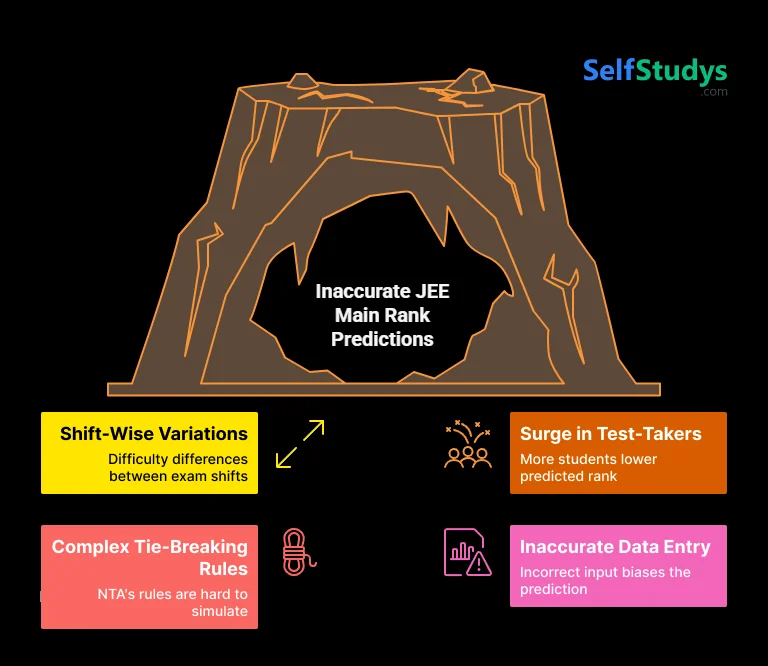
Shift-Wise Variations: A JEE Main rank predictor from percentile tool may not capture if one specific exam shift was harder than others, which leads to a percentile jump. Variations in shift-wise difficulty are one of the strongest flaws of a rank predictor.
Surge in Test-Takers: If the JEE Main rank predictor 2026 by percentile tool has been prepared based on data of the number of test-takers, then a surge in the actual number of test-takers can alter your rank. In fact, in this case, your actual rank will be lower than predicted.
Complex Tie-Breaking Rules: For JEE Main rank predictor category wise algorithms, it is almost impossible to simulate the actual tie-breaking rules that the NTA (National Testing Agency) uses. The NTA uses subject-wise performance (Maths > Physics > Chemistry) and age to break ties.
Inaccurate Data Entry: If a candidate submits inaccurate marks or an incorrect percentile into the JEE Main 2026 rank predictor tool, the final outcome may be biased because tools rely on student-submitted details.
Conclusion
The SelfStudys JEE Main rank predictor from marks is a helpful tool that helps you estimate your expected rank in the Joint Entrance Examination (Main) using your percentile or marks out of 300. Our tool uses past exam data and rank trends to provide a realistic prediction that helps students like you to understand their admission chances. By using our Rank Predictor, you can plan your next steps early, shortlist colleges, and prepare for JoSAA Counselling with confidence. Just enter your percentile score or marks into the tool, along with a few more details as requested, to know your expected rank in JEE Main 2026 instantly.
A JEE Main rank predictor 2026 category wise is an algorithm-based tool that helps you know the estimated All India Rank (AIR) before the official results are released. To predict rank, our tool uses data-driven algorithms to compare your expected marks or percentile with historical trends, the total number of applicants, and session-wise difficulty levels.
SelfStudys' rank predictor JEE Main 2026 offers 90–95% accuracy. However, no tool can guarantee 100% accuracy, and your estimate may differ from the official result.
To get the most accurate estimate from the JEE Main rank predictor 2026 by percentile, you need to provide:
- Expected raw marks (out of 300) or estimated percentile.
- Category (General, OBC-NCL, EWS, SC, ST).
- Seat pool (Male, Female, Other).
- 12th Class domicile state.
Yes. In fact, the JEE Main 2026 rank predictor has an ‘Expected Cut-off’ feature. For 2026, the qualifying percentile for the General category is expected to be around 93.5–95.0.
A percentile is a reflection of your relative performance. For example, a 99th percentile means you scored better than 99% of candidates in your session. On the other hand, AIR is the exact position you achieved among all candidates nationwide. For example, Rank 5,000 means 4,999 students scored higher than you.
CRL stands for Common Rank List, which represents your rank among all students in India. Category rank indicates your rank only among students in your specific category (e.g., SC/ST/OBC). To secure reserved seats in NITs and IIITs, the category rank is crucial.


 Get latest Exam Updates