


 Sign in


 Profile
 Signout

FREE PDF Download
-
1Mathematics 2026 Set - 1


-
2Mathematics 2026 Set - 2
-
3Mathematics 2026 Set - 3
-
4Mathematics 2026 Set - 4
-
5Mathematics 2026 Set - 5
-
6Mathematics 2026 Set - 6
-
7Mathematics 2026 Set - 7
-
8Mathematics 2026 Set - 8
-
9Mathematics 2026 Set - 9
-
10Mathematics 2026 Set - 10
-
11Mathematics 2025 Set - 1
-
12Mathematics 2025 Set - 2
-
13Mathematics 2025 Set - 3
-
14Mathematics 2025 Set - 4
-
15Mathematics 2025 Set - 5
-
16Mathematics 2025 Set - 6
-
17Mathematics 2025 Set - 7
-
18Mathematics 2025 Set - 8
-
19Mathematics 2025 Set - 9
-
20Mathematics 2025 Set - 10
-
21Mathematics 2025 Set - 11
-
22Mathematics 2025 Set - 12
-
23Mathematics 2025 Set - 13
-
24Mathematics 2025 Set - 14
-
25Mathematics 2025 Set - 15
-
26Mathematics 2024 Set 6
-
27Mathematics 2024 Set 7
-
28Mathematics 2024 Set 8
-
29Mathematics 2024 Set 9
-
30Mathematics 2024 Set 10
-
31Maths 2024 Set 1
-
32Maths 2024 Set 2
-
33Maths 2024 Set 3
-
34Maths 2024 Set 4
-
35Maths 2024 Set 5
-
36Maths 2023 Set 1
-
37Maths 2023 Set 2
-
38Maths 2023 Set 3
-
39Maths 2023 Set 4
-
40Maths 2023 Set 5
-
41Maths 2023 Set 6
-
42Maths 2023 Set 7
-
43Maths 2023 Set 8
-
44Maths 2023 Set 9
-
45Maths 2023 Set 10
-
46Maths 2023 Set 11
-
47Maths 2023 Set 12
-
48Maths 2023 Set 13
-
49Maths 2023 Set 14
-
50Maths 2023 Set 15


Maths is such a subject in Class 9 that rewards when you do consistent practice as well as a clear understanding of the topics. With a strong foundation, you will not only achieve good marks in the exam but also prepare yourself for the higher classes. One resource that will help you test your learning and improve your exam performance is the CBSE Class 9 Maths sample paper on the digital platform of SelfStudys. By solving it, you can apply the concepts in a structured exam-like format and gain valuable practice before the actual examination.
Moreover, the CBSE Class 9 Maths sample paper 2026-27 comes up with a variety of questions from different chapters. This enables you to revise the complete syllabus as well as get familiar with the style and pattern of questions. As you keep solving more CBSE Class 9 Sample Papers, you will develop better problem-solving skills, learn to manage your time efficiently, gain confidence to tackle challenging questions, and so on.
Highlights Of The CBSE Class 9 Maths Sample Paper 2026-27
The team of subject-matter experts at SelfStudys designs the CBSE Class 9 Maths SQPs to provide you with a real exam-like experience and help you revise the important topics. You need to remember that the Central Board of Secondary Education does not release these papers officially. In the table below, we have mentioned the highlights of this resource in detail.
|
PARTICULARS |
DETAILS |
|
Name of the Resource |
Class 9 CBSE sample paper Maths |
|
Board |
Central Board of Secondary Education (CBSE) |
|
Class |
9th |
|
Subject |
Mathematics |
|
Format |
PDF (Printable and Downloadable) |
|
Language |
English |
|
Duration |
3 hours |
|
Total Marks |
80 |
|
Availability |
Free to access and download |
|
Number of Sets |
Multiple sample question paper for Class 9 CBSE Maths sets |
|
Question Type |
Objective, short answer, and long answer questions |
|
Syllabus Coverage |
Complete CBSE Class 9 Maths Syllabus |
|
Difficulty Level |
Easy to Moderate and Moderate to Advanced |
|
Best For |
Revision, self-assessment, unit tests, half-yearly, and annual exam preparation |
|
Mode of Practice |
Online viewing and offline PDF practice |
|
Recommend Users |
CBSE Class 9 students, teachers, and parents |
|
Primary Objective |
Revise concepts, improve accuracy, and prepare confidently for the examinations |
Multiple CBSE Class 9 Maths SQPs Sets
On our website, you can access multiple sets of the sample question paper for Class 9 CBSE Maths completely free of cost. With their help, you can have comprehensive practice throughout the academic year. Every set has a unique collection of questions that cover the complete syllabus. It further allows you to exercise different question patterns as well as levels of difficulty. For your benefit, we have mentioned all the direct links to these sets below.
What’s New In The Class 9 CBSE Sample Paper Maths?
The curriculum of Class 9 Maths for the current academic session has been redesigned by the CBSE board. You should know that this is not a minor revision and affects what you will find in the CBSE Class 9 Maths sample paper 2026-27. Here are some key changes that you need to know before you start with your practice.
-
Curriculum realigned with NCF-SE 2023: The new syllabus now follows the National Curriculum Framework for School Education 2023 and NEP 2020. Now, the focus has shifted to understanding concepts, logical reasoning, as well as computational thinking, from memorizing formulas.
-
New NCERT textbook: Maths in Class 9 is now taught from Ganita Manjari, and it replaces the earlier textbook. The names of the chapters, sequence, examples, etc. have changed accordingly.
-
Three new chapters: Sequences and Progressions, Exploring Algebraic Identities, and Introduction to Probability have been added. Moreover, Heron’s Formula has been included in a broader chapter on Area and Perimeter.
-
Chapters removed: The Areas of Parallelograms and Triangles have been removed from the syllabus. Constructions is also gone, and Surface Areas and Volumes has shrunk to just spheres, hemispheres, and cones — cubes, cuboids, and cylinders have moved out.
-
Units reduced to six: The syllabus is now organized into six units instead of seven. Statistics and Probability will appear as Unit VI.
-
More competency-based questions: Now, the paper is focused more on case study, assertion-reasoning, as well as application-based questions. Around 22% of the paper is now dedicated to analyzing, evaluating, and creating. 24% is on application and 54% on remembering as well as understanding.
-
Indian knowledge systems integrated: This revised curriculum includes contributions of Indian mathematicians. So, you might face contextual questions that are built around historical methods and real-life Indian settings.
CBSE Class 9 Maths Exam Pattern And Marking Scheme
In this subject’s exam, the theory paper is for 80 marks, which you need to complete in 3 hours. The remaining 20 marks will come from internal assessment that is conducted by your school throughout the year. In the table below, you will get the full details of the pattern and the marking scheme.
|
Section |
Question Type |
No. of Questions |
Marks Each |
Total Marks |
|
A |
Objective (MCQs and Assertion-Reason) |
20 |
1 |
20 |
|
B |
Very short answer |
5 |
2 |
10 |
|
C |
Short answer |
6 |
3 |
18 |
|
D |
Long answer |
4 |
5 |
20 |
|
E |
Case study/ Source-based |
3 |
4 |
12 |
|
Total |
- |
38 |
- |
80 |
Note: The internal choice is usually provided in a few questions of Sections B, C, D, and E. The remaining 20 marks are awarded as follows.
|
Component |
Marks |
|
Pen and paper test and multiple assessment |
10 |
|
Portfolio |
5 |
|
Lab practical (activities from prescribed books) |
5 |
|
Total |
20 |
How Does Sample Question Paper For Class 9 CBSE Maths Improve Concept Retention?
By just reading the CBSE Class 9th Maths Formula Sheet or revising examples from the textbooks, you cannot remember the mathematical concepts. For this, you need continuous application of whatever you have learned. This is where the CBSE Class 9 sample paper Maths will become your learning resource in an effective way. In this section, we have mentioned some more points on how this resource will improve your retention of the concepts.
-
During the sample paper Maths Class 9 CBSE practice, you need to solve questions without referring to any textbooks or CBSE NCERT Class 9 Maths Notes PDF immediately. The process of recalling formulas, concepts, as well as the methods, you will be able to retain the information for a longer period of time.
-
Many questions in this subject involve knowledge from more than one chapter. When you solve the CBSE Class 9 Maths sample paper with solution, you will learn to combine concepts like algebra, geometry, statistics, etc. wherever needed. Through this integrated approach, you can create stronger conceptual links as well as improve your overall understanding.
-
The mathematical concepts that are important appear in different forms across multiple sets of the CBSE Class 9 Maths sample paper PDF. By solving these varied questions that are based on the same topics, you can apply the concept again and again. In this way, they will become familiar as well as easier to remember during the exams.
-
Maths is a subject that is based on logical reasoning rather than rote learning. Through the CBSE Class 9 Maths sample paper PDF download practice, you will be able to analyze the given information, select the appropriate method, and solve the problems step by step. Then, by repeating this process, you can develop a structured thinking pattern that will support your retention of the concepts.
-
While attempting the CBSE Class 9 Maths sample paper, you will notice the chapters or question types that you struggle with quickly. In this way, you can revisit specific concepts, clear your doubts, reinforce your thinking, and so on before moving on to more advanced practice.
Unit-Wise Weightage And Syllabus For The Sample Paper Maths Class 9 CBSE
The syllabus of Maths in Class 9 is prepared to develop your understanding of concepts, logical reasoning, and problem-solving abilities. It covers all the fundamental topics as well as forms the foundation for higher-level Maths in Classes 10, 11, and 12. Here is a detailed list of all the units that are a part of the syllabus along with their mark distribution.
Unit-Wise Marks Distribution
|
Unit |
Unit Name |
Marks |
|
I |
Number System |
7 |
|
II |
Algebra |
20 |
|
III |
Coordinate Geometry |
4 |
|
IV |
Geometry |
25 |
|
V |
Mensuration |
14 |
|
VI |
Statistics and Probability |
10 |
|
|
Theory Total |
80 |
|
Internal Assessment |
20 |
|
|
Grand Total |
100 |
Chapter-Wise Syllabus With Topics And Subtopics
|
UNIT |
CHAPTER NAME |
TOPICS & SUBTOPICS |
|
Unit I: Number System |
Number System |
Introduction to rational numbers; Representation of rational numbers on the number line; Density of rational numbers and its proof; Finding rational numbers between two rational numbers; Decimal representation of rational numbers; Introduction to irrational numbers; Proof of irrationality of √2 and √3; The square root spiral |
|
Unit II: Algebra |
Introduction to Polynomials |
Algebraic expressions; Definition of a polynomial; Degree of a polynomial; Linear polynomials and their applications; Exploring linear patterns; Modelling linear growth and linear decay; Linear relationships and their visualisation; Slope and y-intercept of the line y = ax + b |
|
Sequences and Progressions |
Introduction to sequences; Explicit or general rule of a sequence; Recursive rule of a sequence; Arithmetic Progressions — nth term, visualising an AP, practical contexts; Sum of the first n natural numbers; Geometric Progressions — nth term, visualising a GP, practical contexts; Applications of GP in fractals; Tower of Hanoi puzzle |
|
|
Exploring Algebraic Identities |
Revisiting algebraic identities; Visualising identities using geometrical models; Factorisation using identities; More identities and their applications; Visualising factorisation of quadratic expressions with and without algebra tiles; Finding new identities; Simplifying rational expressions |
|
|
Linear Equations in Two Variables |
Introduction through practical examples; Solution of a linear equation in two variables and its graphical representation; Slope-intercept form; Drawing graphs for restricted values of x and y; Pair of linear equations in two variables; Graphical method of solving a pair; Nature of solutions — consistency and inconsistency; Substitution and elimination methods |
|
|
Unit III: Coordinate Geometry |
Coordinate Geometry |
Brief history of coordinate geometry; The 2-D Cartesian coordinate system; Distance between two points in the 2-D plane; Midpoint of the line segment joining two points |
|
Unit IV: Geometry |
Introduction to Euclid's Geometry: Axioms and Postulates |
History of geometry; Constructing a square with a given side as described in Baudhayana's Sulbasutras; Discovering Euclid's definitions; Axioms of measurement and rules for geometric objects |
|
Lines and Angles |
Rays and angles; Measures of angles; Intersecting lines and angles; Pairs of angles; Theorems and examples on intersecting lines; Theorems and examples on parallel lines |
|
|
Triangles — Congruence Theorems |
Practical applications of triangles; Proofs of the conditions of congruence of triangles; Theorems on triangles; Propositions and their converse; Problems based on applications of these theorems |
|
|
4-gons (Quadrilaterals) |
Properties of parallelograms; Important theorems related to parallelograms and their proofs; Midpoint theorem and its applications; Notion of central symmetry in the context of parallelograms |
|
|
Circles |
Practical applications and uses of circles; Definitions — centre, diameter, radius; Chords and the angles they subtend; Midpoints and perpendicular bisectors of chords; Distance of chords from the centre; Angles subtended by an arc; Cyclicity of points |
|
|
Unit V: Mensuration |
Area and Perimeter |
Perimeter of shapes; Perimeter of a circle and the introduction to Pi and its irrationality; Length of an arc; Area of rectangles, parallelograms, and triangles; Heron's formula; Squaring a rectangle — proof from Baudhayana's Sulbasutras; Derivation of the area of a circle; Area of a sector; Brahmagupta's formula for the area of a cyclic 4-gon; Heron's formula as a special case of Brahmagupta's formula |
|
Surface Areas and Volumes |
Surface areas and volumes of spheres, including hemispheres; Surface areas and volumes of right circular cones |
|
|
Unit VI: Statistics & Probability |
Statistics |
Graphical representation of data; Measures of central tendency |
|
Introduction to Probability |
Concept of probability and randomness; The probability scale; Empirical probability — analysing statistical data and performing experiments; Theoretical probability — sample space and events; Representing probability through tree diagrams and tables |
How To Attempt The CBSE Class 9 Sample Paper Maths?
In just a few simple steps on our platform, you will be able to access as well as attempt the CBSE Class 9 Maths sample paper 2026-27 for free. We have described all of them in detail below.
-
You should first switch on the device on which you wish to solve the CBSE Class 9 Maths SQPs and open your favorite web browser.
-
There, you need to type www.selfstudys.com in the search area to reach the website directly.
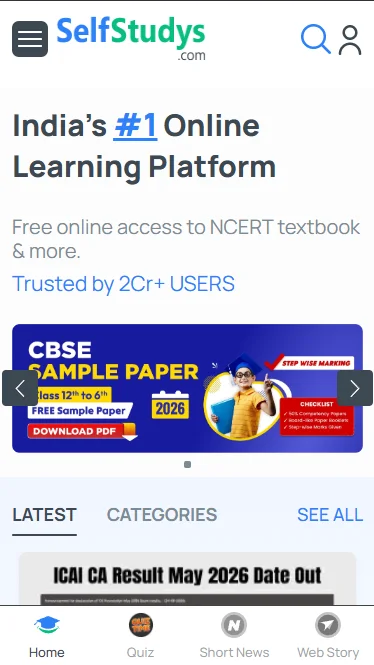
- Once the website is accessible, you should click on the ‘Navigation’ bar and select the ‘CBSE’ section.
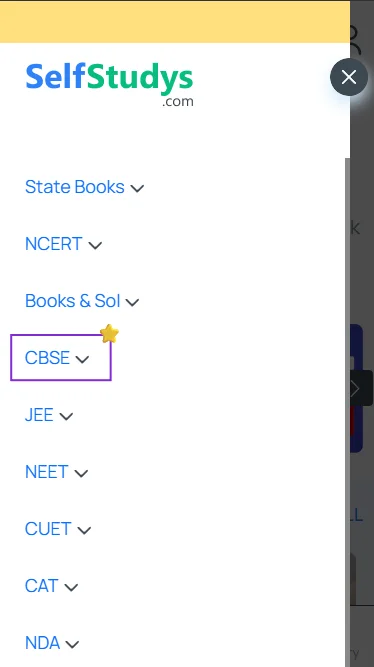
- This section will expand, wherein you can tap on the ‘CBSE Sample Papers’ icon.
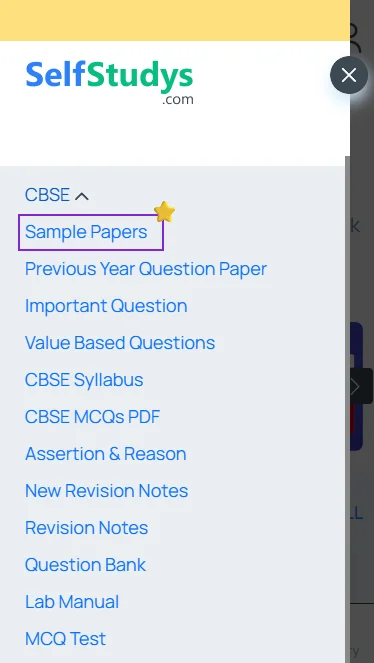
- Now, a new web page will be loaded where you should select ‘Class 9’.
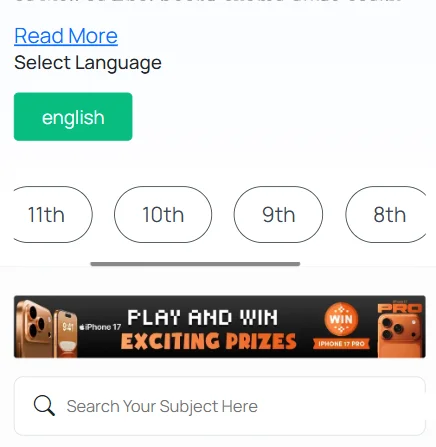
- Then, you can select the subject from various options to get multiple sets for the Class 9 CBSE sample paper Maths.
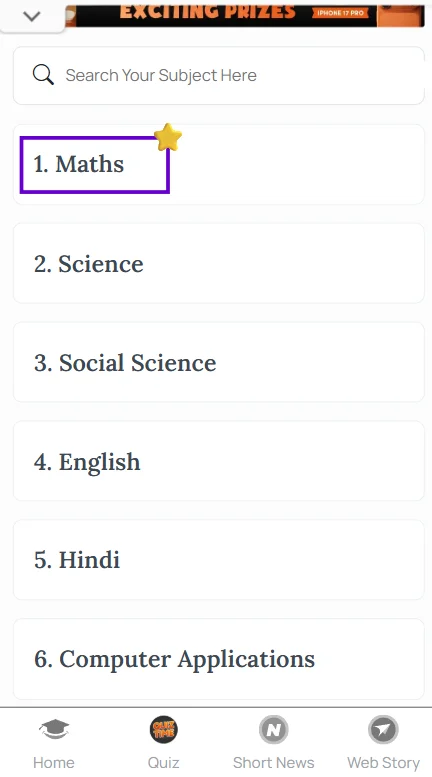
- You need to choose any sample question paper for Class 9 CBSE Maths and click on its icon.
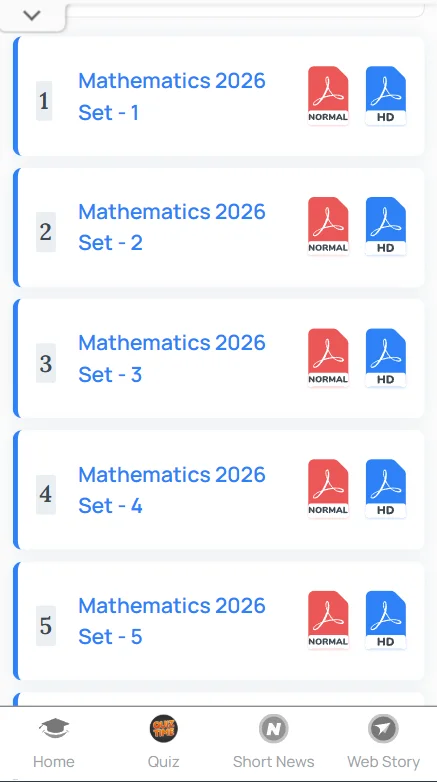
- Finally, you can view the CBSE Class 9 sample paper Maths in HD or normal quality and start attempting its questions.
Note: SelfStudys will only permit you to download the sample paper Maths Class 9 CBSE after a Google Log In or Sign Up.
What Should You Do Before Attempting The CBSE Class 9 Maths Sample Paper With Solution?
If you attempt the CBSE Class 9 Maths sample paper with solution without proper preparation, then it might not reflect your actual level of understanding in an accurate manner. In order to gain the maximum benefit from every practice session, you need to prepare in the same way as you would for the exams. With the following practices, you can make every sample paper attempt more meaningful as well as productive.
-
Before you start with any CBSE Class 9 Maths sample paper PDF, you need to spend 15-20 minutes revising the formulas, identities, properties, as well as theorems from the syllabus. Through this quick revision, you can refresh your memory and reduce the chances of making silly mistakes while solving the numerical or geometry-based questions.
-
You must go through the list of chapters that are prescribed for the exam and make sure that you study every topic at least once. Even when you have a brief overview of the chapter, you will be able to recall the important concepts during the CBSE Class 9 Maths sample paper PDF download practice.
-
You should keep your pen, pencil, eraser, ruler, compass, protractor, and rough sheets ready before solving the CBSE Class 9 Maths sample paper. By having everything within reach, you can prevent any unnecessary interruptions as well as stay focused throughout the practice session.
-
It is important that you attempt the CBSE Class 9 Maths sample paper 2026-27 within the given time limit. By using a timer, you will be able to practice time management, understand how long different sections take, develop the habit of completing the paper on schedule, and so on.
-
You should decide well in advance how you will approach the CBSE Class 9 Maths SQPs. For example, you can begin with easier questions to build your confidence before moving to challenging or CBSE Class 9 Case Study Maths Questions. With a proper strategy, you can avoid any confusion as well as save valuable time during the attempt.
Offline Vs. Online CBSE Class 9 Maths Sample Paper Practice- Which Is Better?
While preparing with the Class 9 CBSE sample paper Maths, you will get unique advantages for both offline and online practice. Rather than choosing one method over the other, you need to understand how each approach contributes to your preparation and use them according to your study goals. We have done a comparison between the two modes so that you can decide which method suits your learning style.
|
Parameter |
Offline Practice |
Online Practice |
|
Learning Experience |
This practice will replicate the actual classroom or school exam environment. |
In this practice, you will have a flexible as well as an interactive learning experience that you can access on any device. |
|
Writing Practice |
When you solve the sample question paper for Class 9 CBSE Maths in offline mode, you can improve your handwriting, step-wise presentation, as well as answer-writing skills. |
The online CBSE Class 9 sample paper Maths focuses more on practice of the concepts instead of handwritten presentation. |
|
Time Management |
With the offline sample paper Maths Class 9 CBSE practice, you can simulate the exact duration of the exam. |
The digital clocks given in the CBSE Class 9 Maths sample paper with solution will make it easier for you to monitor your progress while solving it. |
|
Exam Readiness |
By practicing the CBSE Class 9 Maths sample paper PDF in offline mode, you will develop the habit of writing complete solutions under the conditions of the exam, improve your confidence for school exams, and so on. |
Through the online practice of the CBSE Class 9 Maths sample paper, you will be able to solidify your conceptual understanding as well as get quick access to a wide variety of practice sets. |
|
Best Use Case |
The CBSE Class 9 Maths sample paper PDF download is ideal for full-length mock tests, answer-writing practice, as well as final exam simulation. |
The CBSE Class 9 Maths sample paper 2026-27 in the online phase is good for daily revision, quick practice sessions, solving multiple practice sets in an efficient manner, etc. |
Conclusion
Through consistent practice of the CBSE Class 9 Maths SQPs, you can understand this subject at a deeper level. And this session makes practice more important than usual. As the syllabus has been redesigned, chapters have been added and removed, and weightage has shifted, you now need to apply the concepts properly instead of just recalling them. You should use this resource by sitting in a quiet environment, marking your responses honestly, noting where you lose marks, and finally, fixing those specific gaps before the next attempt. You can get multiple sets on our platform and solve them one by one to score higher marks in the final exams.
Students can begin solving CBSE Class 9 Maths SQPs after completing four or five chapters. Starting early helps them identify strong and weak areas, improve their question-solving approach and work on mistakes before the final examination.
The theory paper is commonly designed for 80 marks and may have a duration of three hours, while the remaining marks are assigned through internal assessment. However, the unit-wise weightage and examination format may vary by school, so students should check the latest paper pattern provided by their teachers.
Yes, the CBSE Class 9 Maths Sample Paper PDF may include detailed solutions and explanations. Students can use them to check their answers, understand the correct methods and identify concepts that require additional revision.
The latest Sample Paper Maths Class 9 CBSE is prepared according to the currently prescribed curriculum. Students should compare the paper with their school’s latest syllabus to ensure that all included chapters and topics are relevant to the 2026-27 academic session.
CBSE generally does not release official sample papers for Class 9 because the examinations are conducted by individual schools. However, students can access practice papers on Selfstudys that are prepared by subject-matter experts according to the prescribed syllabus and common examination patterns.


 Home
Home
 Quiz
Quiz
 Short News
 Web Story
 Get latest Exam Updates