


 Sign in


 Profile
 Signout


FREE PDF Download
-
1Mathematical Induction & Binomial Theorem


-
2Matrices and Determinants
-
3Permutations and Combinations
-
43D Geometry
-
5Limits, Continuity and Differentiability
-
6Differentiation
-
7Sets
-
8Relations and Functions
-
9Trigonometric Functions
-
10Complex Numbers and Quadratic Equations
-
11Permutations and Combinations
-
12Binomial Theorem
-
13Sequences and Series
-
14Straight Lines and Pair of Straight Lines
-
15Conic Sections
-
16Limits and Derivatives
-
17Statistics
-
18Probability
-
19Inverse Trigonometric Functions
-
20Matrices
-
21Determinants
-
22Continuity & Differentiability
-
23Applications of Derivatives
-
24Integrals
-
25Applications of Integrals
-
26Differential Equations
-
27Vector Algebra
-
28Three-Dimensional Geometry
-
29Properties of Triangles
-
30Inequalities, Modulus, Logarithm
-
31Quadratic Equations
-
32Complex Numbers
-
33Progression & Series
-
34Permutation & Combination
-
35Trigonometric Ratios & Identities
-
36Trigonometric Equations
-
37Properties & Solutions of Triangle
-
38Coordinate System
-
39Straight Lines
-
40Circles
-
41Parabola
-
42Ellipse
-
43Hyperbola
-
44Functions
-
45Limits
-
46Indefinite Integration
-
47Definite Integration
-
48Area
-
49Vectors

Maths in JEE Advanced can seem to be difficult for some students as it can include tricky and complex questions. To prepare well for it, students can refer to the JEE Advanced Maths chapter wise previous year questions and start practising; regular practice can help them to improve their overall understanding of the subject.
In recent years, this section has been reported as challenging and time-consuming by many students. The questions require strong conceptual clarity and multi-step problem-solving skills. For example, in JEE Advanced 2026, Mathematics was considered the most challenging section by many candidates and experts. A number of questions were lengthy and calculation-intensive. This resource provides a collection of all levels of questions under one roof; accordingly, students can easily attempt the difficult questions in the actual exam. Through this, students can perform well in the exam and can get into a good engineering college such as IITs and NITs. Students can also use a JEE Advanced Mock Test to enhance their preparation and improve their exam-taking skills.
JEE Advanced Maths Chapter Wise PYQs PDF
Students can access the PDF from the Selfstudys website without paying any kind of amount. After solving questions from the portable document format, students can also refer to the solutions as well as clear doubts then and there.
Here are the links to access any of the chapter-wise question PDFs from SelfStudys.
The solutions of the JEE Advanced Maths chapter wise PYQs are prepared by our subject matter experts with proper research. Students who refer to the solutions can get a brief idea about the way to attempt all questions without making any kind of silly mistakes.
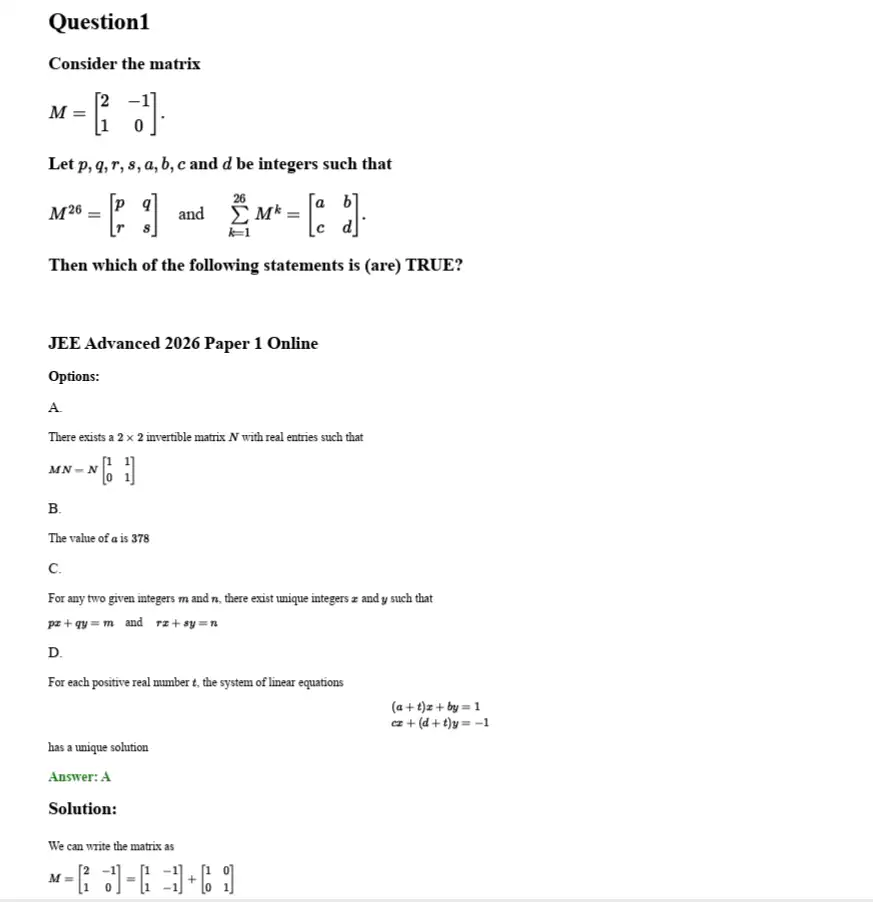
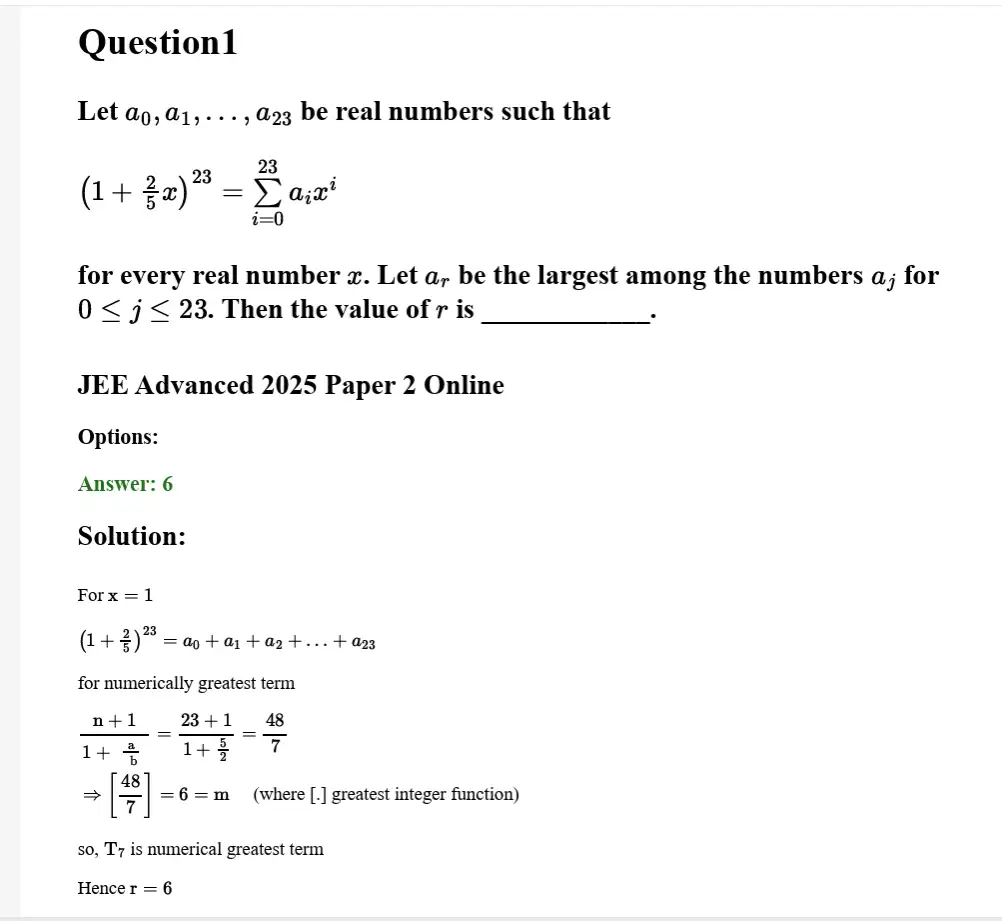
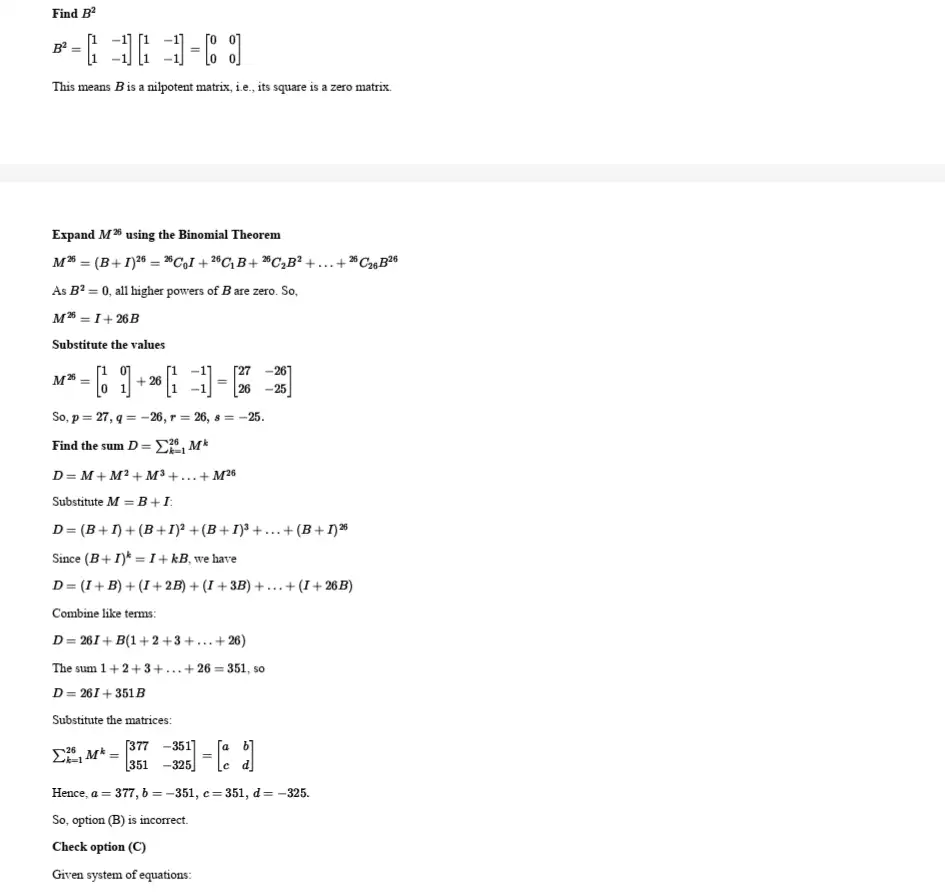
How to Attempt JEE Advanced Maths Chapter Wise PYQs?
To attempt these questions, students need to follow the given steps:
-
Visit the SelfStudys.com website.
-
Click the arrow next to JEE, which can be seen in the navigation bar.
-
A drop-down will appear; select JEE Main Previous Year Question Paper from the list.
-
A new page will appear; select JEE Advanced Chapter wise Previous Year Questions Paper from the given list.
-
Again, a new page will appear, where you need to select the subject to access the JEE Advanced Maths chapter wise PYQs PDF.
Features of JEE Advanced Maths Previous Year Questions Chapter Wise
This subject is considered to be an important one in the entrance exam; to be well prepared for the entrance exam, students need to practise questions. Some of the features of this resource are discussed below:
All the Chapters are Covered: In the PDF, the toughest questions from all chapters are covered so that students can build a strong foundation in each and every lesson.
Different Years of Questions are Included: Different years of questions are included so that students can get to know about the types asked in different years and prepare accordingly.
Hints and Solutions are Given: Hints and solutions for each question are discussed so that students can refer to them whenever they feel confused or stuck.
Available in the PDF: The JEE Advanced Maths previous year questions chapter wise are available in the PDF so that students can access them from anywhere without the internet. Students can also use the JEE Advanced Sample Paper for additional practice.
Free of Cost: If students want to access the PDF without paying any amount, then they can do so by referring to the SelfStudys website.
Diagrams are Given: In the PDF, diagrams are given for some questions so that students can understand any particular question in a proper way.
Examples Of JEE Advanced Maths Chapter Wise Questions With Solutions
Questions in JEE Advanced often require more than direct formula application. They test whether students can connect concepts and apply them properly. Our chapter-wise PYQ collection includes detailed solutions that explain the approach required to solve such problems. Here are a few examples of them.
Example 1: Matrices and Determinants
Question: Let A be a square matrix. Which of the following statements are correct?
Options:
- A. A square matrix with two identical rows cannot have an inverse.
- B. The product of two symmetric matrices is always symmetric.
- C. The transpose of a matrix does not change its determinant.
- D. A matrix and its transpose always have the same order.
ANSWER
Correct Options: A, C, and D
Solution:
- Option A: Correct
If a square matrix has two identical rows, the rows are linearly dependent. A matrix with linearly dependent rows is singular, which means it cannot have an inverse.
- Option B: Incorrect
The product of two symmetric matrices is not always symmetric. It is symmetric only under certain conditions, such as when the matrices commute.
- Option C: Correct
A matrix and its transpose always have equal determinants. Transposing a matrix does not affect the value of its determinant.
- Option D: Correct
The transpose of a matrix changes rows into columns, but the number of rows and columns remain the same. Therefore, the order of a square matrix remains unchanged.
Hence, the correct options are: A, C, and D
Concept Tested: Basic properties of matrices, symmetric matrices, transpose, and
invertibility.
Example 2: Application of Derivatives
Question: For a differentiable function f(x), which of the following statements are correct?
Options:
- A. A function can have a maximum value even when its derivative is not defined at that point.
- B. If a function is increasing in an interval, its derivative must always be positive throughout that interval.
- C. A point where the derivative becomes zero may not necessarily be a maximum or minimum point.
- D. The second derivative can provide information about the nature of a stationary point.
ANSWER
Correct Options: A, C, and D
Solution:
- Option A: Correct
A function may have a maximum at a point where the derivative does not exist. For example, sharp corners or cusps can represent maximum points.
- Option B: Incorrect
A function can be increasing even when its derivative is zero at some points. Therefore, the derivative does not have to be strictly positive everywhere in an increasing interval.
- Option C: Correct
A point where the derivative is zero is called a stationary point. It may represent a maximum, minimum, or neither.
- Option D: Correct
The second derivative helps determine whether a stationary point represents a maximum or minimum by studying the curvature of the function.
Hence, the correct options are: A, C, and D
Concept Tested: Stationary points, maxima-minima, and interpretation of derivatives.
Why Are Maths Chapter Wise PYQs for JEE Advanced Important?
It is highly recommended that students solve the JEE Advanced Maths chapter wise questions with solutions, as it provides many benefits; those benefits are discussed below:
Can Get the Knowledge About the Difficulty Level: By practising these questions on a regular basis, students can get an idea about the level of the actual exam paper.
Can Understand the Pattern of the Paper: The paper pattern is considered to be the question format. It is very important for students to understand the paper pattern, which is possible only by practising the chapter-wise past questions.
Helps to Improve the Speed: It is very important for students to have good speed while attempting the exam. For that purpose, students can start practising questions from the PDFs that are available on the SelfStudys website.
Can Find Their Weak Areas: Practising the Maths chapter wise PYQs for JEE Advanced can help students identify their weak concepts or areas accordingly and work on them.
Develops Problem-Solving Skills: Solving these questions can help students to develop their problem-solving skills: the ability to identify the problems and attempting properly.
Can Maintain their Accuracy: Accuracy is the fact of being right; students can easily maintain their accuracy in the exam after practising the questions.
How to Ace JEE Adv Maths Chapter Wise Previous Year Papers?
To ace JEE Adv Maths chapter wise previous year papers, students need to take care of many things, which are discussed below:
Go Through the Understanding of the Concepts: It is essential for students to have a proper understanding of the concepts included in this subject and review the concepts so that they can score well.
Practise Questions: Students are advised to practise a variety of questions related to the concepts included in the Maths syllabus so that they can ace the exam.
Focus on Accuracy: Maintaining accuracy in JEE Advanced Maths chapter wise previous year questions PDF download is very essential for students. To do so, students need to first read the question carefully as well as understand what is being asked.
Manage Time Efficiently: While attempting the questions, students need to complete them within the time limit to improve speed and accuracy.
Seek Help: If students are struggling to attempt any questions, then it is better to seek help from the teachers and fellow students.
Revise Regularly: To perform well in these questions, students are advised to revise all the concepts and keep them fresh in mind.
A Comprehensive Guide to Solve JEE Advanced Maths Chapter Wise Previous Year Questions PDF Download
Before solving the JEE Advanced Maths chapter wise previous year questions, students need to first follow the guidelines, which are discussed below:
Read the Question Carefully: Students need to read the questions in the PDF so that they can understand what is being asked and what is required to attempt it.
Identify the Concept: Identify the appropriate concept to solve the question; in this step, students need to recall the concepts that they have learnt earlier.
Apply the Concept: Now apply the appropriate concept while attempting JEE Advanced Maths chapter wise PYQs so that one can score better.
Analyse the Mistakes: Analyse the mistakes after attempting the questions so that one can identify the weak areas and work accordingly.
Stay Motivated: While attempting the problems, students need to be very motivated and surround themselves with supportive people.
Use Alternative Methods: Students are advised to use alternative methods if they are stuck on any of the questions included in the JEE Advanced Maths chapter wise PYQs PDF so that they don’t take much time on a single question.
JEE Advanced Maths Chapter Wise PYQs Trend Analysis
The table below shows which chapters carried the most weight in each year's JEE Advanced Maths questions, along with the question formats and difficulty level.
|
Year (Conducting IIT) |
Chapters with Most Questions |
Questions Formats Seen |
Difficulty and Trend |
|
2026- IIT Roorkee |
Functions, Indefinite Integration, Area Under Curves, Coordinate Geometry |
P1: single, multi, numerical, match-list. P2: adds paragraph-based |
Toughest subject in Paper 1; most time-consuming |
|
2025- IIT Kanpur |
Calculus, Probability, Matrices, Vectors and 3D, Complex Numbers |
Single-correct, multi-correct, numerical, match-list |
Moderate to difficult; Paper 2 tougher |
|
2024- IIT Madras |
Functions, Matrices, Permutation and Combination, Conic Sections, Probability |
Single-correct, multi-correct, numerical, match-list |
Lengthy; fewer pure Calculus questions than earlier years |
|
2023- IIT Guwahati |
Calculus, Matrices and Determinants, Vectors and 3D, Sequences and Series |
Single-correct, multi-correct, numerical, match-list |
Moderate to difficult; Algebra gained share |
|
2022- IIT Bombay |
Calculus, Probability, Complex Numbers, Conic Sections |
Single-correct, multi-correct, numerical, match-list |
Moderate but lengthy; calculation-heavy questions |
|
2021- IIT Kharagpur |
Definite Integration, Differential Equations, Probability, Matrices, Vectors and 3D |
Single-correct, multi-correct, numerical, paragraph-based numerical |
Paper 2 harder than Paper 1; Calculus dominated |
When Is the Best Time To Solve JEE Advanced Maths Chapter Wise Previous Year Questions?
The best time to solve JEE Advanced Maths previous year questions chapter wise generally depends on the student’s preference and learning style; some of them are discussed below:
After completing the Chapter: Students can prefer solving the questions after completing each chapter, as these are arranged in a chapter-wise manner.
To Understand the Concepts Better: Students can start solving the questions in case of understanding the concepts, as these questions cover each and every concept.
While Completing the Chapter: In the process of completing the chapter included in the syllabus, students can prefer JEE Advanced Maths chapter wise questions with solutions so that they can practise them simultaneously.
To Solve Confusions: If students are confused in understanding any of the Maths concepts, then they can prefer solving these questions and improve their understanding level.
To Improve Confidence Level: Confidence is considered to be the state of strong feeling while attempting questions; this can only be improved by practising the PYQs on a regular basis.
After Completing the Whole Syllabus: Once the syllabus is completed, it is very important for students to practise questions and improve their overall performance.
What Challenges Can Be Faced While Solving JEE Advanced Maths Chapter Wise PYQs PDF?
Solving Maths chapter wise PYQs for JEE Advanced can be challenging due to several factors, which are discussed below:
Complex Questions: The questions may include complex problems that require a deep understanding of the concepts. For these questions, students may find it difficult to identify the right approach to solve the problems; otherwise, they may get struck.
Time Pressure: The Maths questions are time-bound, and students need to solve a large number of questions within the given time limit. This can create a lot of pressure on students and make it difficult to solve the problems.
Lack of Practice: Lack of practice is one of the significant challenges that students may face while solving JEE Adv Maths chapter wise previous year papers, as without regular practice students may find it difficult to apply the concept.
Difficulty in Visualising the Concept: Some questions might need to visualise the concepts so that they can be applied accordingly, but some students may face difficulty in visualising the concepts.
Silly Mistakes: Silly mistakes like misreading the questions can significantly impact the student’s performance. In this case, students need to be very careful while reading the question.
Note: Focus on understanding the concepts included in the Maths questions rather than just memorising them; this will help students to solve them effectively.
How To Rectify The Mistakes After Solving JEE Advanced Maths Previous Year Questions Chapter Wise?
Rectification of mistakes is the most important phase after solving JEE Advanced Maths chapter wise previous year questions PDF download so that students can improve their preparation process.
Analyse the Mistakes: After solving each set of questions, students need to go through the solutions and need to analyse the mistakes: conceptual understanding of the syllabus, misreading of the question, etc.
Identify the Root Cause of Mistakes: Once you have identified the mistakes, it is better to understand the root cause of those mistakes.
Revise the Concepts: If students have made mistakes in a particular concept while attempting the questions, then it is better to revise the particular concept.
Practise Similar Problems: Once students get to know about the mistakes made while solving the JEE Advanced Maths chapter wise previous year questions, it is important to practise similar sets of problems to avoid the same kind of mistakes in future.
Keep a Record of the Mistakes: Students are advised to keep a proper record of mistakes made and solutions used to rectify the mistakes.
Take a Break: Taking a break while solving questions can avoid plenty of unnecessary mistakes, as after taking a break, the mind feels refreshed.
Conclusion
Maths subject in the JEE Advanced exam is not just about learning the formulas. Students also need to understand how concepts are connected as well as applied in unfamiliar situations. The collection of JEE Advanced Maths chapter wise PYQs helps them to study in the same way as the exam tests. Students can revise the actual problems, find recurring concepts, and learn different approaches to solve the challenging questions.
It is important to manage time efficiently to attempt chapter-wise questions so that students can improve their speed as well as accuracy for the exam.
The benefits of solving this resource are: you can get the knowledge about the difficulty level, it helps to improve the speed, can find weak areas, and many more.
To score well in IIT JEE Advanced Maths, students can follow the given steps, those are: go through the understanding of the concept, practise questions, manage time efficiently, revise regularly, and many more.
Difficulties faced while solving JEE Advanced Maths chapter wise PYQs PDF are: time pressure, complex questions, lack of practice, silly mistakes, and many more.
Important things included in the PDF are: all chapters are covered, hints and solutions are given, available for free, and much more.
Students can attempt the questions from the Selfstudys website; steps to attempt are discussed on this page.


 Home
 Quiz
 Short News
 Web Story
 Get latest Exam Updates