


 Sign in


 Profile
 Signout

Our resource follows the latest syllabus and marking scheme, which makes it one of the most reliable ones. During this class, your preparation should not just be about reading the books. It needs to include applying concepts in a format that is structured like the exam. And the KV sample papers Class 10 2026-27 provide you with exactly the same opportunity. It offers you subject-wise questions for Maths, Science, Social Science, English, and Hindi. By solving papers on a regular basis, you will be able to learn about your strengths and weaknesses while gaining real exam experience as well.
Subject-Wise KV Sample Papers Class 10 2026-27
At SelfStudys, you get the opportunity to access the KV Class 10 sample paper for every important subject. This includes Maths, Science, Social Science, English, and Hindi. By attempting the questions of each subject, you can understand the topics that appear repeatedly and focus on them properly before the board exams. This practice will also help you to master each of the subjects in an effective manner. You can utilize the links given below to solve any of the papers.
| Sr. No. | KV Sample Papers Class 10 Subject-Wise |
| 1 | KV Class 10 Maths Sample Paper |
| 2 | KV Class 10 Science Sample Paper |
| 3 | KV Class 10 Social Science Sample Paper |
| 4 | KV Class 10 English Sample Paper |
| 5 | KV Class 10 Hindi Sample Paper |
Important Topics To Study Before Solving The KV Class 10 Sample Paper
In the table below, you can find all the important topics that you must study before you attempt the Kendriya Vidyalaya Class 10 sample papers.
|
SUBJECT |
IMPORTANT TOPICS |
|
|
Maths |
|
|
|
Science |
Physics |
|
|
Chemistry |
|
|
|
Biology |
|
|
|
Social Science |
|
|
|
English |
|
|
|
Hindi |
|
|
How To Solve The Kendriya Vidyalaya Class 10 Sample Papers?
At SelfStudys, you need to follow these few easy steps to get your hands on the KVS Class 10 sample paper PDF and solve it for free.
- You need to use a web browser on your device and type www.selfstudys.com in the search space.

- Once you are on the homepage, you can click on the ‘Navigation’ tab so that it opens the main menu.
- From this menu, you should locate and tap on the ‘CBSE’ section.
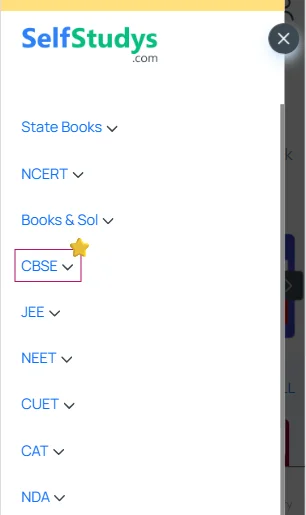
- This section will further open a new menu wherein you have to select the ‘KV Sample Paper’ option.
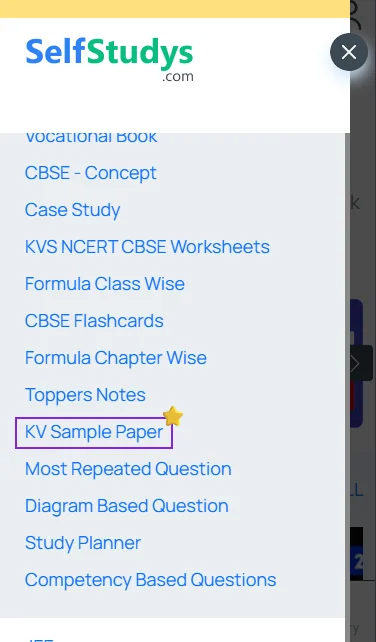
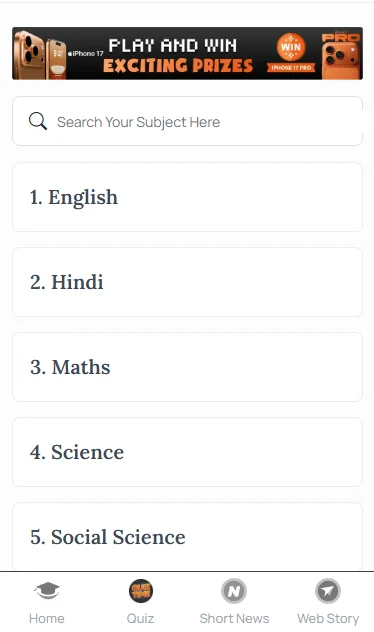
- Now, your screen will display a new web page where you can choose your class to get the list of subjects for the KVS Class 10 sample paper free PDF.

- You have access to select any subject and solve its KV Class 10 sample paper with solutions.
Common Questions Asked In The KVS Class 10 Sample Paper PDF
On the basis of the latest pattern, the KV sample paper Class 10 all subjects, is designed so that it reflects the question types that are asked frequently in the exam. You must know that these papers don’t repeat the questions every year, but follow similar formats, concepts, as well as competency-based patterns. Once you understand these common question types, you will be able to prepare for the exams in a more efficient manner. We have described a few of these question types below for your benefit.
Concept-Based MCQs:
In the KV Class 10 sample paper PDF download, you will find that the objective multiple-choice questions are most commonly asked. Through them, your clarity of the concepts, rather than rote learning, is tested. These questions include case-based or assertion-reason formats in subjects like Science and Social Science. In such questions, you have to apply the concepts in a logical manner. That’s why you need to understand the fundamentals thoroughly.
Case Study-Based Questions:
The KV sample papers Class 10 also have case study or passage-based questions. In them, a paragraph, a data set, or a situation is given. Then, it is followed by multiple sub-questions. You can see this type in Science, Social Science, and English. Through these questions, your analytical thinking as well as real-world application is evaluated. This makes the sample paper aligned with the latest education trends.
Short Answer Questions:
This type of question in the KV sample papers Class 10 2026-27, checks your clarity as well as precision. These questions are usually for 2 to 4 marks, and you have to write concise yet accurate answers. We have noticed that teachers also advise solving such questions from the PDFs so that you can improve your framing of the answers.
Long Answer Questions:
A major component with which you can score more in the KV Class 10 sample paper, as well as exams, is the descriptive or long-answer questions. In them, you have to give detailed explanations, step-by-step solutions, or well-structured answers. You also need to present your answers clearly with proper headings, diagrams, examples, and so on.
Diagram and Map-Based Questions:
Science and Social Science are the two subjects in which you will get diagram-based or map-based questions in the Kendriya Vidyalaya Class 10 sample papers. For such questions, you might need to label the parts, draw figures, or mark locations on the maps. Through these problems, you are assessed for visual understanding as well as presentation skills.
Assertion-Reason Questions:
It is a trending format that is included in the KVS Class 10 sample paper PDF, especially for the Science subject. Here, you need to evaluate whether the given statements are true, as well as whether the reason explains the assertion correctly. These types of questions help in solidifying your critical thinking and are mostly seen in the latest exams.
Literature and Passage-Based Questions:
In the subjects of English and Hindi, you will find unseen passages, poetry-based questions, literature extracts, etc. With these questions, your comprehension, interpretation, and writing ability are evaluated. By solving them in the KVS Class 10 sample paper free PDF, you can improve your speed in reading as well as articulating your responses.
Competency-Based Questions:
In the modern KV Class 10 sample paper with solutions that is available on SelfStudys, the focus on the competency-based questions has increased. In them, you need to apply the concepts to real-life situations. These questions move beyond memorization and require a deeper understanding of the concepts to solve them in the board exams.
Do’s and Don’ts For Solving The KVS Class 10 Sample Paper Free PDF
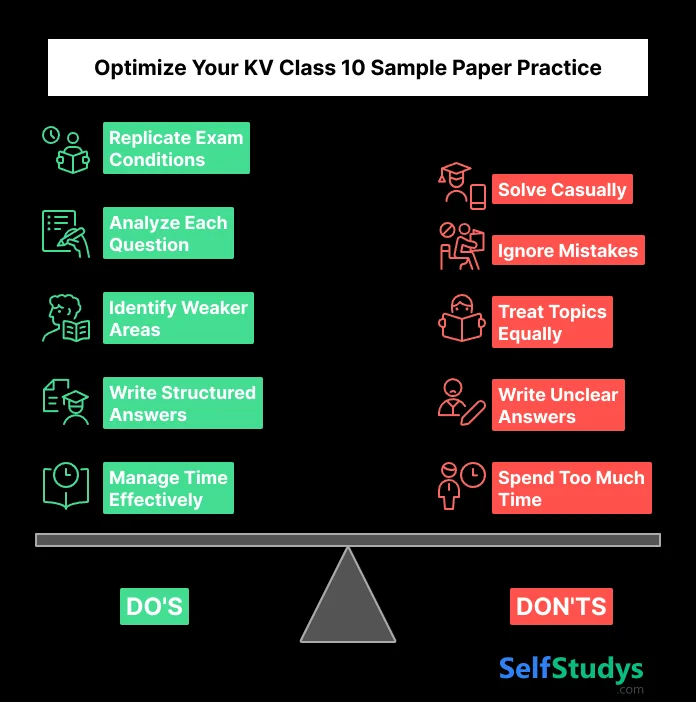
You can only take the full advantage of the KV sample paper Class 10 all subjects, or the KVS NCERT CBSE worksheets when you solve them with the right strategy. According to our team of experts, students often make some mistakes that limit their improvement. That’s why in the table below, we have discussed some dos and don’ts that you should follow while solving the sample papers.
|
DO’S |
DON’TS |
|
When you practice with the KV Class 10 sample paper PDF download, it is very important that you replicate the conditions of the real exam. For this, you should sit in a quiet place, follow a 3-hour timer, avoid distractions, etc. |
You should never solve the KV sample papers Class 10 casually or with breaks. This will reduce the effectiveness of the practice, and you will also fail to prepare for the real pressure of the exam. |
|
After completing the KV sample papers Class 10 2026-27, you must analyze each question. You should review your incorrect answers, find weak concepts, note time-consuming sections, and so on. This is where you will do the actual learning. |
You need to make sure that you don’t ignore your mistakes in the KV Class 10 sample paper or move on without understanding them. This is because by repeating the same errors, you will lower your score in the board exams. |
|
You should use the Kendriya Vidyalaya Class 10 sample papers to find your weaker areas in each subject. Then, you have to create a focused revision plan on the basis of the trends in your performance. |
After solving the KVS Class 10 sample paper PDF, you should not treat all the topics equally. You need to understand not to waste your revision time on the areas where you are already strong. |
|
While you are solving the KVS Class 10 sample paper free PDF, you need to practice writing structured answers. This should include proper steps, headings, diagrams, neat presentation, etc., so that you can gain marks for each step. |
You should not write answers that are unclear or don’t have any structure when you solve the KV Class 10 sample paper with solutions. You will lose marks with a poor presentation even if your concept is correct. |
|
During the KV sample paper Class 10 all subjects practice, you must manage your time in an effective manner. Here, you can allocate time to each section as well as learn when you should skip difficult questions. |
In the KV Class 10 sample paper PDF download, you should never spend too much time on a single question. This way, you will not be able to attempt the entire paper on time. |
Conclusion
The KV sample papers Class 10 are one of the resources that are most practical and result-oriented for your board exam preparation. By solving them, you will get a clear understanding of the exam structure, important topics, question types that might appear, and so on. With their help, you can move beyond the learning that is theory-based and towards real exam readiness. Regular practice will also strengthen your clarity of the concepts, improve your answer-writing skills, develop effective time management strategies, and so on.
Yes, the KV Class 10 sample paper is designed on the basis of the latest syllabus. These papers are updated on a regular basis so that they reflect any changes in the curriculum. This way, we make sure that prepare with the relevant as well as accurate study material.
Yes, at SelfStudys, you can explore and solve the KV sample papers Class 10 2026-27 for all the major subjects free of cost. The subjects include Maths, Science, Social Science, English, and Hindi.


 Home
Home
 Quiz
Quiz
 Short News
 Web Story
 Get latest Exam Updates