


 Sign in


 Profile
 Signout
NEET 2026 Syllabus Released- Check Physics, Chemistry, Biology Topics
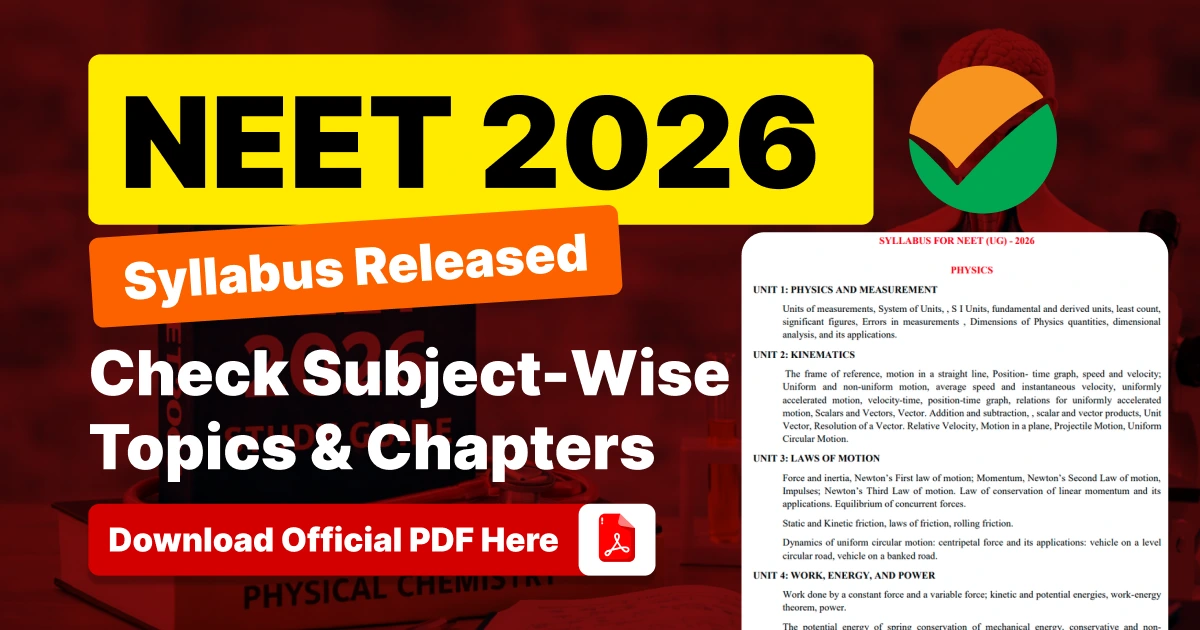


NTA released the official syllabus on 23rd December 2025. When you know exactly what to study, you can plan better, focus on key chapters, and skip topics that won't appear in the exam. This saves time and builds confidence. A focused approach based on the official syllabus can help you score higher and improve your rank.
You can download the NEET 2026 syllabus PDF for free from the official website.
👉 Download the Latest PDF - NEET UG Syllabus 2026
NEET 2026 Syllabus Overview
The NEET 2026 syllabus is based on the latest NCERT Class 11 and 12 curriculum. The National Testing Agency (NTA) has specifically designed it for medical entrance exam preparation. It includes important topics from three main subjects: Physics, Chemistry, and Biology.
This year, the NTA has made some changes to the syllabus. They have updated it to align with the revised NCERT textbooks. Some chapters have been removed, and overlapping topics have been reduced.
If you are preparing for NEET 2026, carefully review the updated NTA syllabus. Check which chapters are included and which have been removed. This will help you study smarter. You can focus your time on the topics that are actually relevant to the exam instead of wasting effort on sections that have been removed.
A clear understanding of the syllabus makes your preparation more organized and effective.
👉 Also Check - NEET 2026 Syllabus Out by NMC – Check Topics & Chapters
NEET UG Physics Syllabus 2026
| Unit | Chapter / Unit Name | Topics Covered |
|---|---|---|
| 1 | Physics and Measurement | Units of measurement; System of Units; SI Units; fundamental & derived units; least count; significant figures; errors in measurement; dimensions of physical quantities; dimensional analysis & applications |
| 2 | Kinematics | Frame of reference; motion in a straight line; position–time graph; speed & velocity; uniform & non-uniform motion; average speed & instantaneous velocity; uniformly accelerated motion; velocity–time & position–time graphs; equations of motion; scalars & vectors; vector addition/subtraction; scalar & vector products; unit vector; resolution of a vector; relative velocity; motion in a plane; projectile motion; uniform circular motion |
| 3 | Laws of Motion | Force & inertia; Newton’s 1st law; momentum; Newton’s 2nd law; impulse; Newton’s 3rd law; conservation of linear momentum & applications; equilibrium of concurrent forces; static & kinetic friction; laws of friction; rolling friction; centripetal force & applications (vehicle on level circular road, banked road) |
| 4 | Work, Energy, and Power | Work by constant & variable force; kinetic & potential energy; work–energy theorem; power; potential energy of spring; conservation of mechanical energy; conservative & non-conservative forces; motion in a vertical circle; elastic & inelastic collisions (1D and 2D) |
| 5 | Rotational Motion | Centre of mass (two-particle system, rigid body); basics of rotational motion; moment of force; torque; angular momentum; conservation of angular momentum & applications; moment of inertia; radius of gyration; moments of inertia (simple geometrical objects); parallel & perpendicular axes theorems & applications; equilibrium of rigid bodies; rigid body rotation & rotational equations; comparison of linear & rotational motion |
| 6 | Gravitation | Universal law of gravitation; acceleration due to gravity and variation with altitude & depth; Kepler’s laws; gravitational potential energy; gravitational potential; escape velocity; satellite motion; orbital velocity; time period & energy of satellite |
| 7 | Properties of Solids and Liquids | Elastic behaviour; stress–strain; Hooke’s law; Young’s modulus, bulk modulus, modulus of rigidity; fluid pressure (fluid column); Pascal’s law & applications; effect of gravity on fluid pressure; viscosity; Stokes’ law; terminal velocity; streamline & turbulent flow; critical velocity; Bernoulli’s principle & applications; surface energy & surface tension; angle of contact; excess pressure across curved surface; applications (drops, bubbles, capillary rise); heat & temperature; thermal expansion; specific heat capacity; calorimetry; change of state; latent heat; heat transfer (conduction, convection, radiation) |
| 8 | Thermodynamics | Thermal equilibrium; zeroth law; concept of temperature; heat, work & internal energy; first law of thermodynamics; isothermal & adiabatic processes; second law of thermodynamics; reversible & irreversible processes |
| 9 | Kinetic Theory of Gases | Equation of state of a perfect gas; work done in compressing a gas; kinetic theory of gases (assumptions); concept of pressure; kinetic interpretation of temperature; RMS speed of gas molecules; degrees of freedom; law of equipartition of energy & applications to specific heat capacities of gases; mean free path; Avogadro’s number |
| 10 | Oscillations and Waves | Oscillations & periodic motion (time period, frequency); displacement as a function of time; periodic functions; SHM and its equation; phase; spring oscillations (restoring force, force constant); energy in SHM (K.E. & P.E.); simple pendulum (time period derivation); wave motion; longitudinal & transverse waves; speed of travelling wave; displacement relation for a progressive wave; superposition principle; reflection of waves; standing waves in strings & organ pipes (fundamental mode, harmonics); beats |
| 11 | Electrostatics | Electric charges; conservation of charge; Coulomb’s law; force between multiple charges (superposition); continuous charge distribution; electric field (point charge, field lines); electric dipole & field due to dipole; torque on dipole in uniform field; electric flux; Gauss’s law & applications (infinite line charge, infinite plane sheet, thin spherical shell); electric potential (point charge, dipole, system of charges); potential difference; equipotential surfaces; electrostatic potential energy (two point charges, dipole); conductors & insulators; dielectrics & polarization; capacitors & capacitance; capacitors in series/parallel; parallel plate capacitor with/without dielectric; energy stored in a capacitor |
| 12 | Current Electricity | Electric current; drift velocity; mobility and relation with current; Ohm’s law; electrical resistance; V–I characteristics (Ohmic & non-Ohmic); electrical energy & power; resistivity & conductivity; series/parallel resistor combinations; temperature dependence of resistance; internal resistance; potential difference & emf of a cell; cells in series/parallel; Kirchhoff’s laws & applications; Wheatstone bridge; metre bridge |
| 13 | Magnetic Effects of Current and Magnetism | Biot–Savart law (circular loop); Ampere’s law & applications (long straight wire, solenoid); force on moving charge in uniform E & B fields; force on current-carrying conductor in uniform magnetic field; force between parallel current-carrying conductors (definition of ampere); torque on current loop; moving coil galvanometer (sensitivity; conversion to ammeter/voltmeter); current loop as magnetic dipole (dipole moment); bar magnet as equivalent solenoid; magnetic field lines; magnetic field due to dipole along axis & perpendicular; torque on magnetic dipole; para-, dia-, ferromagnetic substances (examples); temperature effect on magnetic properties |
| 14 | Electromagnetic Induction and Alternating Currents | Electromagnetic induction; Faraday’s law; induced emf and current; Lenz’s law; eddy currents; self & mutual inductance; alternating current; peak and RMS values of AC current/voltage; reactance & impedance; LCR series circuit; resonance; power in AC circuits; wattless current; AC generator; transformer |
| 15 | Electromagnetic Waves | Displacement current; electromagnetic waves & characteristics; transverse nature of EM waves; electromagnetic spectrum (radio, microwave, IR, visible, UV, X-rays, gamma rays); applications of EM waves |
| 16 | Optics | Reflection of light; spherical mirrors; mirror formula; refraction at plane & spherical surfaces; thin lens formula; lens maker formula; total internal reflection & applications; magnification; power of lens; combination of thin lenses in contact; refraction through prism; microscope & astronomical telescope (reflecting/refracting) and magnifying power; wave optics: wavefront & Huygens’ principle; laws of reflection/refraction via Huygens; interference; Young’s double slit experiment; fringe width; coherent sources; sustained interference; diffraction (single slit, central maximum width); polarization; plane-polarized light; Brewster’s law; uses of polaroid/plane-polarized light |
| 17 | Dual Nature of Matter and Radiation | Dual nature of radiation; photoelectric effect; Hertz and Lenard observations; Einstein’s photoelectric equation; particle nature of light; matter waves; de Broglie relation |
| 18 | Atoms and Nuclei | Alpha-particle scattering; Rutherford model; Bohr model; energy levels; hydrogen spectrum; nucleus composition & size; atomic masses; mass–energy relation; mass defect; binding energy per nucleon & variation with mass number; nuclear fission; nuclear fusion |
| 19 | Electronic Devices | Semiconductors; semiconductor diode; I–V characteristics (forward/reverse bias); diode as rectifier; LED I–V; photodiode; solar cell; Zener diode; Zener as voltage regulator; logic gates (OR, AND, NOT, NAND, NOR) |
| 20 | Experimental Skills | Vernier calipers (internal/external diameter, depth); screw gauge (thickness/diameter); simple pendulum (dissipation: amplitude² vs time graph); metre scale (mass by moments); Young’s modulus (metallic wire); surface tension by capillary rise & detergent effect; viscosity by terminal velocity; speed of sound using resonance tube; specific heat capacity (solid & liquid) by mixtures; resistivity using metre bridge; resistance using Ohm’s law; galvanometer resistance & figure of merit (half deflection); focal length (convex mirror, concave mirror, convex lens) by parallax; prism deviation vs incidence graph; refractive index of glass slab (travelling microscope); p–n junction diode characteristics; Zener diode characteristics & breakdown voltage; identification of diode/LED/resistor/capacitor from a mixed set |
NEET UG Chemistry Syllabus 2026
Physical Chemistry Syllabus for NEET UG 2026
| Unit | Unit Name | Topics Covered |
|---|---|---|
| 1 | Some Basic Concepts in Chemistry | Matter and its nature; Dalton’s atomic theory (atom, molecule, element, compound); laws of chemical combination; atomic & molecular masses; mole concept, molar mass; percentage composition; empirical & molecular formulae; chemical equations and stoichiometry |
| 2 | Atomic Structure | Electromagnetic radiation; photoelectric effect; hydrogen spectrum; Bohr model (postulates, energy & radii relations, limitations); dual nature & de Broglie relation; Heisenberg uncertainty; basics of quantum mechanics and quantum mechanical model; atomic orbitals (Ψ, Ψ² for 1s/2s); quantum numbers; shapes of s, p, d orbitals; electron spin; Aufbau, Pauli exclusion, Hund’s rule; electronic configuration; stability of half/fully filled orbitals |
| 3 | Chemical Bonding and Molecular Structure | Kossel–Lewis approach; ionic & covalent bonds; ionic bond formation + factors + lattice enthalpy; electronegativity; Fajan’s rule; dipole moment; VSEPR shapes; valence bond theory & hybridization (s, p, d); resonance; MO theory (LCAO, bonding/antibonding, σ/π), configurations of homonuclear diatomics; bond order/length/energy; metallic bonding (basic idea); hydrogen bonding & applications |
| 4 | Chemical Thermodynamics | System/surroundings; extensive/intensive properties; state functions; types of processes; first law (work, heat, internal energy, enthalpy); heat capacity & molar heat capacity; Hess’s law; enthalpies (bond dissociation, combustion, formation, atomization, sublimation, phase transition, hydration, ionization, solution); second law; spontaneity (ΔS universe, ΔG system); standard Gibbs energy change and equilibrium constant |
| 5 | Solutions | Concentration terms (molality, molarity, mole fraction, % by volume/mass); vapour pressure; Raoult’s law; ideal vs non-ideal solutions; colligative properties (RLVP, depression in freezing point, elevation in boiling point, osmotic pressure); molar mass determination; abnormal molar mass; van’t Hoff factor |
| 6 | Equilibrium | Dynamic equilibrium; physical equilibria (solid–liquid, liquid–gas, solid–gas), Henry’s law; chemical equilibrium law; Kp, Kc and significance; ΔG/ΔG° in equilibrium; factors affecting equilibrium (concentration, pressure, temperature, catalyst); Le Chatelier’s principle; ionic equilibrium (weak/strong electrolytes, ionization); acid-base concepts (Arrhenius, Bronsted–Lowry, Lewis); ionization constants; water ionization; pH scale; common ion effect; salt hydrolysis & pH; solubility product; buffer solutions |
| 7 | Redox Reactions and Electrochemistry | Oxidation/reduction concepts; redox reactions; oxidation number rules; balancing redox; electrolytic vs metallic conduction; conductance and molar conductivity + concentration dependence; Kohlrausch’s law & applications; electrochemical cells (electrolytic/galvanic); electrodes and potentials (standard); half-cell and cell reactions; emf measurement; Nernst equation & applications; relation between cell potential and Gibbs energy; dry cell, lead accumulator; fuel cells |
| 8 | Chemical Kinetics | Rate of reaction; factors affecting rate (concentration, temperature, pressure, catalyst); elementary/complex reactions; order & molecularity; rate law; rate constant and units; zero & first order (differential/integral forms), characteristics and half-lives; temperature dependence; Arrhenius theory; activation energy (calculation); collision theory for bimolecular gaseous reactions (no derivation) |
Inorganic Chemistry Syllabus for NEET UG 2026
| Unit | Unit Name | Topics Covered |
|---|---|---|
| 9 | Classification of Elements and Periodicity in Properties | Modern periodic law; present form of periodic table; s, p, d, f blocks; periodic trends: atomic/ionic radii, ionization enthalpy, electron gain enthalpy, valence, oxidation states, chemical reactivity |
| 10 | p-Block Elements (Group 13 to 18) | General introduction; electronic configuration; general trends in physical & chemical properties across periods and down groups; unique behaviour of the first element in each group |
| 11 | d- and f-Block Elements | Transition elements (1st row): general introduction; electronic configuration; occurrence & characteristics; trends—physical properties, ionization enthalpy, oxidation states, atomic radii, colour, catalytic behaviour, magnetic properties, complex formation, interstitial compounds, alloy formation; K₂Cr₂O₇ & KMnO₄: preparation, properties, uses. Inner transition elements: lanthanoids—electronic configuration, oxidation states, lanthanoid contraction; actinoids—electronic configuration, oxidation states |
Organic Chemistry Syllabus for NEET UG 2026
| Unit | Unit Name | Topics Covered |
|---|---|---|
| 12 | Coordination Compounds | Introduction; Werner’s theory; ligands; coordination number; denticity; chelation; IUPAC nomenclature (mononuclear complexes); isomerism; bonding—valence bond approach + basic crystal field theory; colour & magnetic properties; importance/applications (qualitative analysis, extraction of metals, biological systems) |
| 13 | Purification and Characterisation of Organic Compounds | Purification: crystallization, sublimation, distillation, differential extraction, chromatography (principles & applications). Qualitative analysis: detection of N, S, P, halogens. Quantitative analysis (basic principles): estimation of C, H, N, halogens, S, P; empirical & molecular formula calculations; numerical problems in organic quantitative analysis |
| 14 | Some Basic Principles of Organic Chemistry | Tetravalency of carbon; shapes of simple molecules; hybridization (s, p); classification by functional groups (halogens, O, N, S); homologous series; isomerism (structural & stereoisomerism); nomenclature (trivial & IUPAC); covalent bond fission (homolytic/heterolytic); free radicals, carbocations, carbanions; stability of carbocations/free radicals; electrophiles & nucleophiles; electronic effects—inductive, electromeric, resonance, hyperconjugation; types of reactions—substitution, addition, elimination, rearrangement |
| 15 | Hydrocarbons | Classification; isomerism; IUPAC nomenclature; general methods of preparation; properties & reactions. Alkanes: conformations (sawhorse & Newman for ethane); halogenation mechanism. Alkenes: geometrical isomerism; electrophilic addition mechanism; addition of H₂, halogens, water, HX (Markovnikov & peroxide effect); ozonolysis; polymerization. Alkynes: acidic character; addition of H₂, halogens, water, HX; polymerization. Aromatic hydrocarbons: nomenclature; benzene structure & aromaticity; electrophilic substitution mechanism—halogenation, nitration, Friedel–Crafts alkylation/acylation; directive influence in monosubstituted benzene |
| 16 | Organic Compounds Containing Halogens | General methods of preparation; properties & reactions; nature of C–X bond; substitution reaction mechanisms; uses; environmental effects of chloroform, iodoform, freons, DDT |
| 17 | Organic Compounds Containing Oxygen | General methods of preparation; properties; reactions; uses. Alcohols: identification of 1°, 2°, 3° alcohols; dehydration mechanism. Phenols: acidic nature; electrophilic substitution—halogenation, nitration, sulphonation; Reimer–Tiemann reaction. Ethers: structure. Aldehydes & ketones: carbonyl nature; nucleophilic addition to >C=O; relative reactivity; key reactions—addition of HCN, NH₃ & derivatives, Grignard reagent; oxidation; reduction (Wolff–Kishner, Clemmensen); acidity of α-hydrogen; aldol condensation; Cannizzaro; haloform; tests to distinguish aldehydes vs ketones. Carboxylic acids: acidic strength and factors affecting it |
| 18 | Organic Compounds Containing Nitrogen | General methods of preparation; properties; reactions; uses. Amines: nomenclature, classification, structure; basic character; identification of 1°, 2°, 3° amines; basicity. Diazonium salts: importance in synthetic organic chemistry |
| 19 | Biomolecules | General introduction & importance of biomolecules. Carbohydrates: classification; aldoses & ketoses; monosaccharides (glucose, fructose); constituent monosaccharides of oligosaccharides (sucrose, lactose, maltose). Proteins: α-amino acids (elementary idea), peptide bond, polypeptides; protein structures—primary/secondary/tertiary/quaternary (qualitative only); denaturation; enzymes. Vitamins: classification & functions. Nucleic acids: chemical constitution of DNA & RNA; biological functions. Hormones: general introduction |
| 20 | Principles Related to Practical Chemistry | Detection of extra elements (N, S, halogens) in organic compounds; detection of functional groups—hydroxyl (alcoholic/phenolic), carbonyl (aldehydes/ketones), carboxyl, amino. Preparations (chemistry involved): inorganic—Mohr’s salt, potash alum; organic—acetanilide, p-nitroacetanilide, aniline yellow, iodoform. Titrimetry (chemistry involved): acids-bases & indicators; oxalic acid vs KMnO₄; Mohr’s salt vs KMnO₄. Qualitative salt analysis principles: cations—Pb²⁺, Cu²⁺, Al³⁺, Fe³⁺, Zn²⁺, Ni²⁺, Ca²⁺, Ba²⁺, Mg²⁺, NH₄⁺; anions—CO₃²⁻, S²⁻, SO₃²⁻, NO₃⁻, NO₂⁻, Cl⁻, Br⁻, I⁻ (insoluble salts excluded). Experiments (principles involved): enthalpy of solution of CuSO₄; enthalpy of neutralization (strong acid + strong base); preparation of lyophilic/lyophobic sols; kinetics study—iodide ions with H₂O₂ at room temperature |
NEET UG Biology Syllabus 2026
| Unit | Unit Name | Topics Covered |
|---|---|---|
| 1 | Diversity in Living World | What is living?; biodiversity; need for classification; taxonomy & systematics; species concept & taxonomical hierarchy; binomial nomenclature; five-kingdom classification; Monera/Protista/Fungi (major groups), lichens, viruses & viroids; plant groups (algae, bryophytes, pteridophytes, gymnosperms—features + examples); animal groups (non-chordates up to phyla, chordates up to classes—features + examples). |
| 2 | Structural Organisation in Animals and Plants | Morphology & modifications; tissues; anatomy and functions of flowering plant parts (root, stem, leaf, inflorescence—cymose & racemose, flower, fruit, seed); families—Malvaceae, Cruciferae, Leguminosae, Compositae, Graminae; animal tissues; morphology/anatomy/functions of systems (digestive, circulatory, respiratory, nervous, reproductive) of frog (brief). |
| 3 | Cell Structure and Function | Cell theory; prokaryotic vs eukaryotic cells; plant vs animal cell; cell envelope/membrane/wall; organelles (ER, Golgi, lysosomes, vacuoles, mitochondria, ribosomes, plastids, microbodies); cytoskeleton; cilia/flagella/centrioles; nucleus; biomolecules (proteins, carbohydrates, lipids, nucleic acids); enzymes (types, properties, action, classification/nomenclature); cell cycle; mitosis & meiosis and significance. |
| 4 | Plant Physiology | Photosynthesis (site, pigments—basic idea; light/biosynthetic phases; cyclic/non-cyclic photophosphorylation; chemiosmotic hypothesis; photorespiration; C3/C4; factors); respiration (glycolysis, fermentation, TCA, ETS; ATP yield; amphibolic pathways; RQ); plant growth & development (seed germination; growth phases/rate; conditions; differentiation/dedifferentiation/redifferentiation; growth regulators—auxin, gibberellin, cytokinin, ethylene, ABA). |
| 5 | Human Physiology | Breathing & respiration; body fluids & circulation; excretory products & elimination; locomotion & movement; neural control & coordination; chemical coordination & regulation (endocrine glands/hormones and related disorders—brief). |
| 6 | Reproduction | Sexual reproduction in flowering plants (gametophytes, pollination, pollen–pistil interaction, double fertilization, post-fertilization events, seed/fruit; apomixis, parthenocarpy, polyembryony); human reproduction (systems, gametogenesis, menstrual cycle, fertilisation, early embryonic development, implantation, pregnancy/placenta—basic, parturition—basic, lactation—basic); reproductive health (STD prevention; contraception, MTP; amniocentesis; infertility & ART—IVF/ZIFT/GIFT—basic awareness). |
| 7 | Genetics and Evolution | Heredity & variation (Mendelism + deviations; chromosomal theory; sex determination; linkage/crossing over; sex-linked inheritance; Mendelian & chromosomal disorders); molecular basis of inheritance (DNA/RNA, replication, central dogma, transcription/translation, gene regulation—lac operon, HGP, DNA fingerprinting); evolution (origin of life, evidences, Darwin, modern synthesis, mechanisms—mutation/recombination/natural selection, gene flow/drift, Hardy–Weinberg, adaptive radiation, human evolution). |
| 8 | Biology and Human Welfare | Health & disease; pathogens/parasites (malaria, filariasis, ascariasis, typhoid, pneumonia, common cold, amoebiasis, ringworm, dengue, chikungunya); immunology basics (vaccines); cancer; HIV/AIDS; adolescence; drug/alcohol/tobacco abuse; microbes in human welfare (food processing, industrial products, sewage treatment, energy, biocontrol, biofertilizers). |
| 9 | Biotechnology and Its Applications | Principles & processes of biotechnology (genetic engineering / recombinant DNA technology); applications in health & agriculture (insulin, vaccines, gene therapy); GMOs (Bt crops); transgenic animals; biosafety (biopiracy, patents). |
| 10 | Ecology and Environment | Organisms & environment (population interactions—mutualism, competition, predation, parasitism; population attributes—growth, birth/death rate, age distribution); ecosystem (patterns, components, productivity, decomposition, energy flow, pyramids); biodiversity & conservation (concept/patterns/importance; loss; hotspots; endangered organisms; extinction; Red Data Book; biosphere reserves; national parks/sanctuaries; sacred groves). |
-------
👉 Read Also - NIRF Ranking 2025: Top Medical Colleges in India
👉 Read Also - NIRF Ranking 2025: Top Pharmacy Colleges in India
---




 Home
Home
 Quiz
Quiz
 Short News
 Web Story
 Get latest Exam Updates