


 Sign in


 Profile
 Signout

-
 2026
2026
Previous Year Paper
-
2025
Previous Year Paper
-
2024
Previous Year Paper
-
2023
Previous Year Paper
-
2022
Previous Year Paper
-
2021
Previous Year Paper
-
2020
Previous Year Paper
-
2019
Previous Year Paper
-
2018
Previous Year Paper
-
2017
Previous Year Paper
-
2016
Previous Year Paper
-
2015
Previous Year Paper
-
2014
Previous Year Paper
-
2013
Previous Year Paper
-
2012
Previous Year Paper
-
2011
Previous Year Paper
-
2010
Previous Year Paper
-
2009
Previous Year Paper
This examination has a highly competitive selection process, and you need to adopt smart strategies in order to excel. One such resource that can help you do so is the NDA previous year question paper, which is available for free practice on the digital platform of SelfStudys. You can learn directly from the papers that have already been used by the Union Public Service Commission (UPSC) rather than guessing what the exam may look like. This will make your preparation more focused as well as exam-oriented.
Furthermore, with the help of the NDA previous year paper, you will get a detailed look at the pattern of the exam, the question types that are usually asked, its overall difficulty level, and so on. By solving the papers on a regular basis, you can get a better understanding of how the questions are framed as well as what topics are covered again and again. In this way, you will not only boost your confidence but also find the areas where you need to focus more.
Important Dates For The National Defence Academy Examination 2026
The table displayed below represents the important dates regarding the upcoming NDA examination. You should go through it for any clarification.
|
EVENT |
NDA 1 |
NDA 2 |
|
Date of Notification Release |
10th December 2025 |
20th May 2026 |
|
Start Date for Application |
10th December 2025 |
20th May 2026 |
|
Last Date for Receipt of Applications |
30th December 2026 (6 pm) |
11th June 2026 |
|
Application Form Correction Date |
1st January 2026 - 7th January 2026 |
11th June 2026 - 16th June 2026 |
|
Date of Admit Card Release |
To be notified |
To be notified |
|
NDA 2026 Exam Date |
12th April 2026 |
13th September 2026 |
|
Date of Written Exam Result |
8th May 2026 |
October 2026 |
|
Date of Written Exam Result (with name) |
13th May 2026 |
National Defence Academy Examination Overview
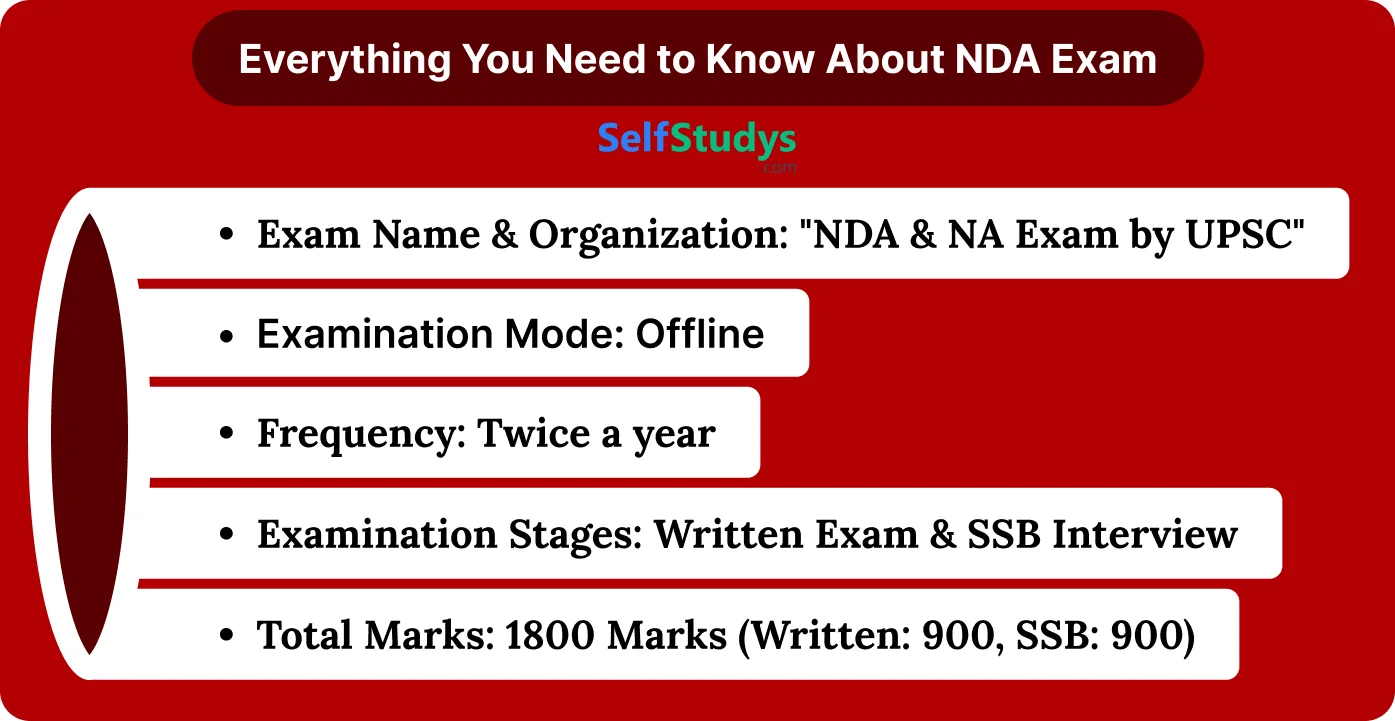
The details related to the National Defence Academy and Naval Academy examination are given in a tabular format below.
|
PARTICULARS |
DETAILS |
|
Name of the Examination |
NDA & NA exam: National Defence Academy and Naval Academy examination |
|
Exam Conducting Organization |
UPSC: Union Public Service Commission |
|
Examination Level |
National |
|
Frequency of the Examination |
Two times a year |
|
Examination Mode |
Offline |
|
Medium of Examination |
|
|
Stages of the Examination |
Two
|
|
Number of Papers |
Two
|
|
Examination Duration |
5 hours
|
|
Total Number of Questions |
270 questions
|
|
Total Number of Marks |
|
|
Marking Scheme |
|
|
Availability of NDA PYQ |
Several Sets Of The NDA Previous Year Paper
The NDA previous year question paper with solution PDF is available for a number of past years on our website. You can check out these papers and even download them free of cost. With the help of these past papers, you will be able to enhance your problem-solving skills in an effective way. Regular practice also helps you to identify your stronger and weaker areas. Then, you can work on your specific weaknesses through focused study sessions. Below are the direct links to every past paper that is accessible on our platform. You can choose any one of them and start solving the related questions.
| NDA Previous Year Paper | NDA Year Wise Link (2026-2009) |
|---|---|
| NDA 2026 Previous Year Question Paper | |
| NDA 2025 Previous Year Question Paper | |
| NDA 2024 Previous Year Question Paper | |
| NDA 2023 Previous Year Question Paper | |
| NDA 2022 Previous Year Question Paper | |
| NDA 2021 Previous Year Question Paper | |
| NDA 2020 Previous Year Question Paper | |
| NDA 2019 Previous Year Question Paper | |
| NDA 2018 Previous Year Question Paper | |
| NDA 2017 Previous Year Question Paper | |
| NDA 2016 Previous Year Question Paper | |
| NDA 2015 Previous Year Question Paper | |
| NDA 2014 Previous Year Question Paper | |
| NDA 2013 Previous Year Question Paper | |
| NDA 2012 Previous Year Question Paper | |
| NDA 2011 Previous Year Question Paper | |
| NDA 2010 Previous Year Question Paper | |
| NDA 2009 Previous Year Question Paper |
NDA PYQ With Solutions
The team of subject-matter experts at SelfStudys provides you with the NDA PYQ PDF. After analyzing each question carefully, the correct answers along with detailed explanations are prepared by the team. You will find these answers on the last few pages of the PDF. You should check out the solutions to verify your responses as well as pinpoint any mistakes. Then, it is advised to clear your doubts regarding the mistakes you made with the help of NDA Notes.
Vacancies Available For Different Posts Through NDA Exam
This year, the Union Public Service Commission will be conducting the examination for admission into the Army, Navy, and Air Force wings of the NDA for the 157th Course and for the 119th Indian Naval Academy Course (INAC). These courses will commence on 1st January 2027.
The number of vacancies that will be filled through the exam results is mentioned in the table below.
|
Academy |
Service |
Vacancies |
Total |
|
|
Male |
Female |
|||
|
National Defence Academy |
Army |
198 |
10 |
208 |
|
Navy |
37 |
05 |
42 (All Executive Branch) |
|
|
Air Force |
||||
|
Flying |
90 |
02 |
92 |
|
|
Ground duties (tech) |
16 |
02 |
18 |
|
|
Ground duties (non-tech) |
08 |
02 |
10 |
|
|
Naval Academy (10+2 Cadet Entry Scheme) |
21 |
03 |
24 (All Executive Branch) |
|
|
Total |
370 |
24 |
384 |
|
Selection Process For The NDA Examination
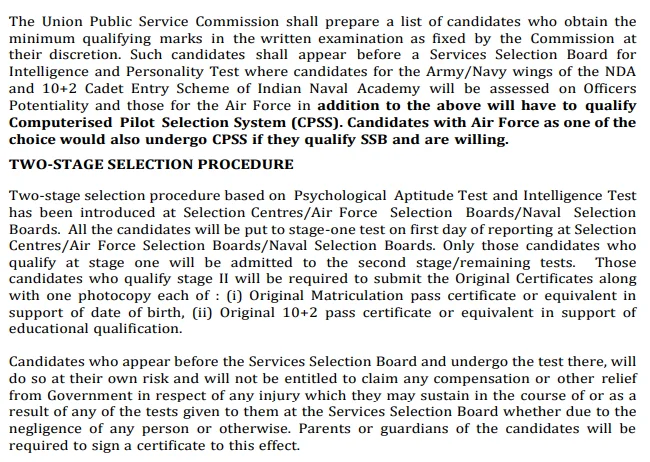
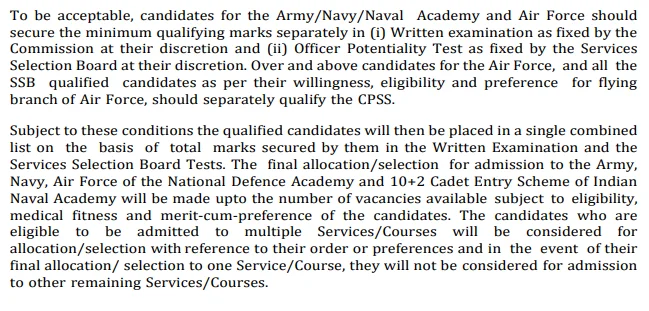
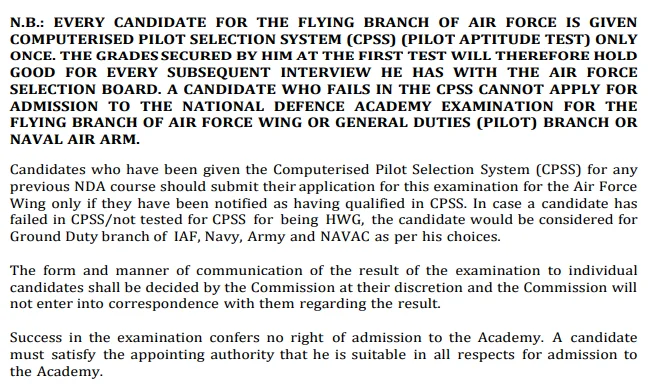
There are two stages involved in the selection process for the National Defence Academy and Naval Academy. One is the written examination, and the other is the SSB interview. We have given the details about both of them below.
Scheme Of Written Examination
The subjects, time duration, and maximum marks allocated for each subject are described in the table below.
|
SUBJECT |
CODE |
DURATION |
MAXIMUM MARKS |
|
Mathematics |
01 |
2 ½ hours |
300 marks |
|
General Ability Test |
02 |
2 ½ hours |
600 marks |
|
TOTAL |
5 hours |
900 marks |
|
|
SSB Interview |
900 marks |
||
-
Every subject paper will include objective-type multiple-choice questions. The Maths question paper and part ‘B’ of the General Ability Test will be available in English as well as Hindi.
-
You have to write the answers with your own hands as you will not be allowed scribe help under any circumstances.
-
The Union Public Service Commission has the freedom to fix the qualifying marks for any or all subjects of the exam.
-
You will not be permitted to use a calculator or a mathematical or logarithmic table for answering the questions.
SSB Interview
With the help of the images displayed below, you can understand all the details related to the SSB interview, which is conducted after the written exam.
How To Download The NDA Previous Year Question Paper With Solution PDF From SelfStudys?
If you are willing to get your hands on the NDA previous year paper with solution and download it from our website, you have to follow the process mentioned below.
- The first step is to open our homepage on your screen, which you can do by typing www.selfstudys.com on any web browser.

- Once it opens up, you have to click on the ‘Navigation’ bar that is displayed in the top left corner.
- This way, you can check our main menu and select the ‘NDA’ section.

- The specific section will showcase a variety of study materials from where you can tap on the ‘NDA previous year paper’.
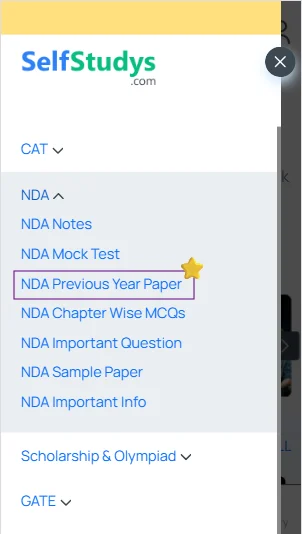
- Now, all the year-wise NDA previous year question paper with solution will be visible on your screen.
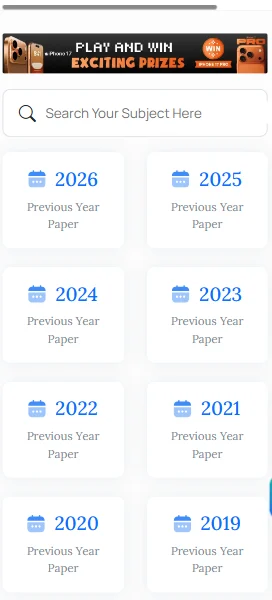
- You can either start solving the previous year NDA question paper with solution PDF one by one for each year or choose any random one.
- You can also save the NDA exam previous year question paper on your device for later practice.
Note: We recommend that you Log In or Sign Up with your Gmail ID on SelfStudys beforehand for easy NDA exam previous year paper PDF download.
Eligibility Criteria For The NDA Examination
There are a variety of components that determine your eligibility for this examination. Our experts have gathered this information from official sources, and you can refer to the details below.
Nationality
-
You will be able to take this exam as an Indian citizen or a subject of Nepal.
-
You will also be able to apply if you are of Indian origin but have migrated from East African Countries of Kenya, Zambia, Uganda, Malawi, Zaire, the United Republic of Tanzania, and Ethiopia, or Vietnam; and Pakistan, Burma, and Sri Lanka. Your intention should be to settle permanently in India.
Marital Status, Age Limit, and Sex
-
Only unmarried male and female candidates can apply for the NDA examination.
-
For age, you must be born between 1st July 2007 and 1st July 2010 for NDA I and between 1st January 2008 and 1st January 2011 for NDA II. Your date of birth will be accepted by the Commission as per your:
-
Matriculation
-
Secondary School Leaving Certificate
-
A certificate equivalent to Matriculation that is recognized by an Indian University
-
Extract from a Register of Matriculates, which is maintained by a University.
-
- You have to undertake that you are not going to marry until the completion of your training. If you get married during the exam period, then you will not be selected for the training. In case you marry during the training, then you will be discharged and have to refund all the expenditure that is incurred on you by the government.
Educational Qualifications
-
NDA Army Wing: 12th class pass as per the school education pattern for 10+2. An equivalent exam conducted by the State education board or university is also valid.
-
NDA Air Force and Naval Wing: INA 10+2 Cadet Entry Scheme: 12th class pass with Physics, Chemistry, and Maths subjects.
-
You can also apply if you are still appearing in the class 12th.
-
If you qualify for the SSB interview but are not able to submit your original Matriculation or 10+2 certificate at that time, then you have to forward self-attested photocopies by 10th December 2026 to:
-
Directorate General of Recruiting, Army Headquarters, West Block III, R.K. Puram, New Delhi-110066.
-
Naval Academy candidates to Naval Headquarters, DMPR, OI&R Section, Room No. 204, ‘C’ Wing, Sena Bhavan, New Delhi 110011.
-
Syllabus From Which NDA PYQ PDF Is Prepared
The syllabus of the National Defence Academy exam is quite vast, and you must be aware of all the topics that are covered in different subjects. That’s why we have made a detailed table below that includes information related to each subject and its topics that are included in the previous year question paper NDA.
|
NDA Previous Year Question Paper Syllabus |
||
|
PAPER 1: MATHS (300 marks) |
||
|
UNIT |
TOPICS |
|
|
Algebra |
Concept of set, operations on sets, Venn diagrams. De Morgan laws, Cartesian product, relation, equivalence relation. Representation of real numbers on a line. Complex numbers— basic properties, modulus, argument, and cube roots of unity. Binary system of numbers. Conversion of a number in the decimal system to the binary system and vice versa. Arithmetic, Geometric, and Harmonic progressions. Quadratic equations with real coefficients. Solution of linear inequations of two variables by graphs. Permutation and Combination. Binomial theorem and its applications. Logarithms and their applications. |
|
|
Matrices and Determinants |
Types of matrices, operations on matrices. Determinant of a matrix, basic properties of determinants. Adjoint and inverse of a square matrix, Applications-Solution of a system of linear equations in two or three unknowns by Cramer’s rule and by Matrix Method. |
|
|
Trigonometry |
Angles and their measures in degrees and in radians. Trigonometrical ratios. Trigonometric identities. Sum and difference formulae. Multiple and Sub-multiple angles. Inverse trigonometric functions. Applications-Height and distance, properties of triangles. |
|
|
Analytical Geometry of Two and Three Dimensions |
Rectangular Cartesian Coordinate system. Distance formula. Equation of a line in various forms. Angle between two lines. Standard forms of parabola, ellipse, and hyperbola. Eccentricity and axis of a conic. Point in a three-dimensional space, distance between two points. Direction Cosines and direction ratios. Angle between two lines and angle between two planes. Equation of a sphere. |
|
|
Differential Calculus |
Concept of a real-valued function–domain, range and graph of a function. Composite functions, one-to-one, onto, and inverse functions. Notion of limit, Standard limits- examples. Continuity of functions- examples, algebraic operations on continuous functions. |
|
|
Integral Calculus |
Integration as inverse of differentiation, integration by substitution and by parts, standard integrals involving algebraic expressions, trigonometric, exponential and hyperbolic functions. |
|
|
Differential Equations |
Definition of order and degree of a differential equation, formation of a differential equation by examples. General and particular solutions of differential equations. Application in problems of growth and decay. |
|
|
Vector Algebra |
Vectors in two and three dimensions, magnitude and direction of a vector. Unit and null vectors, addition of vectors, scalar multiplication of a vector, scalar product or dot product of two vectors. Vector product or cross product of two vectors. |
|
|
Statistics |
Classification of data, Frequency distribution, cumulative frequency distribution. Graphical representation- Histogram, Pie Chart, frequency polygon. Measures of Central tendency- Mean, median, and mode. Variance and standard deviation- determination and comparison. Correlation and regression. |
|
|
Probability |
Random experiment, outcomes and associated sample space, events, mutually exclusive and exhaustive events, impossible and certain events. Union and Intersection of Events. Complementary, elementary, and composite events. Definition of probability- classical and statistical. Elementary theorems on probability. Conditional probability, Bayes’ theorem. |
|
|
PAPER 2: GENERAL ABILITY TEST (600 marks) |
||
|
Part A: English (200 marks) |
This paper will be designed to test your understanding of English and workmanlike use of words. The syllabus covers various aspects like:
It is to test your proficiency in English. |
|
|
Part B: General Knowledge (400 marks) |
In this part, around 6 sections or subjects are covered, which are mentioned below. |
|
|
Physics (25% weightage) |
Physical Properties and States of Matter, Mass, Weight, Volume, Density and Specific Gravity, Principle of Archimedes, Pressure Barometer. Motion of objects, Velocity and Acceleration, Newton’s Laws of Motion, Force and Momentum, Parallelogram of Forces, Stability and Equilibrium of bodies, Gravitation, elementary ideas of work, Power and Energy. Effects of Heat, Measurement of Temperature and Heat, change of State and Latent Heat, Modes of transference of Heat. Sound waves and their properties, Simple musical instruments. Rectilinear propagation of Light, Reflection and refraction. Spherical mirrors and Lenses, Human Eye. Natural and Artificial Magnets, Properties of a Magnet, Earth as a Magnet. Static and Current Electricity, conductors and Non-conductors, Ohm’s Law, Simple Electrical Circuits, Heating, Lighting and Magnetic effects of Current, Measurement of Electrical Power, Primary and Secondary Cells, Use of X-Rays. Simple Pendulum, Simple Pulleys, Siphon, Levers, Balloon, Pumps, Hydrometer, Pressure Cooker, Thermos Flask, Gramophone, Telegraphs, Telephone, Periscope, Telescope, Microscope, Mariner’s Compass; Lightning Conductors, Safety Fuses. |
|
|
Chemistry (15% weightage) |
Physical and Chemical Changes. Elements, Mixtures and Compounds, Symbols, Formulae and simple Chemical Equations, Law of Chemical Combination (excluding problems). Properties of Air and Water. Preparation and Properties of Hydrogen, Oxygen, Nitrogen and Carbon dioxide, Oxidation and Reduction. Acids, bases, and salts. Carbon- different forms. Fertilizers- Natural and Artificial. Materials used in the preparation of substances like Soap, Glass, Ink, Paper, Cement, Paints, Safety Matches, and gunpowder. Elementary ideas about the structure of the Atom, Atomic Equivalent and Molecular Weights, Valency. |
|
|
General Science (10% weightage) |
Difference between the living and non-living. Basis of Life- Cells, Protoplasms and Tissues. Growth and Reproduction in Plants and Animals. Elementary knowledge of the Human Body and its important organs. Common Epidemics, their causes and prevention. Food- Source of Energy for man. Constituents of food, Balanced Diet. The Solar System- Meteors and Comets, Eclipses. Achievements of Eminent Scientists. |
|
|
History, the Freedom Movement, etc. (20% weightage) |
A broad survey of Indian History, with emphasis on Culture and Civilisation. Freedom Movement in India. Elementary study of Indian Constitution and Administration. Elementary knowledge of Five Year Plans of India. Panchayati Raj, Co-operatives and Community Development. Bhoodan, Sarvodaya, National Integration and Welfare State, Basic Teachings of Mahatma Gandhi. Forces shaping the modern world; Renaissance, Exploration and Discovery; War of American Independence. French Revolution, Industrial Revolution, and Russian Revolution. Impact of Science and Technology on Society. Concept of one World, United Nations, Panchsheel, Democracy, Socialism and Communism. Role of India in the present world. |
|
|
Geography (20% weightage) |
The Earth, its shape and size. Latitudes and Longitudes, Concept of time. International Date Line. Movements of Earth and their effects. Origin of Earth. Rocks and their classification; Weathering- Mechanical and Chemical, Earthquakes and Volcanoes. Ocean Currents and Tides. Atmosphere and its composition; Temperature and Atmospheric Pressure, Planetary Winds, Cyclones and Anticyclones; Humidity; Condensation and Precipitation; Types of Climate, Major Natural regions of the World. Regional Geography of India- Climate, Natural vegetation. Mineral and Power resources; location and distribution of agricultural and Industrial activities. Important Sea ports and main sea, land and air routes of India. Main items of Imports and Exports of India. |
|
|
Current Events (10% weightage) |
Knowledge of Important events that have happened in India in recent years. Current important world events. Prominent personalities- both Indian and International, including those connected with cultural activities and sports. |
|
|
INTELLIGENCE AND PERSONALITY TEST |
||
|
Stage I and Stage II are the two stages of the SSB selection process. You are only allowed to participate in Stage II if you pass Stage I. The specifics are: |
||
|
A |
Stage I comprises the Officer Intelligence Rating (OIR) tests are Picture Perception and Description Test (PP&DT). The candidates will be shortlisted based on a combination of performance in the OIR Test and the PP&DT. |
|
|
B |
Stage II Comprises of Interview, Group Testing Officer Tasks, Psychology Tests, and the Conference. These tests are conducted over 4 days. The details of these tests are given on the website www.joinindianarmy.nic.in. |
|
|
||
How To Solve The NDA Previous Year Paper With Solution Effectively?
The subject-matter experts at SelfStudys have provided a step-by-step guide that can help you to solve the NDA previous year paper PDF in an effective manner.
-
Before you start solving the NDA previous year question paper, you must take some time to get familiar with the pattern and syllabus of the exam. Once you understand the structure, you will be able to make sense of the questions and approach them strategically. You should also review the syllabus to know what topics are covered in each section so that you can focus your efforts during practice.
-
Math is a paper through which your quantitative and analytical abilities are evaluated.
-
The GAT exam includes sections like English, Physics, Chemistry, General Knowledge, and Current Affairs.
-
-
You should replicate the exam conditions while you begin to solve the NDA previous year paper. For this, you can set a timer for every section to get a feel of a real exam. You can also attempt the NDA Mock Test on our platform for free. In this way, you will be able to check your time management skills and make sure that you are comfortable with the duration of the exam.
-
As you work through the NDA PYQ and the NDA Sample Paper, you may start with the easier questions or the ones that you are confident about. By doing so, you can boost your confidence, complete the paper more efficiently, as well as get a sense of accomplishment.
-
It is important that you focus on accuracy first while solving the NDA previous year question paper with solution PDF. You should not rush through the questions but take time to read each one, recheck your answers, and avoid guessing in a random manner. In case you are not sure about the question, you can skip it and move on to the next one.
-
After completing the NDA PYQ PDF, you must go through every question and compare your responses with the provided solutions. Doing so is quite important because it will help you pinpoint the topics where you are weak, understand your mistakes, as well as learn more efficient ways to solve problems.
Terms And Conditions Of Services
In this section, we have provided the information regarding the stipend, pay, allowances, and promotions that are offered to selected candidates.
FIXED STIPEND FOR CADET TRAINING
| FIXED STIPEND FOR CADET TRAINING | |
|
Stipend to male and female candidates during the entire training duration in service academics. This means during the training period at IMA (Indian Military Academy). |
INR 56,100 per month. It is equal to the starting pay in Level 10. |
PAY
|
RANK |
PAY LEVEL |
|
Lieutenant to Major |
Lieutenant (Level 10): INR 56,100 to INR 1,77,500 |
|
Captain (Level 10 B): INR 61,300 to INR 1,93,900 |
|
|
Major (Level 11): INR 69,400 to INR 2,07,200 |
|
|
Lieutenant Colonel to Major General |
Lieutenant Colonel (Level 12 A): INR 1,21,200 to INR 2,12,400 |
|
Colonel (Level 13): INR 1,30,600 to INR 2,15,900 |
|
|
Brigadier (Level 13 A): INR 1,39,600 to INR 2,17,600 |
|
|
Major General (Level 14): INR 1,44,200 to INR 2,18,200 |
|
|
Lieutenant General (Higher Administrative Grade) Scale |
Level 15: INR 1,82,200 to INR 2,24,100 |
|
Lieutenant General (Higher Administrative Grade+) Scale |
Level 16: INR 2,05,400 to INR 2,24,400 |
|
Vice Chief of the Army Staff/ Army Commander/ Lieutenant General (Non-Functional Selection Grade) |
Level 17: INR 2,25,000 (Fixed) |
|
Chief of the Army Staff |
Level 18: INR 2,50,000 (Fixed) |
|
Military Service Pay to the officers from the rank of Lieutenant to Brigadier |
INR 15,500 per month (Fixed) |
Depending upon rank and area of posting, officers posted to Field Areas will be eligible for the following Field Area Allowances:
|
RH Max Offr- INR 42,500 Siachen Allowance |
HARDSHIP |
||
|
High |
Medium |
Low |
|
|
HIGH |
R1H1 Offrs: INR 25,000
|
R1H2 Offr: INR 16,900
|
R1H3 Offrs: INR 5,300
|
|
MED |
R2H1 Offrs: INR 16,900
|
R2H2 Offr: INR 10,500
|
R2H3 Offrs: INR 3,400
|
|
LOW |
R3H1 Offrs: INR 5,300
|
R3H2 Offr: INR 3,400
|
R3H3 Offrs: INR 1,200
|
Note: The rates of allowances would be enhanced by 25% automatically each time the
DA goes up by 50%.
OTHER ALLOWANCE
|
Dearness Allowance |
Allowed as per the same rates and under the same conditions that apply to the civilian personnel from time to time. |
|
Para Allowance |
INR 10,500 per month |
|
Para Reserve Allowance |
INR 2,625 per month |
|
Para Jump Instructor Allowance |
INR 10,500 per month |
|
Project Allowance |
INR 3,400 per month |
|
Special Forces Allowance |
INR 25,000 per month |
|
Technical Allowance (Tier I) |
INR 3,000 per month |
|
Technical Allowance (Tier II) |
INR 4,500 per month |
|
Dress Allowance |
INR 20,000 per year (Rate will be enhanced by 25% each time DA is increased by 50%) |
|
Ration Allowance |
In peace and field areas |
|
Transport Allowance |
Higher TPTA Cities: INR 7,200 + DA thereon |
|
Other Places: INR 3,600 + DA thereon |
|
|
Children Education Allowance |
INR 2,250 per month per child (for the two eldest surviving only) from Nursery to 12th class. |
|
Hostel Subsidy |
INR 6,750 per month per child (for the two eldest surviving only) from Nursery to 12th class. |
PROMOTIONAL AVENUES
|
ARMY |
NAVY |
AIR FORCE |
MINIMUM COMMISSIONED SERVICE REQUIRED FOR PROMOTION |
|
Lieutenant |
Sub Lieutenant |
Flying Officer |
On Commission |
|
Captain |
Lieutenant |
Flight Lieutenant |
02 years |
|
Major |
Lieutenant Commander |
Squadron Leader |
06 years |
|
Lieutenant Colonel |
Commander |
Wing Commander |
13 years |
|
Colonel |
Captain |
Group Captain |
On Selection |
|
Colonel (Time Scale) |
Captain (Time Scale) |
Group Captain (Time Scale) |
26 years |
|
Brigadier |
Commodore |
Air Commodore |
On Selection |
|
Major General |
Rear Admiral |
Air Vice Marshal |
On Selection |
|
Lieutenant General |
Vice Admiral |
Air Marshal |
On Selection |
|
General |
Admiral |
Air Chief Marshal |
On Selection |
RETIREMENT BENEFITS: According to the rules in force from time to time, Pension, Gratuity, and Casualty Pensionary Awards are allowed.
Why Should You Solve The NDA Previous Year Question Paper With Solution?
Solving the NDA previous year paper with solution along with the NDA Important Questions is not just about practice; it’s about strategic preparation. Every paper that you solve will bring you one step closer to success in the exam. Some points that reflect the importance of this study material are mentioned in detail below.
-
One great benefit of the NDA previous year question paper with solution practice is getting a deep understanding of the exam format as well as question structure. By solving them, you can learn the types and number of questions, as well as their difficulty level. Through this early exposure, you will be able to approach the real exam with a clear strategy.
-
When you solve the previous year NDA question paper with solution PDF under timed conditions, you can improve your time management skills quite efficiently. The past papers' practice will help you get used to the pressure of solving a particular set of questions. You can also learn how to allocate proper time to each section and question.
-
By solving a variety of NDA exam previous year question paper as well as the NDA Chapter-Wise MCQs, you will start to see the patterns in question types that are asked again and again. This will be quite helpful during your preparation as you can notice the topics with high weightage, focus on the concepts or chapters that might appear in the exam, and so on.
-
You will be able to sharpen your speed as well as accuracy with the practice of the NDA exam previous year paper PDF download. By solving the questions repeatedly, you will get faster at solving similar problems, recognize familiar question patterns, and avoid any mistakes due to lack of practice.
Special Instructions Related To The NDA Exam
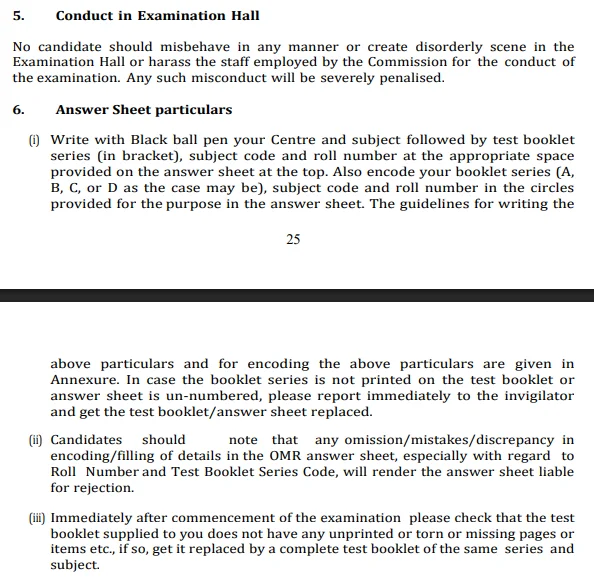
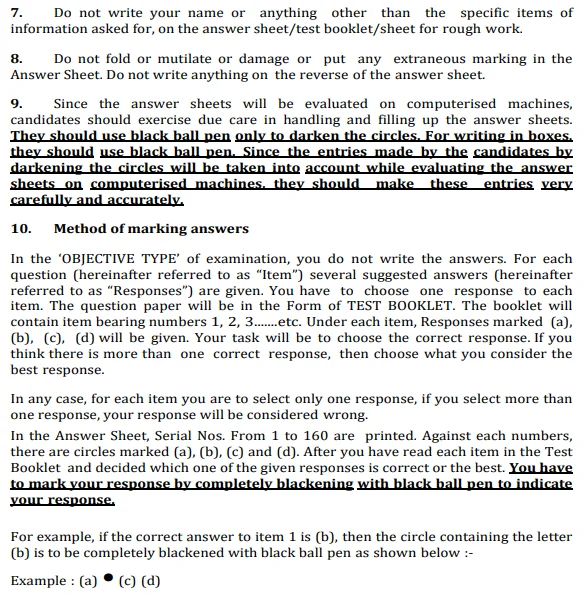
In order to take the Objective Type test, you have to follow some instructions during the exam. You can go through all these instructions in the images displayed below.
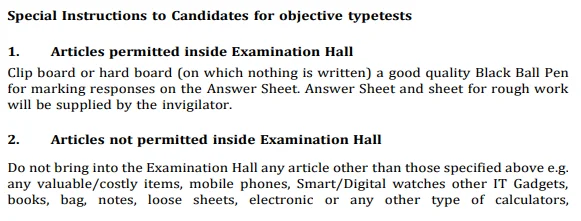
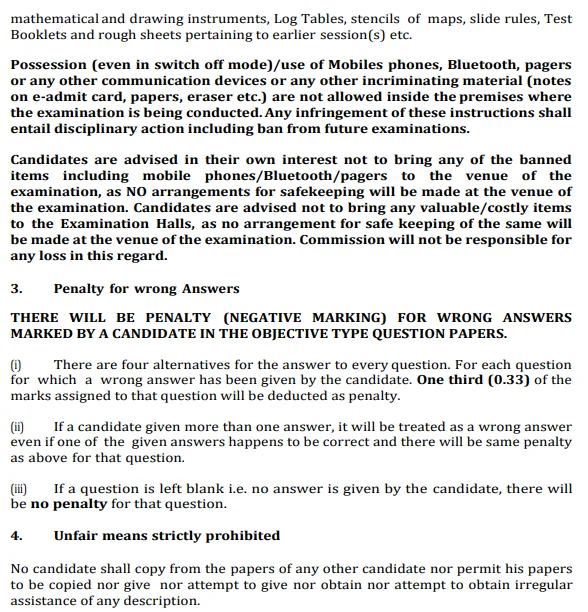
NDA Exam Previous Year Question Paper Difficulty Level Analysis
In the difficulty level of the previous year question paper NDA, there has been a gradual change over the years. It reflects the evolving approach of the UPSC in evaluating your conceptual understanding, analytical ability, time management skills, etc. The overall pattern of the exam remains consistent; the complexity of the questions in the Maths as well as General Ability Test sections varies from one session to another.
Our team of subject-matter experts has analyzed several NDA previous year paper PDF so that you can understand the fluctuations, find recurring trends, as well as prepare for the level of questions that you might encounter in the upcoming exam.
Paper-Wise Difficulty Level
|
Year |
Difficulty Level |
Analysis |
|
2025 |
Maths: Moderate to Difficult |
The focus of the questions was on clarity of the concepts. This was especially in Algebra, Calculus, Coordinate Geometry, and Trigonometry. In a number of problems, multiple steps in calculation were required. |
|
GAT: Moderate |
The questions in English were focused on grammar. General Knowledge included several current affairs as well as science-based conceptual questions. |
|
|
2024 |
Maths: Moderate |
The paper was balanced and had a mix of direct formula-based and application-oriented questions. Time management played a very important role. |
|
GAT: Moderate |
There was a balanced distribution across English, Physics, Chemistry, Biology, History, Geography, and Current Affairs with a few analytical questions. |
|
|
2023 |
Maths: Moderate to Difficult |
A greater focus was on problem-solving as well as logical reasoning. The questions on Geometry and Calculus were quite lengthy. |
|
GAT: Moderate to Difficult |
The sections of Science and Current Affairs were slightly more challenging. They required a deep knowledge of the concepts. |
|
|
2022 |
Maths: Moderate |
The questions here were mostly syllabus-based as well as straightforward. The topics that had higher weightage were Arithmetic and Algebra. |
|
GAT: Moderate |
During this year, most of the questions were based on standard concepts of NCERT. This made the paper manageable for the candidates who were well-prepared. |
|
|
2021 |
Maths: Easy to Moderate |
The paper had more direct conceptual questions with fewer lengthy calculations. This made it relatively easier than subsequent years. |
|
GAT: Easy to Moderate |
The section of English was quite easy, while General Knowledge contained factual as well as direct questions. |
Overall Trend Over The Years
|
Year |
Overall Difficulty |
Key Observation |
|
2025 |
Moderate to Difficult |
There was increased focus on conceptual understanding, analytical thinking, as well as effective time-management. |
|
2024 |
Moderate |
It was a well-balanced exam with a mix of easy, moderate, and challenging questions across both papers. |
|
2023 |
Moderate to Difficult |
The questions that became more prominent were analytical and application-based, especially in Maths. |
|
2022 |
Moderate |
This exam was quite predictable and followed previous trends. It was quite suitable for candidates with strong fundamentals. |
|
2021 |
Easy to Moderate |
During this year, the exam was comparatively easier than recent years. It had more direct questions and less lengthy calculations. |
Centers Of NDA Examination
For this year, the NDA exam will be conducted in the cities that are mentioned in the table below.
|
Agartala |
Agra |
Ajmer |
Ahmedabad |
|
Aizawl |
Aligarh |
Almora (Uttarakhand) |
Anantpur (Andhra Pradesh) |
|
Chhatrapati Sambhajinagar (Aurangabad, Maharashtra) |
Bengaluru |
Bareilly |
Bhopal |
|
Bilaspur (Chhatisgarh) |
Chandigarh |
Chennai |
Coimbatore |
|
Cuttack |
Dehradun |
Delhi |
Dharamshala |
|
Dharwad |
Dispur |
Faridabad |
Gangtok |
|
Gaya |
Gautam Buddh Nagar |
Ghaziabad |
Gorakhpur |
|
Gurugram |
Gwalior |
Hyderabad |
Imphal |
|
Indore |
Itanagar |
Jabalpur |
Jaipur |
|
Jammu |
Jodhpur |
Jorhat |
Kargil |
|
Kochi |
Kohima |
Kolkata |
Kozhikode (Calicut) |
|
Leh |
Lucknow |
Ludhiana |
Madurai |
|
Mandi |
Mumbai |
Mysore |
Nagpur |
|
Nashik |
Navi Mumbai |
Panaji (Goa) |
Patna |
|
Sri Vijaya Puram (Port Blair) |
Prayagraj (Allahabad) |
Puducherry |
Pune |
|
Raipur |
Rajkot |
Ranchi |
Sambalpur |
|
Shillong |
Shimla |
Siligudi |
Srinagar |
|
Srinagar (Uttarakhand) |
Surat |
Thane |
Thiruvananthapuram |
|
Tiruchirapalli |
Tirupati |
Udaipur |
Varanasi |
|
Vellore |
Vijayawada |
Visakhapatnam |
Hanumakonda (Warangal Urban) |
Note: You need to note that apart from Chennai, Dispur, Kolkata, and Nagpur, there will be a ceiling on the number of candidates that are allotted to each center. Allotment of the center will be on a first-apply-first-allot basis. Once the particular center’s capacity is attained, it will be frozen. If you cannot get a center of your choice due to the ceiling, then you need to choose it from the remaining ones. That’s why you are advised to apply early so that you can get your preferred center.
Conclusion
The practice of the NDA previous year question paper along with a thorough analysis is considered to be a highly effective strategy if you want to succeed in the National Defence Academy and Naval Academy examination. With the help of these papers, you will get valuable insights into exam patterns, questions, difficulty levels, etc. Furthermore, by doing a revision of the past papers, you will become familiar with the question types that appear in the exam most often and get a competitive edge.
Once you have completed the syllabus and have a basic understanding of it, then solving the previous year question paper NDA is considered to be the best time. Generally, you can start the PYP practice about 2 to 3 months before the exam. During this stage, your concepts should be clear, and solving the past papers will enable you to test your knowledge, refine your strategy, and focus on weaker areas.
No doubt, the NDA exam previous year question paper practice is an essential part of your preparation, but it should not be your only study resource. You need to have a well-rounded study plan that includes textbooks, reference materials, online courses, mock tests, etc. In this way, you will be able to make sure you have done thorough preparation for the exam.
Ideally, our experts recommend you solve at least 5 to 10 NDA previous year question paper with solution before the real exam. By doing so, you will gain a better knowledge of question types and also notice the recurring patterns. Moreover, it is also important to revise the answers thoroughly as well as focus on the areas where you made mistakes.
In the NDA PYQ PDF, two major sections are covered, which are Maths and General Ability Test. In the Maths section, topics like Algebra, Geometry, and Calculus are included. The GAT section has subjects like English, Physics, Chemistry, General Knowledge, etc. With their practice, you will be able to improve your overall understanding of the syllabus easily.
The NDA PYQ is an important study resource because they provide you with detailed insights into the structure, format, as well as difficulty level of the questions asked in the exam across different years. By solving them, you can get familiar with each aspect and ultimately enhance your problem-solving skills.


 Home
Home
 Quiz
Quiz
 Short News
 Web Story
 Get latest Exam Updates