


 Sign in


 Profile
 Signout

-
 2026
2026
Previous Year Paper
-
2025
Previous Year Paper
-
2024
Previous Year Paper
-
2023
Previous Year Paper
-
2022
Previous Year Paper
-
2021
Previous Year Paper
-
2020
Previous Year Paper
-
2019
Previous Year Paper
-
2018
Previous Year Paper
-
2017
Previous Year Paper
-
2016
Previous Year Paper
-
2015
Previous Year Paper
-
2014
Previous Year Paper
-
2013
Previous Year Paper
-
2012
Previous Year Paper
-
2011
Previous Year Paper
-
2010
Previous Year Paper
-
2009
Previous Year Paper
-
2008
Previous Year Paper
-
2007
Previous Year Paper
-
2006
Previous Year Paper
-
2005
Previous Year Paper
It is conducted for admission into MBBS, BDS, AYUSH, and other medical courses. In order to score well in this examination, you have to prepare in a very strategic manner. And for this, you should use the NEET previous year question papers on SelfStudys. They will allow you to evaluate your performance, find any weak areas, as well as work on your time management skills.
On our platform, you can access the NEET PYQs in PDF form completely free of cost. This means you can practice with them anytime, as per your study schedule. Solving these papers will also help you get familiar with repeated concepts as well as commonly asked questions from Physics, Chemistry, and Biology. Therefore, you must include this resource in your preparation routine to maximize your chances of success in the upcoming exam.
Highlights Of The National Eligibility cum Entrance Test (UG)
The NEET (UG) is held across the country as well as abroad every year. Some of the important highlights of this examination are mentioned below for your reference.
-
The National Testing Agency conducts the NEET for medical undergraduate courses.
-
It is a national-level pen-and-paper-based examination held for 3 hours.
-
There are a total of three sections in the exam containing 180 multiple-choice questions for 720 marks.
-
The paper is conducted in 13 languages, which are English, Hindi, Assamese, Bengali, Gujarati, Kannada, Malayalam, Marathi, Odia, Punjabi, Tamil, Telugu, and Urdu.
-
In Physics and Chemistry, there are 45 questions for 180 marks each.
-
The Biology section is divided into two sub-sections, Botany and Zoology. It includes 90 questions for 360 marks.
-
The marking scheme that is followed in the exam is:
-
+4 marks for a correct answer.
-
-1 for incorrect answer.
-
0 marks for unanswered.
-
-
The official websites where you can get additional information about the National Eligibility cum Entrance Test are https://nta.ac.in/ and https://neet.nta.nic.in/.
-
The option to choose the question paper medium will be available as per the table mentioned below.
|
Medium of Question Paper |
Examination Centres |
|
English |
Examination centers in India and Outside India |
|
English and Hindi |
Examination centers in India |
|
English, Hindi, and Assamese |
Examination centers in Assam |
|
English, Hindi, and Bengali |
Examination centers in West Bengal, Tripura, and the Andaman & Nicobar Islands |
|
English, Hindi, and Gujarati |
Examination centers in Gujarat, Daman & Diu, and Dadra & Nagar Haveli |
|
English, Hindi, and Kannada |
Examination centers in Karnataka |
|
English, Hindi, and Malayalam |
Examination centers in Kerala and Lakshadweep |
|
English, Hindi, and Marathi |
Examination centers in Maharashtra |
|
English, Hindi, and Odia |
Examination centers in Odisha |
|
English, Hindi, and Punjabi |
Examination centers in Punjab, Chandigarh, and Delhi/New Delhi (including Faridabad, Ghaziabad, Gurugram, Noida/Greater Noida |
|
English, Hindi, and Tamil |
Examination centers in Tamil Nadu, Puducherry, and the Andaman & Nicobar Islands |
|
English, Hindi, and Telugu |
Examination centers in Andhra Pradesh and Telangana |
|
English, Hindi, and Urdu |
Examination centers in India |
Year-Wise NEET PYQs
Here, you get a huge collection of the year-wise NEET previous year question paper PDFs completely free. By practicing these papers year by year, you will understand the evolution of the exam pattern, question trends, chapter-wise weightage, difficulty level over time, and so on. When you solve the PYPs in a systematic manner, you will also become familiar with the question types that are asked frequently across Physics, Chemistry, and Biology. It provides you with a real exam-like experience that improves your time management, accuracy, as well as confidence. You can click on the links mentioned below for direct access to these papers.
How Has The NEET Question Paper Changed And What Does It Mean For Your Preparation?
It is quite important that you understand the exam has evolved in a significant manner over the years before you solve the previous year NEET question papers with solutions PDF. The paper that you will face in the upcoming year is not the same one that was conducted in 2019 or 2021. If you just keep solving the papers without understanding these shifts, then you might get a false sense of readiness. In this section, we have explained how the exam has changed and what it means for your PYQ as well as NEET Important Questions strategy in detail.
Year-Wise Difficulty Level Analysis
|
Year |
Overall Difficulty |
Subject-Wise Difficulty |
Key Observation |
|
2025 |
Moderate |
Physics: Toughest (20% questions rated difficult) Chemistry: Moderate Biology: Easier and scoring |
The pattern was similar to the 2023 exam and had 37% easy questions. |
|
2024 |
Moderate |
Physics: Most difficult, numerical-heavy Chemistry: Moderate Biology: Easiest section |
The previous year question papers NEET was dominated by Mechanics, Electromagnetism, and Modern Physics. |
|
2023 |
Moderate to Tough |
Physics: Toughest section Chemistry: Moderate to Tough Biology: Easier |
35% of the questions were classified as easy, and the questions based on assertion-reasoning increased this year. |
|
2022 |
Moderate |
Physics: Moderate Chemistry: Easy to Moderate Biology: Easy to Moderate |
The weightage of numericals was heavy. Around 23 to 24 questions were easy, and only 5 to 6 were difficult. |
|
2021 |
Moderate to Difficult |
Physics: Challenging and lengthy Chemistry: Moderate Biology: Moderate |
The format section A/B was introduced. The questions on match-the-column made the paper quite time-consuming. |
|
2020 |
Easy to Moderate |
Physics: Moderate Chemistry: Easy to Moderate Biology: Easy |
This was the most straightforward paper in recent years. |
|
2019 |
Moderate |
Physics: Toughest section Chemistry: Easy to Moderate Biology: Easy to Moderate |
The paper was straightforward, and all 180 questions were compulsory. |
Note: Since 2021, Physics has been the hardest section consistently. The overall paper has shifted from straightforward to application-based and time-pressured. The experience you will have with the practice of the 2020 previous year NEET question papers with solutions PDF free download will be much easier than the actual exam.
How Has The Question Format Evolved?
|
Aspect |
Pre 2021 Papers |
Post 2021 Papers |
|
Structure |
All 180 questions compulsory |
Section A has 35 compulsory questions, and in Section B, you have to attempt 10 questions out of 15 for each subject. |
|
Dominant question types |
Direct MCQs and simple numericals |
Mix of MCQs, assertion-reasoning, match-the-column, and multi-statement. |
|
Numerical Weightage |
Lower |
From 2024 onwards, there are 30% of numerical questions in Physics. |
|
NCERT dependence |
High across all subjects |
It is still high for Biology, but the Physics subject requires application skills beyond the NCERT. |
|
Strategic decision-making required |
Minimal, as you have to answer everything. |
Now, it's quite high because choosing which section B questions to attempt vs. skip is a critical skill. |
Note: You can build your concepts by practicing the NEET exam previous year question papers before 2021. In order to prepare for the Section A/B decision-making or the assertion-reasoning format, you need to prioritize the 2022-2026 papers.
Which Chapters Have Gained or Lost Importance
We have mentioned all the high-frequency chapters for Physics, Chemistry, and Biology in the table below.
|
Chapter |
Year-Wise |
5-Year Total |
Trend |
|
PHYSICS |
|||
|
Current Electricity |
2021: 4 2022: 4 2023: 4 2024: 3 2025: 3 |
18 |
Consistently high |
|
Electrostatic Potential and Capacitance |
2021: 6 2022: 3 2023: 2 2024: 2 2025: 3 |
16 |
High but variable |
|
Semiconductors |
2021: 3 2022: 3 2023: 3 2024: 4 2025: 2 |
15 |
Consistently important |
|
Ray Optics |
2021: 4 2022: 3 2023: 3 2024: 2 2025: 2 |
14 |
Slightly declining |
|
Gravitation |
2021: 3 2022: 2 2023: 2 2024: 2 2025: 3 |
12 |
Stable |
|
Alternating Current |
2021: 2 2022: 2 2023: 3 2024: 2 2025: 2 |
11 |
Stable |
|
Low-Yield Chapters (0 to 1 questions in most years) |
Thermal Properties of Matter, Nuclei, Waves, and Electromagnetic Induction |
||
|
CHEMISTRY |
|||
|
Aldehydes, Ketones, and Carboxylic Acids |
2021: 2 2022: 5 2023: 4 2024: 1 2025: 3 |
15 |
High but unpredictable |
|
Coordination Compounds |
2021: 2 2022: 2 2023: 2 2024: 4 2025: 3 |
13 |
Rising |
|
Chemical Kinetics |
2021: 2 2022: 2 2023: 2 2024: 3 2025: 3 |
12 |
Rising |
|
General Organic Chemistry |
2021: 2 2022: 1 2023: 2 2024: 3 2025: 4 |
12 |
Clear upward trend |
|
Equilibrium |
2021: 1 2022: 2 2023: 2 2024: 3 2025: 3 |
11 |
Clear upward trend |
|
Hydrocarbons |
2021: 3 2022: 1 2023: 2 2024: 3 2025: 3 |
12 |
Variable but important |
|
Low-Yield Chapters (0 to 1 questions in most years) |
Redox Reactions, p-Block (Group 13-14) |
||
|
BIOLOGY |
|||
|
Molecular Basis of Inheritance |
2021: 9 2022: 7 2023: 8 2024: 6 2025: 7 |
37 |
Highest in the entire exam |
|
Biotechnology: Principles and Processes |
2021: 6 2022: 5 2023: 4 2024: 5 2025: 6 |
26 |
Consistently high |
|
Principles of Inheritance and Variation |
2021: 2 2022: 6 2023: 5 2024: 6 2025: 3 |
22 |
High but variable |
|
Structural Organization in Animals |
2021: 4 2022: 4 2023: 6 2024: 4 2025: 4 |
22 |
Stable |
|
Biomolecules |
2021: 4 2022: 2 2023: 4 2024: 6 2025: 4 |
20 |
Rising |
|
Cell Cycle and Cell Division |
2021: 5 2022: 4 2023: 6 2024: 4 2025: 1 |
20 |
Declining in 2025 |
|
Biotechnology and Its Applications |
2021: 6 2022: 3 2023: 2 2024: 4 2025: 4 |
19 |
Variable |
|
Human Reproduction |
2021: 3 2022: 3 2023: 3 2024: 4 2025: 5 |
18 |
Rising |
|
Human Health and Disease |
2021: 1 2022: 2 2023: 3 2024: 5 2025: 5 |
16 |
Strong upward trend |
|
Low-Yield Chapters (0 to 1 questions in most years) |
Living World, Neural Control and Coordination |
||
How This Data Should Change Your PYQ Strategy?
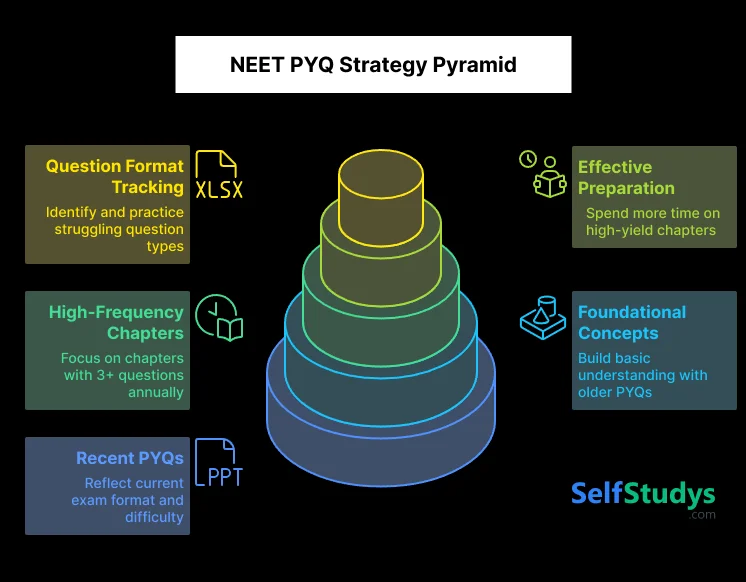
On the basis of the year-by-year shifts, here are some of the points that you can use to approach the NEET previous year question papers.
-
You should start your practice with the NEET PYQs from the most recent years. This is because they reflect the current format of the exam, difficulty level, chapter priorities, and so on. You need to treat them as your primary material for the exam preparation.
-
You can use the NEET previous year question paper PDFs from 2019 to 2021 to build your foundational concepts. They cannot be treated as accurate simulations of the exam as the format and difficulty are different.
-
During your revision, you must focus on the chapters that covered 3+ questions every year. Some chapters that are guaranteed to be important in the upcoming exam as well are Molecular Basis of Inheritance, Biotechnology, Current Electricity, Coordination Compounds, and General Organic Chemistry.
-
For a much more effective preparation, you can spend 3 hours on these high-frequency chapters in the previous year NEET question papers with solutions PDF rather than spending the same time on low-yield ones.
-
You should also track the question formats you struggle with while solving the previous year NEET question papers with solutions PDF free download. If the questions based on assertion-reason and multi-statement are increasing year over year, then you need to practice that format specifically across each subject.
How To Solve The NEET Previous Year Question Paper PDFs Effectively- The 3-Round Method
Our team of subject-matter experts has noticed that many aspirants solve the previous year question papers NEET the wrong way. Some treat them as just another question bank or solve them passively without any analysis. But you need to remember that this resource is not just for practice. It is one of the strongest tools with which you can understand the exam psychology, chapter weightage, repeated concepts, and so on. Here is a 3-round method that you can use to solve these papers in an effective manner.
Round 1- Diagnostic Round
This is the first round where your goal is to analyze your level of preparation and not just score high marks.
-
You should solve the NEET exam previous year question papers in a chapter-wise manner. Also, make sure that you don’t check the solutions immediately.
-
You can mark the questions into different categories like easy, confusing, wrong, unattempted, etc.
-
In this round, it is important that you find your weak chapters, repeated mistakes, as well as the concepts that are frequently asked.
-
You can even maintain a notebook for your mistakes and track your conceptual as well as silly errors.
-
Your main focus should be on understanding why you got a NEET previous year question papers question wrong.
In this way, you will discover your weaker areas before you start with your serious preparation.
Round 2- Practice Round
In the second round, you should begin with the full-length solving of the NEET PYQs and follow the time limit properly.
-
During this timed practice of the past papers, you need to build your speed, accuracy, exam stamina, and so on.
-
You should learn how to decide which questions to attempt and which ones to skip.
-
You also need to track your subject-wise scores across various NEET previous year question paper PDFs.
-
You have to find the chapters where you keep scoring low even after repeated practice.
-
Here, your focus is to fix your gaps in concepts rather than only solving a number of papers.
The main purpose of this round is to turn your preparation into performance under time pressure.
Round 3- Simulation Mode
This is the stage where you have to condition yourself for the final examination. Here, you can solve the same previous year NEET question papers with solutions PDF again under the strict exam conditions.
-
You need to attempt the full paper as well as NEET mock tests in one sitting with proper NEET discipline.
-
Until you finish the entire exam, you should not look at the given solutions.
-
You have to practice managing pressure, focus, question-selection strategy, etc.
-
You also need to analyze whether your mistakes are due to a lack of knowledge or exam pressure.
-
With the help of repeated simulations of the previous year NEET question papers with solutions PDF free download, you can improve your time management as well as reduce any careless errors.
In this round, you will be able to measure your actual readiness for the exam and prepare yourself mentally for the real National Eligibility cum Entrance Test (UG).
How To Download The Previous Year NEET Question Papers With Solutions PDF?
On our platform, you just need to follow a few easy steps to reach the previous year question papers NEET and download them for free.
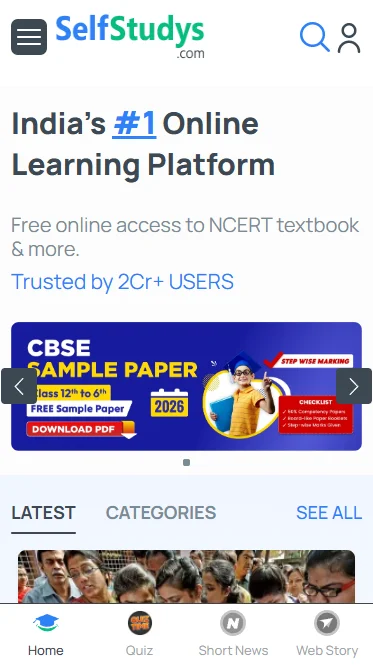
- First, you have to type www.selfstudys.com into the web browser you like to use the most.
-
There, you will see the ‘Navigation’ bar, and you should click on it to access the main menu.
-
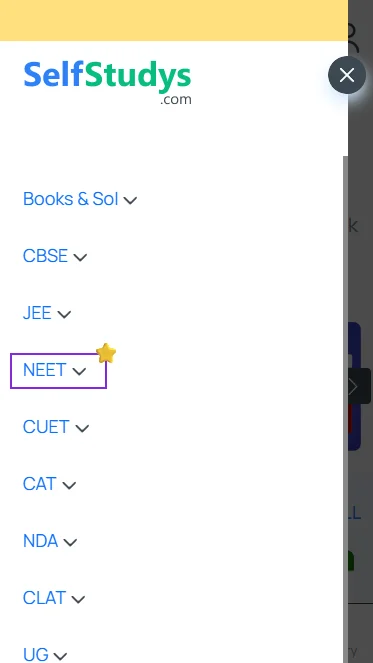
In this menu, you need to select the ‘NEET’ section as highlighted below.
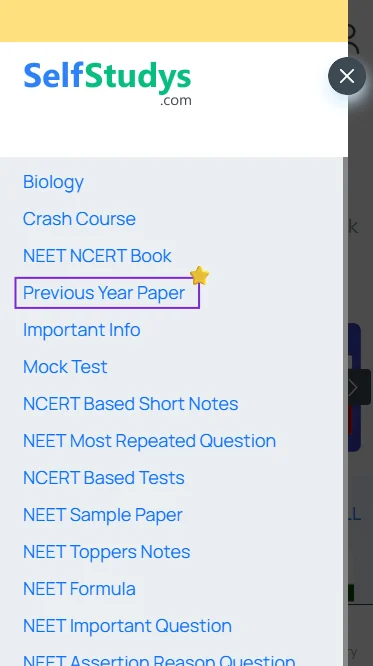
- Next, you can tap on the ‘Previous Year Paper’ icon to reach the page of NEET exam previous year question papers.
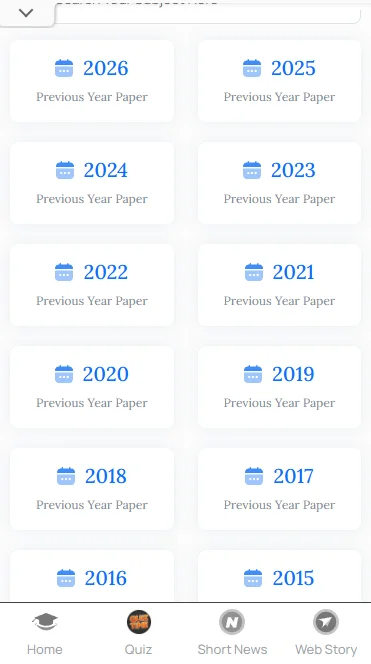
- Now, from various year-wise options for the NEET previous year question papers, you can select any one.
- After selecting the year for the NEET PYQs, you can either solve them by viewing the PDF online or downloading it.
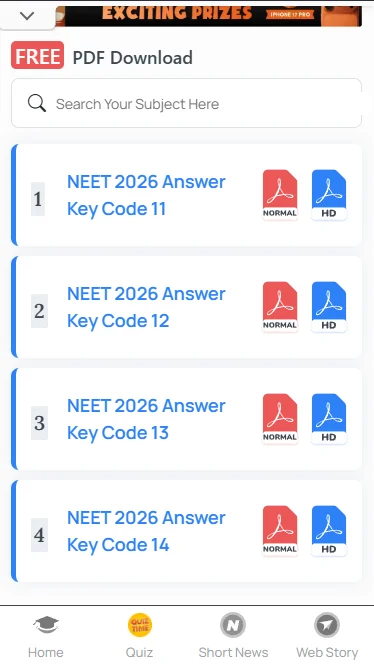
Note: To complete the NEET previous year question paper PDFs downloading procedure, you need to Log In or Register with your Google account on SelfStudys.
Instructions To Follow In The NEET Exam Hall
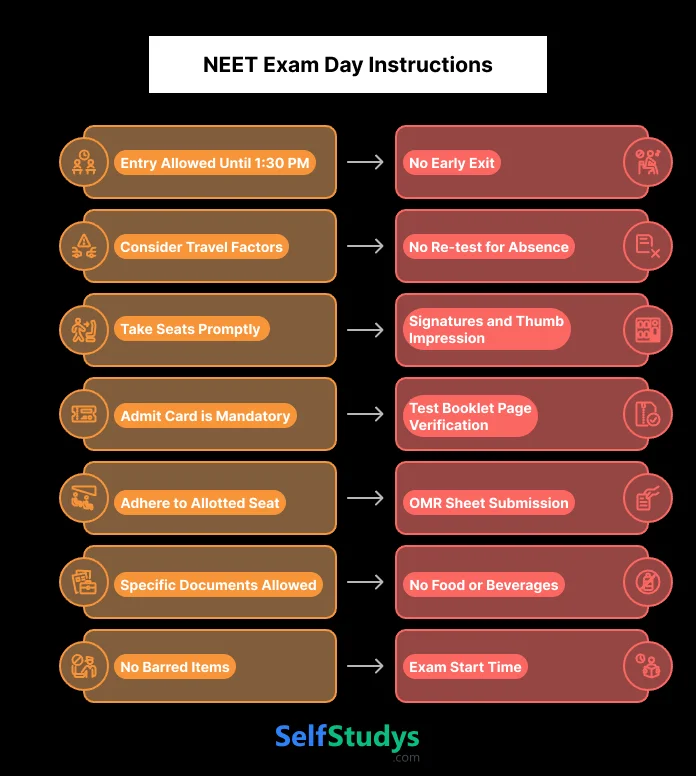
There are some instructions that you need to follow for a smooth NEET examination experience. We have mentioned the most important ones below for your reference.
-
Every exam center opens three hours before the National Eligibility cum Entrance Test (UG) starts. You will not be allowed to enter the exam hall after 1:30 PM.
-
You need to ensure that you consider all the factors, like traffic, center location, weather conditions, and so on, before you leave home.
-
As soon as the exam hall opens, you should take your seats immediately.
-
At the demand of the Centre Superintendent, you have to show your Admit Card. If you do not possess one, you will not be allowed to enter the hall.
-
You will be allotted a seat with your roll number, and you must find it. In case you appear in the exam from a seat or room that is not allotted to you, then your candidature will be canceled.
-
You can bring only the following documents on the exam day at the center.
-
A printed copy of the Admit Card with a passport-size photograph. The photo should be the same as the one uploaded on your application form.
-
You need to paste one post-card size colored photograph with a white background on your Proforma.
-
Any 1 authorized photo ID (PAN card, driving license, voter ID, Passport, Aadhaar card, DigiLocker, APAAR ID)
-
If you are claiming relaxation under the PwBD category, then you need a certificate of physical limitation to write and/or a PwBD certificate issued by the Competent Authority.
-
-
You cannot bring any barred items or those that could be used for unfair practices.
-
You will not be permitted to leave your seat or the exam hall until the exam concludes. You can only do so after handing over your OMR sheet to the invigilator.
-
You are not allowed to take tea, coffee, cold drinks, snacks, etc. into the exam center.
-
The NEET will start at the exact time that is mentioned in your Admit Card. The invigilator will also make an announcement for the same.
-
You have to sign twice on the Attendance sheet as well as put your Thumb Impression at the given space.
-
You need to check and make sure that your Test Booklet has the same number of pages as written on the top of the cover page.
-
In case you are not able to appear for the test on the scheduled date under any circumstances, then a re-test will not be held by the NTA.
Conclusion
The previous year NEET question papers with solutions PDF are known to be a study resource that is not just for practice. With their help, you can understand the real structure, level of difficulty, question patterns, and so on related to the examination. By solving them, you will be able to find the important topics, improve your accuracy, strengthen your time management, as well as build your confidence for the actual exam day.
The experts of SelfStudys recommend that ideally, you need to solve around 5 to 10 years of previous year question papers NEET. By solving multiple papers, you will be able to recognize the concepts that are repeated, improve your speed in solving questions, build exam confidence, etc. Moreover, your focus should be mainly on analyzing every paper and learning from your mistakes, rather than solving too many papers.
The NEET previous year question papers are very useful when you are in the final revision phase. This is because they have the most exam-relevant questions as well as concepts. When you solve them in the last few months, you can revise the important formulas, NCERT-based facts, diagrams, commonly repeated topics, and so on quickly. However, you should also revise theory and notes alongside the PYP practice.
One of the best ways to solve the NEET previous year question paper PDFs is by following a structured approach. First, you should solve them chapter-wise in order to build your concepts, then attempt full-length papers, and finally, solve them again under strict exam conditions.
The exact questions from the previous year NEET question papers with solutions PDF free download do not repeat in the exam. But you should know the PYPs have concepts, patterns, and styles of questions that reappear quite frequently in the examination. A number of Biology facts, Physics formulas, or Chemistry reaction-based questions are taken from the past papers.
Yes, as a beginner, you can start your preparation with the NEET exam previous year question papers. By doing so, you will be able to understand the level of questions that are expected in the exam and avoid studying unnecessary topics. You will also get a realistic idea of the areas where you need a stronger understanding of the concepts.


 Home
Home
 Quiz
Quiz
 Short News
 Web Story
 Get latest Exam Updates