


 Sign in


 Profile
 Signout

Branches of Science and Their Subfields: Types, Fields and Complete List
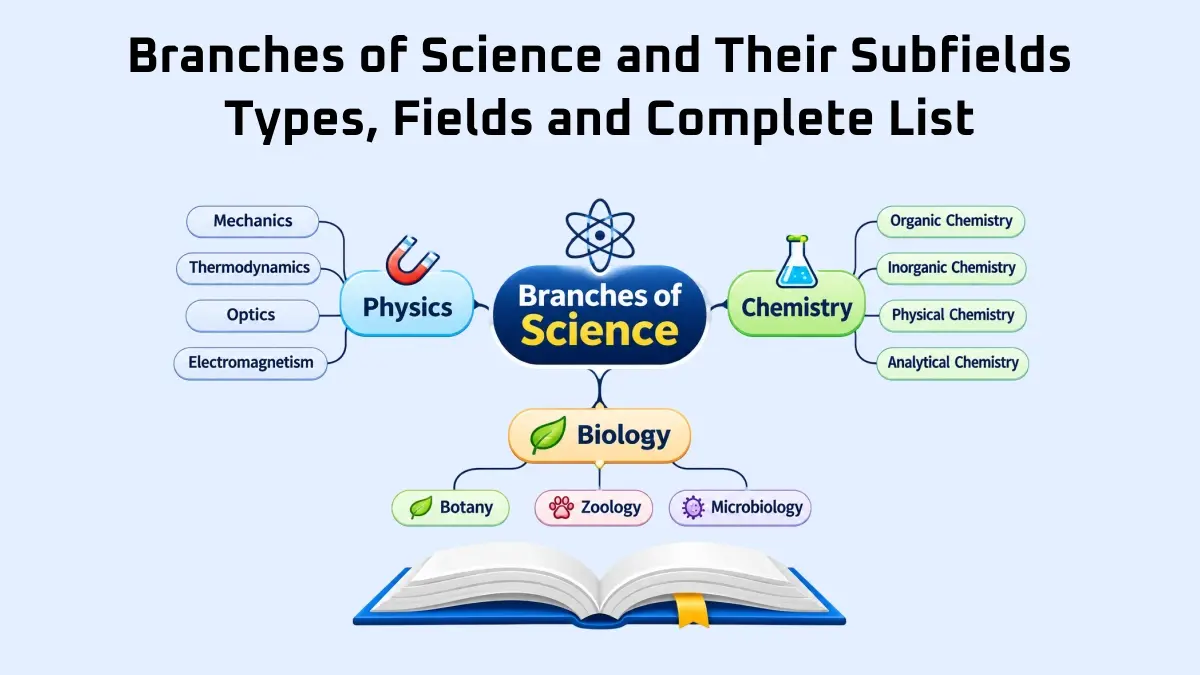

The science has three major divisions, namely the Natural Science, the Formal Science, and the Social Science. These sciences have various fields and subfields, and each field or subfield studies some or the other aspects of nature.
Types of Science - Understanding All Branches of Science and Their Subfields: Types of Science enables students to cover topics like Physics, Chemistry, Biology, Mathematics, Psychology, and Economics. These sciences offer various options for further studies as well as career opportunities after class 12th.
Branches of Science and Their Subfields: Types of Science
The three types of science are Natural Science, Formal Science and Social Science. The first one involves the study of the natural world, whereas the second is concerned with the study of mathematics and logic, and the third focuses on social aspects of humans.
The following table illustrates the branches of sciences along with their domains.
|
Natural Science |
Formal Science |
Social Science |
|
Physics |
Mathematics |
Sociology |
|
Chemistry |
Logic |
Economics |
|
Biology |
Statistics |
Anthropology |
|
Astronomy |
Computer Science |
Political Science |
|
Earth Science |
Data Science |
Psychology |
|
Environmental Science |
Information Theory |
Human Geography |
|
Geology |
Theoretical Computer Science |
History |
Some fields overlap between categories. For example, Computer Science includes both theoretical and applied work, while Geography covers natural and social processes.
Branches of Natural Science
Natural Science focuses on the study of living things, matter, energy, and the physical world. This is achieved through observation, experimentation, and scientific data.
There are two major branches of Natural Science, namely Physical Science and Biological Science.
|
Physical Science |
Biological Science |
|
Physics |
Botany |
|
Chemistry |
Zoology |
|
Astronomy |
Microbiology |
|
Geology |
Genetics |
|
Meteorology |
Ecology |
|
Oceanography |
Biochemistry |
|
Earth Science |
Molecular Biology |
|
Environmental Science |
Physiology |
Physical Science and its branches
Physical Science studies matter, energy and non-living systems. Its major branches include Physics, Chemistry, Astronomy and Earth Science.
1. Physics
Physics deals with matter, energy, motion, forces, space, and time. Physics provides us with explanations of natural phenomena like gravity, electricity, magnetism, and light.
Main divisions of Physics are as follows:
- Mechanics: The study of motion and forces.
- Thermodynamics: The study of heat and energy.
- Electromagnetism: The study of electric and magnetic fields.
- Optics: The study of light.
- Quantum Physics: The study of matter and energy at the atomic level.
- Nuclear Physics: The study of atomic nuclei.
2. Chemistry
Chemistry studies the composition, structure, properties and reactions of substances. It explains how atoms and molecules interact to form different materials.
The three major branches of Chemistry are:
|
Branch |
What it studies |
|
Organic Chemistry |
Carbon compounds, their properties and reactions |
|
Inorganic Chemistry |
Elements and compounds, including metals, minerals and salts |
|
Physical Chemistry |
Physical principles behind chemical reactions and processes |
Other fields include Analytical Chemistry, Environmental Chemistry and Biochemistry.
3. Earth Science
Earth Science studies the planet's structure, atmosphere, oceans and natural processes.
|
Branch |
What it studies |
|
Geology |
Rocks, minerals and Earth's structure |
|
Meteorology |
Weather and atmospheric conditions |
|
Oceanography |
Oceans and marine processes |
|
Seismology |
Earthquakes and seismic waves |
|
Environmental Science |
Environmental systems and human impacts |
4. Astronomy
Astronomy is the scientific study of celestial bodies and occurrences outside Earth's atmosphere. This involves the study of stars, planets, galaxies, and the whole universe.
Some of its subdivisions are Astrophysics, Cosmology, Planetary Science, and Stellar Astronomy.
Biological Science and its branches
Biological Science or Life Science is the branch of science that deals with the study of living things.
These are the major subdivisions of Biological Science:
|
Branch |
What it studies |
|
Botany |
Plants and plant life |
|
Zoology |
Animals and their characteristics |
|
Microbiology |
Microorganisms such as bacteria and fungi |
|
Genetics |
Heredity and variation |
|
Ecology |
Relationships between organisms and their environment |
|
Biochemistry |
Chemical processes in living organisms |
|
Molecular Biology |
Biological processes at the molecular level |
|
Physiology |
Functions of living organisms and their organs |
|
Anatomy |
Structure of organisms and body parts |
|
Evolutionary Biology |
Evolution and diversity of living organisms |
Biological science is related to medicine, agriculture, biotechnology, and environment research.
Branches of Formal Science
Formal science investigates abstract systems using mathematics, logic, and deduction. The rules, theories, and techniques developed by these branches are utilized in scientific research and technologies.
In contrast to experimental sciences, many of the outcomes in formal sciences are obtained through proofs.
Main branches of Formal Science
|
Branch |
What it studies |
|
Mathematics |
Numbers, quantities, shapes and patterns |
|
Logic |
Principles of valid reasoning and arguments |
|
Statistics |
Collection, analysis and interpretation of data |
|
Computer Science |
Computation, algorithms and computer systems |
|
Data Science |
Methods for analysing and interpreting data |
|
Information Theory |
Measurement, storage and transmission of information |
Characteristics of Formal Science
Formal Science has several distinguishing features:
- Abstract ideas: Abstract entities, mathematical concepts, relations are its subjects of study.
- Deductive methods: Deductions can be made using certain rules and premises.
- Systems of axioms: Mathematical propositions are deduced from axioms.
- Language of symbols and rules: Ideas can be expressed using language of symbols and rules.
Applications of Formal Science
Formal Sciences facilitate scientific research and problem solving in several fields.
For instance, Mathematics is applied in Physics, Engineering and Economics. Statistics assists scientists in the analysis of medical and sociological data. Computer Science facilitates software development and artificial intelligence.
Branches of Social Science
It deals with human behavior and their society, culture and institutions. They study them through surveys, observations, interviews, documentation and statistics to solve social problems.
Major areas of Social Science are Sociology, Economics, Anthropology, Political Science, Psychology, Geography and History.
Social Science branches and their subfields
|
Branch |
Major subfields |
|
Anthropology |
Cultural Anthropology, Biological Anthropology, Linguistic Anthropology |
|
Economics |
Microeconomics, Macroeconomics, Development Economics |
|
Geography |
Human Geography, Economic Geography, Population Geography |
|
History |
Political History, Economic History, Social History |
|
Political Science |
Comparative Politics, International Relations, Political Theory |
|
Psychology |
Cognitive Psychology, Social Psychology, Developmental Psychology |
|
Sociology |
Social Theory, Social Demography, Criminology |
1. Anthropology
Anthropology studies human societies, cultures and biological development. It examines traditions, languages, social practices and human evolution.
2. Economics
Economics studies how individuals, businesses and governments produce, distribute and use goods and services. Its main fields include Microeconomics, Macroeconomics and Development Economics.
3. Geography
Geography examines Earth's surface and the distribution of human activities. Human Geography is commonly studied within Social Science, while Physical Geography is closely connected with Natural Science.
4. History
History studies past events and human societies through written records, archaeological evidence and other sources. Its major areas include Political History, Economic History and Social History.
5. Political Science
Political Science studies governments, political institutions, public policies and political behaviour. Its subfields include International Relations, Comparative Politics and Political Theory.
6. Psychology
Psychology studies mental processes and behaviour. It covers memory, learning, emotions, personality and social interactions.
7. Sociology
Sociology studies social relationships, institutions and communities. It examines social change, inequality, population trends and group behaviour.
Interdisciplinary Branches of Science
Some scientific fields combine knowledge from multiple disciplines. These are called interdisciplinary sciences.
|
Interdisciplinary field |
Related branches |
|
Biochemistry |
Biology and Chemistry |
|
Biophysics |
Biology and Physics |
|
Astrophysics |
Astronomy and Physics |
|
Environmental Science |
Biology, Chemistry, Earth Science and Social Science |
|
Neuroscience |
Biology, Psychology and Chemistry |
|
Biotechnology |
Biology, Chemistry and Technology |
|
Bioinformatics |
Biology, Computer Science and Statistics |
|
Geophysics |
Geology and Physics |
|
Cognitive Science |
Psychology, Computer Science, Linguistics and Neuroscience |
These fields help researchers study problems that involve more than one scientific discipline.
Difference Between Natural, Formal and Social Science
|
Basis |
Natural Science |
Formal Science |
Social Science |
|
Main focus |
Nature and the physical world |
Abstract systems and logical structures |
Human society and behaviour |
|
Methods |
Experiments and observations |
Mathematical proofs and logical reasoning |
Surveys, interviews, observations and data analysis |
|
Examples |
Physics, Chemistry, Biology |
Mathematics, Logic, Statistics |
Sociology, Economics, Psychology |
|
Applications |
Medicine, energy, environmental research |
Computing, modelling, statistical analysis |
Public policy, education, social research |
Courses and Career Options in Different Branches of Science
Students can choose courses based on their interests and academic qualifications. The available programmes and admission requirements vary by institution.
|
Science field |
Common courses |
Career options |
|
Physics |
BSc Physics, MSc Physics |
Physicist, Research Scientist |
|
Chemistry |
BSc Chemistry, MSc Chemistry |
Chemist, Laboratory Analyst |
|
Biology |
BSc Biology, BSc Biotechnology |
Biologist, Research Assistant |
|
Mathematics |
BSc Mathematics, MSc Mathematics |
Mathematician, Data Analyst |
|
Computer Science |
BSc Computer Science, BTech CSE |
Software Developer, Computer Scientist |
|
Environmental Science |
BSc Environmental Science |
Environmental Analyst, Researcher |
|
Psychology |
BA/BSc Psychology, MA/MSc Psychology |
Researcher, Psychology-related roles |
|
Economics |
BA/BSc Economics, MA Economics |
Economist, Economic Analyst |
|
Sociology |
BA Sociology, MA Sociology |
Social Researcher, Policy Researcher |
Some careers require postgraduate study, professional qualifications or specialised training.
---
👉 CBSE Class 12 Study Materials
CBSE Class 12 study material includes latest syllabus, sample papers, NCERT books and solutions, previous year question papers, chapter-wise important questions, case study questions, assertion-reason questions, and competency-based questions — all updated as per the latest CBSE board exam pattern.



 Home
 Quiz
 Short News
 Web Story
 Get latest Exam Updates