




 Sign in


 Profile
 Signout
JEE Main Chemistry 2026 Chapter-wise Weightage & Topics - Complete Guide


The NTA has released the official syllabus for JEE Main 2026. Start your preparation early by covering the essential chapters.
The NTA has reduced the syllabus in recent years, making it even more crucial to focus on high-weightage topics. A strategic approach will save you time and boost your score.
Understanding the chapter-wise weightage in Chemistry can make your JEE Main preparation much smarter. When you know which topics carry more marks, you can dedicate your energy to those chapters that yield higher scores.
Analysis of previous years' papers reveals that certain topics appear repeatedly in the exam. Targeting these chapters first will give you a significant advantage over others.
👉 Also Check - JEE Main 2026 Chapter-wise Weightage - Physics, Chemistry & Maths Complete Guide
Overview of the JEE Main Chemistry Syllabus 2026
The JEE Main Chemistry syllabus for 2026 is divided into three main sections: Physical Chemistry, Inorganic Chemistry, and Organic Chemistry. Each section has its own set of important topics.
Physical Chemistry (Section A) covers fundamental topics. You will study some basic concepts of chemistry, atomic structure, and chemical bonding and molecular structure. It also includes chemical thermodynamics, equilibrium, and redox reactions and electrochemistry. Solutions and chemical kinetics are also part of this section.
Inorganic Chemistry (Section B) focuses on elements and their properties. This section includes the classification of elements and periodicity in properties. You will also learn about p-block elements (Groups 13 and 14), d- and f-block elements, and coordination compounds.
Organic Chemistry (Section C) deals with carbon-based compounds. It includes the purification and characterization of organic compounds and some basic principles of organic chemistry. Hydrocarbons are also covered here. You will also study organic compounds containing halogens, oxygen, and nitrogen. Principles related to practical chemistry complete this section. This clear division helps you organize your study plan. You can effectively balance your preparation across all three areas of chemistry.
👉 Also Check - JEE Main Maths 2026 Chapter-wise Weightage & Topics - Complete Guide
👉 Also Check - JEE Main Physics 2026 Chapter-wise Weightage & Topics - Complete Guide
JEE Main Chemistry Chapter Weightage 2026
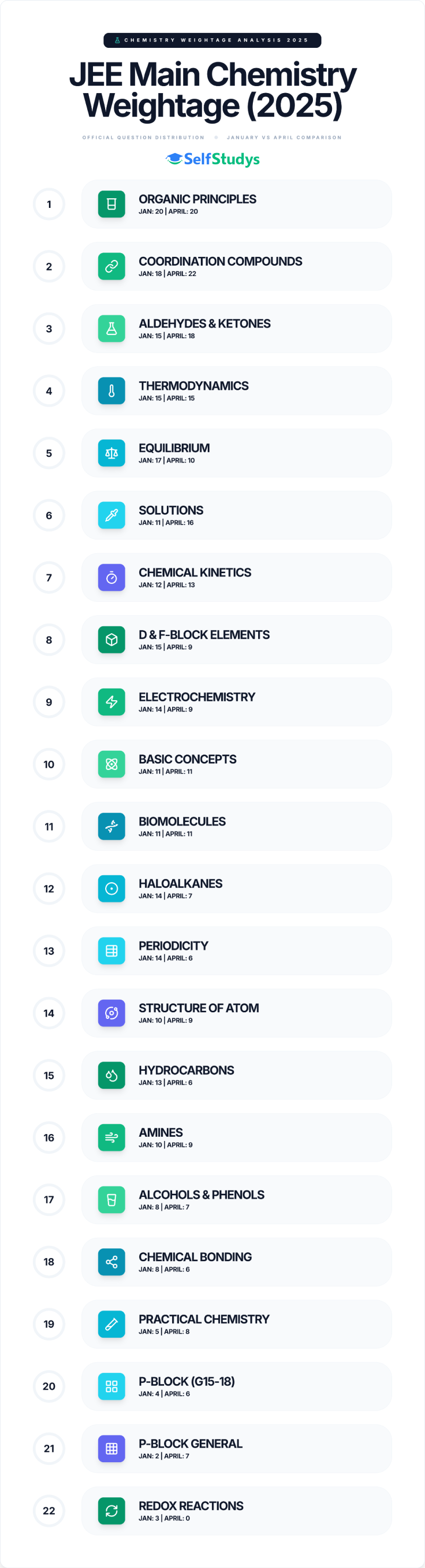
The chapter-wise weightage for JEE Main 2026 is derived from a detailed analysis of past years' question paper trends. Chemistry is broadly divided into three major branches: Organic, Inorganic, and Physical Chemistry. A breakdown of chapters with the number of questions and their corresponding weightage will help students understand which topics to focus on during their preparation.
| JEE Main Chemistry Chapter Weightage | ||
| Chapter Name | Question No JEE Main 2025 January session | Question No JEE Main 2025 April session |
| Organic Chemistry - Some Basic Principles and Techniques | 20 | 20 |
| Coordination Compounds | 18 | 22 |
| Aldehydes, Ketones and Carboxylic Acids | 15 | 18 |
| Thermodynamics | 15 | 15 |
| Equilibrium | 17 | 10 |
| Solutions | 11 | 16 |
| Chemical Kinetics | 12 | 13 |
| The d and f-Block Elements | 15 | 9 |
| Electrochemistry | 14 | 9 |
| Some Basic Concepts of Chemistry | 11 | 11 |
| Biomolecules | 11 | 11 |
| Haloalkanes and Haloarenes | 14 | 7 |
| Classification of Elements and Periodicity in Properties | 14 | 6 |
| Structure of Atom | 10 | 9 |
| Hydrocarbons | 13 | 6 |
| Amines | 10 | 9 |
| Alcohols, Phenols and Ethers | 8 | 7 |
| Chemical Bonding and Molecular Structure | 8 | 6 |
| Principles Related to Practical Chemistry | 5 | 8 |
| The p-Block Elements (Group 15 to 18) | 4 | 6 |
| The p-Block Elements | 2 | 7 |
| Redox Reactions | 3 | 0 |
Subdiscipline-wise Question Trends in Chemistry
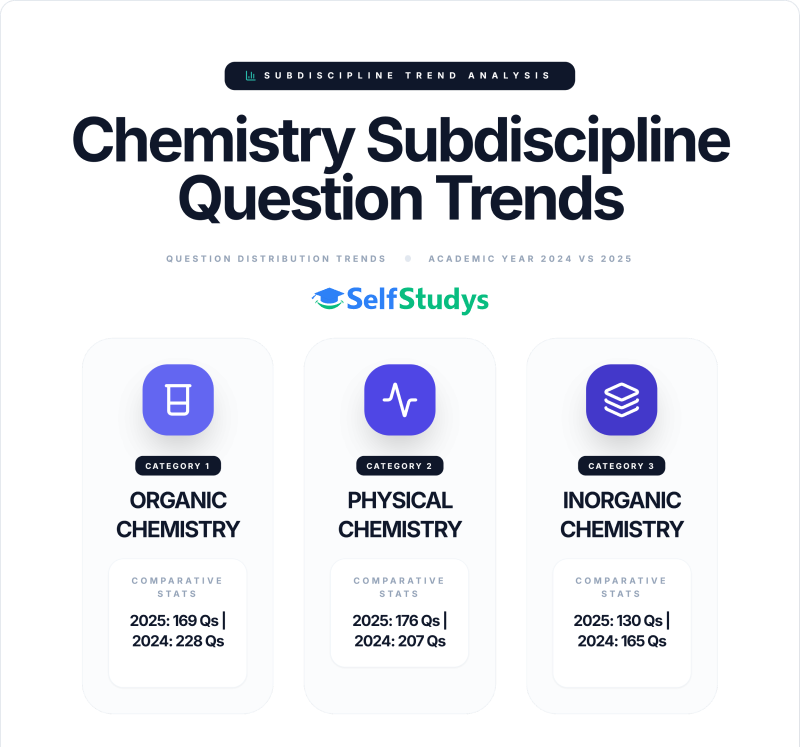
Organic Chemistry dominated in 2024, while Physical Chemistry led in 2025. Inorganic Chemistry had fewer questions but still contributed significantly.
| Subdiscipline-wise Question Trends in Chemistry | |||
| Year | Organic Chemistry | Physical Chemistry | Inorganic Chemistry |
| 2025 | 169 questions | 176 questions | 130 questions |
| 2024 | 228 questions | 207 questions | 165 questions |
Class-wise Distribution of Chemistry Questions
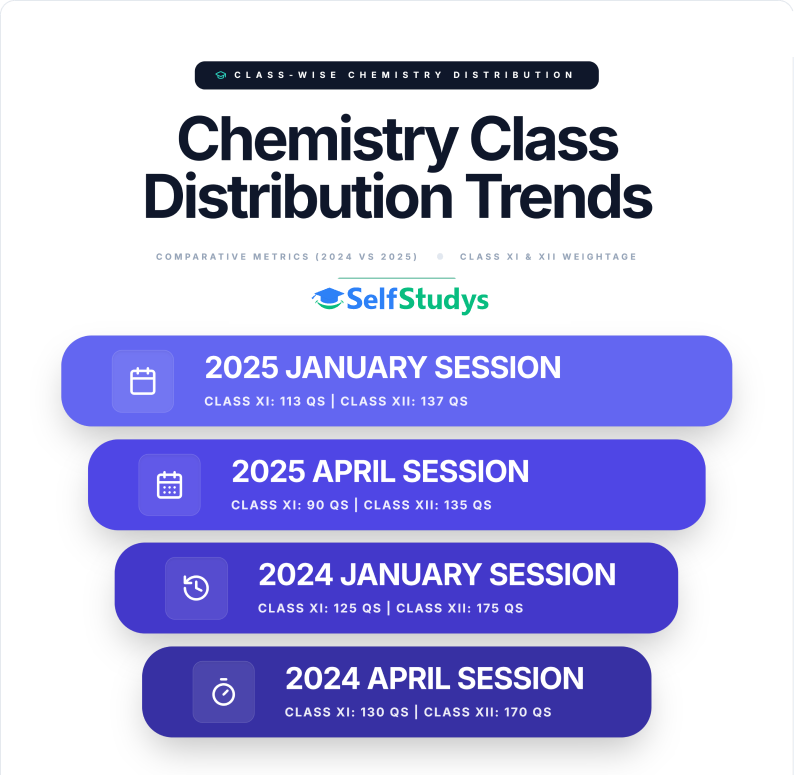
The table below shows the distribution of Chemistry questions from Class 11 and Class 12 in JEE Main 2024 and 2025 exams. It covers both January and April sessions.
| Class-wise Distribution of Chemistry Questions | |||
| Year | Class | April Session | January Session |
| 2025 | XI | 90 | 113 |
| XII | 135 | 137 | |
| 2024 | XI | 130 | 125 |
| XII | 170 | 175 | |
Chemistry High Weightage Chapters And Topics For JEE Main 2026
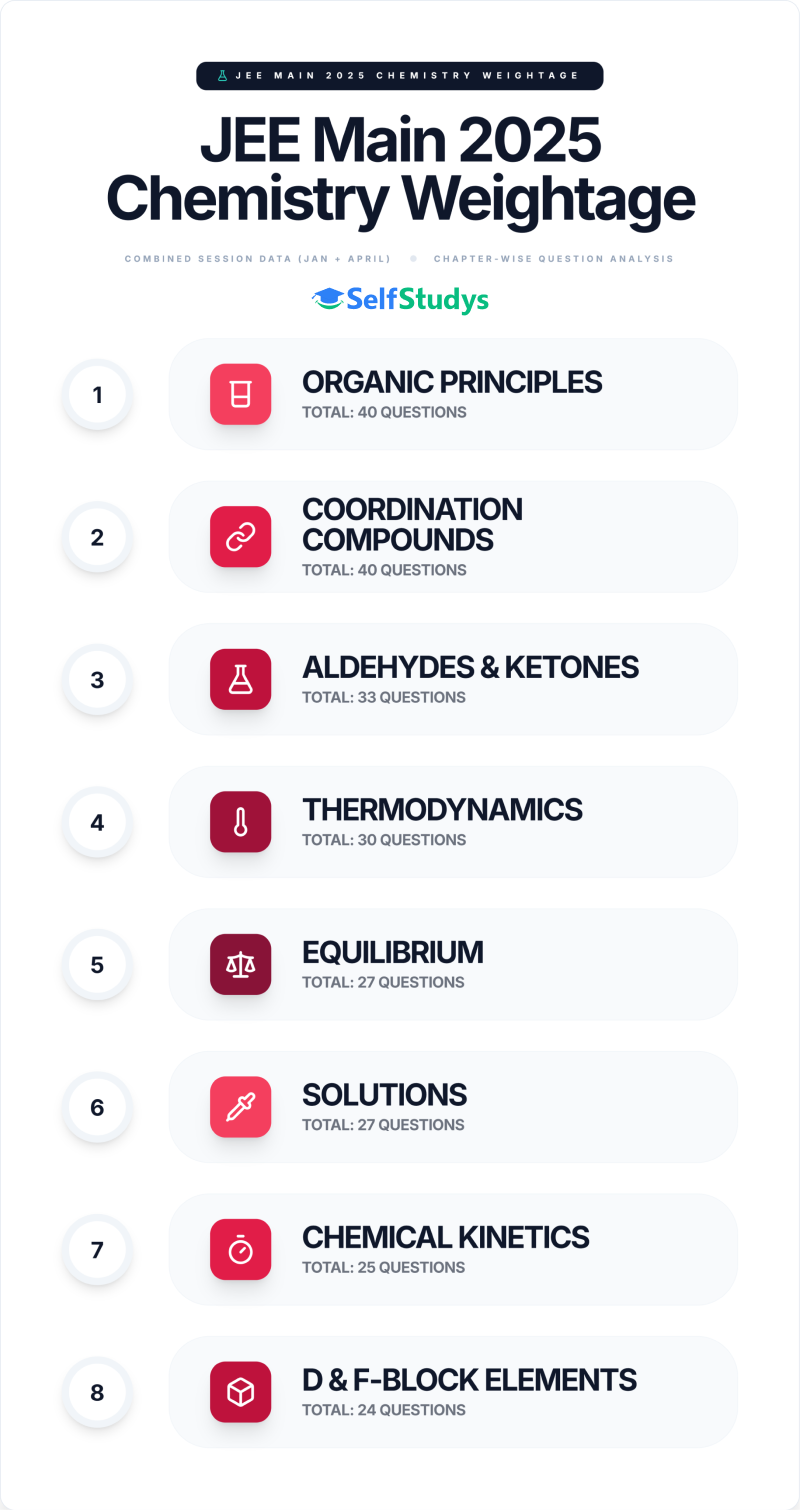
These 8 chapters are extremely important for JEE Main Chemistry. Together, they contribute more than 50% of total questions in both January and April sessions. Chapters like Coordination Compounds and Basic Principles of Organic Chemistry appear frequently in every attempt. Focus on these topics to boost your score quickly.
The table below shows how questions were distributed across these key Chemistry chapters.
| Chapter Name | No of Question Asked In JEE Main 2025 (January And April Session) |
| The d and f-Block Elements | 24 |
| Chemical Kinetics | 25 |
| Solutions | 27 |
| Equilibrium | 27 |
| Thermodynamics | 30 |
| Aldehydes, Ketones and Carboxylic Acids | 33 |
| Coordination Compounds | 40 |
| Organic Chemistry – Some Basic Principles & Techniques | 40 |
--------------
-




 Home
Home
 Quiz
Quiz
 Short News
 Web Story
 Get latest Exam Updates







