


 Sign in


 Profile
 Signout
CBSE Introduces Mandatory Three Language Policy for Classes 9–10 Starting July 2026
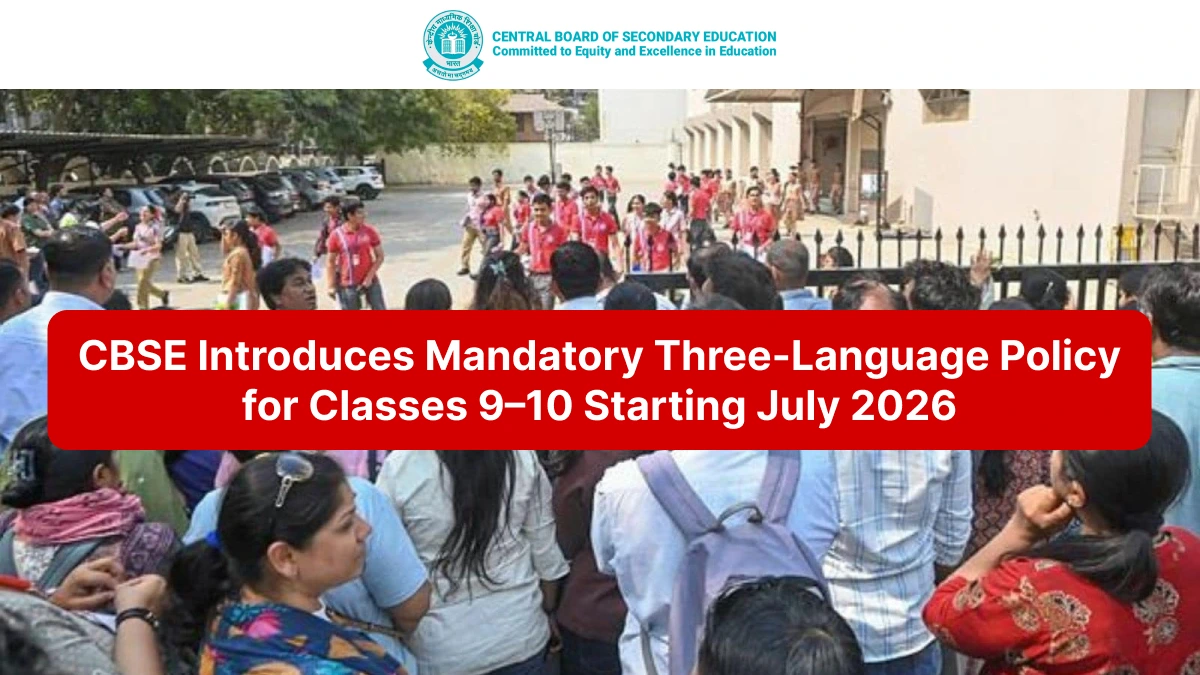


The Central Board of Secondary Education (CBSE) has made it mandatory for students in Classes 9 and 10 to study three languages, effective from July 1, 2026. However, as a measure of relief, there will be no Board examination for the third language (designated as R3) at the Class 10 level.
In a circular issued on May 15, the CBSE stated that this step has been taken "to keep the focus on learning and to alleviate any form of unnecessary pressure on students."
This move aligns with the guidelines outlined in the National Education Policy (NEP) 2020 and the National Curriculum Framework for School Education 2023, both of which recommend the three-language formula across all school levels.
How Will the Third Language Be Assessed?
CBSE has clarified that all R3 assessments will be conducted internally by the schools themselves. There will be no centralized Board examination for the third language. Students' performance in R3 will be reflected on the CBSE certificate, but it will be based entirely on school-level assessments.
The Board has also given an assurance that no student will be barred from appearing for the Class 10 Board examinations on account of R3.
Textbooks are not Ready Yet
However, there is a catch. Textbooks dedicated to R3 at the secondary level are not currently available. For the time being, CBSE has asked schools to use Class 6-level textbooks (2026-27 edition) for the language selected in Class 9. Schools may also utilize local literature—such as short stories, poetry, and non-fiction—as a supplement to these textbooks.
CBSE is currently developing textbooks for several Indian languages. Take a look at some of the languages included in the list:
Languages Being Developed for R3
- Assamese
- Bengali
- Marathi
- Tamil
- Telugu
What about the teachers?
CBSE has acknowledged that, at present, there is a shortage of language teachers in all schools. As a temporary solution, the Board has permitted schools to do the following:
- Utilize existing teachers of other subjects who possess a working knowledge of the language.
- Share teaching resources with neighboring schools.
- Adopt virtual or hybrid teaching methods.
- Appoint retired teachers to address this shortage.
Rules for Choosing a Third Language
Schools may select a third language from the CBSE-approved list; however, there is one condition: of the three languages studied by the student, at least two must be Indian languages. Schools are required to update their language choices on the OASIS portal by June 30, 2026.
Exemptions for Special Cases
CBSE has provided flexibility on a case-by-case basis for certain groups. These include:
- Children with Special Needs (CWSN)
- Foreign students studying in India
- Students enrolled in CBSE-affiliated schools abroad
This marks a significant shift in the conduct of secondary education under CBSE. While the objective is to promote multilingualism, schools will require time to arrange for textbooks, teachers, and other logistical requirements before the policy can be implemented smoothly.
--
👉 CBSE Class 10 Study Materials
CBSE Class 10 study material includes latest syllabus, sample papers, NCERT books and solutions, previous year question papers, chapter-wise important questions, case study questions, assertion-reason questions, and competency-based questions — all updated as per the latest CBSE board exam pattern.




 Home
Home
 Quiz
Quiz
 Short News
 Web Story
 Get latest Exam Updates