




 Sign in


 Profile
 Signout
CBSE Three-Language Policy Explained: Benefits, Challenges and Impact on Students
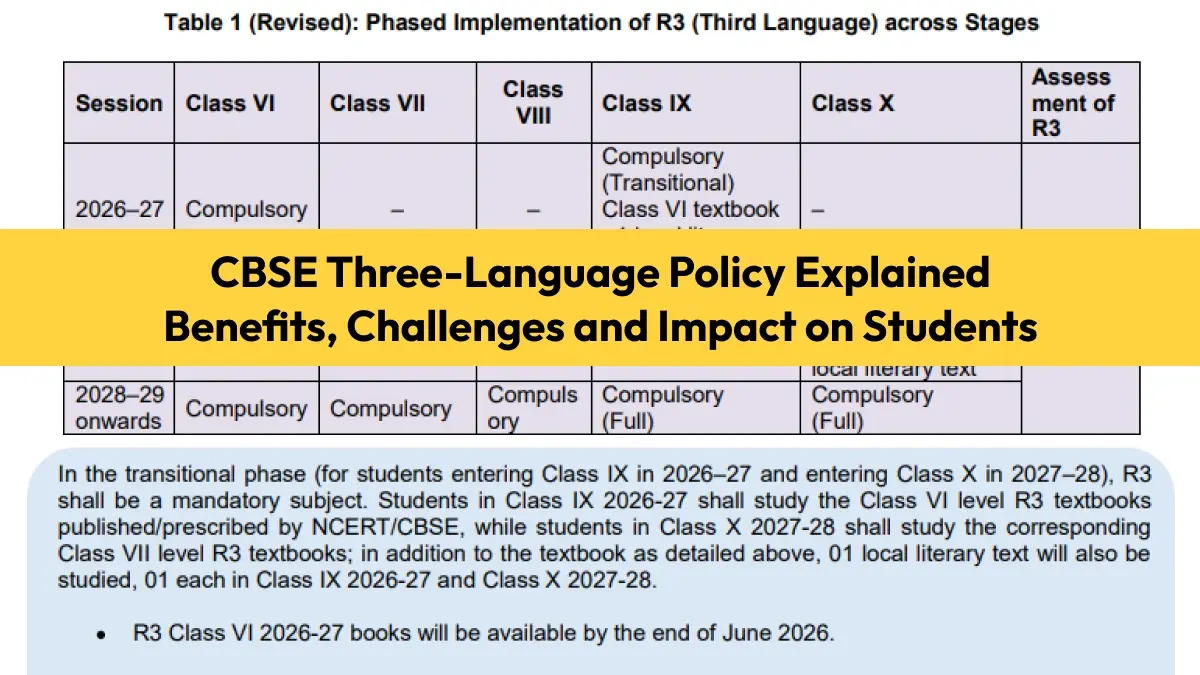


Implementation of the CBSE three-language policy is in progress and is planned in phases. It is aimed at encouraging students to study more languages and learn about cultures. According to the policy, each student must study two languages as the mandatory part of the curriculum, and the third language is optional.
The policy should bring benefits in terms of improved language skills, cultural awareness and communication ability of the students. At the same time, many students, parents and schools worry about scheduling of the lessons, lack of teachers, books and assessment methods as well as additional burden on students.
What Is CBSE Three-Language Policy?
According to the new language policy, there are two language requirements for students – the first one is called **R1**, and the second is called **R2**. The third language, called **R3**, is optional.
The implementation is going in phases. Schools work on adjustment of their timetables and resources in order to provide the additional language requirement.
Benefits of Studying Multiple Languages
According to the opinion of educators, learning multiple languages may contribute to improvement of communication skills and increase the cultural awareness.
According to the education experts, the following benefits can be expected due to multilingual learning:
- Better communication skills
- Improvement of memory and cognitive functions
- Cultural awareness
- Confidence in communicating with people from different regions
- Improved perspectives in studying and career
In case of multilingual country like India, it may be beneficial to learn additional Indian languages in order to connect with other people and to learn more about different cultures.

Problems Associated with Implementation of the Three-Language Policy
Although the policy has many advantages for students, schools face difficulties while implementing it.
Among the main concerns, the following issues should be mentioned:
- Addition of additional periods to the existing timetable
- Availability of qualified teachers of the additional languages
- Lack of books and other resources
- Understanding of the assessment method
- Additional academic burden of the students
Schools try to add the additional language course into the timetable without expanding the hours of the lessons. Some institutions try to add the additional language periods through the redistribution of other subjects' periods.
Student Experience and Pressure on Academic Load
Students have different opinions about the learning of the additional language. While some students consider additional language learning interesting and easy to handle, others think that it requires additional time and effort besides other academic subjects.
With regular practice and proper time management, students will be able to balance language studies and main academic subjects.
Some students will use additional languages only in the class, but for some it may be helpful in communications or further in life.
Role of School in Implementation of the Policy
School plays an important role in the implementation of the policy. Adequate planning, adequate availability of teachers and learning materials will be important for successful implementation.
It is suggested that language learning should be focused not only on passing examinations but also on development of communication skills.
School should provide the balance between language learning and core academic subjects in order to avoid the burden on students.
Impact of the Absence of the Board Exam for the Third Language
The absence of the Class 10 Board Exam for the third language should decrease examination burden on students.
However, according to the opinion of the educators, students should pay attention to the language and focus on language skills development and not only examination preparations.
Continual assessment and learning practices may be helpful in improving language skills.
Conclusion
The success of the **CBSE three-language policy** depends on how effectively the policy will be implemented by schools. Availability of the trained teachers, sufficient learning resources, appropriate time in the classroom and opportunities for practical learning will be important.
The policy can provide the improvement of language and cultural knowledge, but proper planning will be needed in order to let students cope with the additional load.
-------
👉 CBSE Class 12 Study Materials
CBSE Class 12 study material includes latest syllabus, sample papers, NCERT books and solutions, previous year question papers, chapter-wise important questions, case study questions, assertion-reason questions, and competency-based questions — all updated as per the latest CBSE board exam pattern.
--
👉 CBSE Class 10 Study Materials
CBSE Class 10 study material includes latest syllabus, sample papers, NCERT books and solutions, previous year question papers, chapter-wise important questions, case study questions, assertion-reason questions, and competency-based questions — all updated as per the latest CBSE board exam pattern.




 Home
Home
 Quiz
Quiz
 Short News
 Web Story
 Get latest Exam Updates







