




 Sign in


 Profile
 Signout
Difference Between RBCs and WBCs for CBSE 12th Board Exam
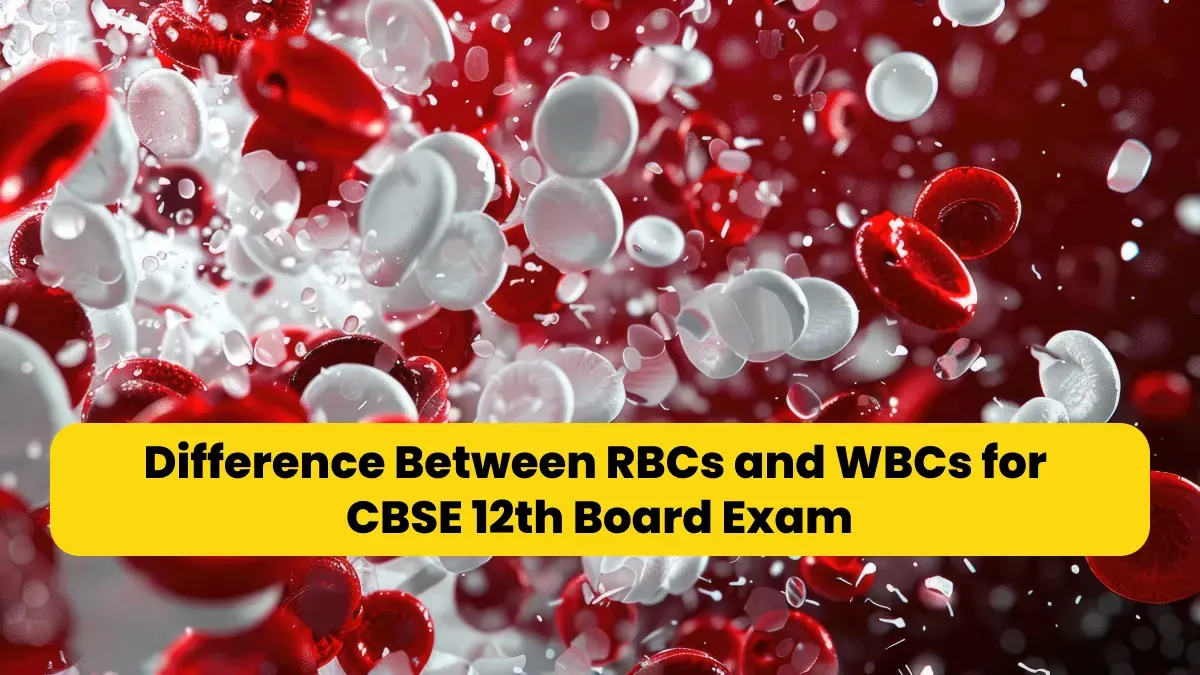

Blood is an important connective tissue that performs several functions in the human body. Some of them include carrying oxygen, transporting waste materials, protecting the body against infections, and so on. There are various types of components present in blood, such as RBCs (Red Blood Cells) and WBCs (White Blood Cells).
Both RBCs and WBCs are two types of blood cells; however, they have different structures and functions. The main function of the RBCs is to transport oxygen in the body with the help of hemoglobin, whereas the role of WBCs is to protect the body from infections and diseases through immunity.
There are some differences between the RBCs and WBCs in terms of structure, size, function, life span, production, and quantity in blood.
What are RBCs (Red Blood Cells)?
The Red Blood Cells, also referred to as Erythrocytes, are the most numerous types of blood cells found in the body of a human being. They are responsible for carrying oxygen from the lungs to various parts of the body.
RBCs possess haemoglobin proteins that bind oxygen to them and give the blood its red coloration. RBCs do not have nuclei, hence making them capable of containing more haemoglobin and delivering oxygen effectively.
RBCs are made in the red bone marrow through a process known as erythropoiesis. An average RBC can live for about 120 days.
Main Functions of RBCs
- Transport oxygen from the lungs to body cells
- Transport a little carbon dioxide to the lungs
- Keep the color of blood red because of hemoglobin
- Contribute in keeping the normal functioning of the body through oxygen supply

What are WBCs (White Blood Cells)?
White Blood Cells (Leukocytes) constitute an essential part of the immune system of the body as they provide immunity against pathogens such as bacteria and viruses.
The White Blood Cells differ from the Red Blood Cells (RBC) in that the former have a nucleus and occur in several forms, namely neutrophils, lymphocytes, monocytes, eosinophils, and basophils.
These cells are formed in the bone marrow and also occur in association with lymphatic glands and the spleen. The life span of these cells is different from one another.
Main Functions of WBCs
- Fight infections and diseases
- Protect the body from harmful microorganisms
- Produce antibodies for immune defence
- Remove damaged cells and foreign particles
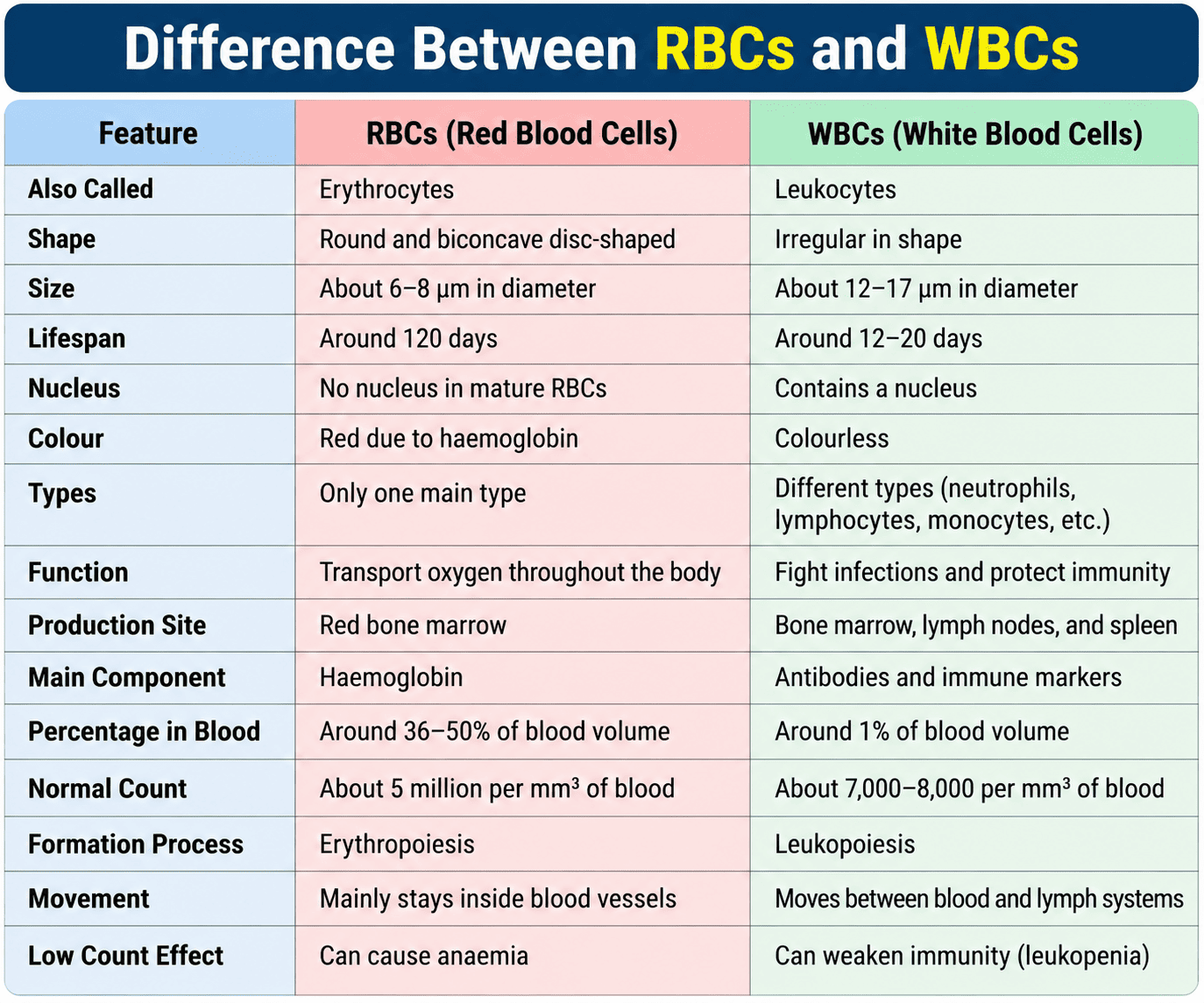
Difference Between RBCs and WBCs
| Feature | RBCs (Red Blood Cells) | WBCs (White Blood Cells) |
|---|---|---|
| Also Called | Erythrocytes | Leukocytes |
| Main Function | Transport oxygen throughout the body | Fight infections and protect immunity |
| Shape | Round and biconcave disc-shaped | Irregular in shape |
| Size | About 6–8 µm in diameter | About 12–17 µm in diameter |
| Nucleus | No nucleus in mature RBCs | Contains a nucleus |
| Colour | Red due to haemoglobin | Colourless |
| Lifespan | Around 120 days | Around 12–20 days (varies by type) |
| Types | Only one main type | Different types like neutrophils, lymphocytes, monocytes, etc. |
| Production Site | Red bone marrow | Bone marrow, lymph nodes, and spleen |
| Main Component | Haemoglobin | Antibodies and immune markers |
| Percentage in Blood | Around 36–50% of blood volume | Around 1% of blood volume |
| Normal Count | About 5 million per mm³ of blood | About 7,000–8,000 per mm³ of blood |
| Formation Process | Erythropoiesis | Leukopoiesis |
| Movement | Mainly stays inside blood vessels | Moves between blood and lymph systems |
| Low Count Effect | Can cause anaemia | Can weaken immunity (leukopenia) |
Key Differences Between RBCs and WBCs
- The function of RBCs is mostly concerned with the transport of oxygen, while WBCs are associated with the defence of the body.
- Haemoglobin is found in RBCs, while WBCs have immune related substances such as antibodies.
- RBCs lack nuclei after their maturation, while the presence of a nucleus is observed in WBCs.
- There is a greater number of RBCs than WBCs.
- The lifespan of RBCs is fixed up to 120 days, while the lifespan of WBCs varies depending on their function and type.
Students appearing for the CBSE Class 12 Biology Board Exam can prepare effectively with study materials such as CBSE Sample Paper Class 12 and CBSE Previous Year Papers Class 12. Solving sample papers will give them knowledge about the pattern of the exam, marking scheme, and question types. Going through previous year papers will provide them an opportunity to analyze important topics and develop answering skills.
RBCs and WBCs are two of the components of blood which play distinct roles in the body. The role of RBCs is oxygen transport in the blood with the help of haemoglobin, while WBCs defend the body from diseases.
Difference between RBCs and WBCs is very important for the CBSE Class 12 Biology Board Exam. For the exam, it is necessary for the students to know these points regarding the structure, function, lifespan, and formation of these cells.




 Home
Home
 Quiz
Quiz
 Short News
 Web Story
 Get latest Exam Updates







