




 Sign in


 Profile
 Signout
Difference Between Thermoplastic and Thermosetting Plastic for CBSE 12th Board Exam

Thermoplastics and thermosetting plastics are two very useful forms of polymer studied in CBSE Class 12 Chemistry. Both these materials are composed of long-chain polymers; however, they differ in terms of their properties and uses.
Thermoplastic is a type of plastic which can be molded several times without suffering any chemical changes. The molecular structure of these polymers is linear or branched and are weakly associated with each other due to weak intermolecular forces. These properties make thermoplastics recyclable and reusable.
However, the molecular structure of thermosetting plastic is more cross-linked and hence rigid. It becomes difficult to melt and shape once heated. Thermosetting polymers are suitable where strength and thermal stability are important.
Let us know about the difference between these two forms of plastics.
Defining Thermoplastic
Thermoplastics are the type of polymer, which gets softened on heating and solidified on cooling. This cycle can be repeated again and again without altering their structure.
They possess linear or branched chain structure in which the polymer chains are held together by the presence of weaker intermolecular forces, hence these weaker forces provide them mobility to move freely under heating conditions making them easily mouldable and shapeable.
The applications of thermoplastics can be seen in wide variety of industries like packaging, automobile, building, electronics, medical and consumer goods. Some examples of the thermoplastics are polyethylene (PE), polypropylene (PP), polyvinyl chloride (PVC), polystyrene (PS), and polyethylene terephthalate (PET).
Important Characteristics of Thermoplastics
-
Can be melted and reshaped: Thermoplastics can be heated, softened, and moulded into different shapes multiple times.
-
Linear or branched structure: They have long polymer chains arranged in linear or branched forms.
-
Weak intermolecular forces: The weak bonding between polymer chains allows easy movement when heated.
-
Reversible process: Heating and cooling processes can be repeated without permanent changes.
-
Recyclable material: Since thermoplastics can be reshaped, they are easier to recycle.
-
Wide applications: They are used for making packaging materials, pipes, containers, toys, and household products.

Defining Thermosetting Plastic
Thermosetting plastics are the type of polymers which harden permanently upon heating or curing. On curing, the polymer chains form very strong cross-links resulting in three dimensional network structures.
As compared to thermoplastic polymers, thermosetting plastic polymers do not melt or mold after setting. This is due to the formation of very strong cross-linking which makes the thermosetting polymers good insulators against heat, tough and durable.
Some examples of thermosetting polymers are epoxy resin, Bakelite (Phenolic resin), polyester resin, melamine and urea formaldehyde.
Important Characteristics of Thermosetting Plastics
-
Irreversible curing: Once cured, thermosetting plastics cannot be softened or reshaped again.
-
Cross-linked structure: They have a three-dimensional network structure formed by strong chemical bonds.
-
High strength and rigidity: They are strong, hard, and maintain their shape under pressure.
-
Heat resistance: They can withstand high temperatures without losing their shape.
-
Chemical resistance: They are resistant to many chemicals and environmental conditions.
-
Electrical insulation: They are widely used as electrical insulators due to their high resistance to electricity.
Difference Between Thermoplastic and Thermosetting Plastic
| S.No. | Category | Thermoplastics | Thermosetting Plastics |
|---|---|---|---|
| 1 | Mechanical Properties | Thermoplastics are flexible, ductile, and can be deformed easily. | Thermosetting plastics are rigid, strong, and hard. |
| 2 | Molecular Structure | They have linear or branched polymer chain structures. | They have highly cross-linked three-dimensional structures. |
| 3 | Melting Behaviour | They can be melted and reshaped multiple times. | They cannot be melted or reshaped after curing. |
| 4 | Effect of Heat | They become soft when heated and hard when cooled. | They maintain their shape and strength even at high temperatures. |
| 5 | Recycling | They can be recycled and reused easily. | They are difficult to recycle because they cannot be remoulded. |
| 6 | Applications | Used in packaging materials, pipes, containers, and consumer products. | Used in electrical components, automotive parts, aerospace materials, and construction products. |
| 7 | Examples | Polyethylene (PE), polypropylene (PP), PVC, and PET. | Epoxy resin, Bakelite, melamine, and polyester resin. |
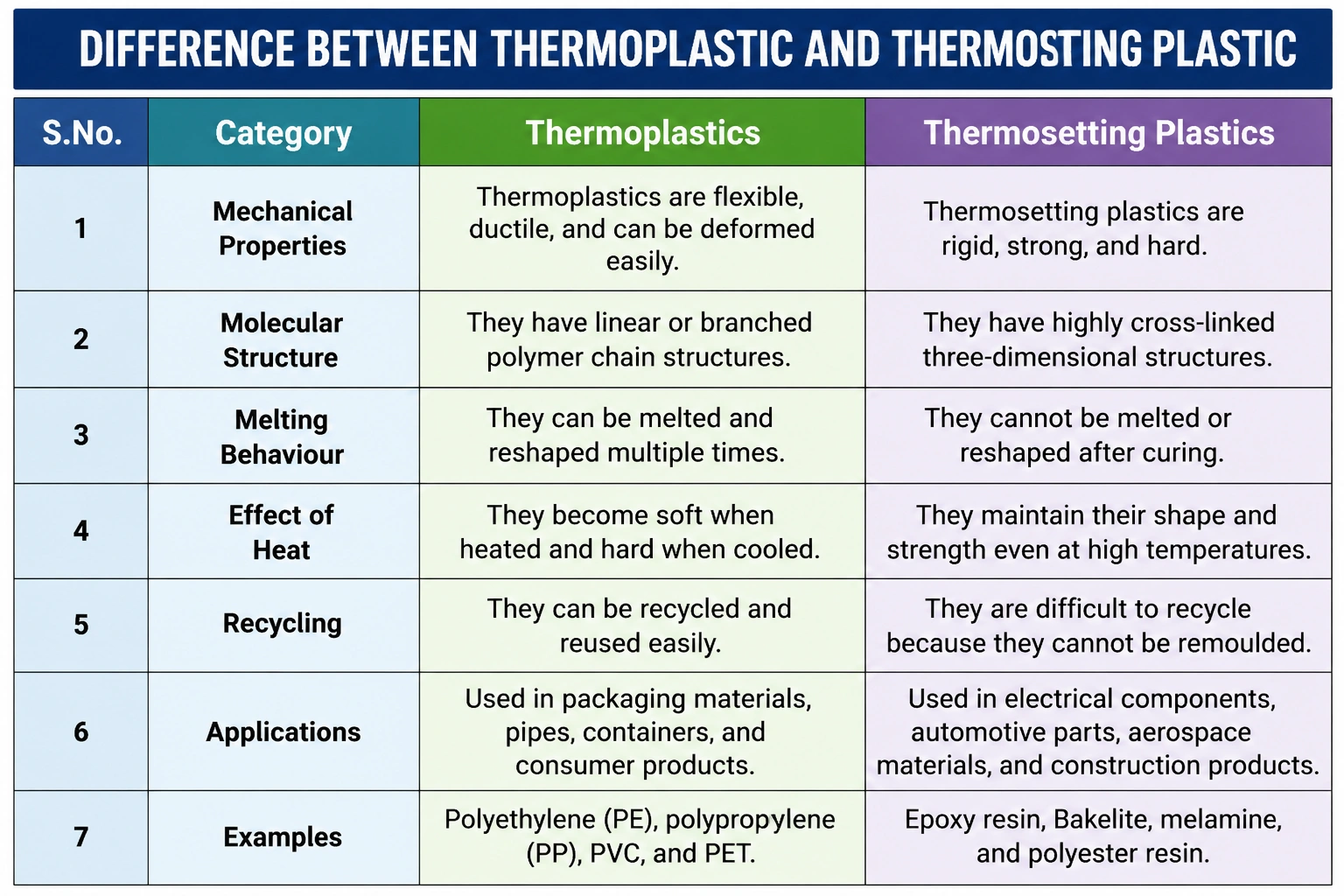
Thermoplastic plastic difference from thermosetting plastic due to their reaction to heat and their molecular structure; thermoplastics are capable of softening and reshaping themselves again and again, but thermosetting plastics once cured become hard forever.
Students preparing for the CBSE Class 12 Board Exam can also improve their exam preparation with useful study materials like CBSE Sample Paper Class 12 and CBSE Previous Year Papers Class 12. Practising sample papers helps students understand the latest exam pattern, marking scheme, and important question types. Solving previous year papers also helps in improving time management, accuracy, and confidence before the final board examination.




 Home
Home
 Quiz
Quiz
 Short News
 Web Story
 Get latest Exam Updates







