


 Sign in


 Profile
 Signout
Acids vs Bases: Comparison Chart for CBSE 10th Science Board Exam
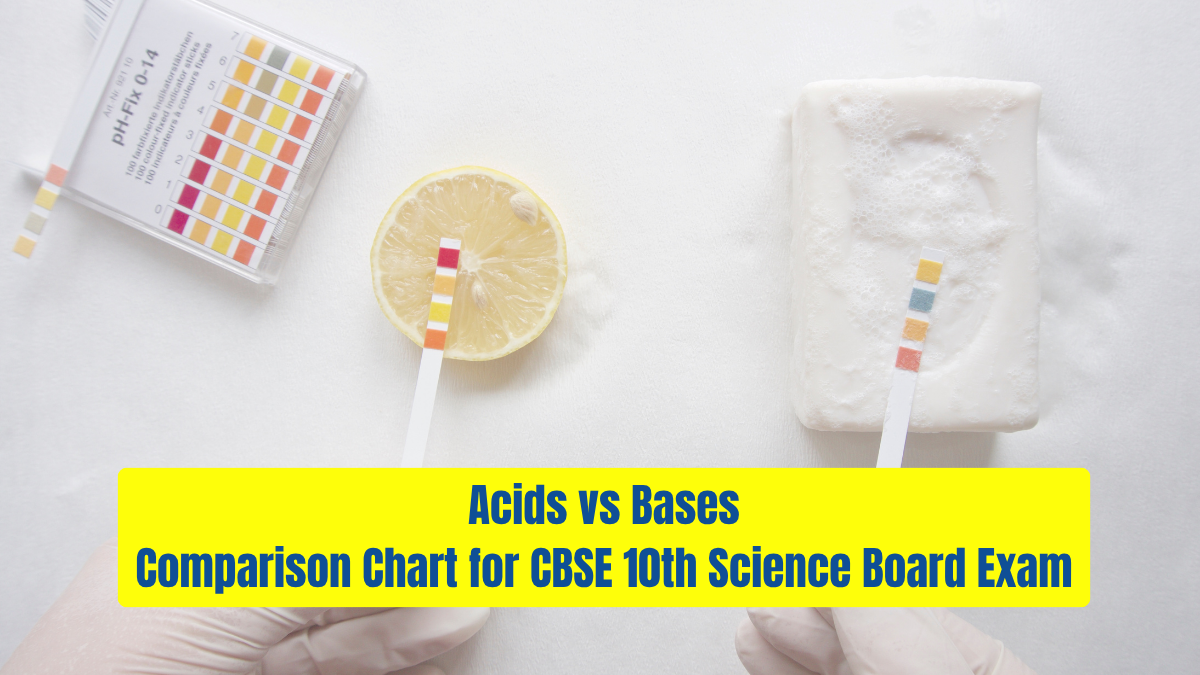

Acids and bases are important topics in CBSE Class 10 Science Chemistry. Questions related to their properties, pH values, examples, and reactions are commonly asked in board exams. To make revision easier, students can understand the major differences between acids and bases with the help of a simple comparison chart.
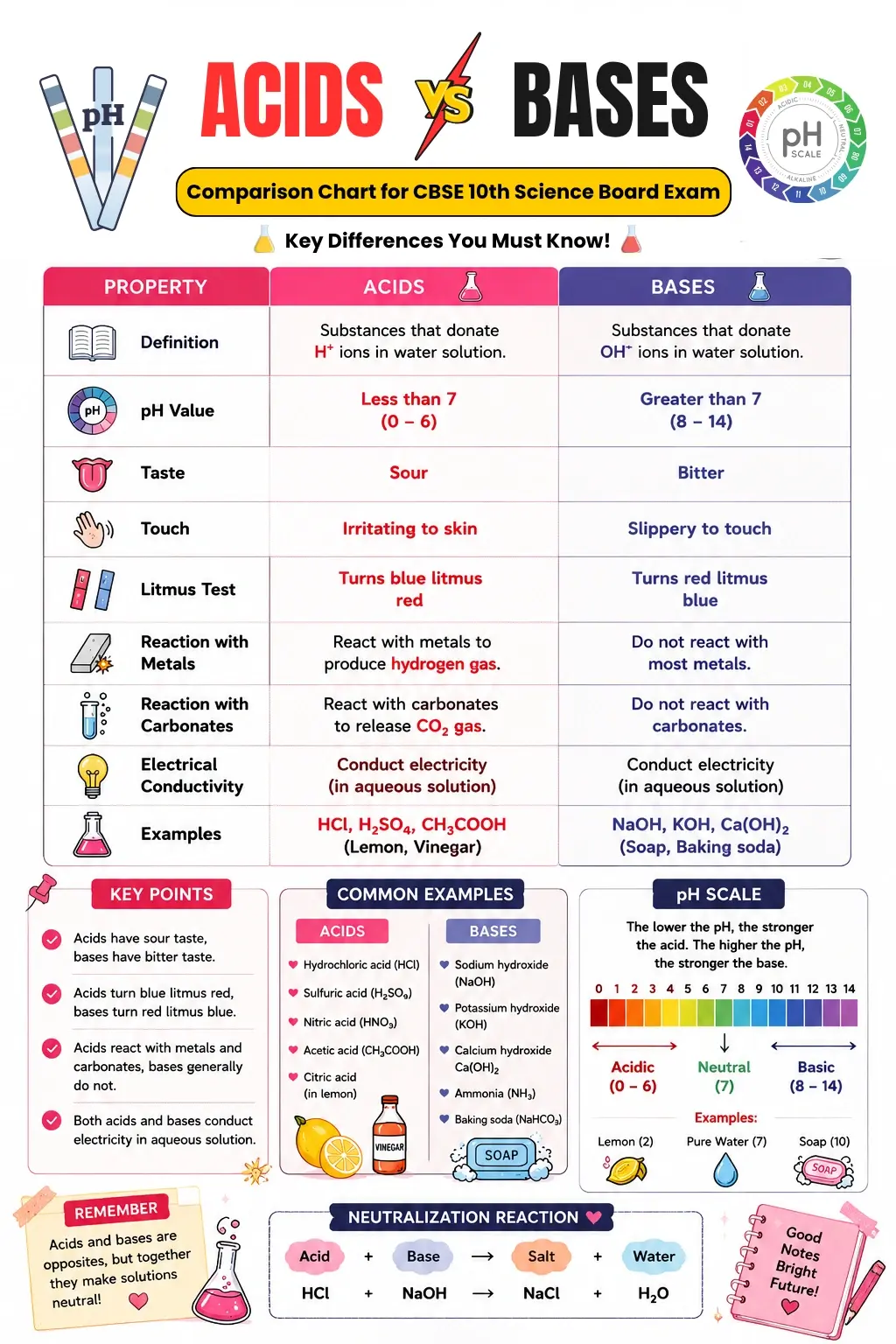
To make revision easier, this Acids vs Bases comparison chart explains the major differences between acids and bases in a simple way. Students can use this table for quick revision before their CBSE Class 10 Science Board Exam.
👉 Acids vs Bases PDF Notes Download Link Here
Difference Between Acids and Bases
| Property | Acids | Bases |
|---|---|---|
| Definition | Substances that release H⁺ ions in water | Substances that release OH⁻ ions in water |
| pH Value | Less than 7 | Greater than 7 |
| Taste | Sour | Bitter |
| Litmus Test | Turn blue litmus red | Turn red litmus blue |
| Touch | Can be irritating to skin | Feel slippery or soapy |
| Reaction with Metals | Produce hydrogen gas | Usually do not react with most metals |
| Reaction with Carbonates | Release carbon dioxide gas | Generally do not react with carbonates |
| Examples | HCl, H₂SO₄, CH₃COOH | NaOH, KOH, Ca(OH)₂ |

Properties of Acids
Acids produce hydrogen ions (H⁺) when dissolved in water. They usually have a pH value below 7 and show acidic properties. Common examples include hydrochloric acid, sulphuric acid, and acetic acid.
Acids turn blue litmus paper red and react with metals to release hydrogen gas. They also react with carbonates to produce carbon dioxide gas.
Properties of Bases
Bases release hydroxide ions (OH⁻) in water and have a pH value above 7. They usually taste bitter and feel slippery. Examples of bases include sodium hydroxide, potassium hydroxide, and calcium hydroxide.
Bases turn red litmus paper blue and react with acids to form salt and water.
Neutralisation Reaction
The reaction between an acid and a base is called a neutralisation reaction.
Acid + Base → Salt + Water
Example:
HCl + NaOH → NaCl + H₂O
Understanding the difference between acids and bases helps students prepare better for the CBSE Class 10 Science Board Exam. For more practice, students can also refer to CBSE SQP Class 10 Science and CBSE Class 10 Science PYQs to understand important question patterns.




 Home
Home
 Quiz
Quiz
 Short News
 Web Story
 Get latest Exam Updates