


 Sign in


 Profile
 Signout
Chemical Equation Balancing Tricks for CBSE 10th Science Exam
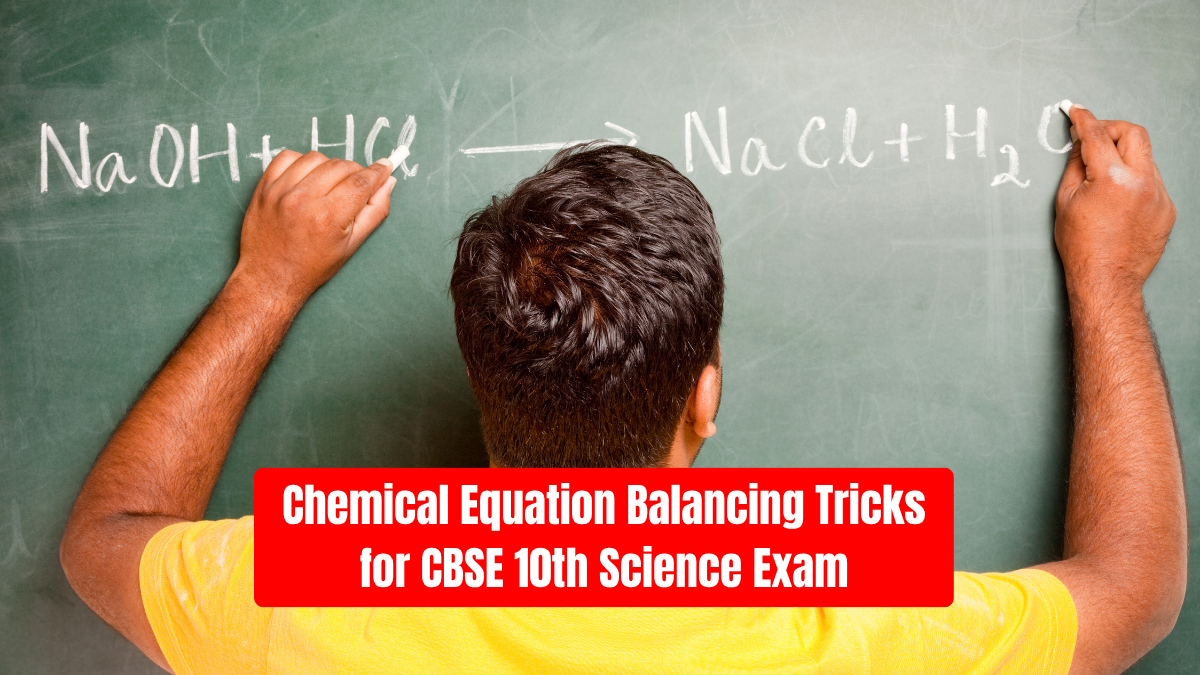

Chemical equation balancing is an important topic from CBSE Class 10 Science Chapter – Chemical Reactions and Equations. A chemical equation represents a chemical reaction using chemical symbols and formulas. To make an equation correct, the number of atoms of each element must be equal on both sides. This follows the Law of Conservation of Mass.
Balancing chemical equations helps students understand chemical reactions and solve board exam questions easily. With the right tricks and practice, students can balance equations quickly and accurately.
What is Chemical Equation Balancing?
A chemical equation shows the reactants and products involved in a chemical reaction. An unbalanced equation has an unequal number of atoms on both sides.
Example:
H₂ + O₂ → H₂O
This equation is unbalanced because oxygen atoms are not equal on both sides.
Balanced equation:
2H₂ + O₂ → 2H₂O
Now, the number of hydrogen and oxygen atoms is equal.
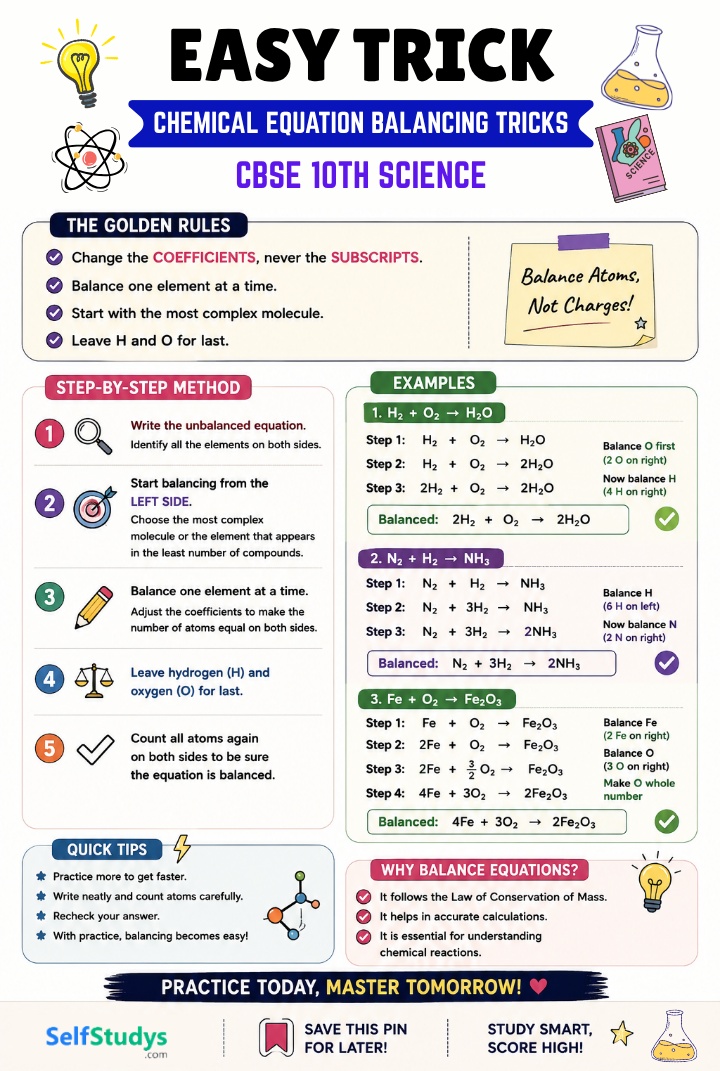
👉 Download PDF: Chemical Equation Balancing Tricks
Important Tricks to Balance Chemical Equations
1. Change Coefficients Only
Always change the numbers written before chemical formulas. Never change subscripts because they represent the actual chemical formula of a compound.
2. Balance One Element at a Time
Start balancing elements one by one. It is easier to balance the elements that appear in fewer compounds first.
3. Balance Complex Compounds First
Begin with the compound containing more elements. This makes the balancing process simpler.
4. Keep Hydrogen and Oxygen Last
Hydrogen and oxygen often appear in many compounds, so balance them after balancing other elements.
5. Check Atom Count Again
After balancing, count all atoms on both sides to ensure that the equation is completely balanced.
Step-by-Step Example
Unbalanced equation:
N₂ + H₂ → NH₃
Balance nitrogen first:
N₂ + H₂ → 2NH₃
Now balance hydrogen:
N₂ + 3H₂ → 2NH₃
The equation is balanced because both sides have equal nitrogen and hydrogen atoms.
Chemical equation balancing is an easy but important concept for the CBSE Class 10 Science Board Exam. By following simple rules, avoiding common mistakes, and practising regularly, students can improve their accuracy and confidence.
For better preparation, students can also practise using CBSE SQP Class 10 and CBSE Class 10 PYQs to understand exam patterns and important questions.




 Home
Home
 Quiz
Quiz
 Short News
 Web Story
 Get latest Exam Updates