




 Sign in


 Profile
 Signout
Difference Between Metals and Non-Metals for CBSE 10th Board Exam

Metals and non-metals are important topics covered in the CBSE Class 10 Science chapter “Metals and Non-Metals”. These elements are different from each other based on their physical and chemical properties.
Metals are generally shiny, hard, and good conductors of heat and electricity. On the other hand, non-metals usually do not conduct heat and electricity and have different physical properties.
Understanding the difference between metals and non-metals is important for board exams because questions based on their properties, reactions, and comparisons are frequently asked.
Questions from this chapter are frequently asked in CBSE Class 10 Science board exams. The chapter carries around 5–8 marks weightage, depending on the CBSE question paper pattern.
What are Metals?
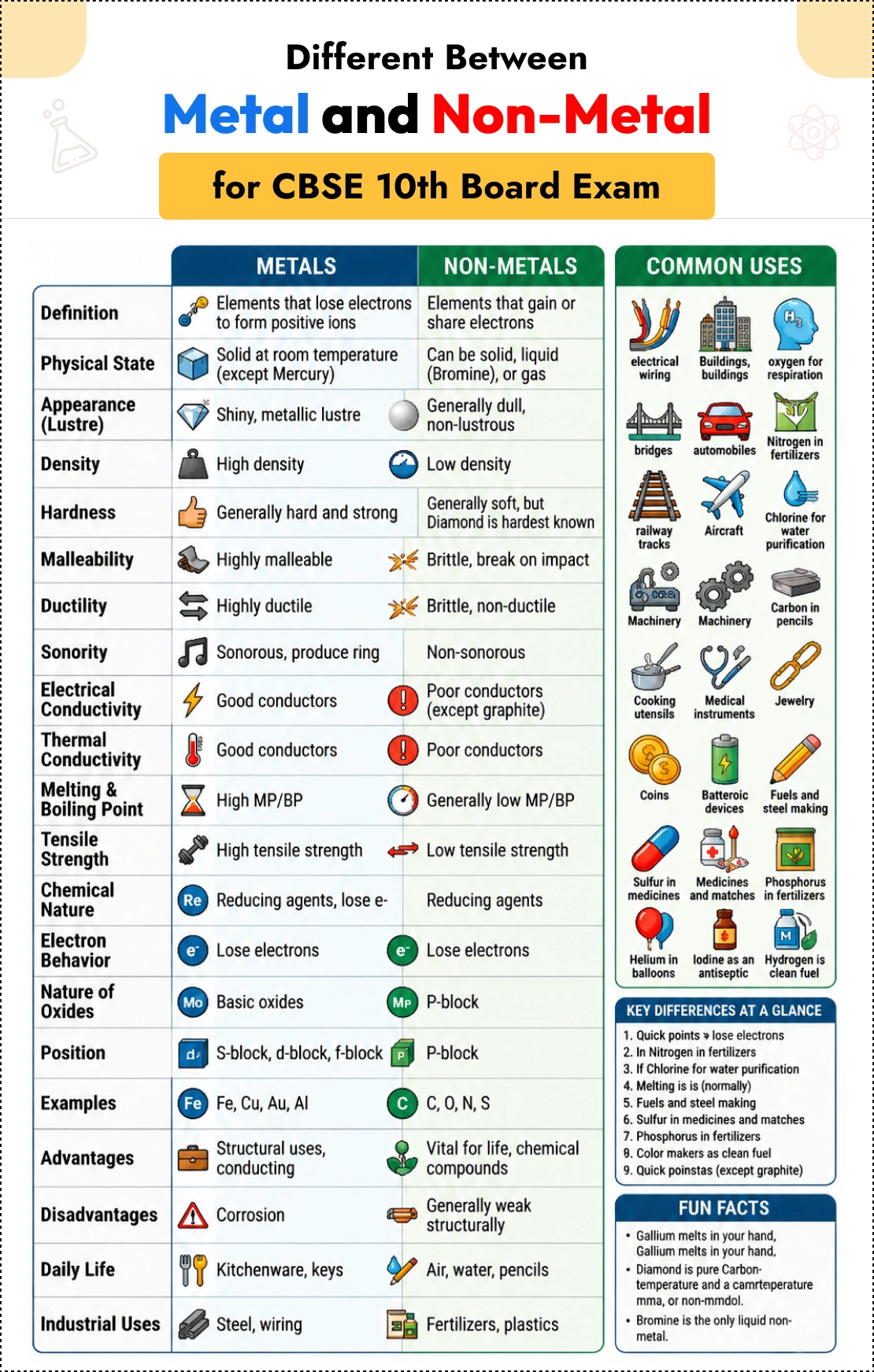
Metals are elements that are generally shiny, hard, and good conductors of heat and electricity. They can be shaped into different forms and are widely used in daily life.
Examples of metals include iron, aluminium, copper, gold, and silver.
Important Properties of Metals
- Lustrous: Metals have a shiny surface.
- Good Conductors: Metals conduct heat and electricity easily.
- Malleable: Metals can be beaten into thin sheets.
- Ductile: Metals can be drawn into wires.
- High Melting and Boiling Points: Most metals have high melting and boiling points.
What are Non-Metals?
Non-metals are elements that generally do not have metallic properties. They are usually dull in appearance and poor conductors of heat and electricity.
Examples of non-metals include carbon, oxygen, sulphur, nitrogen, and chlorine.
Important Properties of Non-Metals
- Dull Appearance: Most non-metals do not have a shiny surface.
- Poor Conductors: Non-metals do not conduct heat and electricity easily.
- Brittle: Solid non-metals break easily when force is applied.
- Non-Malleable and Non-Ductile: They cannot be converted into sheets or wires.
- Low Melting and Boiling Points: Most non-metals have lower melting and boiling points compared to metals.
Difference Between Metals and Non-Metals

Students can improve their preparation by practising important questions through Sample Paper Class 10 CBSE to understand the latest exam pattern and question format.
Practising CBSE Previous Year Question Papers Class 10 also helps students identify repeated concepts, important topics, and improve their board exam preparation.



 Home
Home
 Quiz
Quiz
 Short News
 Web Story
 Get latest Exam Updates







