

 Sign in


 Profile
 Signout
NTA Updates Translation Process: Translators to Ensure Quality of AI-Generated Work
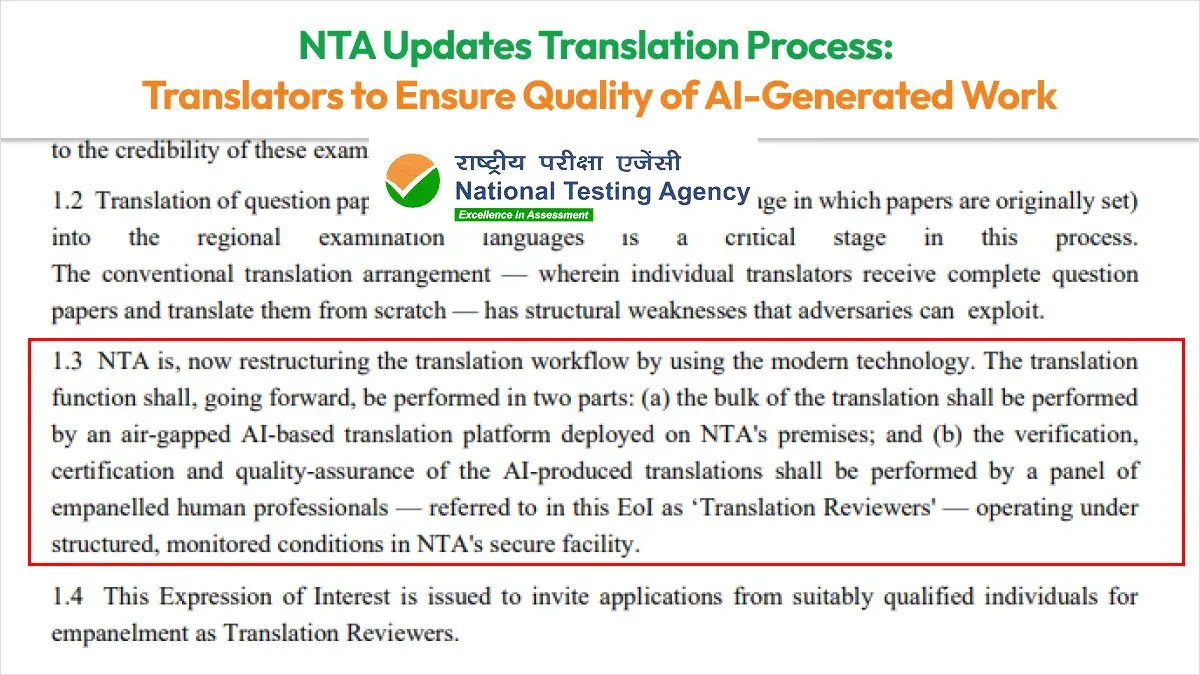


In addition to this transformation, there is a rethinking about the roles of translators, where translators will not only translate questions from English into various Indian languages but would also be required to review “AI-generated translations”, point out errors of language, technical or scientific nature, provide corrections and certify the final translation of the examination question.
In its EOI, NTA has noted that the role of translator in this case is different from that of translator in the previous cycles.
It must be noted that NTA conducts a number of competitive examinations such as NEET, JEE Mains, CUET, UGC-NET and others in 13 languages.
Through the process of restructuring, the translation function is going to be executed in two stages – “the bulk of the translation shall be done through an air gapped AI-based translation tool on the premises of NTA” and the verification, certification and quality assurance of the AI produced translation shall be done through a panel of empanelled human professionals.
This panel of empanelled human professionals is going to be called the “Translation Reviewers” who shall operate in a structured, monitored condition in NTA’s secure facility.
The selected reviewer will only see “individual items, presented one at a time, in a randomized order that bears no relationship to the order in which items appear in the final paper”. The reviewers will not see the assembled paper either, NTA added.
NTA has taken additional security steps after the NEET UG paper leak earlier this year, which sparked outrage, protests and CBI investigation.
Translators and question paper setters have been put under the scanner following the NEET UG paper leak. It is found by the CBI investigation into the NEET UG paper leak that the arrested subject expert Manisha Mandhare is not only involved in setting the question paper but also its translation.
---



 Home
Home
 Quiz
Quiz
 Short News
 Web Story
 Get latest Exam Updates