




 Sign in


 Profile
 Signout
Difference Between Scalar and Vector Quantities for CBSE Class 12 Board Exam

Scalar and vector quantities are important concepts in CBSE Class 12 Physics. These concepts help students understand physical quantities related to motion, force, and other areas of physics.
The main difference between scalar and vector quantities is that scalar quantities have only magnitude, while vector quantities have both magnitude and direction.
Understanding the difference between these two quantities is important for solving numerical problems in topics like motion, work, force, and electricity.
What are Scalar Quantities?
A scalar quantity is a physical quantity that has only magnitude but no direction. It can be represented by a single numerical value along with its unit.
Scalar quantities follow normal algebraic rules for addition, subtraction, multiplication, and division.
Examples of Scalar Quantities:
- Mass
- Time
- Temperature
- Distance
- Speed
- Energy
- Work
For example, if a student studies for 5 hours, the value represents time. It does not require any direction, so it is a scalar quantity.
What are Vector Quantities?
A vector quantity is a physical quantity that has both magnitude and direction. It is represented using arrows or bold symbols to show its direction.
Vector quantities cannot be added directly like scalar quantities. They follow specific rules such as the triangle law and parallelogram law of vector addition.
Examples of Vector Quantities:
- Displacement
- Velocity
- Acceleration
- Force
- Momentum
- Electric Field
For example, if a car moves at 40 km/h towards the north, it represents velocity because it has both magnitude (40 km/h) and direction (north).

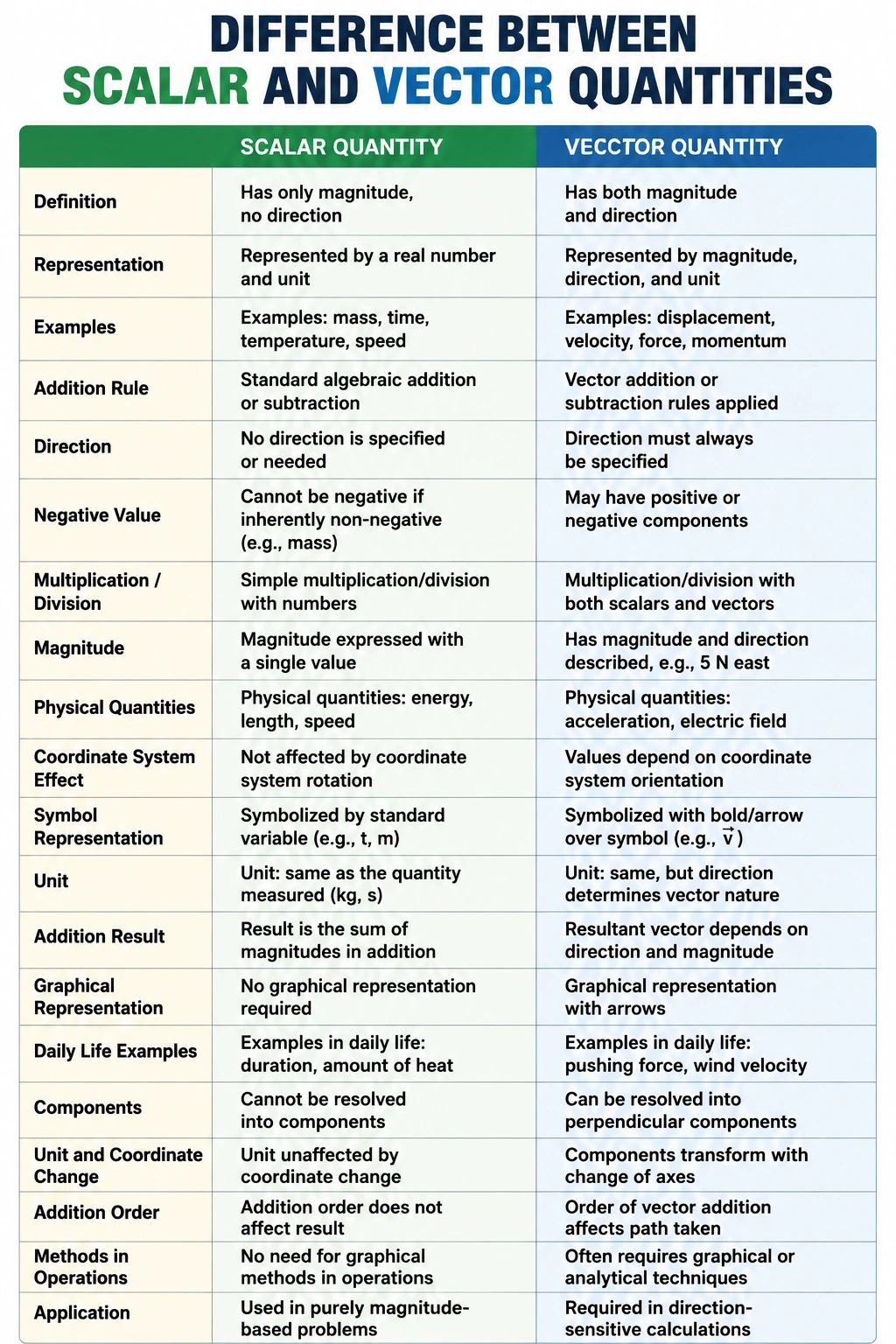
Difference Between Scalar and Vector Quantities
| Scalar Quantity | Vector Quantity |
|---|---|
| Has only magnitude, no direction | Has both magnitude and direction |
| Represented by a real number and unit | Represented by magnitude, direction, and unit |
| Examples: mass, time, temperature, speed | Examples: displacement, velocity, force, momentum |
| Standard algebraic addition or subtraction | Vector addition or subtraction rules applied |
| No direction is specified or needed | Direction must always be specified |
| Cannot be negative if inherently non-negative (e.g., mass) | May have positive or negative components |
| Simple multiplication/division with numbers | Multiplication/division with both scalars and vectors |
| Magnitude expressed with a single value | Has magnitude and direction described, e.g., 5 N east |
| Physical quantities: energy, length, speed | Physical quantities: acceleration, electric field |
| Not affected by coordinate system rotation | Values depend on coordinate system orientation |
| Symbolized by standard variable (e.g., t, m) | Symbolized with bold/arrow (e.g., v→) |
| Unit: same as the quantity measured (kg, s) | Unit: same, but direction determines vector nature |
| Result is the sum of magnitudes in addition | Resultant vector depends on direction and magnitude |
| No graphical representation required | Graphical representation with arrows |
| Examples in daily life: duration, amount of heat | Examples in daily life: pushing force, wind velocity |
| Cannot be resolved into components | Can be resolved into perpendicular components |
| Unit unaffected by coordinate change | Components transform with change of axes |
| Addition order does not affect result | Order of vector addition affects path taken |
| No need for graphical methods in operations | Often requires graphical or analytical techniques |
| Used in purely magnitude-based problems | Required in direction-sensitive calculations |
👉 Download PDF: Difference Between Scalar and Vector Quantities
Simple Examples to Understand Scalar and Vector
Scalar Example:
A person walks 5 km in a park.
Here, only the distance is given. There is no information about direction, so it is a scalar quantity.
Vector Example:
A person walks 5 km towards the east.
Here, both magnitude (5 km) and direction (east) are given, so it is a vector quantity.
Importance of Scalar and Vector Quantities in Physics
Scalar and vector quantities are used in many important concepts of physics.
- Scalars are used in calculations involving quantities like energy, time, and mass.
- Vectors are used in motion, force, acceleration, and displacement problems.
- They help students understand direction-based physical situations.
- Vector concepts are important for solving numerical problems in mechanics.
For CBSE Class 12 Physics board exams, students should clearly understand the difference between scalar and vector quantities because questions based on definitions, examples, and numerical applications are frequently asked.
Students can improve their preparation by practising Sample Paper Class 12 CBSE to understand the latest exam pattern and question types.
Solving CBSE Previous Year Question Papers Class 12 PDF also helps students identify important concepts and prepare better for board examinations.




 Home
Home
 Quiz
Quiz
 Short News
 Web Story
 Get latest Exam Updates







