


 Sign in


 Profile
 Signout
Difference Between Sn1 and Sn2 Reaction for CBSE 12th Board Exam


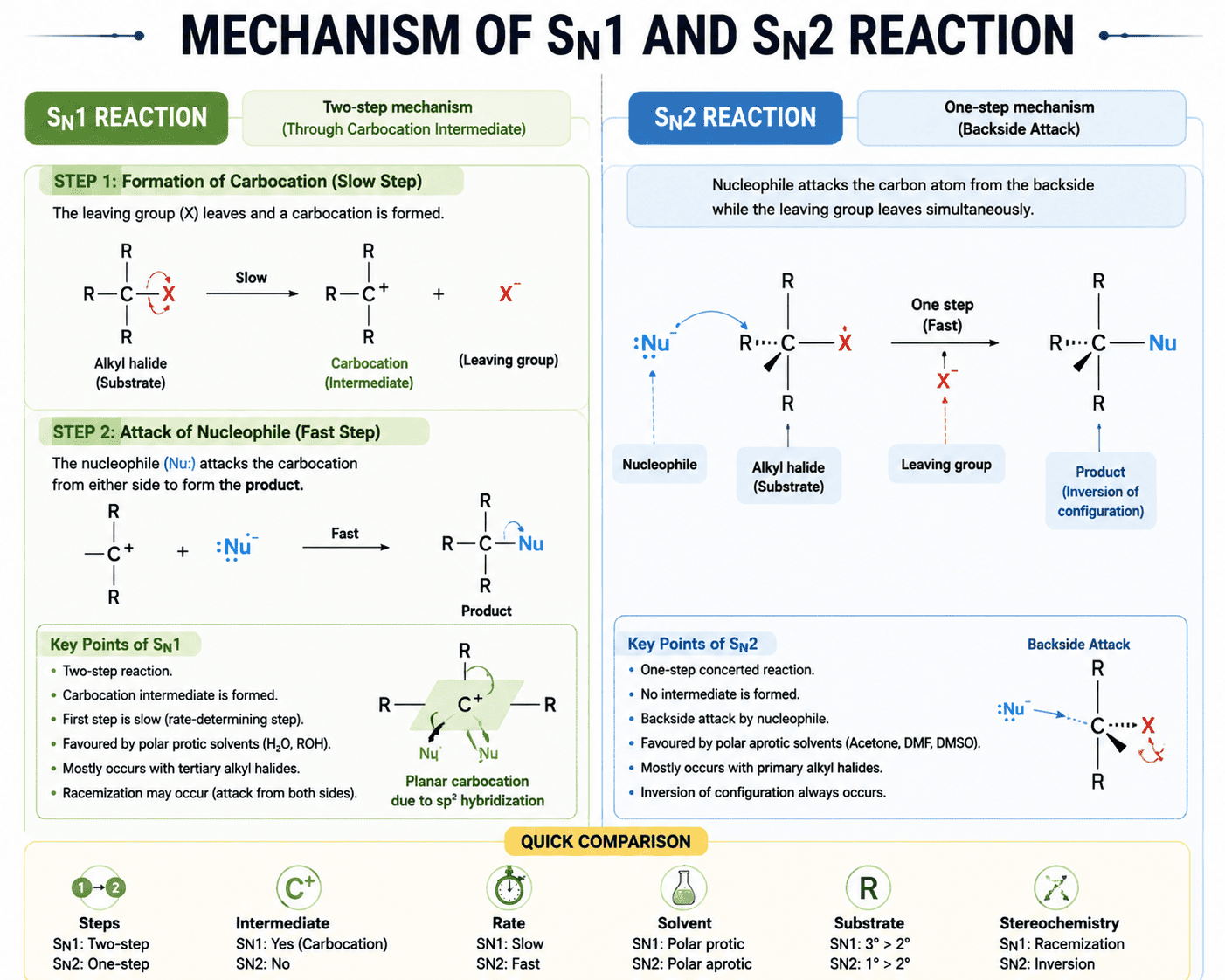
SN1 and SN2 reactions are important nucleophilic substitution reactions studied in the Haloalkanes and Haloarenes chapter of CBSE Class 12 Chemistry. In these reactions, a nucleophile replaces a leaving group attached to a carbon atom.
Although both SN1 and SN2 reactions involve the replacement of a leaving group, their reaction mechanism, number of steps, reaction rate, solvent requirement, and stereochemistry are different.
For CBSE Class 12 board exams, students should understand the basic mechanism and key differences between SN1 and SN2 reactions because questions based on these concepts are commonly asked in organic chemistry.
What is SN1 Reaction?
SN1 stands for Substitution Nucleophilic Unimolecular Reaction. It is a type of nucleophilic substitution reaction that takes place in two steps.
In an SN1 reaction, the leaving group first separates from the substrate and forms a carbocation intermediate. After that, the nucleophile attacks the carbocation to form the final product.
The reaction rate of SN1 depends only on the concentration of the substrate, which is why it is called a unimolecular reaction.
SN1 reactions generally occur with tertiary alkyl halides because tertiary carbocations are more stable compared to primary carbocations.
Mechanism of SN1 Reaction
SN1 reaction takes place in two main steps:
Step 1: Formation of Carbocation
In the first step, the bond between carbon and leaving group breaks. The leaving group leaves the molecule, resulting in the formation of a positively charged carbocation.
This is the slowest step of the reaction and is known as the rate-determining step.
Example:
Alkyl Halide → Carbocation + Leaving Group
Step 2: Attack of Nucleophile
In the second step, the nucleophile attacks the positively charged carbocation and forms the final product.
This step is faster because carbocations are highly reactive.
Important Characteristics of SN1 Reaction
- In an SN1 reaction, there are two reaction steps.
- It has a carbocation intermediate.
- The first step is the slowest part of the reaction.
- It is slower compared to SN2 reaction.
- It is favored by polar protic solvent, such as water and alcohol.
- It mostly happens with tertiary alkyl halide.
- It can lead to racemization because of carbocation’s planar structure.

What is SN2 Reaction?
SN2 stands for Substitution Nucleophilic Bimolecular Reaction. It is a nucleophilic substitution reaction that takes place in one step.
In an SN2 reaction, the nucleophile attacks the carbon atom while the leaving group leaves at the same time. Since both processes happen together, no intermediate is formed.
The reaction rate depends on both the substrate and nucleophile concentration, which is why it is called a bimolecular reaction.
SN2 reactions generally occur with primary alkyl halides because they have less steric hindrance.
Mechanism of SN2 Reaction
SN2 reaction occurs through a single step.
The nucleophile attacks the carbon atom from the opposite side of the leaving group. This attack is called a backside attack.
During this process:
- A new bond is formed between carbon and nucleophile.
- The leaving group leaves simultaneously.
- No carbocation intermediate is formed.
Due to backside attack, SN2 reaction always results in inversion of configuration.
Important Characteristics of SN2 Reaction
- SN2 reaction is unimolecular and takes place in one step.
- There is no intermediate involved.
- It is faster than SN1 reaction.
- It is favored by polar aprotic solvents such as acetone and DMF.
- It usually takes place with primary alkyl halides.
- It invariably causes the inversion of configuration.
- It is sterically hindered.
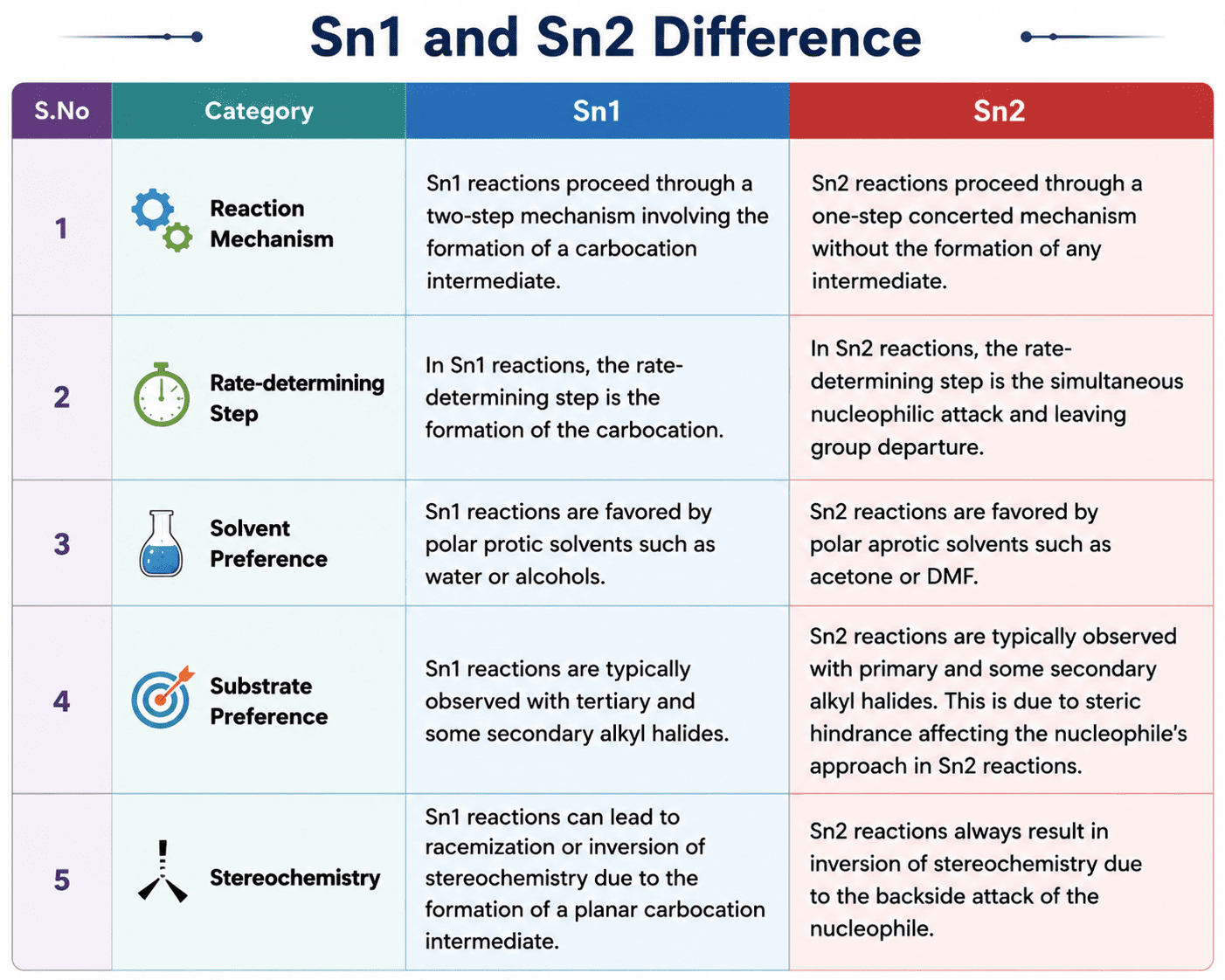
Difference Between SN1 and SN2 Reaction
|
S.No |
Category |
Sn1 |
Sn2 |
|
1 |
Reaction Mechanism |
Sn1 reactions proceed through a two-step mechanism involving the formation of a carbocation intermediate. |
Sn2 reactions proceed through a one-step concerted mechanism without the formation of any intermediate. |
|
2 |
Rate-determining Step |
In Sn1 reactions, the rate-determining step is the formation of the carbocation. |
In Sn2 reactions, the rate-determining step is the simultaneous nucleophilic attack and leaving group departure. |
|
3 |
Solvent Preference |
Sn1 reactions are favored by polar protic solvents such as water or alcohols. |
Sn2 reactions are favored by polar aprotic solvents such as acetone or DMF. |
|
4 |
Substrate Preference |
Sn1 reactions are typically observed with tertiary and some secondary alkyl halides. |
Sn2 reactions are typically observed with primary and some secondary alkyl halides. This is due to steric hindrance affecting the nucleophile's approach in Sn2 reactions. |
|
5 |
Stereochemistry |
Sn1 reactions can lead to racemization or inversion of stereochemistry due to the formation of a planar carbocation intermediate. |
Sn2 reactions always result in inversion of stereochemistry due to the backside attack of the nucleophile. |
👉 Download PDF: Difference Between SN1 and SN2 Reaction
So from the above definition and table, we understand what is Sn1 and Sn2 , Sn1 and Sn2 difference and difference between Sn1 and Sn2 Reaction Mechanism.
Along with understanding reaction mechanisms, solving Sample Paper Class 12 CBSE can help students test their knowledge and prepare effectively for the Chemistry board examination.
Practising CBSE Previous Year Question Papers Class 12 PDF helps students analyse previous exam trends and improve their answer-writing skills for the board exam.




 Home
Home
 Quiz
Quiz
 Short News
 Web Story
 Get latest Exam Updates