

 Sign in


 Profile
 Signout

JEE Main 2027 Preparation Tips: How to Balance Physics, Chemistry and Maths
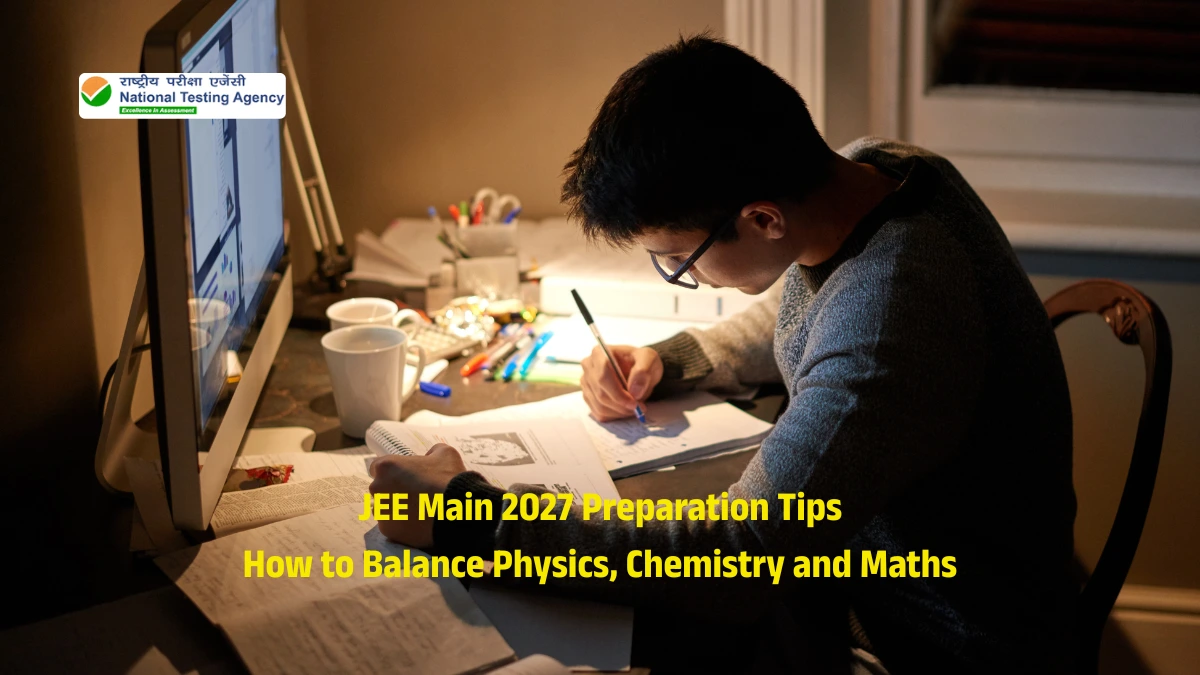

A preparation plan for JEE Main 2027 should strike the right balance between Physics, Chemistry, and Mathematics. Simply studying for long hours is not enough; instead, students must possess a strong conceptual understanding of the subjects, combined with regular practice and effective time management skills.
The biggest difficulty faced by students of engineering stream is a proper allocation of time to all these three subjects. The key to Physics is concept based knowledge, while Chemistry is a mix of theoretical as well as numerical knowledge. In the case of Mathematics, it is problem solving that counts.
Understand the JEE Main 2027 PCM Syllabus
Before preparing a study schedule, students have to first understand the syllabus and identify their strengths and weaknesses. NTA has issued the syllabus for JEE Main 2027 on its official website jeemain.nta.nic.in.
Before preparing the topic list and choosing the reference books, students have to check the official syllabus. Chapters can be segregated into three categories: those which are well understood by students, those which require revision, and those which require thorough preparation.
Mock test papers should be included in the schedule along with regular revision. Students should not waste time just on one subject.
JEE Main 2027 Physics Preparation Strategy
The subject Physics demands proficiency in conceptual knowledge, formulas, and applications. Learning formulae by rote can make solving numericals very tough in Physics.
It is advised for students to start from basics and slowly reach the JEE Main standard questions. NCERT books are very good to develop fundamentals, especially if any particular chapter seems tough for students.
Once a concept is learnt, students should practice simple numerical problems before going ahead with complicated numericals.
Key topics are mechanics, electricity, magnetism, optics, thermodynamics, and modern physics. Students should practice problems from these topics based on their level of preparation.
It is useful to maintain a separate formula notebook. It should contain key formulae, application of the formulae, and errors students can make while using the formulae. Revision of such notebooks is helpful, instead of leaving the revision of formulae till the last few weeks before the examination.
JEE Main 2027 Chemistry Preparation Strategy
Preparation in Chemistry differs from that of Physical, Organic and Inorganic Chemistry. The student should not apply the same method of preparation for each chapter.
Physical Chemistry
Physical Chemistry includes both theoretical knowledge and numericals. Some of the major areas of study are mole concept, thermodynamics, chemical equilibrium and all those concepts covered in the syllabus.
The student should have a clear idea about the necessary formulae, perform calculations and try to improve accuracy. Solving varied numericals will help in detecting mistakes.
Organic Chemistry
The study of Organic Chemistry is easier when the student has knowledge of reaction mechanism, functional groups and the interlinking among chemical reactions.
Instead of remembering each reaction separately, the student should find a pattern in reactions. Short notes of reactions and solving conversion-based questions are helpful in preparation.
Inorganic Chemistry
The regular revision of chemical properties, periodic trends, chemical reactions and all other concepts included in the syllabus is necessary in Inorganic Chemistry.
NCERT books provide good foundational knowledge. The student may prepare concise notes and revise periodically.
How to Prepare Mathematics for JEE Main 2027
Mathematics entails a lot of practice and logic. Mathematics differs from other disciplines because reading theories does not constitute the main preparation aspect in it.
Students need to concentrate on subjects such as algebra, calculus, coordinate geometry, vector, and three-dimensional geometry among others. Each chapter needs to be introduced with an understanding of the concept and then moving to questions of different levels of difficulty.
This enables the student to spot patterns in the question types and use the correct problem-solving approach. Speed plays a vital role, but the first thing that needs to be considered is accuracy.
It is highly recommended that each student maintains a notebook with questions he finds difficult. Such a notebook will contain questions whose answers were wrong, mistakes in calculations, and alternatives.
In case one faces difficulties while solving a difficult question, one needs to set it aside and go to the rest of the questions before coming back to it.
JEE Main 2027 Daily PCM Study Timetable
The realistic schedule will ensure that the time required to prepare for each subject (Physics, Chemistry, and Mathematics) is equally divided.
For instance, if six hours are available for self-study then the time can be equally divided. The following is a sample schedule, and it is not the official schedule by NTA.
| Study Session | Subject | Duration | Suggested Activity |
|---|---|---|---|
| Session 1 | Physics | 2 Hours | Concept revision, formulas and numerical practice |
| Session 2 | Chemistry | 2 Hours | NCERT reading, reactions and numerical questions |
| Session 3 | Mathematics | 2 Hours | Concept practice and problem-solving |
Students may also tailor this schedule based on their weak subjects. For instance, students who find it difficult to comprehend Mathematics can give more time to that subject without forgetting to revise Physics and Chemistry each day.
Taking short pauses between classes is important for the students to deal with tiredness. Some time will also be allocated for revising and analyzing some mock tests.
How to Revise PCM Effectively
The process of revising needs to be part of preparation for JEE Main 2027 throughout the year, as students can lose previous information when they constantly go through new topics.
The following activities will be part of the ideal revision plan:
- Revision of important formulas in Physics and their practical applications.
- Revision of chemical reactions and related concepts using NCERT notes.
- Solving mathematical problems from already covered chapters in Mathematics.
- Maintaining an errors notebook containing the questions you got wrong or had difficulty with.
- Practising past papers of JEE Main for topics already covered.
Students should spend most of their revision time revising topics that they find hard to remember.
Importance of Mock Tests for JEE Main 2027
Mock tests are essential for preparing for the examinations. These enable the students to evaluate themselves and learn how to manage their time during exams and select questions.
At first, the students can practice chapter wise and subject wise tests. As the time passes by, when the students have covered most of the syllabus, they can opt for complete mock tests.
After appearing in each mock test, the students should evaluate themselves rather than just looking at the overall marks scored. The mistakes that are usually made in mock tests are due to wrong concepts, calculation mistakes, time management issues, and extra guessing.
The students should find out why they had answered incorrectly and revise those subjects.
Common Mistakes to Avoid During PCM Preparation
The candidate spends most of the time on the topic he likes because of its easiness. But constant avoidance of weak topics makes it difficult for the candidates to prepare themselves.
Not revising the answers in case of any mistake is another important problem among the students. They must take care of accuracy in their work before moving to other problems.
Having many reference books may be of no use as it makes the entire process more difficult. It is better to complete all the good books and practice the related problems.
Schedules which do not have sufficient time for sleeping, eating and resting are another problem for the candidates. They should work in a regular manner rather than working very hard at times.
How to Maintain Consistency Until JEE Main 2027
The preparation for PCM needs to be balanced where the development of each person in all the three streams is required along with the improvement of their personal weaknesses.
They should not compare the time they spend studying with other students but try to improve their concepts and solving skills.
Studying NCERT books, practicing the subjects, revising properly and taking mock tests are some ways to make one's preparation for JEE Main 2027 more effective. Sleeping enough and having realistic aims are as important as focusing on preparation.
-------
👉 Also Read - JEE Main 2027 Registration Begins: How to Apply, Eligibility, Fee and Exam Dates
👉 Also Read - JEE Main 2027 Photo and Signature Guidelines: Check Size, Format, Pixels and Upload Steps
👉 Also Read - JEE Main 2027: How to Solve Difficult Questions Without Losing Time
👉 Also Read - JEE Main 2027 Attempt Limit: Check Eligibility, Age and Rules
👉 Also Read - JEE Main 2027 Registration: Check Application Dates, Documents and Eligibility
👉 Also Read - JEE Main Application Form 2027: Common Mistakes to Avoid While Filling the Form
👉 Also Read - JEE Main 2027 Session 1 Exam Dates Announced by NTA: Check Complete Schedule



 Home
 Quiz
 Short News
 Web Story
 Get latest Exam Updates